
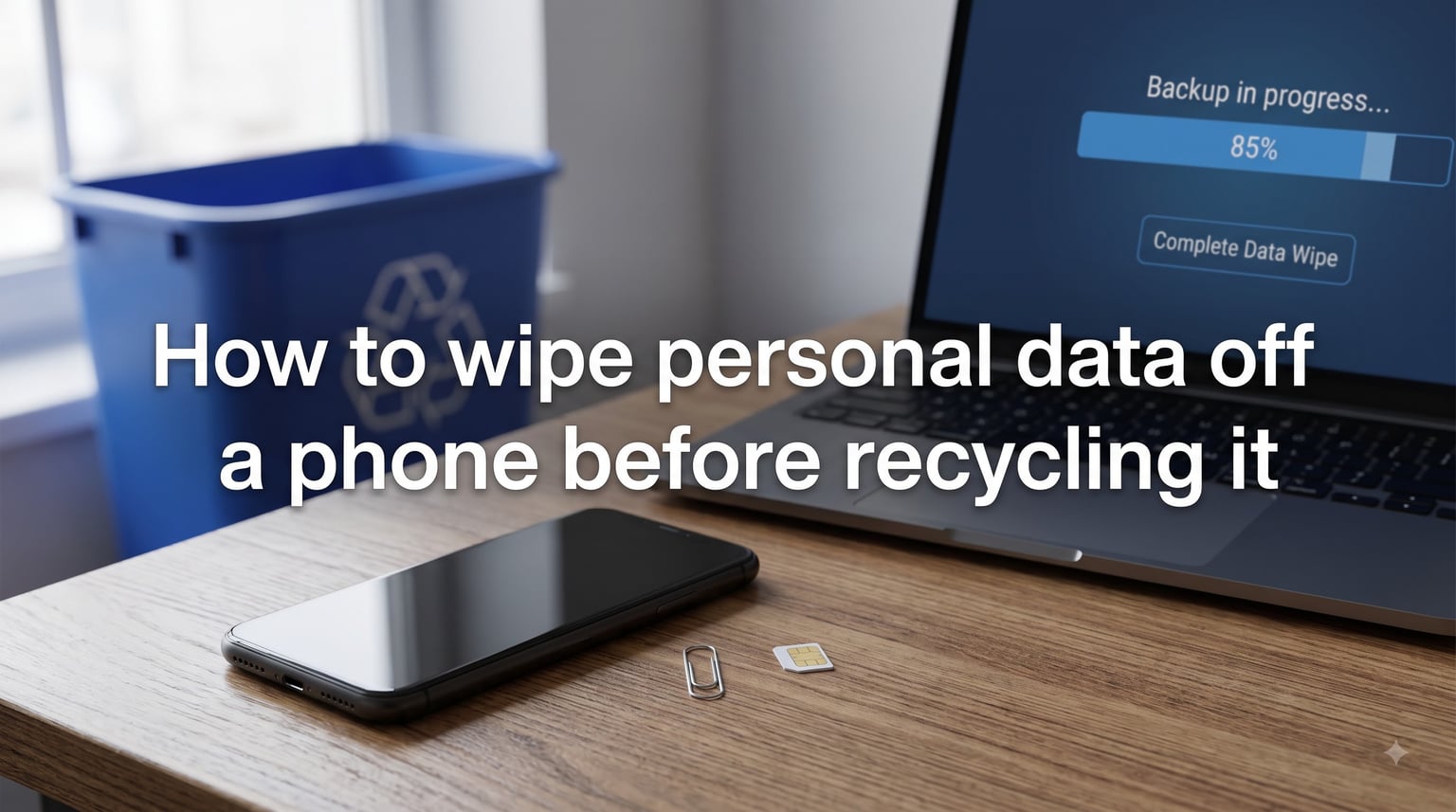
Yes, you absolutely must wipe personal data off a phone before recycling it. Our team has tested and documented every step across both iPhone and Android devices, and the process takes about 15 to 30 minutes once you know what to do. Learning how to wipe personal data off a phone before recycling it protects you from identity theft, fraud, and unauthorized access to your accounts.
Simply deleting your photos or tapping “delete” is not enough. Professional data recovery tools can pull information off phones that were only lightly cleared. This guide walks you through every step, including what to do if your phone will not even turn on.
Here is the short version: back up your data, sign out of all accounts, remove your SIM and SD cards, encrypt your phone (on Android), and then perform a factory reset. The sections below cover each step in detail for both iPhone and Android devices.
Table of Contents
Why You Must Wipe Your Phone Before Recycling?
Your phone holds more personal information than almost anything else you own. Contacts, banking apps, passwords, photos, location history, emails, and health data all live on that device. When you hand it off without a proper wipe, you hand all of that off too.
The FTC and the UK’s National Cyber Security Centre both explicitly recommend removing personal information before getting rid of any phone. This is not paranoia. Real people have had their identities stolen from phones that were sold or donated without being properly wiped.
Here is the part most people miss: deleting a file does not actually erase it. When you delete a photo or a contact, the phone just removes the pointer to that data. The actual data stays on the storage chip until something else writes over it. Specialized recovery software can scan for and recover these “deleted” files weeks or months later.
A factory reset is better, but on older Android phones it may still leave recoverable fragments behind. That is why this guide includes encryption as a critical step for Android users. When you encrypt your phone first and then factory reset, any leftover data fragments become unreadable garbage that no one can piece back together.
Quick Checklist: How to Prepare Your Cell Phone for Recycling
Before diving into the details, here is a quick overview of everything you need to do. You can use this as a mental checklist or come back to it as you work through each step.
Complete checklist:
1. Back up all photos, contacts, messages, and app data to the cloud or a computer.
2. Sign out of every account (iCloud, Google, Samsung, email, banking apps).
3. Remove your SIM card and any microSD memory card.
4. On Android, encrypt the phone before resetting (extra security layer).
5. Disable Factory Reset Protection (sign out of Google/Samsung properly).
6. Turn off Find My iPhone (iOS) or Find My Device (Android).
7. Perform a full factory data reset.
8. Verify the reset completed and the phone shows the setup screen.
9. Remove the phone from your account dashboard online.
10. Recycle, trade in, donate, or sell with confidence.
Step 1: Back Up Your Data
This is the one step you cannot skip or rush. Once you factory reset, everything is gone for good. Take ten minutes to make sure you have copies of anything you want to keep.
For iPhone users: Open Settings, tap your name at the top, then tap iCloud. Go to iCloud Backup and tap “Back Up Now.” Make sure the backup completes before moving on. You can verify it finished by checking the timestamp under “Last successful backup.” You can also plug your iPhone into a Mac or PC and back it up through Finder or iTunes as a second copy.
For Android users: Go to Settings, then Google, then Backup. Tap “Back up now” to sync your app data, call history, contacts, and settings to your Google Account. For photos, open Google Photos and make sure your entire library has synced. If you have a Samsung phone, also check your Samsung Cloud backup in Settings under your Samsung account.
If your phone will not turn on (covered in detail later), your cloud backup from days or weeks ago may be the only copy you have. Check your iCloud or Google account dashboard online to see what was already backed up automatically.
Step 2: Sign Out of All Accounts
This step prevents Activation Lock on iPhones and Factory Reset Protection on Androids. If you skip this, the next person who gets your phone may not be able to set it up, and the phone stays linked to your account forever.
iPhone sign-out process: Open Settings, tap your name, then scroll down and tap “Sign Out.” Enter your Apple ID password to confirm. This disables Find My iPhone and removes the device from your Apple ID. If you are trading the phone in, this step is mandatory. Apple trade-ins will be rejected if the phone is still locked to your account.
Android sign-out process: Go to Settings, then Accounts or “Users and accounts.” Tap each account listed and select “Remove account.” Pay special attention to your Google account and your Samsung account if you have one. Samsung devices have Factory Reset Protection that locks the phone to the last Google account used. Signing out properly disables this protection.
Do not forget to sign out of messaging apps, banking apps, and email accounts manually as well. Some apps do not fully clear with a simple account removal. Log out of WhatsApp, Signal, your banking app, and any two-factor authentication apps before you move to the next step.
Step 3: Remove SIM Card and SD Card
Your SIM card and SD card contain data that a factory reset will not touch. The SIM card holds your phone number, carrier info, and contacts saved to the SIM. The SD card may hold photos, downloads, and app data. Both need to come out before you recycle the phone.
Use a SIM ejection tool or a straightened paperclip to open the SIM tray. On most phones, the tray is on the side of the device. Push the pin into the small hole and the tray pops out. Pull it out gently and remove the SIM card. If your phone has a microSD card, it is usually in the same tray or under the back cover on older models.
What to do with the SIM card: Keep it if you are staying with the same carrier. If you are switching carriers or no longer need it, physically destroy it. Cut through the gold chip with scissors or snap it in half. Throwing away an intact SIM card is a security risk because someone could clone your number or access carrier-linked services.
What to do with the SD card: You can keep it, reuse it in another device, or wipe it. To wipe it before recycling, connect it to a computer with an SD card reader and format it. For maximum security, use a secure erase tool or fill the card with junk files and format it again. Multiple overwrite passes make recovery essentially impossible.
Step 4: Encrypt Your Phone (Android Only)
This step applies to Android phones and is the single biggest thing you can do to prevent data recovery after a factory reset. On modern iPhones (iPhone 5s and later), encryption is always on by default. Android phones need you to verify or enable it manually before resetting.
On most modern Android phones (Android 10 and later), encryption is enabled by default. You can verify this by going to Settings, then Security, then looking for “Encryption and credentials.” If it says “Encrypted,” you are good to go. If not, tap “Encrypt phone” and wait for the process to complete. This can take an hour or more, and the phone must stay charged throughout.
Here is why this matters. When encryption is active, all data on the phone is scrambled using a key tied to your PIN or password. When you factory reset, the phone destroys the encryption key. Without that key, any leftover data fragments are mathematically impossible to read. This is far more secure than a factory reset alone on an unencrypted device.
Reddit users in the r/privacy and r/AndroidQuestions communities consistently recommend this exact approach. One user put it bluntly: “Make sure to encrypt your old mobile phone with a random password BEFORE the factory reset. Factory reset alone does not necessarily erase all data.” That advice is correct and worth following.
Step 5: Perform a Factory Reset
The factory reset is the final and most important step in the wiping process. This erases all data from the phone’s internal storage and returns it to the state it was in when it left the factory. After this, the phone boots to the initial setup screen.
iPhone factory reset: Go to Settings, tap General, scroll to the bottom and tap “Transfer or Reset iPhone.” Tap “Erase All Content and Settings,” then confirm. Enter your passcode and Apple ID password if prompted. The phone will wipe itself and restart. This process takes 5 to 15 minutes depending on storage size.
Android factory reset: Go to Settings, then System, then “Reset options.” Tap “Erase all data (factory reset).” You will be asked to confirm and enter your PIN, pattern, or password. On Samsung phones, the path is Settings, then General Management, then Reset, then “Factory data reset.” The process takes 5 to 20 minutes.
After the reset finishes, the phone should restart and show the “Hello” screen on iPhone or the setup wizard on Android. If it does, you have successfully wiped your personal data off the phone. Do not complete the setup process. Just power the phone off and it is ready to recycle.
How to Wipe an iPhone Before Recycling?
Wiping an iPhone is straightforward because Apple builds encryption into every device by default. You do not need a separate encryption step. Here is the exact sequence for wiping any iPhone running iOS 12 or later.
First, back up to iCloud or your computer. Second, go to Settings, tap your name, scroll down, and tap “Sign Out.” Enter your Apple ID password to turn off Find My iPhone and remove the device from your account. Third, remove your SIM card using the tray ejector tool. Fourth, go to Settings, General, “Transfer or Reset iPhone,” and tap “Erase All Content and Settings.” Confirm your choices and let the phone complete the wipe.
If your iPhone is running iOS 15 or later, there is a “Prepare for Trade-In” shortcut in Settings that walks you through all of these steps in a guided flow. It signs you out, removes the SIM info, and erases the phone in one sequence. This is the easiest method if your iPhone is updated.
One last thing for iPhone owners: go to icloud.com/find on a computer and confirm your iPhone no longer appears in your device list. If it still shows up, remove it manually. This prevents Activation Lock from causing problems for the next owner or the recycling center.
How to Wipe an Android Phone Before Recycling?
Android wiping involves a few more steps than iPhone because encryption settings vary between manufacturers and models. The core process is the same, but the menu paths differ between Samsung, Google Pixel, and other brands.
Samsung Galaxy phones: Back up your data. Sign out of your Samsung account and your Google account (Settings, then Accounts and backup, then Manage accounts). Remove your SIM and SD cards. Go to Settings, then Security, and confirm the phone is encrypted. Then go to Settings, General Management, Reset, and “Factory data reset.” Tap “Reset” and enter your password to confirm.
Google Pixel and other Android phones: Back up to your Google Account. Sign out of all accounts in Settings. Remove SIM and SD cards. Confirm encryption in Settings under Security. Go to Settings, System, “Reset options,” and tap “Erase all data (factory reset).” Confirm and wait for the wipe to finish.
After the reset, your Android phone should boot to the setup screen. Do not sign in or complete setup. Power the phone off. Go to your Google Account dashboard (myaccount.google.com) and confirm the phone has been removed from your list of devices.
How to Wipe a Phone That Will Not Turn On
This is one of the most common questions we see in forums. A phone that has a cracked screen, water damage, or a dead battery that will not charge can still contain all your personal data. You cannot factory reset it the normal way, but you have several options.
Option 1: Remote wipe. If your phone was connected to your Google or Apple account, you can trigger a remote erase. For Android, go to android.com/find on a computer, sign in with your Google account, and select “Erase device.” For iPhone, go to icloud.com/find, select your device, and click “Erase iPhone.” The phone will wipe itself the next time it connects to the internet. This only works if the phone can still power on and connect to Wi-Fi or cellular data, even if the screen is blank.
Option 2: Charge it long enough to boot. Some phones that appear completely dead just need a longer charge or a different cable. Try charging the phone for at least 30 minutes with a known-good cable and charger. If the screen is cracked but the phone still works, use a USB-C to HDMI adapter or a screen mirroring tool to view and control the phone on a TV or monitor. Then you can perform a normal factory reset.
Option 3: Remove the storage. On some older Android phones, you can remove the back panel and take out the battery and internal storage. This is not possible on most modern phones with sealed backs, but it is worth checking if your phone is more than five years old.
Option 4: Physical destruction. If none of the above works and you are worried about data security, you can physically destroy the phone’s storage chip. Remove the SIM and SD cards first. Then destroy the phone by smashing the motherboard. The storage chip is usually located near the processor. Use a hammer to crack the chip itself. This is a last resort, but it guarantees no one can recover your data. Wear safety glasses and gloves.
For recycling purposes, physically destroyed phones can still be dropped off at e-waste recycling centers. The valuable metals inside are recoverable even when the phone is smashed.
Can Someone Recover Your Data After a Factory Reset?
This is the question that keeps people up at night, and it is worth a clear answer. On modern, encrypted phones that were factory reset properly, data recovery is essentially impossible. Here is why.
Modern iPhones (iPhone 5s and newer) have hardware-level encryption enabled at all times. When you factory reset an iPhone, the encryption key is destroyed. Every bit of personal data on the phone becomes permanently unreadable. No software, no forensic lab, no government agency can recover that data without the key. It is gone.
Modern Android phones (Android 10 and newer, or Android 6+ with encryption enabled) work the same way. The encryption key is tied to your lock screen credential. A factory reset destroys that key. Any remaining data fragments are scrambled beyond recovery.
Where things get risky is on older phones. Devices from before 2014, or Android phones that were never encrypted, may still have recoverable data after a factory reset. Forensic tools like Cellebrite can sometimes pull deleted files from unencrypted storage. If your phone is older and you cannot encrypt it, physical destruction of the storage chip is the safest option.
As one Ars Technica forum user noted: “Sign out of all accounts, do the factory reset, and that should be good for 98.7% of people.” For the remaining 1.3% with highly sensitive data on older devices, encryption or physical destruction closes the gap.
Where to Recycle Your Phone Safely
Once your phone is wiped, you have several good options for disposal. Recycling keeps toxic materials like lithium, cobalt, and rare earth metals out of landfills and recovers them for reuse.
Most carriers and electronics retailers (Best Buy, Staples, Apple Stores) accept old phones for recycling at no charge. Manufacturer trade-in programs from Apple and Samsung offer credit toward a new device. Local e-waste recycling centers and municipal hazardous waste drop-offs also accept phones.
If you want to donate, organizations like Cell Phones for Soldiers and the National Coalition Against Domestic Violence accept old phones. Charities either refurbish them or recycle them to fund their programs. Just make sure the phone is wiped before donating.
Frequently Asked Questions
Should I wipe my phone before recycling it?
Yes, you should always wipe your phone before recycling it. Your phone contains personal data including contacts, photos, passwords, banking information, and location history. Without a proper wipe, anyone who receives the phone can access this information using data recovery tools. A factory reset combined with account sign-out and encryption protects you from identity theft and fraud.
How to wipe data from a phone that won’t turn on?
If your phone will not turn on, try a remote wipe through iCloud (for iPhone) or android.com/find (for Android). If the phone cannot connect to the internet, try charging it with a different cable for 30 minutes to see if it boots. As a last resort, physically destroy the storage chip on the motherboard with a hammer. The phone can still be recycled at an e-waste center after physical destruction.
How to permanently erase data from phone so that it cannot be recovered?
To permanently erase data, encrypt the phone first, then perform a factory reset. On iPhone, encryption is always on. On Android, enable encryption in Settings under Security before resetting. The factory reset destroys the encryption key, making all remaining data fragments unreadable. On older phones without encryption, physical destruction of the storage chip is the only guaranteed method.
How do I prepare my cell phone for recycling?
Follow these steps: 1) Back up your data to iCloud or Google, 2) Sign out of all accounts including Apple ID or Google account, 3) Remove your SIM card and SD card, 4) Encrypt the phone on Android, 5) Disable Find My iPhone or Find My Device, 6) Perform a factory reset, 7) Confirm the phone shows the setup screen, 8) Power it off and take it to a recycling center.
Conclusion
Knowing how to wipe personal data off a phone before recycling it comes down to five steps: back up, sign out, remove cards, encrypt, and factory reset. On modern phones with encryption enabled, this process makes data recovery virtually impossible. For older or dead phones, remote wipe or physical destruction fills the gap.
Take 20 minutes to do it right. Your identity, accounts, and personal information are worth far more than the time it takes to wipe a phone properly.