
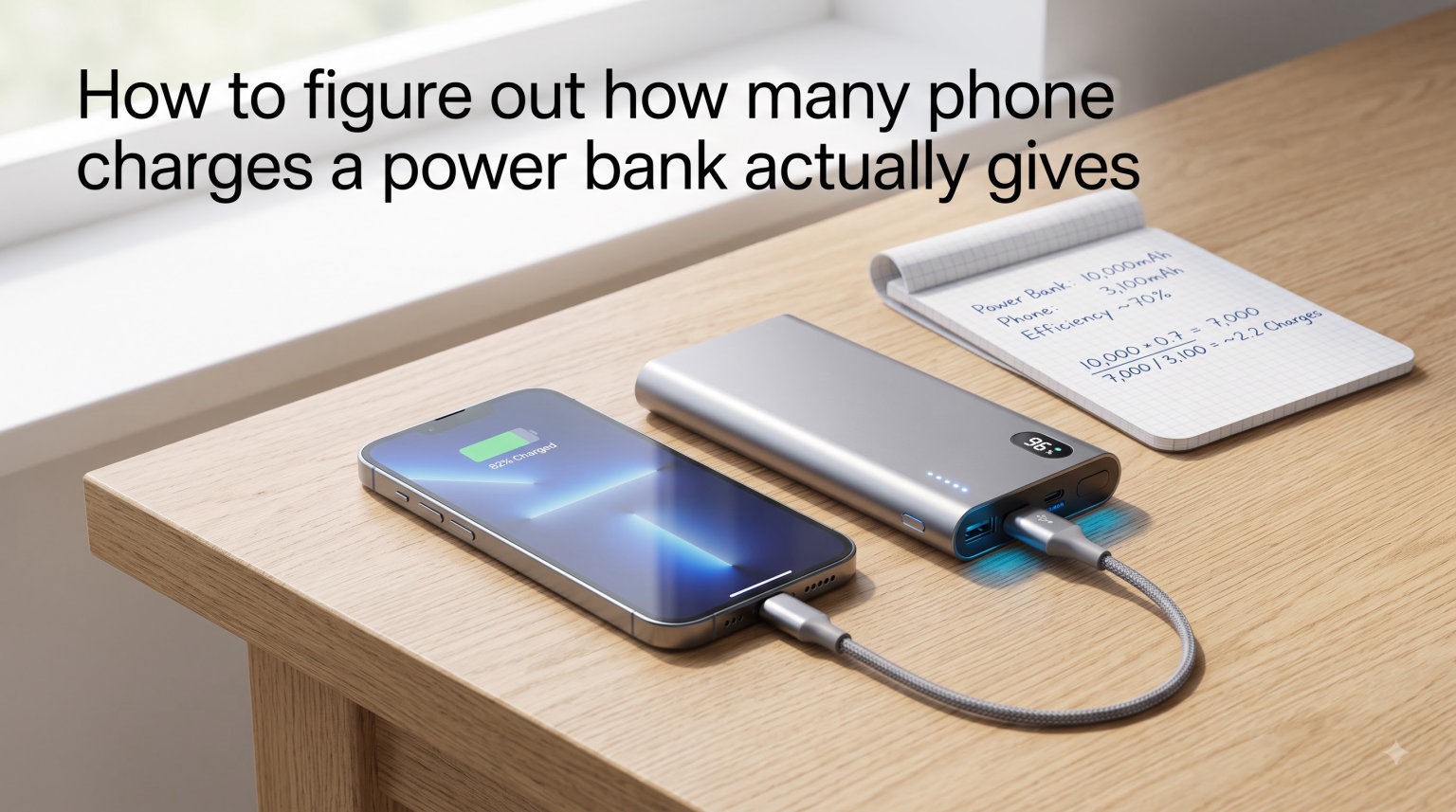
You buy a 20,000mAh power bank expecting it to charge your phone five times, and you get three. If that sounds familiar, you are not alone. The gap between the number printed on the box and the charges you actually see is one of the most common frustrations we hear from people who rely on portable power every day.
The reason is not a scam. Power banks store energy at one voltage and deliver it at another, and that conversion costs real energy. Once you understand the math, you can predict your real-world charges within a few percentage points before you ever plug in.
This guide walks through the exact formula, a faster shortcut rule, real examples by power bank size, and how to physically test what your unit delivers. By the end you will know precisely how many phone charges a power bank actually gives.
Table of Contents
The Quick Answer: The Formula for Phone Charges
To figure out how many phone charges a power bank actually gives, use this Watt-hour formula: (Power Bank Capacity in Wh x 0.85) / Phone Battery Capacity in Wh. The 0.85 factor accounts for the roughly 15% of energy lost during the voltage conversion from the 3.7V internal cell to the 5V USB output your phone needs.
For a faster estimate without doing the math, multiply the power bank’s mAh rating by 0.65, then divide by your phone’s mAh. So a 10,000mAh power bank becomes roughly 6,500mAh usable, which is about two full charges for a typical 3,300mAh phone battery.
Both methods land in the same place because they describe the same physics. Now let’s look at why the loss happens in the first place.
Why Power Bank mAh Does Not Match Your Phone mAh?
The mismatch comes down to voltage. Power bank lithium cells store their energy at 3.7 volts internally, but the USB port on the outside pushes that energy out at 5 volts. That step-up conversion is not free, and the difference in voltage is why the mAh number on the box cannot be compared directly to the mAh number on your phone.
Milliamp-hours only tell you part of the story because they ignore voltage. A 10,000mAh cell at 3.7V holds about 37 watt-hours of energy. When that same energy gets pushed out at 5V, the current drops, so the effective mAh at the USB port is closer to 7,400mAh before any other losses.
On top of the voltage conversion, the internal circuitry, voltage regulator, cable resistance, and heat generation all consume additional energy. Add those together and you typically lose 30 to 40 percent of the rated capacity before the energy lands in your phone’s battery.
This is exactly why Reddit users on r/batteries report that the actual usable output lands around 60 to 70 percent of the labeled mAh. The label is not lying about the cell, it just describes the raw cell storage, not the usable output at the USB port.
The Watt-Hour Formula for Calculating Phone Charges
The most accurate way to calculate how many phone charges a power bank gives uses Watt-hours rather than mAh, because Watt-hours account for voltage. The formula is Charge Count = (Power Bank Wh x Efficiency) / Phone Wh, where efficiency is typically 0.85 for a good quality unit.
Here is the step-by-step method using a real example with a Samsung Galaxy S23 (3,900mAh battery, roughly 15Wh) and a 10,000mAh power bank (rated at 37Wh).
Step 1: Find your power bank’s Watt-hours. Multiply mAh by 3.7V, then divide by 1000. A 10,000mAh cell gives 10,000 x 3.7 / 1000 = 37Wh.
Step 2: Find your phone’s Watt-hours. The Galaxy S23 has a 3,900mAh battery at 3.85V, so 3,900 x 3.85 / 1000 = about 15Wh.
Step 3: Apply the efficiency factor. 37Wh x 0.85 = 31.45Wh of usable energy.
Step 4: Divide usable energy by your phone’s Wh. 31.45 / 15 = roughly 2.1 full charges.
So a quality 10,000mAh power bank delivers about two full charges for a Galaxy S23. Plug in your own numbers and you can predict the result before you ever buy.
The Quick 60-70% Rule for Fast Estimates
When you do not have the Watt-hour specs in front of you, the 60-70% rule gets you close enough for everyday decisions. Take the power bank’s mAh, multiply by 0.65, and divide by your phone’s mAh. The result is your expected number of full charges.
This shortcut works because the voltage conversion, circuitry losses, and heat generation average out to roughly 35 percent lost across decent quality power banks. Forum users on r/UsbCHardware and r/onebag consistently validate the 0.65 multiplier as a reliable real-world estimate.
The rule has limits. Cheap unbranded units can deliver closer to 55 percent of their rated mAh, while premium units with high-quality cells and well-designed regulators can hit 70 percent or slightly above. Use the rule for budgeting, then verify with a meter if accuracy matters.
Capacity Examples by Power Bank Size
Here is how the numbers shake out across the three most common power bank sizes, assuming a typical modern phone with a 4,000mAh battery and using the 65 percent usable-capacity rule.
5,000mAh power bank: Usable output is about 3,250mAh. That gives roughly 0.8 full charges for a 4,000mAh phone, or a single partial top-up from 20 percent to about 85 percent. Best for an emergency boost on a long commute.
10,000mAh power bank: Usable output is about 6,500mAh. That covers about 1.6 full charges for a 4,000mAh phone, or roughly one and a half days of normal use. This is the sweet spot for daily carry.
20,000mAh power bank: Usable output is about 13,000mAh. That delivers about 3.25 full charges for a 4,000mAh phone, enough for a weekend trip or two phones sharing one power bank.
For larger phones like the iPhone 15 Pro Max (4,422mAh) or Samsung Galaxy S24 Ultra (5,000mAh), expect roughly one fewer charge across each tier. For smaller phones with a 3,000mAh battery, you will see closer to one extra charge per tier.
How to Test Your Power Bank’s Actual Capacity?
If you want hard numbers instead of estimates, you can measure what your power bank actually delivers with a USB power meter. These cost between ten and twenty dollars and plug between the power bank and your phone to track total energy delivered.
Start with a fully charged power bank and a phone drained to about five percent. Plug the USB meter into the power bank, then your phone into the meter, and let it charge uninterrupted until the power bank shuts off or the phone hits 100 percent. The meter will display total Watt-hours delivered.
Compare that Watt-hour reading to your power bank’s rated Wh. A 10,000mAh unit rated at 37Wh that delivers 30Wh to your phone is operating at about 81 percent efficiency, which is solid. Anything below 60 percent of the rated Wh suggests either a low-quality unit, a worn-out cell, or a mislabeled capacity.
Reddit users on r/batteries regularly recommend this method, and their results line up with the 60-70 percent usable figure we have been using throughout this guide. If you test multiple units, the meter is the fastest way to separate a quality power bank from a misleading one.
Factors That Reduce Power Bank Efficiency
Efficiency is not a fixed number. Several variables push the usable capacity up or down, which is why two people with the same power bank can report slightly different results.
Temperature is a big one. Lithium cells deliver less energy in cold conditions and degrade faster in heat. If you charge your phone outside in winter or leave the power bank in a hot car, expect five to ten percent less usable energy than the formula predicts.
Battery age matters too. Lithium cells lose capacity over charge cycles, so a power bank you have used daily for two years may deliver 80 percent of what it did when new. This is normal chemistry, not a defect.
Cable quality and length also play a role. Long, thin, or cheap cables increase resistance and turn more energy into heat before it reaches your phone. A short, thick, high-quality cable can recover several percent of lost capacity.
Airline Rules: Power Bank Watt-Hour Limits for Flights
If you fly, you need to understand Watt-hours because airlines restrict power banks by Wh, not mAh. The FAA and most international carriers allow power banks up to 100Wh in carry-on baggage without special approval. That works out to roughly 27,000mAh at the standard 3.7V internal cell voltage.
Between 100Wh and 160Wh (about 27,000 to 43,000mAh), most airlines require advance approval and limit you to a maximum of two units. Above 160Wh, power banks are banned from commercial flights entirely.
Power banks are never allowed in checked luggage regardless of size. Always pack them in your carry-on, and check your specific carrier’s rules before you travel, because policies vary between airlines and some have stricter limits than the baseline FAA rules.
FAQs
How to tell how many charges a power bank has?
Divide the power bank’s rated mAh by roughly 1.5 to account for voltage conversion and circuit losses, then divide by your phone’s mAh. A 10,000mAh power bank delivers about 6,500mAh usable, so for a 4,000mAh phone you get about 1.6 charges. For exact numbers, test with a USB power meter that tracks total Watt-hours delivered.
How to calculate how many times a power bank can charge a phone?
Use the Watt-hour formula: (Power Bank Wh x 0.85) / Phone Wh. Convert mAh to Wh by multiplying by the cell voltage (3.7V for power banks, 3.85V for phones) and dividing by 1000. A 10,000mAh power bank is about 37Wh, and at 85 percent efficiency delivers 31.45Wh. Divide by your phone’s Wh rating to get the number of full charges.
How many phone charges does a 20000 power bank have?
A 20,000mAh power bank delivers roughly 13,000mAh of usable output, which translates to about 3 to 4 full charges for a typical modern phone with a 4,000mAh battery. For a smaller 3,000mAh phone, expect closer to 4 to 4.5 charges. Actual numbers vary with cable quality, temperature, and the efficiency of the power bank’s circuitry.
Do I need 10000mAh or 20,000 mAh power bank?
A 10,000mAh power bank covers about 1.5 to 2 full phone charges and is ideal for daily carry, commuting, and single-day backup. A 20,000mAh unit covers 3 to 4 charges and suits weekend trips, long flights, or charging multiple devices. Choose based on how long you will be away from a wall outlet and how many devices you need to keep powered.
Do power banks lose capacity over time?
Yes. Lithium cells degrade with each charge cycle, typically retaining about 80 percent of original capacity after 300 to 500 full cycles. Heavy daily use, exposure to heat, and frequent deep discharges accelerate degradation. A power bank used daily for two years may deliver noticeably fewer charges than when it was new.
Conclusion: Real Charges, Real Math
Figuring out how many phone charges a power bank actually gives comes down to two reliable methods. Use the Watt-hour formula (Power Bank Wh x 0.85 / Phone Wh) for accuracy, or the 65 percent shortcut for fast estimates on the go. Both explain why a 10,000mAh unit realistically charges a modern phone about one and a half to two times, not the three times the raw mAh number suggests.
For the most precise numbers, invest in a USB power meter and test your specific unit. The label tells you what the cell holds, but the meter tells you what actually reaches your phone, and that is the number that matters when you are counting charges on a long trip.
Keep these formulas handy the next time you shop for a power bank in 2026, and you will never be surprised by the gap between the box and the real world again.