
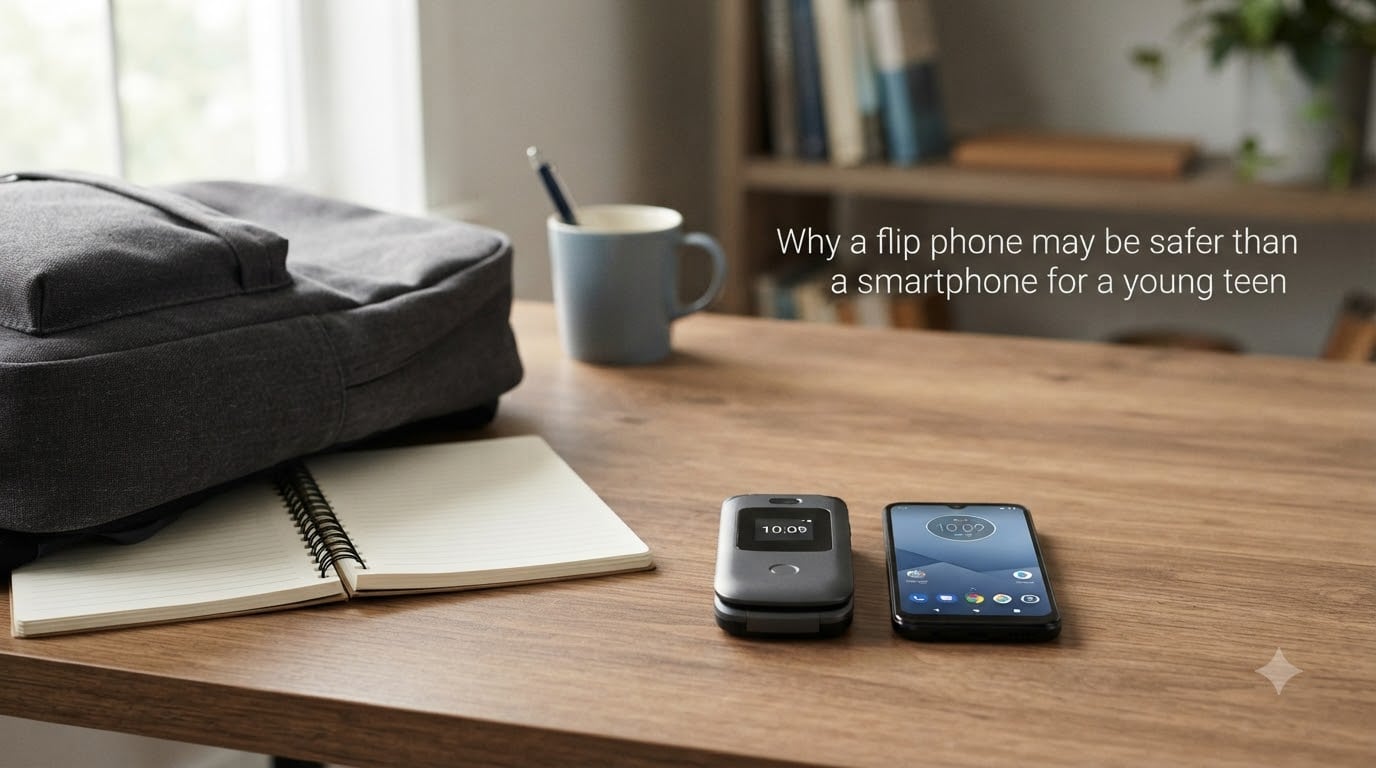
When my niece turned 13, my sister faced the question every modern parent dreads: what kind of phone should she get? Every friend in her class already had a smartphone. The pressure was intense. But after weeks of research, my sister went with a flip phone instead, and the safety benefits became obvious within the first month.
A flip phone may be safer than a smartphone for a young teen because it eliminates internet browsing, social media access, app downloads, and the data collection that comes with them. Without these features, the most common pathways for cyberbullying, malware, privacy violations, and screen addiction simply do not exist on the device.
In this guide, I will walk through every safety advantage a flip phone offers over a smartphone for young teenagers. I will cover data security risks, mental health impacts, cyberbullying prevention, privacy concerns, and practical advice for parents making this decision in 2026.
Table of Contents
The Hidden Security Risks Smartphones Pose to Teens
Smartphones are powerful mini-computers, and that power comes with real vulnerabilities. According to security research, approximately 6.3% of smartphones globally carry some form of malware. For a teenager who downloads apps freely, clicks links in messages, and connects to public Wi-Fi, that risk multiplies significantly.
Malware and Malicious Apps
Smartphone apps can disguise themselves as legitimate tools while quietly harvesting data in the background. Security researchers call this “maskware.” A free game your teen downloads might be tracking location, reading contacts, and sending that data to third-party servers without anyone noticing.
Teens rarely read app permissions carefully. They tap “allow all” to get to the game faster. Each permission granted is another door opened for data collection, tracking, and potential exploitation.
Data Collection by Third-Party Brokers
Smartphones constantly generate data: browsing history, location coordinates, app usage patterns, contact lists, and behavioral profiles. Third-party data brokers collect this information and build detailed consumer profiles, even for minors. Your 13-year-old’s digital habits are being catalogued and potentially sold before they even understand what privacy means.
One study found that the average Android app shares data with an average of 40 third parties. Every app your teen installs potentially multiplies that exposure.
Public Wi-Fi Vulnerabilities
Smartphones connect to Wi-Fi networks automatically. When your teen is at a coffee shop, library, or friend’s house, their phone may join an unsecured network without any prompt. Forbes reported that nearly 40% of people who use public Wi-Fi have had their data compromised in some way.
On an unsecured network, hackers can intercept data transmissions, inject malicious code, and steal login credentials. A teenager checking Instagram at a mall food court could unknowingly hand over passwords and personal information to someone sitting three tables away.
How Flip Phones Reduce the Attack Surface
The single biggest safety advantage of a flip phone is what security professionals call a “smaller attack surface.” An attack surface is every possible entry point a hacker or malicious actor could use to access a device. Smartphones have massive attack surfaces. Flip phones have almost none.
No Internet Browser Means No Web-Based Threats
Most flip phones either lack a browser entirely or have one so limited it cannot render modern web pages. This means phishing sites, malicious downloads, and browser-based tracking scripts simply cannot run. The most common way malware reaches a phone, the web browser, is effectively neutralized.
Many basic flip phones do not even have Wi-Fi capability. Without Wi-Fi, there is no connection to unsecured public networks. The Forbes statistic about 40% of public Wi-Fi users being compromised becomes irrelevant.
No App Store Means No Malicious Downloads
Flip phones do not download apps. There is no App Store, no Google Play, no third-party APK installation. The maskware problem that plagues smartphones, where a free flashlight app secretly harvests your contacts, simply cannot happen on a device that does not install software.
This is not a minor point. The vast majority of smartphone malware arrives through app installations. By removing that capability entirely, flip phones eliminate the primary delivery mechanism for mobile threats.
No Background Data Collection
Without apps running in the background, flip phones cannot continuously track location, monitor behavior, or send usage data to servers. The phone makes calls, sends texts, and that is essentially it. Third-party data brokers have almost nothing to collect from a flip phone user.
Flip Phone vs Smartphone: Safety Comparison
Here is a direct comparison of how flip phones and smartphones stack up across key safety categories for teens:
| Safety Feature | Flip Phone | Smartphone |
|---|---|---|
| Internet browsing | None or extremely limited | Full access, including risky sites |
| App downloads | Not available | Unlimited, including malicious apps |
| Social media access | None | Full access to all platforms |
| Public Wi-Fi risk | None (no Wi-Fi on most models) | High, auto-connects to networks |
| Malware exposure | Negligible | 6.3% of devices infected |
| Data collection by apps | None | Extensive, shared with 40+ third parties per app |
| Cyberbullying access | Limited to calls and texts | All platforms and messaging apps |
| Screen time risk | Low, limited engagement | High, designed for maximum engagement |
| GPS tracking | Available on some models for emergencies | Continuous tracking by apps and OS |
| Battery life | Days per charge | Hours per charge |
The pattern is clear. Every category where smartphones create risk, flip phones either eliminate or dramatically reduce that risk.
Social Media, Cyberbullying, and Mental Health
This is where the safety argument for flip phones becomes deeply personal. Social media platforms are designed to be addictive, and teenagers are particularly vulnerable to their effects on mental health. A smartphone puts every major social platform in your teen’s pocket, accessible at any hour of the day or night.
The Cyberbullying Problem
Cyberbullying happens primarily through social media apps and messaging platforms. Instagram, Snapchat, TikTok, and group chat apps are the most common channels. When a teen has a smartphone, they carry every potential bully in their school right in their pocket.
On a flip phone, the only communication channels are calls and SMS texts. Both are easily monitored and far less conducive to the relentless, 24/7 harassment that defines cyberbullying. There are no anonymous accounts, no group chat pile-ons, no viral posts designed to humiliate.
Parents in online forums consistently report that removing social media access is one of the most effective ways to stop cyberbullying. One parent shared that after switching their daughter to a flip phone, the anxiety and distress from online harassment stopped almost overnight.
Mental Health and Social Media
The research connecting smartphone social media use to teen mental health issues is growing. Teens who spend more than three hours per day on social media face significantly higher rates of anxiety, depression, and sleep disruption. A smartphone makes that level of usage easy and almost automatic.
Some teens are actually choosing flip phones themselves for mental health reasons. Members of Gen Z have been driving a measurable increase in flip phone sales as they recognize the toll that constant smartphone engagement takes on their wellbeing. This is not just a parent-driven trend anymore.
Screen Time and Real-World Focus
The average American teenager spends over seven hours per day looking at screens, not including schoolwork. That is nearly half of their waking hours. Smartphones are designed to capture attention through notifications, infinite scroll feeds, autoplay videos, and reward-loop mechanics borrowed directly from slot machine design.
Flip phones do none of this. There is no feed to scroll, no video to autoplay, no notification badges pulling attention back to the device. A teen with a flip phone checks it when they need to make a call or send a text, then puts it away.
Sleep and Academic Impact
Smartphones in the bedroom are one of the leading causes of teen sleep deprivation. Blue light disrupts melatonin production, and the urge to check one more notification delays sleep onset. Sleep-deprived teens struggle academically, emotionally, and socially.
A flip phone does not create the same compulsion. Most teens will not stay up until 2 AM texting on a numeric keypad. The device naturally encourages healthier sleep habits simply by being less engaging.
Physical Buttons and Simplicity
The tactile nature of a flip phone, physical buttons, a small screen, and a simple menu, actively discourages prolonged use. Every action requires more deliberate effort than swiping a touchscreen. This built-in friction is a safety feature in disguise because it naturally limits engagement.
Privacy and Data Collection Differences
Privacy is one of the most overlooked safety dimensions when parents choose a phone. Smartphones are essentially surveillance devices that happen to make calls. They track location constantly, log browsing history, record app usage patterns, and share all of this with operating system providers, app developers, and advertising networks.
What Smartphones Track
A typical smartphone running Android or iOS collects and transmits location data dozens of times per hour. It logs every website visited, every search performed, every app opened and for how long, every contact in the address book, and every photo taken including metadata like time and GPS coordinates.
For an adult, this surveillance is concerning. For a 13-year-old who does not understand privacy implications, it is the construction of a permanent digital profile that will follow them into adulthood.
What Flip Phones Track
Flip phones collect minimal data. They log call records and text message metadata required by the cellular carrier, and that is essentially it. There is no browsing history because there is no browser. There are no app usage patterns because there are no apps. The device simply does not generate the data that brokers want.
Some modern flip phones do include GPS for emergency services and basic navigation. This is actually a safety benefit because it allows parents to locate their teen in an emergency without enabling the continuous location tracking that smartphone apps perform.
When a Flip Phone Makes Sense for Your Teen?
Not every situation calls for a flip phone. But for many families with young teens, particularly those between 11 and 14, the benefits are significant. Here are the scenarios where a flip phone is the clear choice for safety and responsibility.
First Phone for a Middle Schooler
A flip phone is an ideal first phone. It teaches the fundamentals of mobile communication, calling, texting, managing contacts, and being reachable, without exposing a young teen to the full complexity of the internet. Parents can establish baseline habits around phone responsibility before introducing a smartphone later.
Emergency Communication
The core reason most parents want their teen to have a phone is emergency contact. A flip phone handles this perfectly. Calls and texts work reliably, battery life lasts for days instead of hours, and the simple interface means no fumbling through apps during a stressful situation.
Many parents forget that smartphone battery life can be a safety issue. A smartphone that has been used heavily all day may be dead by evening. A flip phone that has been sitting in a backpack for three days still has charge when you need it.
Cost Savings for Families
Flip phones are significantly cheaper to buy and to operate than smartphones. The hardware costs less, the monthly service plans are cheaper, and there is no need for expensive data packages. For families with multiple children approaching phone age, the savings add up quickly.
Lower cost also means lower stakes. If a teen loses or breaks a flip phone, replacing it is a fraction of the cost of replacing a smartphone. This reduces family conflict and financial stress.
Building Responsible Technology Habits
Many parents view a flip phone as a training device. It allows teens to prove they can handle phone responsibility, returning calls, not losing the device, communicating respectfully, before earning smartphone privileges. This graduated approach to technology introduction is something child development experts increasingly recommend.
How to Talk to Your Teen About Getting a Flip Phone?
The hardest part of choosing a flip phone is not the safety analysis. It is the conversation with your teen. Forum discussions reveal that embarrassment is the number one objection teens have to flip phones. When every friend has a smartphone, a flip phone feels like a statement that your parents do not trust you.
Addressing Peer Pressure
Be honest with your teen about why you are choosing a flip phone. Frame it as a safety decision, not a punishment or a lack of trust. Explain the specific risks you want to protect them from: cyberbullying, data collection, sleep disruption, and screen addiction. Teenagers are more likely to accept a decision when they understand the reasoning behind it.
It can also help to point out that flip phones are becoming trendy. Gen Z’s growing interest in dumbphones means your teen may actually be ahead of a cultural curve, not behind it.
Setting Clear Expectations
Establish exactly what the flip phone is for and what needs to happen before a smartphone becomes an option. For example: “This phone is for calling us, texting friends, and emergencies. When you turn 15, if you have shown you can use it responsibly, we will discuss getting a smartphone.” Clear milestones give teens something to work toward.
Planning the Transition
Talk about the long-term plan. Your teen needs to know that a flip phone is not a permanent sentence. Discuss what responsible smartphone use looks like, what apps you would allow, what parental controls would be in place, and when the transition might happen. This forward-looking conversation reduces resentment and builds cooperation.
One strategy that has worked well for many families is the phased approach. Start with a flip phone at age 12 or 13. At 14 or 15, consider a phone with limited smartphone features. By 16, a full smartphone with established ground rules feels like an earned privilege rather than a given right.
Frequently Asked Questions
Is a flip phone safer than a smartphone?
Yes, a flip phone is safer than a smartphone for most security purposes. Flip phones have no app store, limited or no internet browsing, and no Wi-Fi connectivity on most models, which eliminates the primary pathways for malware, data theft, and privacy violations. Studies show approximately 6.3% of smartphones carry malware, while flip phones face negligible risk.
What is the safest phone for a teenager?
The safest phone for a teenager depends on their age and maturity. For young teens aged 11 to 14, a flip phone or basic phone without internet access is the safest option. It provides calling and texting for communication and emergencies while eliminating social media, cyberbullying access, and data collection risks. As teens mature, phones with limited smartphone features and strong parental controls become appropriate.
Why are flip phones better than smartphones?
Flip phones are better than smartphones for specific use cases because they offer longer battery life, lower cost, simpler operation, and significantly reduced security and privacy risks. They eliminate social media addiction, reduce screen time, prevent malware infections, and stop third-party data collection. For communication basics like calls and texts, they perform the core function of a phone without the complications.
Are flip phones better for kids?
Flip phones are often better for kids, especially as a first phone. They allow parents to stay in contact with their child for safety and emergencies without exposing them to internet dangers, social media, or excessive screen time. Flip phones help children develop responsible phone habits gradually before transitioning to a smartphone when they are older and more mature.
Making the Right Choice for Your Family
Understanding why a flip phone may be safer than a smartphone for a young teen comes down to a simple principle: fewer features mean fewer risks. By eliminating internet access, app downloads, social media, and always-on connectivity, flip phones remove the most common pathways for malware, cyberbullying, privacy violations, and screen addiction.
Every family’s situation is different. Some teens handle smartphone responsibility well at 13. Others benefit from a few years of flip phone simplicity first. The key is making an informed decision based on your teen’s maturity, your family’s safety priorities, and the specific risks you want to minimize.
If you are weighing this choice right now, start with a flip phone. Establish communication habits, build trust, and create a clear path toward smartphone privileges. Your teen’s safety, mental health, and digital wellbeing are worth far more than fitting in with what everyone else is carrying.