
I dug through my drawer last month looking for my old power bank. I finally found it, fully charged it, and headed out for a weekend trip. By Saturday afternoon, my phone was dead and the power bank was down to a single LED light. It had been sitting there for almost a year.
If that sounds familiar, the issue is not that you bought a bad unit. The issue is that almost nobody teaches us how to store a power bank correctly when it is not in regular use. The good news is that a few simple habits can keep your power bank holding near-full capacity for years. In this guide, I will walk you through exactly how to store a power bank so it doesn’t lose capacity, why each step matters, and the small mistakes that quietly destroy lithium-ion cells.
Table of Contents
Why Power Banks Lose Capacity Over Time?
Every modern power bank runs on lithium-ion or lithium-polymer cells. These chemistries are amazing because they hold a lot of energy in a small package, but they are also sensitive to three things: heat, voltage stress, and being left empty for too long.
Even when you are not using your power bank, the cells are slowly draining on their own. This is called self-discharge. Most lithium-ion cells lose between 2% and 5% of their charge every month. That sounds harmless, but if you store a power bank at 100% for six months it will still be mostly full. If you store it at 10%, it can drop below the safe minimum and suffer permanent damage called deep discharge.
Capacity loss happens in two ways. First, every full charge and discharge slowly wears the cells. Second, leaving cells at high voltage (full) or low voltage (empty) for long periods accelerates chemical breakdown inside the battery. Storage is where the second type of damage really adds up.
How to Store a Power Bank So It Doesn’t Lose Capacity?
Below are the six steps I follow every time I put a power bank into storage, whether that is for a weekend trip or for the entire winter. Each one is based on what battery manufacturers like Anker, Adata, and the ACCC recommend.
Step 1: Charge It to the Right Level (50-70%)
The single most important thing you can do is store your power bank at around 50% to 70% charge. That range puts the lithium-ion cells in their most stable chemical state. Charging to 100% and leaving it there pushes the cells to high voltage, which speeds up degradation. Draining it to 0% does the opposite and risks deep discharge damage.
Most power banks have four LED indicator lights. Two lit up LEDs is a rough sign you are in the right zone. Three LEDs is fine. One LED or zero means you need to top it up before storing it.
Step 2: Find a Cool, Dry Location
Heat is the number one enemy of stored lithium-ion cells. The ideal storage temperature is between 15 and 25 degrees Celsius (59 to 77 degrees Fahrenheit). A bedroom closet, a desk drawer, or a hallway shelf all work well.
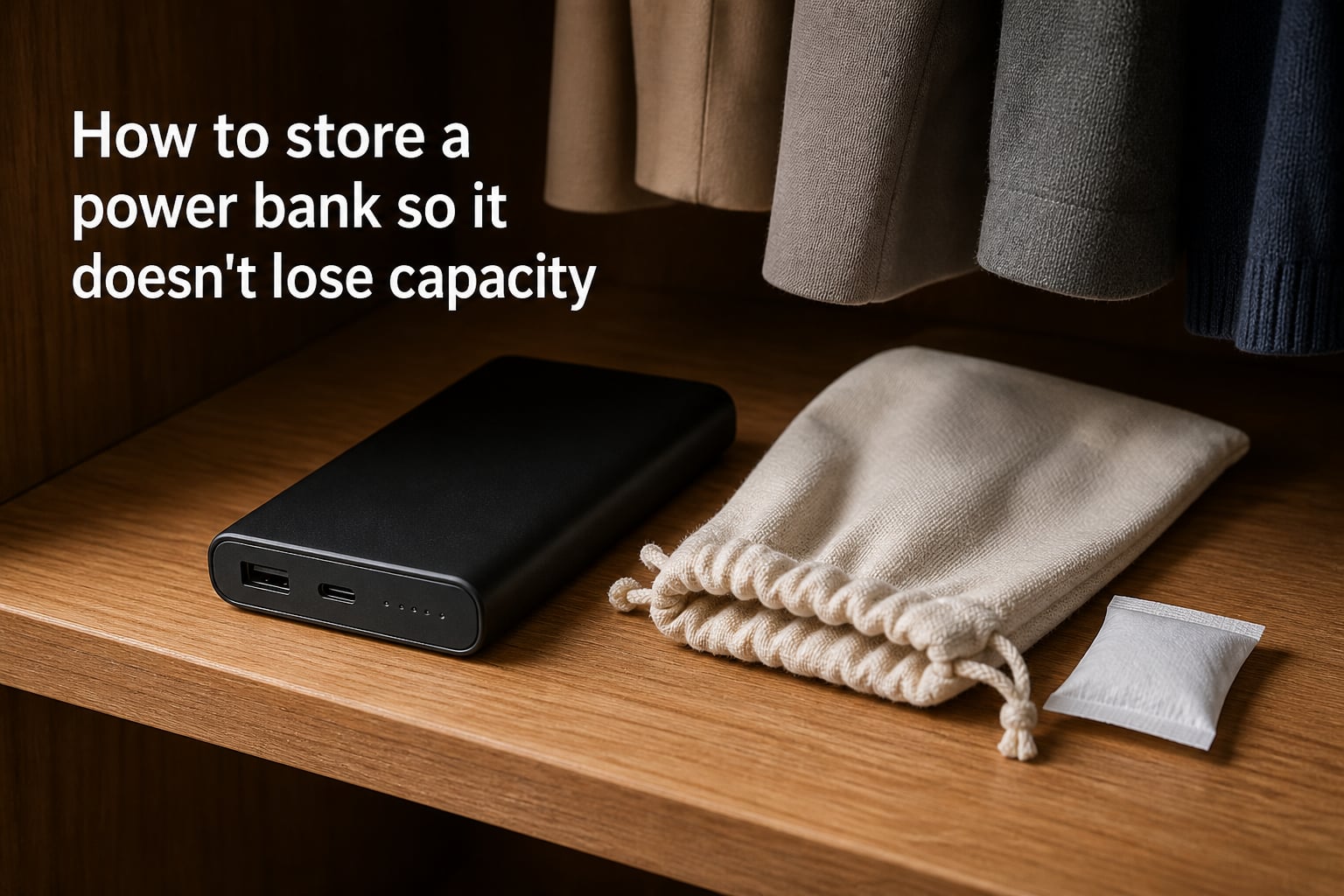
Avoid hot spots like glove boxes, car trunks, garages without climate control, and windowsills in direct sunlight. Even a few hours at 40 degrees Celsius (104 degrees Fahrenheit) can permanently reduce capacity. I keep mine in a fabric pouch inside a closet shelf, well away from any heat source.
Step 3: Unplug All Cables and Devices
Always disconnect any cable, charging brick, or device from the power bank before storage. A connected cable can cause parasitic drain and may even create a slow short circuit if a stray wire touches the port.
This step takes ten seconds and removes one of the most common ways power banks die unexpectedly.
Step 4: Protect from Moisture and Dust
Humidity corrodes the USB ports over time. Dust can settle into the ports and cause poor connections. Store the power bank in a small fabric pouch, a ziplock bag with the air pressed out, or the original box if you still have it.
If you are in a coastal or tropical climate, toss a small silica gel packet in with it. That alone can extend the life of the ports by years.
Step 5: Recharge Every 3 to 4 Months
Because of self-discharge, a stored power bank slowly loses charge even untouched. If you leave it for six months, the charge can drop low enough to cause deep discharge damage. Anker explicitly recommends recharging stored units at least once every 3 to 4 months.
I set a recurring reminder on my phone every three months. I pull the unit out, top it back up to around 60%, and put it back. That five-minute task is what keeps a power bank healthy through long storage.
Step 6: Inspect for Signs of Degradation
Each time you recharge during storage, take thirty seconds to look the unit over. Warning signs include a swollen or puffy case, a chemical smell, unusual heat during charging, or a much shorter run time than you remember. Any of these mean the battery is failing and the unit should be retired safely, not thrown in the regular trash.
What NOT to Do When Storing a Power Bank?
Sometimes the mistakes are easier to remember than the rules. Here are the five biggest no-nos.
Do not store fully charged or fully depleted. Both extremes stress the cells. Aim for the 50% to 70% sweet spot every time.
Do not leave a power bank in a hot car. Interior car temperatures can exceed 60 degrees Celsius (140 degrees Fahrenheit) in summer. That single afternoon can permanently damage the cells.
Do not store in damp places. Bathrooms, basements with leaks, and outdoor sheds are poor choices because moisture corrodes the internal circuitry.
Do not leave cables plugged in. Even a small accessory left in the USB port can slowly drain the cells and create heat at the connector.
Do not forget it for more than six months. If you ignore a power bank for a year, expect noticeable capacity loss even with perfect conditions.
Seasonal and Travel Storage Tips
Storing a power bank through winter follows the same rules, with one twist. Cold itself does not harm lithium-ion cells, but freezing temperatures can cause condensation once you bring the unit back into a warm room. Let it warm up to room temperature before turning it on, and do not charge it while it is still cold.
Summer storage is mostly about avoiding hot cars and direct sun. I keep mine in a backpack or insulated bag when traveling in heat, never loose on a car seat.
If you are flying, most airlines allow power banks under 100Wh in carry-on luggage only. The cabin stays at a comfortable temperature, which is actually ideal for storage during the flight. Do not check them into cargo, where temperatures swing more.
For emergency backup units, I rotate two power banks. One stays in active use, the other stays stored at 60% charge and gets swapped in every three months. That way both units stay healthy.
Frequently Asked Questions
How to store a power bank when not in use?
Charge the power bank to roughly 50% to 70%, unplug all cables, and place it in a cool, dry spot like a closet or drawer. Recharge it back to around 60% every three to four months to prevent deep discharge damage.
What is the safest way to store power banks?
The safest method is to store the power bank at around 60% charge in a cool, dry, well-ventilated location between 15 and 25 degrees Celsius. Keep it away from direct sunlight, heat sources, and moisture, and inspect it every few months.
How long will a 20000mAh power bank last?
A well cared for 20000mAh power bank typically lasts 2 to 3 years of regular use, or up to around 500 full charge cycles. If stored correctly between uses, it can hold near-full capacity for 3 to 4 years before noticeable degradation.
Where should a power bank be kept?
Keep your power bank in a cool, dry, indoor location such as a bedroom closet, desk drawer, or hallway shelf. Avoid cars, garages, bathrooms, and windowsills, where temperature swings and humidity shorten battery life.
Does storing a power bank drain it?
Yes. All lithium-ion power banks self-discharge at roughly 2% to 5% per month. Over six months a stored unit can drop from 60% to below the safe minimum, which is why a quick recharge every 3 to 4 months is essential.
Can a power bank be stored in a car?
Storing a power bank in a car is not recommended. Interior temperatures in summer can exceed 60 degrees Celsius, which permanently damages lithium-ion cells. In winter, freezing followed by warm-up cycles also harm the battery. Always store the unit indoors.
Final Thoughts
Learning how to store a power bank the right way is really just three habits in disguise. Charge it to about 60% before putting it away, keep it cool and dry, and check on it every few months. That routine alone prevents the most common causes of capacity loss in lithium-ion cells.
If your power bank has been sitting in a drawer for months, pull it out today. Top it up to around 60%, wipe the ports clean, and put it somewhere with stable room temperature. Set a calendar reminder for three months from now, and you will have a power bank that still works like new when you actually need it. That is the whole game.