
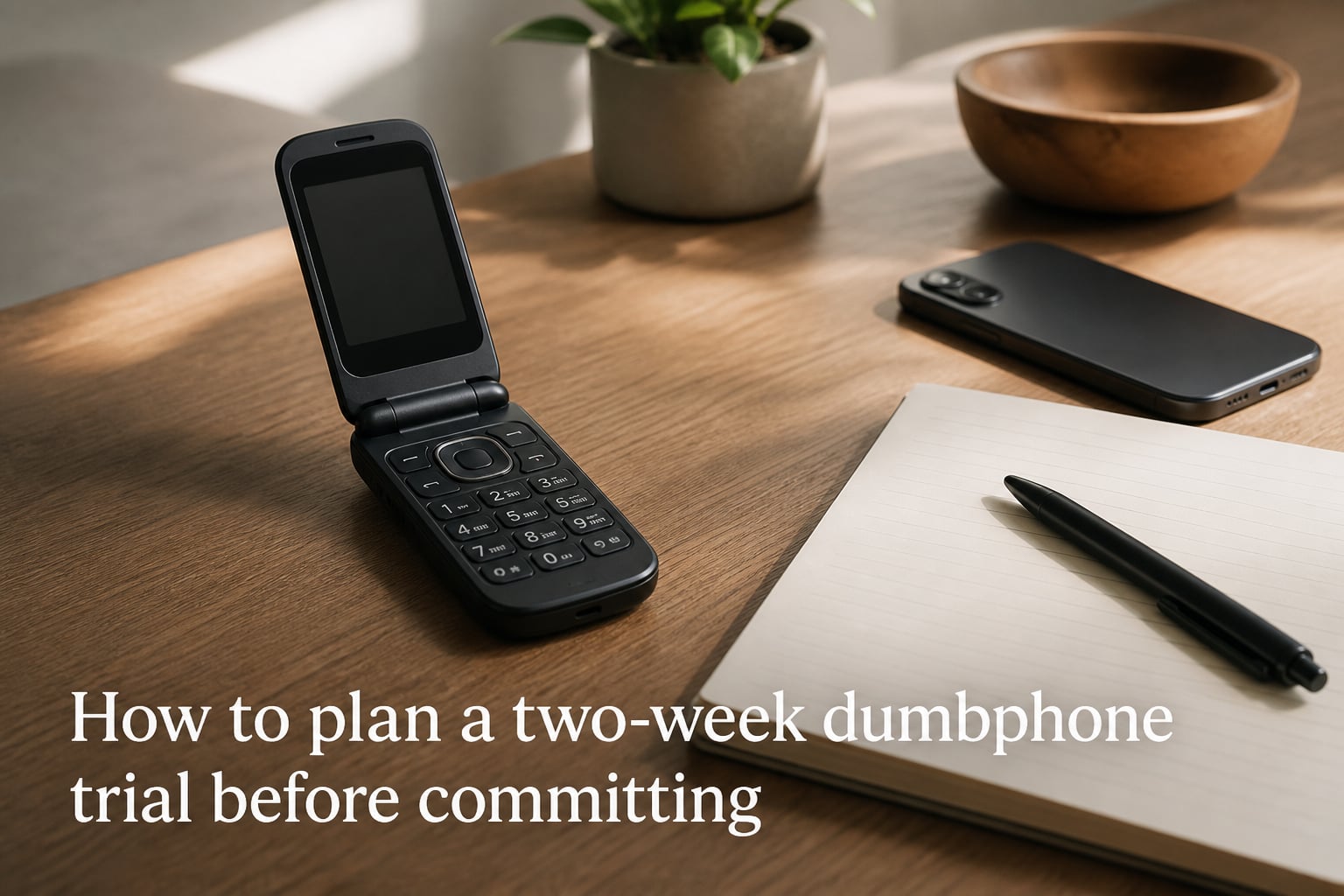
Three years ago, I stared at my phone’s screen-time report: 7 hours and 42 minutes of daily use. That number kicked off what would become the most productive two weeks of my adult life. I ran my first dumbphone trial with a borrowed flip phone, a pocket notebook, and zero plan. I learned a lot the hard way.
A dumbphone trial is a deliberate, time-boxed experiment where you swap your smartphone for a basic phone (or strip your smartphone down to bare essentials). The goal is simple: discover whether simplified phone usage actually works for your real life before you commit to a permanent switch. Most people who try this fail on their first attempt, not because dumbphones do not work, but because they did not plan the trial properly.
This guide walks you through everything I wish I had known. You will learn how to choose your trial method, prepare your tech and routines, navigate the daily ups and downs, and evaluate whether the lifestyle genuinely fits. Whether you are fighting phone addiction, seeking deeper focus, or just curious about the minimalist phone movement, this framework gives you a structured path forward.
Table of Contents
What Is a Dumbphone Trial?
A dumbphone trial is a planned period, typically two weeks, where you replace or radically simplify your smartphone to test whether a simpler device fits your daily routine. You commit to calling, texting, and minimal features only. Then you pay attention to what you miss, what you do not miss, and what surprises you.
This is different from a general digital detox. A detox usually means going phone-free or locking apps away for a weekend. A dumbphone trial is more specific: you still have a phone in your pocket, but it is stripped down. You are testing a replacement lifestyle, not just taking a break.
There are three main ways to run a trial. You can buy or borrow a dedicated feature phone (like a flip phone or candy-bar phone). You can convert your existing smartphone into a dumbphone using grayscale, app deletion, and notification blocking. Or you can run a hybrid approach where you keep your smartphone for work emergencies but carry a basic phone for personal use during the trial.
Why Two Weeks Is the Sweet Spot?
Two weeks hits a specific sweet spot that shorter or longer trials miss. Here is why this timeframe works.
The first three to five days are pure withdrawal. Your brain is used to constant dopamine hits from notifications, scrolling, and quick app checks. Research on habit disruption shows that this acute discomfort peaks around day four, then steadily declines. If you quit after a weekend, you only experience the pain and none of the payoff.
By the second week, something shifts. You stop reaching for your phone reflexively. Conversations get longer. Sleep often improves. Forum users on r/dumbphones consistently report that days 8 through 14 are when they start to feel the real benefits: better focus, reduced anxiety, and a strange sense of calm. A five-day trial never gets you there.
Two weeks is also short enough to commit to without blowing up your life. You can tell your boss, your family, and your friends that you are running an experiment with a firm end date. Nobody panics. If it goes badly, you have an exit ramp. Fourteen days is serious enough to produce real data but not so long that it feels like a prison sentence.
Step 1: Choose Your Dumbphone Trial Method
Before you do anything else, pick your method. This decision shapes everything that follows.
Method A: Real Feature Phone
This is the most authentic dumbphone experience. You get a basic phone that handles calls, texts, maybe a camera and alarm, and nothing else. Popular options include flip phones from Nokia, basic TCL devices, and purpose-built minimalist phones like the Light Phone or Punkt MP02. This method gives you the cleanest read on whether you can live without smartphone features.
The downside is cost and logistics. You need to make sure your SIM card is compatible, and you may need to adjust your carrier plan. If you decide dumbphone life is not for you, you are left with a device you do not need.
Method B: DIY Smartphone Dumbphone
This is the most popular approach for first-timers. You keep your existing phone but strip it down aggressively. Delete every social media app. Disable all notifications except calls and texts. Switch the display to grayscale. Simplify your lock screen and home screen so nothing invites you to tap. The Lifehacker method and the factory-reset approach from She’s a Beast both fall into this category.
The advantage is zero cost and easy reversibility. The disadvantage is that your smartphone is still a smartphone. Muscle memory and one tap on the App Store can undo hours of preparation. This method requires discipline.
Method C: Hybrid Two-Device Setup
You carry a dumbphone for personal use but keep your smartphone at home or in a drawer for specific tasks. Maybe you check email once a day on the smartphone, then put it away. This is the approach many long-term dumbphone users eventually settle into, and it is a smart way to test the waters without going cold turkey.
Pick the method that matches your personality. If you know you cannot resist reinstalling Instagram, go with Method A. If you want to test the concept before spending money, start with Method B. If your job genuinely requires smartphone apps, Method C is your realistic path.
Step 2: Prepare Your Phone, SIM, and Apps
Preparation makes or breaks a dumbphone trial. Get this right before day one and the two weeks become dramatically easier.
Check SIM and Carrier Compatibility
If you are using a real feature phone, confirm your SIM card will work. Most modern flip phones use nano-SIMs, but older phones may need a different size. Visit your carrier’s website or call customer service to verify that your plan supports voice and text on a non-smartphone device. Some carriers even offer cheaper talk-and-text-only plans that can save you money during the trial.
If you are doing the DIY method, your SIM situation does not change. But take a screenshot of your current data usage before the trial starts. This gives you a baseline for comparison when you evaluate results.
The App Triage: Keep vs Delete
Make a list of every app on your phone and sort it into three categories: delete immediately, keep with restrictions, or keep essential. Be brutal. Social media, news apps, games, and video streaming go in the delete pile. Navigation, banking, and your camera might stay if you are doing the DIY method, but only with notifications off.
For the DIY approach, physically delete the apps rather than just hiding them. If you leave them installed and rely on willpower, you will cave by day three. Forum users consistently report that the factory-reset method (wipe everything, then reinstall only what is essential) produces the best results for iPhone users.
Set Up Your Emergency Backup
Tell at least three people you trust that you are starting this trial. Give them your dumbphone number if you have one. Agree on how they should reach you in an actual emergency. Having this safety net removes the anxiety that kills many trials before they begin.
Also, keep your smartphone accessible but not on your person. Put it in a drawer, a glove compartment, or a closet. The rule is: you can use it for genuine emergencies or one planned task per day, but you do not carry it in your pocket.
Step 3: Set Up Your Support Systems
A dumbphone removes tools you use dozens of times per day. You need replacements ready before those gaps become frustrating.
Navigation Without Google Maps
This is the number one concern people raise before a trial. Plan ahead. Write down directions to places you visit regularly. Buy or dig out a paper map for your area. If you are driving, get a dedicated GPS unit for your car. Some dumbphones do have basic GPS, but do not count on anything close to smartphone-level navigation.
Many trial veterans report that losing instant maps actually improved their spatial awareness. They started remembering routes instead of blindly following turn-by-turn directions. But that transition is easier when you have paper backups during the adjustment period.
Banking, Payments, and Shopping
Mobile banking and tap-to-pay are hard to replace. Plan to use a laptop or desktop for banking tasks during the trial. Pull out a physical debit or credit card for payments instead of Apple Pay or Google Pay. If you normally use your phone for two-factor authentication, set up SMS-based codes or buy a hardware security key before the trial begins.
This is where many work-from-home professionals and frequent travelers hit a wall. Mobile authenticator apps, expense tracking, and receipt scanning all live on smartphones. Identify every app in this category and write down a manual alternative for each one.
Music, Podcasts, and Entertainment
If your dumbphone supports an FM radio or has expandable storage for MP3s, load it up before the trial. Otherwise, rediscover dedicated devices: a dedicated music player, a portable radio, or even a small Bluetooth speaker paired with a laptop at home. Libraries are still a thing, and Libby (for audiobooks) works on tablets and computers.
Many people find that losing the infinite streaming scroll actually brings back enjoyment of music. When you cannot skip endlessly, you listen to albums front to back again.
Work Communication Plan
Talk to your manager and close colleagues before the trial. Explain what you are doing and how long it will last. Set expectations for response times. If your job requires Slack, email, or calendar apps, decide whether you will check those on a laptop at specific times or use the hybrid method with your smartphone for work only.
People on r/dumbphones who succeed at this almost always communicate their plan upfront. Those who surprise their coworkers with sudden unreachability tend to abandon the trial under social pressure.
Your 14-Day Dumbphone Trial Framework
This is the framework I built after my first messy attempt failed on day six. It breaks the two weeks into three phases with specific daily checkpoints. Keep a small notebook or use a notes app on your laptop to track each day.
Phase 1: The Withdrawal Days (Days 1 to 4)
These first four days are the hardest part of any dumbphone trial. Your brain is literally recalibrating without constant dopamine stimulation. Expect to feel irritable, bored, and reach for your phone dozens of times per hour only to find a device that cannot deliver the fix.
Day 1: The novelty helps. You feel motivated and committed. Write down your reasons for doing this trial in your notebook. Note your screen-time baseline from yesterday. Try not to brag too much on social media (where you are probably not posting anyway).
Day 2: The first real test. You will encounter a moment where a smartphone would have been useful and your dumbphone is not. Maybe you need to look up an address, split a bill, or scan a QR code. Write down every friction point. This list becomes your most valuable data.
Day 3: Phantom notification syndrome kicks in. You will feel your pocket vibrate when nothing happened. This is normal and it passes. Note how many times you instinctively check for notifications. The number will shock you.
Day 4: Often the lowest point. Motivation fades and the discomfort peaks. This is where most unplanned trials die. Having the structure and knowing that day five brings relief is what gets you through. Re-read your reasons from day one.
Phase 2: The Adjustment Days (Days 5 to 9)
The fog starts lifting. Your brain stops screaming for stimulation and begins to settle into the new rhythm. This phase is where the real insights emerge.
Day 5: Something shifts. Many people report waking up more rested or noticing they read a book for an hour without checking their phone once. Write these moments down. They are the early signals that the trial is working.
Day 6: You start developing workarounds. You remember directions because you looked them up beforehand. You call instead of text for longer conversations. You use your laptop for tasks you used to do on your phone absently.
Day 7: The halfway checkpoint. Review your friction-point list from day two. How many of those issues are still frustrating? How many did you solve with a workaround? This mid-trial review tells you a lot about your adaptability.
Days 8 and 9: You stop thinking about the trial constantly. The dumbphone (or stripped smartphone) just becomes your phone. Conversations feel deeper. You notice things you were too distracted to see before. People on forums describe this stretch as unexpectedly peaceful.
Phase 3: The Settling Days (Days 10 to 14)
This phase is about gathering final data and preparing your decision. The trial stops feeling like an experiment and starts feeling like a potential lifestyle.
Days 10 to 12: Track your energy levels, sleep quality, and mood compared to your pre-trial baseline. Most trial participants report measurable improvements in all three areas by this point. Write down specific examples, not just vague feelings.
Day 13: Start your formal evaluation. Look at your friction-point list, your daily notes, and your energy data. Begin asking the real question: could I keep doing this, or some version of this, permanently?
Day 14: Final decision day. You do not have to commit to anything extreme. Your options are: go back to your smartphone full-time, adopt a permanent hybrid setup, or switch to a dumbphone permanently. All three are valid outcomes. The trial gave you the data to choose intentionally.
Common Challenges and How to Beat Them
Every trial hits roadblocks. Here are the most common ones from forum research and my own experience, along with practical solutions.
Challenge: Group Chats and Messaging
Losing access to iMessage, WhatsApp group chats, and group texting is one of the most emotionally difficult parts of a trial. You feel cut off from your social circle. The fix is communication before the trial. Tell your close groups what you are doing. Give them your dumbphone number for texts. Schedule a weekly catch-up call or in-person hangout so you stay connected through a different channel.
Challenge: GPS and Navigation Emergencies
You will eventually need directions somewhere unfamiliar and your dumbphone will not help. Plan for this by keeping your smartphone in your car or bag for navigation emergencies only. Set a rule: navigation use is allowed, but you pull over, use the phone, then put it away. This prevents the smartphone from creeping back into your pocket.
Challenge: QR Codes and Digital-Only Systems
Restaurants, parking meters, event tickets, and even some medical check-ins now assume everyone has a smartphone. This is a real friction point that no workaround fully solves. For restaurants, ask for a paper menu (most still have one). For parking, carry quarters and small bills. For events, print your tickets at home. It is annoying but manageable for two weeks.
Challenge: Work Pressure
If your job runs on Slack, Teams, email, or specialized mobile apps, going fully dumb is not realistic. This is where the hybrid method shines. Carry your dumbphone for personal hours. Keep your smartphone for work hours only, stored out of sight when you are off the clock. This boundary actually improves work-life balance for many people.
Challenge: Social Pressure and Judgment
People will think you are weird. Coworkers may tease you. Friends may feel ignored. Prepare a short, confident explanation: I am doing a two-week experiment to reduce my screen time. Most people respect it once they understand the timeframe. Some even get curious and want to try it themselves.
How to Evaluate Your Dumbphone Trial Results
Once you finish the two weeks, it is time for an honest assessment. No competitor provides a structured evaluation framework, so here is one you can use immediately.
Score These Five Categories (1 to 5 Each)
Mental clarity and focus: Did you concentrate better during work, reading, or conversations? Did you feel less mentally scattered? Score 1 if no improvement, 5 if dramatic improvement.
Sleep and energy: Did you fall asleep faster? Wake up more refreshed? Feel less fatigued during the day? Compare to your pre-trial notes.
Emotional wellbeing: Did anxiety decrease? Did you feel more present with family and friends? Did you experience less FOMO (fear of missing out) by the end?
Practical functionality: Could you handle daily tasks without major disruption? How many friction points from day two remained unsolved by day fourteen?
Sustainability: Could you realistically keep this up for another month? Another six months? Be honest, not aspirational.
What Your Score Means
Total 20 to 25: The dumbphone lifestyle clearly works for you. Consider a permanent switch or a committed hybrid setup. You have the data to back your decision.
Total 13 to 19: You see real benefits but also real friction. The hybrid approach is likely your best long-term path. Keep a dumbphone for personal time and use your smartphone strategically for tasks that genuinely need it.
Total 5 to 12: The full dumbphone lifestyle is probably not right for you, and that is completely fine. You still learned valuable information about your phone habits. Consider keeping the DIY changes (grayscale, fewer apps, notifications off) on your smartphone to capture some benefits without the full switch.
Signs the Trial Worked
You reach for a phone less often even after the trial ends. You sleep better and feel calmer. You discovered you can live without checking your phone every five minutes. You enjoyed the mental space and want more of it. These outcomes mean the trial gave you exactly what you needed.
Signs It Is Not for You
Your work suffered. You felt genuinely isolated rather than peacefully disconnected. The friction of replacing basic tasks overwhelmed any mental health benefits. This is useful data, not a failure. You now know that a smartphone serves you well and can use it more intentionally going forward.
Frequently Asked Questions
How much does a dumb phone plan cost?
A basic talk-and-text plan for a dumbphone typically costs between $10 and $30 per month from major carriers and MVNOs. Some carriers offer pay-as-you-go plans for as little as $5 to $10 monthly if you rarely use minutes. This is significantly cheaper than most smartphone data plans.
What app turns a phone into a dumb phone?
Several apps help convert a smartphone into a dumbphone, including Blank Spaces and Minimalist Launcher for Android, and using built-in tools like Screen Time, grayscale mode, and Focus modes for iPhone. The most effective method combines app deletion, notification disabling, and grayscale display rather than relying on a single app.
Does a dumb phone require a subscription?
Most dumbphones do not require a special subscription beyond a basic carrier plan for calls and texts. Purpose-built minimalist phones like the Light Phone may offer optional subscription services for features like podcast streaming or hotspot functionality, but these are add-ons, not requirements. A basic flip phone works with a standard prepaid or postpaid voice plan.
Is getting a dumb phone worth it?
A dumbphone is worth it if you struggle with phone addiction, want to reduce screen time, or value deeper focus and better sleep. Running a two-week trial first is the best way to find out before committing to a purchase. Many people benefit from a hybrid setup rather than going fully dumb, keeping a smartphone for specific tasks while using a basic phone for daily life.
Can I use WhatsApp on a dumbphone?
Most basic dumbphones cannot run WhatsApp because they lack the required operating system. Some feature phones running KaiOS support WhatsApp, and a few select models like the Punkt MP02 offer limited messaging app support via Catapult. If WhatsApp is essential for your communication, the DIY dumbphone method on your existing smartphone is a better fit than a traditional feature phone.
Conclusion
Planning a two-week dumbphone trial before committing is the smartest way to discover whether simplified phone usage fits your life. Pick your method, prepare your tech and support systems, follow the three-phase framework, and evaluate honestly using the scoring rubric. The trial gives you real data instead of guesswork.
You do not have to go all-in on a permanent dumbphone lifestyle to benefit from this experiment. Many people find that a hybrid approach, or even just keeping a few smartphone changes like grayscale and fewer notifications, transforms their relationship with technology. The point is intentional choice, not deprivation.
Start your trial this week. Pick a start date, tell three people, and begin. Fourteen days from now you will know exactly whether a dumbphone belongs in your future.