
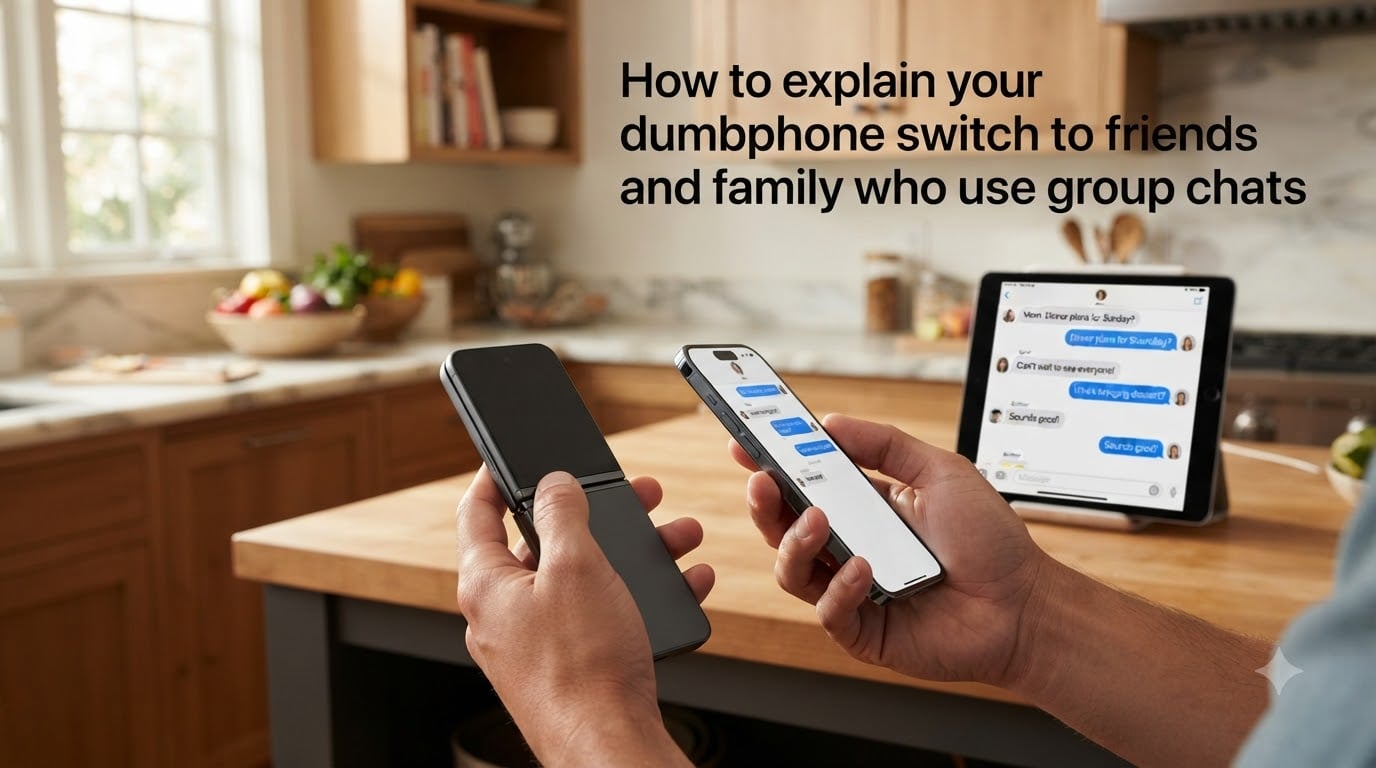
I made the switch to a dumbphone last year, and the first 72 hours were brutal. My cousin texted me a question in our family group chat, then called me twice, then sent a single sad emoji to my old iMessage address. I had underestimated just how much of my social life ran through group chats.
If you are planning to switch to a dumbphone, or already have, the hardest part is not the device. It is the conversation. Friends and family who lean on group chats to coordinate dinners, share kid photos, and decide Sunday brunch spots genuinely feel the absence when you go quiet. This guide will walk you through how to explain your dumbphone switch to friends and family who use group chats, with scripts you can copy and use today.
Table of Contents
Why Group Chats Matter for Staying Connected?
Group chats are the default operating system of modern family life and tight friend circles. A family group chat handles birthday planning, last-minute babysitter swaps, and the steady drip of cousins sharing photos of their kids. A friend group chat coordinates weekend trips, commiserates about work, and sends memes that mean “I am thinking of you.”
When you remove yourself from that loop, even temporarily, the people in it notice. One Washington Post reporter who ditched her smartphone for a month wrote that her defection to a flip phone “was taken as a farewell” by four close friends. That is the real social risk of the dumbphone switch: not missing messages, but being misread as no longer wanting to be in the conversation.
This is why the explanation matters more than the device itself. A clear, early message prevents weeks of awkward silences and private texts between relatives asking “is she okay?” I learned this the hard way, and I want to save you from the same mistake.
The Green Bubble Problem: Group Chats on Dumbphones
Before you explain your switch, you need to understand the technical reality people will quietly judge you on. The “green bubble problem” is real, and it is the first thing iPhone-using friends will bring up, even if they pretend they do not care.
Modern group messaging runs on four overlapping protocols:
SMS – the original text standard, works on every phone, dumb or smart, but limited to 160 characters and no real group support.
MMS – the upgrade that adds photos and basic group messaging, but often falls back to SMS on dumbphones.
RCS – Google’s modern replacement, offers read receipts, typing indicators, and rich group chats, but only works on smartphones with cellular data.
iMessage – Apple’s blue-bubble protocol, locked to Apple devices, and the source of the green versus blue bubble divide.
When you switch to a dumbphone, your messages arrive as SMS or MMS. To your iPhone friends, your replies show up with green bubbles. The thread may downgrade, reactions may vanish, and photos may stop loading reliably. One user on Reddit summed it up: “Group messages with iPhone users is kind of broken” after switching.
Knowing this helps you frame your explanation. You are not being antisocial. You are simply leaving a closed messaging ecosystem that does not invite you back in. That framing is fair, and it lands.
How to Explain Your Dumbphone Switch to Friends and Family Group Chats
Explaining the switch works best as a short, deliberate sequence rather than a single grand announcement. I have used this five-step approach with three different group chats, and it has held up well.
Step 1: Tell the Closest People First
Before you post anything in a group chat, message your partner, your parents, and your closest friend individually. These are the people who will defend your choice to others and absorb the awkward early questions. One-on-one messages also let you personalize the reason (mental health, focus, a new baby, screen time concerns) without performing for a crowd.
Step 2: Send the Announcement in the Group Chat Itself
It feels strange to announce a tech downgrade in a group chat, but doing so in the very chat you will be quieter in is the cleanest move. It stops people from imagining you are sick, traveling, or mad at them. Keep it short, warm, and specific.
Step 3: Frame It as a Personal Choice, Not a Critique
Friends and family will get defensive if they read your switch as a judgment on their screen habits. Lead with “I” language and avoid any tone that sounds like a public service announcement. The goal is to be understood, not to recruit anyone.
Step 4: Offer Concrete Alternatives for Staying Reachable
Tell people exactly how to reach you for time-sensitive things. A phone number, an email, a WhatsApp-on-tablet setup, or “call me for anything urgent” are all fine. The point is to remove the guessing game. People tolerate a lot of friction when they know the workaround.
Step 5: Set Expectations About Response Time
Tell people you will reply slower, and you will miss some threads. This is the most important step, and the one most people skip. Pre-emptively saying “if I do not respond in a day, please call me” resets the social contract.
Script Templates for Common Scenarios
These are the messages I actually sent, lightly edited. Copy and adapt them to your voice.
Script 1: The Group Chat Announcement
“Hey everyone, quick heads-up: I switched to a basic phone this week for my own peace of mind. I will still be around, just slower on text. For anything time-sensitive, please call me directly. Love you all, will catch up soon.”
Script 2: When Your Mom Asks “Why Did You Do This to Yourself?”
“I was spending four hours a day on my phone and not sleeping well. I wanted to try something simpler for a while. I can still receive texts and calls, and I will call you every Sunday at 5 like always.”
Script 3: When a Friend Says “Now You Are Going to Be Hard to Reach”
“Honestly, I am easier to reach by phone now than I was buried in my apps. If you need me fast, call. If it can wait, text and I will get back to you within a day. I am still here, just less online.”
Script 4: When Someone Asks “Are You Trying to Be Like Those Gen Z Influencers?”
“No influencer involved. I just wanted to read more books and be less distracted at dinner. If it works I will keep doing it, if it doesn’t I will switch back. Either way I am still me.”
Script 5: When a Group Chat Goes Quiet and You Want Back In
“I know I have been quiet, catching up on this thread now. Send me the highlight, or fill me in on the call tonight?”
Script 6: When You Need to Re-Explain to a New Person
“I use a flip phone by choice. I see texts, I just reply less. Email is the fastest way to reach me during the day.”
Script 7: When Hosting or Planning an Event
“I am still in charge of the group chat for the reunion. I will check it every evening and call anyone who needs a faster answer.”
Communication Strategies That Actually Work
Scripts help with the first conversation, but habits sustain the relationship. Here is what I have seen work across my own circle and across the dumbphone Reddit community.
Be the one who calls. Calling flips the dynamic. You go from being the unreachable one to being the person who makes time for real voices.
Send a weekly roundup text. A short Sunday message to the family chat summarizing your week keeps you visible without requiring real-time presence.
Keep a tablet or old phone on Wi-Fi for WhatsApp and email. A surprising number of dumbphone users do this. It is not cheating. It is the hybrid most people actually run.
Set a “call hour.” Pick one hour a day when you answer every call. People learn to use it.
Stop apologizing. After the first month, drop the “sorry for the slow reply.” You are not in customer service. You are in a relationship.
What Not to Do in Group Chats
Once you are on a dumbphone, a few habits will save you from looking disengaged. Do not react to every message with an emoji, because reactions rarely send over SMS. Do not send long wall-of-text replies, because they will get fragmented. Do not announce you missed something, because it makes you the broken link. Do not disappear for weeks without a single check-in, because silence reads as distance.
Handling Pushback from Skeptical Family Members
Some relatives will treat your switch as a personal insult. A mother-in-law may worry you are unreachable in an emergency. A sibling may feel you have made a snide statement about their own screen time. A teenage niece may simply decide you are now uncool.
Stay calm and repeat the same line across all of them: “I did this for myself, and I am still here for you.” Do not argue, do not justify, do not list ten reasons. One reason, repeated, is the most convincing thing you can say.
If someone is truly upset, ask them a specific question: “What are you worried will happen?” Often the fear is concrete and fixable. They worry they will not hear from you. They worry you will miss an emergency. They worry they will have to call long-distance. Name the fear, then offer the simple workaround.
Alternative Ways to Stay in the Loop
Group chats are not the only channel, and they were not the first channel. A few low-tech alternatives hold up well for dumbphone users. Group email threads work for older relatives who already check their inbox. Voice notes sent over WhatsApp from a tablet or laptop reach friends who prefer audio. Group SMS to just two or three people still works on every flip phone. Scheduled weekly video calls replace the daily drip of group chat presence.
One often-overlooked option is a phone-number-shared iPad or old iPod Touch kept on Wi-Fi at home. You can run WhatsApp, Signal, and email on it without ever carrying a smartphone. Many in the dumbphone community quietly use this setup and consider it fully compatible with the dumbphone lifestyle.
Long-Term Relationship Maintenance After the Switch
The first six weeks are the hardest. After that, friends and family adjust. The people who matter will call, will email, and will stop expecting you to react to group memes within five minutes. The people who only ever reached you through a group chat will fade a little, and that is okay. It is not a failure of the dumbphone. It is a sorting of how your relationships actually worked.
To keep the strong ties strong, schedule two real conversations a week, by voice, with people you care about. Send one meaningful text per day, even if it is short. Show up to events in person when you can, because presence matters more than texting. Over time, the dumbphone switch becomes a filter, not a wall.
Frequently Asked Questions
Do group chats work on flip phones?
Group chats work on a flip phone only as SMS or MMS, which means basic text in groups of up to about 10 people. You will not see read receipts, typing indicators, reactions, or high-quality photos. iMessage and RCS group chats will downgrade to SMS when you reply, and iPhone users will see green bubbles instead of blue.
What is the point of a family group chat?
A family group chat exists to coordinate shared life in real time: scheduling dinners, swapping kid photos, sharing news, and making quick decisions without a phone tree. It functions as a low-effort gathering place for relatives who do not otherwise communicate daily. The point is continuous, low-stakes presence, not deep conversation.
What not to do in group chats?
Avoid sending reactions, because they usually do not transmit over SMS. Avoid long messages, which fragment. Avoid disappearing for weeks without a check-in, because silence reads as distance. Avoid announcing every missed message, because it makes you the broken link. And avoid over-explaining your phone choice, because one calm reason repeated is better than a daily defense.
How do I explain my switch to family who expect instant responses?
Tell them directly, before they get frustrated, that you now reply slower. Give them a specific faster channel, like a phone call or an email. Example: For anything urgent, call me. For anything that can wait, text and I will reply within a day. Then actually reply within a day, so the new contract holds. The combination of honesty and follow-through is what makes the switch sustainable.
Final Thoughts on Explaining Your Dumbphone Switch
Learning how to explain your dumbphone switch to friends and family who use group chats comes down to one thing: tell the truth early, offer a workaround, and follow through. That is the whole job. The dumbphone is the easy part. The relationships are the work, and they are worth the work.
Pick one script from this guide, send it today, and give your circle two weeks to adjust. By month three, you will wonder why you ever worried about it.