
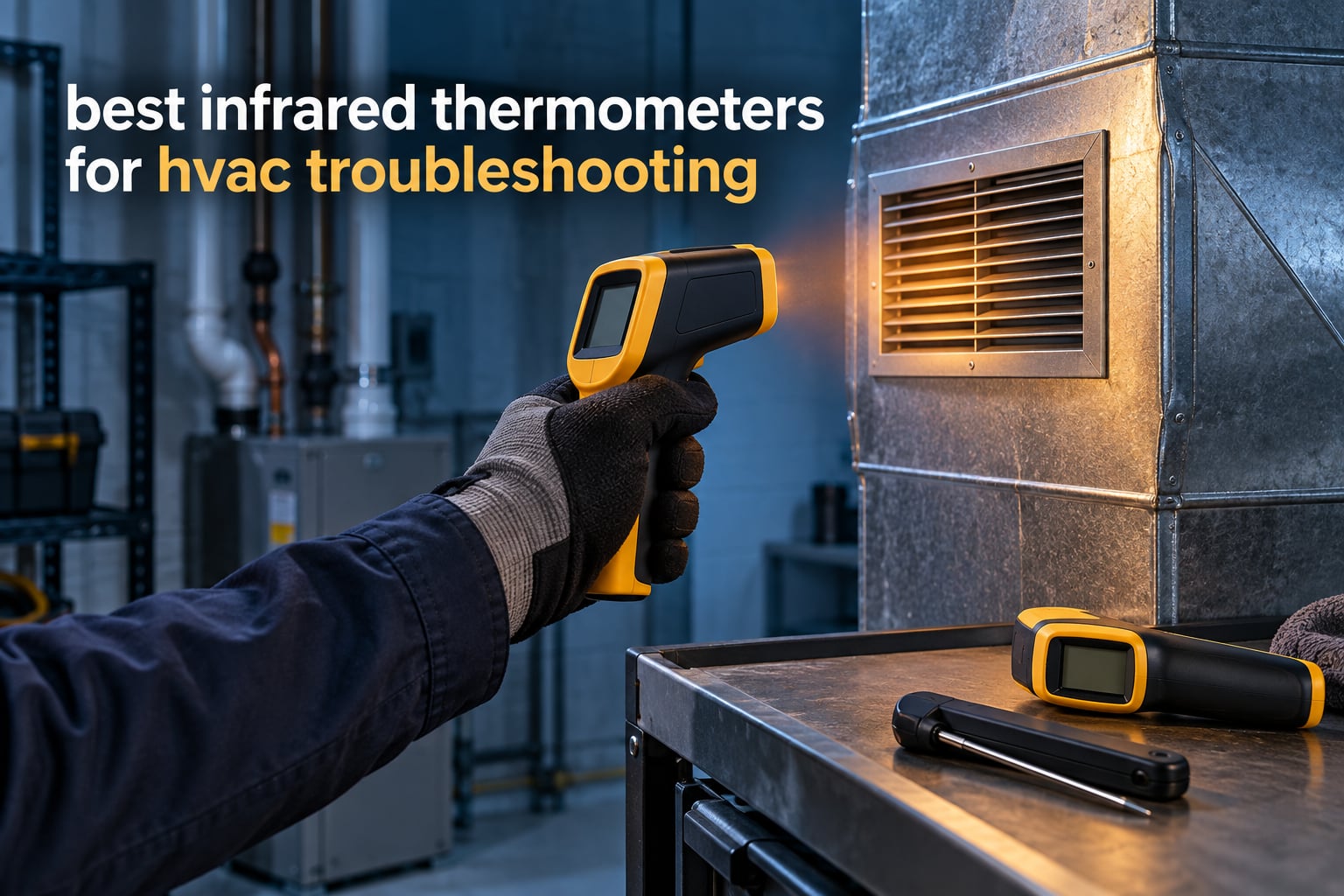
An infrared thermometer for HVAC troubleshooting is a non-contact temp gun that reads the surface temperature of ductwork, refrigerant lines, coils, water pipes and electrical panels from the infrared radiation they emit. It lets a technician find hot spots, starved registers and temperature splits without climbing into a hot equipment cabinet or pulling a panel apart. The three picks we would hand a working technician first are the Fluke 62 Max for overall field work, the Etekcity Lasergrip 1080 for value and adjustable emissivity, and the Klein Tools IR5 for dual laser targeting on small registers.
Here is the thing almost every roundup gets wrong: an IR gun does not measure air temperature, airflow, humidity or anything inside a system. It measures the skin of a surface. Get that straight and the tool becomes far more useful, because you will reach for it for the right jobs and you will know when to switch to a pipe clamp or a dual-channel thermocouple meter for absolute refrigerant line temperatures.
This guide covers ten of the most-reviewed infrared thermometers available now, ranked for the way HVAC work actually gets done: service calls, installs, comfort diagnostics, home inspections and energy audits. If you want a broader look at temperature tools for the home, our picks for instant read thermometers and smart thermometers cover contact measurement, which is a different job.
Table of Contents
Top 3 Picks for HVAC Troubleshooting in 2026

Fluke 62 Max
- 10:1 distance-to-spot
- Adjustable emissivity
- -22F to 932F
- IP54 and 3 year warranty

Etekcity Lasergrip 1080
- Adjustable emissivity 0.1-1.0
- 12:1 distance-to-spot
- -58F to 1130F
- 2 year warranty
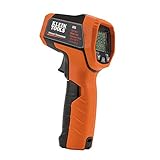
Klein Tools IR5
- Dual laser spot framing
- Adjustable emissivity 0.1-1.0
- 12:1 ratio
- 2 m drop protection
Best Infrared Thermometers for HVAC Troubleshooting at a Glance in 2026
The table below is the short version. Every product listed here earns its place for a specific HVAC task, and the feature column tells you which one. For the full reasoning on each, read the numbered reviews that follow.
| Product | Specs | Action |
|---|---|---|
| Fluke 62 Max |
|
Check Latest Price |
 Klein Tools IR07 Klein Tools IR07 |
|
Check Latest Price |
| Klein Tools IR5 |
|
Check Latest Price |
 Fluke 59 Max+ Fluke 59 Max+ |
|
Check Latest Price |
 UEi PDT655 UEi PDT655 |
|
Check Latest Price |
 DEASOMIYE JD-04 DEASOMIYE JD-04 |
|
Check Latest Price |
| Etekcity Lasergrip 1080 |
|
Check Latest Price |
 TempPro TempScan TP30 TempPro TempScan TP30 |
|
Check Latest Price |
 Temirup IR05B-RD Temirup IR05B-RD |
|
Check Latest Price |
 Klein Tools IR1 Klein Tools IR1 |
|
Check Latest Price |
1. Fluke 62 Max Industrial Infrared Thermometer – Best Overall for HVAC Troubleshooting
Fluke 62 Max Industrial Infrared Thermometer, -22 to +932 Degree F Range, Single Laser Targeting, 10:1 Distance to Spot Ratio, IP54 Rating, Includes 3 Year Warranty, (Not for Human Temp)
Range: -22F to 932F
Accuracy: plus or minus 1.5 percent
10:1 distance-to-spot
IP54 and 3 meter drop
Pros
- Repeatable readings with min max difference and average modes
- Compact and light enough to clip to a belt loop
- Large backlit display readable in dark mechanical rooms
- 10 hour battery life
- 3 year warranty
Cons
- Emissivity needs manual adjustment for shiny metal
- Point-and-shoot interface with no hold mode
- The included documentation is mostly unannotated illustrations
The Fluke 62 Max is the gun I would put in a service truck first, and the reason is simple: it does the boring 90 percent of HVAC surface work without asking you to think. Point it at a supply register, a return grille, a refrigerant line or a panel and the number settles quickly and repeats. The display shows minimum, maximum, difference and average, which means you can scan a large duct run and walk away with the hottest and coldest values rather than a stack of mental arithmetic.
The stated accuracy is plus or minus 1.5 degrees C or 1.5 percent of reading, with a 10:1 distance-to-spot ratio. At 10:1, a one inch spot means you should be about 10 inches from the target, and the further back you go the wider the cone grows. On a big piece of duct board that is not a problem. On a thin suction line it is, which is why this is not my first pick for refrigerant work.
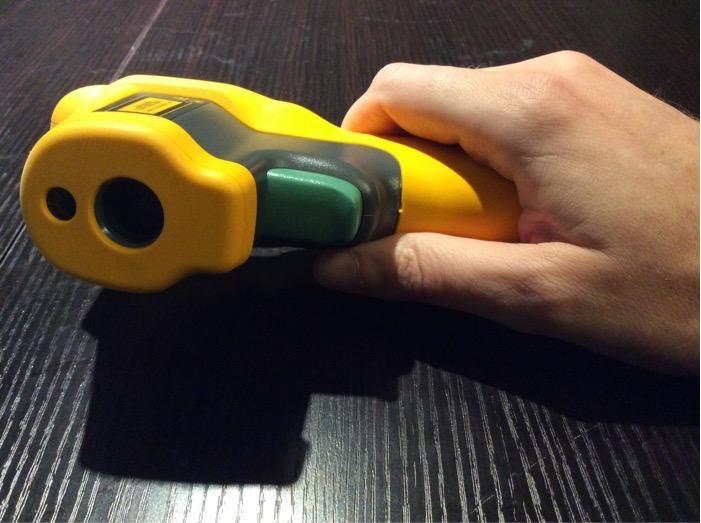
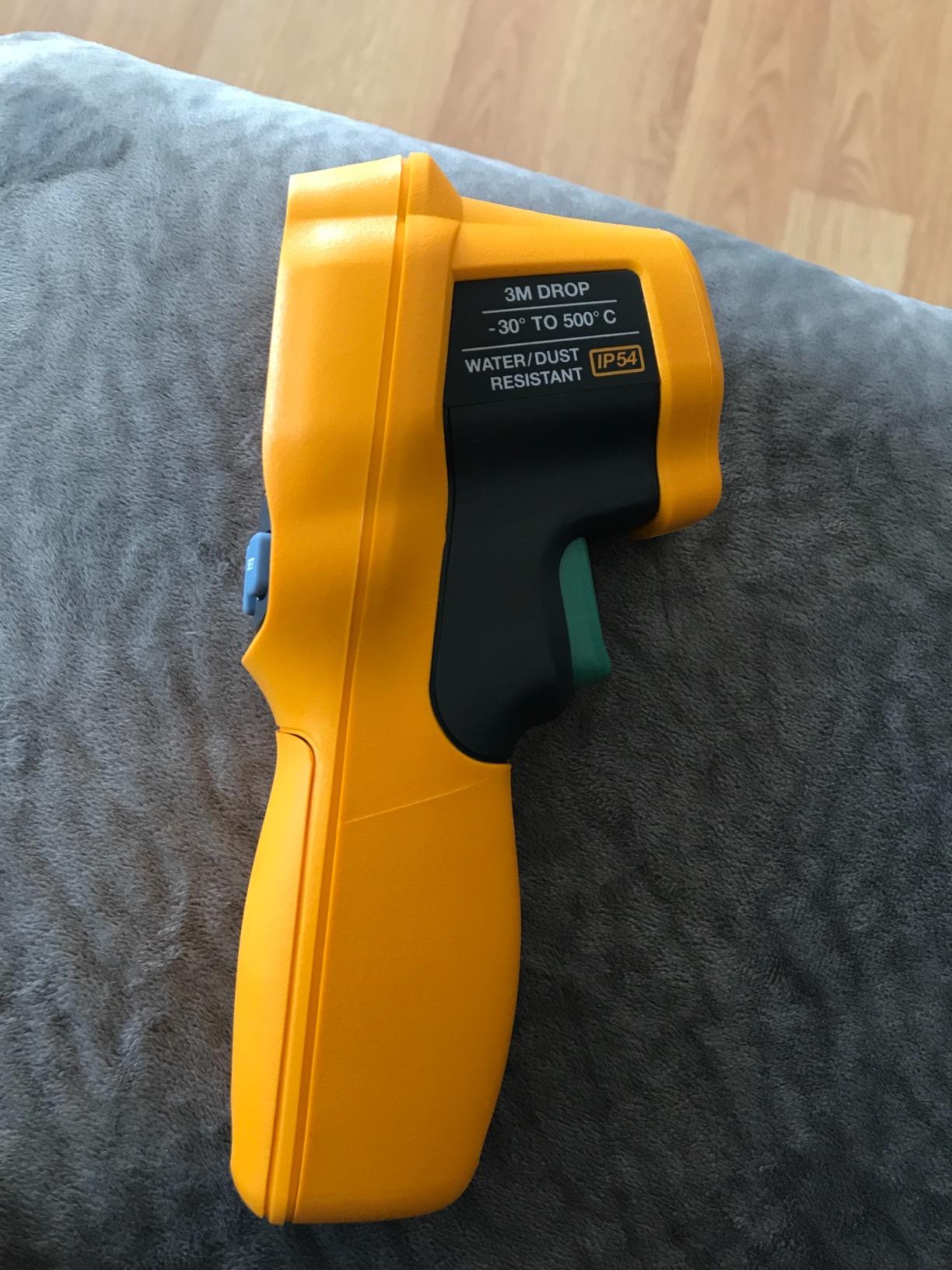
Build quality is the other reason it wins. It carries an IP54 rating for dust and splashing liquid and is rated to survive a 3 meter drop, and at 6.8 inches long it fits a pocket without the bulk. The screen is large and backlit, which matters more than it sounds when you are reading a return air temperature in a dark mechanical room or a rooftop unit in full sun. Battery life is listed at around 10 hours on a single AA cell.
Two honest caveats. The first is emissivity: on shiny or bare metal surfaces the reading drifts until you dial the setting to match the material, and the Fluke 62 Max makes you do that manually every time. The second is that the interface is deliberately plain, with no hold mode, so on a high ceiling vent you will want to find a way to see the screen after you pull the trigger. If you are weighing this against a heated option, note that this is an industrial instrument and not rated for human body temperature.
Why the Fluke 62 Max suits whole-system diagnostics
Technicians who want a broader view of their tools often pair a point gun like this with a thermometer built for meat and other contact cooking work, because a contact probe verifies what the IR surface reading suggests. On a heating call, you can scan a furnace cabinet for a hot spot, then confirm with a contact thermometer on the suspect metal.
That division of labour is exactly how we use it. IR tells you where to look, and a contact reading tells you how much you can trust the number. For duct temperature splits, follow the smart thermometer guide for the probe side of that workflow.
Where the Fluke 62 Max will frustrate you
If your work is mostly on thin copper or foil-faced flex duct, the fixed 10:1 ratio means you end up nose-to-surface more often than you would like. The unit is also industrial only, so do not buy it expecting any kind of body-temperature use.
And the documentation is thin. Reviewers complain the supplied sheets are largely unannotated illustrations, so plan on learning the emissivity table and mode switching from experience or from a printed reference you keep in the pouch.
2. Klein Tools IR07 Dual Infrared and Probe Thermometer – Best for Vent and Duct Air Readings
Klein Tools IR07 Dual Infrared (IR) and Probe Pocket Size LCD Digital Thermometer
IR plus probe thermometer
8:1 distance-to-spot
Range: -40F to 752F
T1 minus T2 differential
Pros
- Only dual IR and probe design in this group
- Hanging hook gives hands-free vent readings
- 500 millisecond response suits split checks
- Pocketable at 6.5 inches
- Laser pointer plus backlit LCD
Cons
- Fixed display orientation reads upside down for right-handed users
- No display rotation setting
- Mode switching between min max and T1 T2 is confusing
- 8:1 is the narrowest ratio here
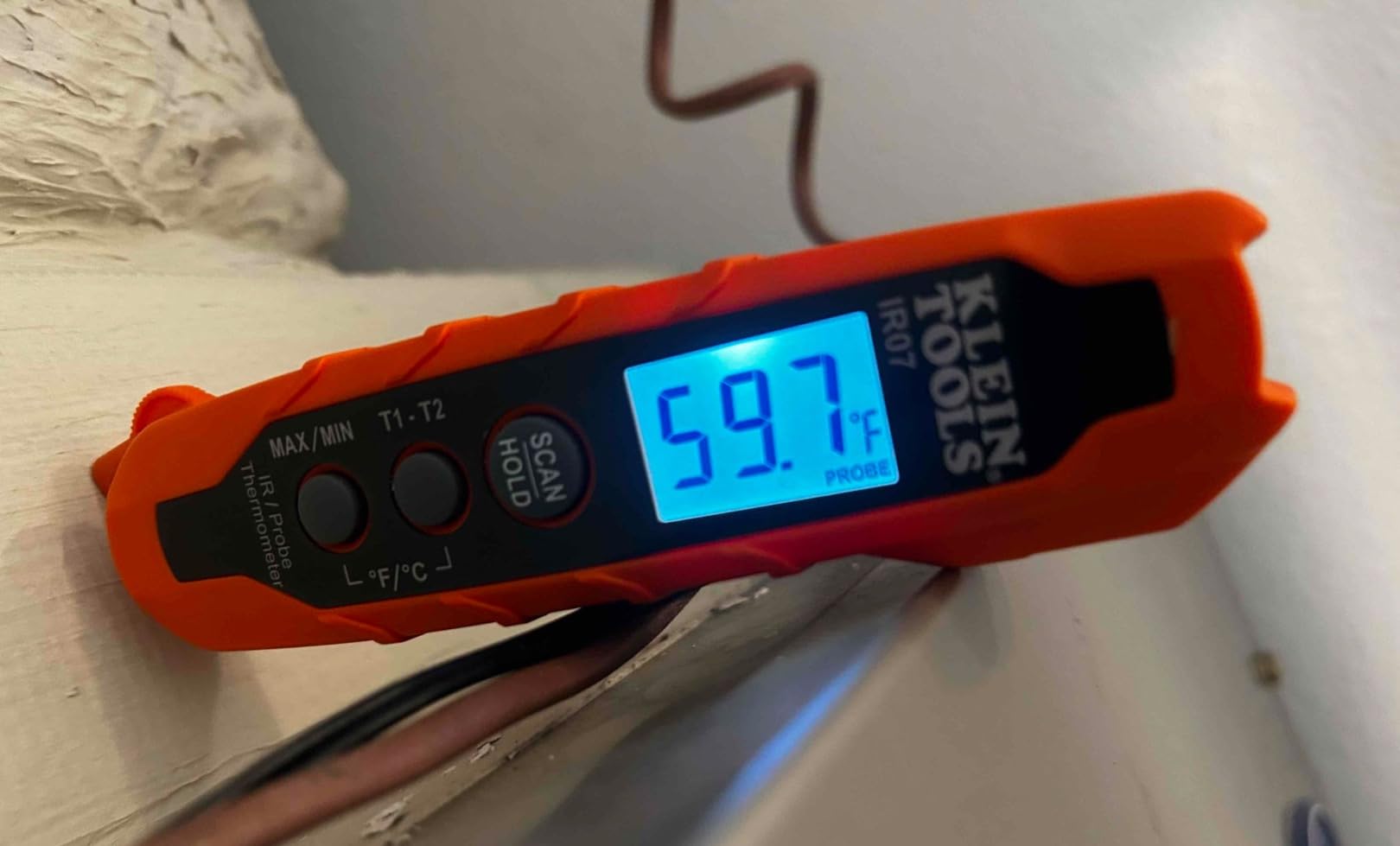
Most IR guns in this roundup measure surface and nothing else. The Klein IR07 measures surface and something else, which is why it earns a place even though its optics are the weakest in the group. It pairs an infrared sensor with a fold-out temperature probe, and the probe has a hanging hook so you can clip it into a return vent or duct opening and read the moving air without holding anything.
That is not a minor feature. A surface reading of duct board tells you about the metal. A probe reading tells you about the air inside, which is the number a comfort complaint is actually about. HVACR technicians who carry this one tend to use both sides: IR to spot the problem area, probe to confirm the temperature of the air coming out of it.
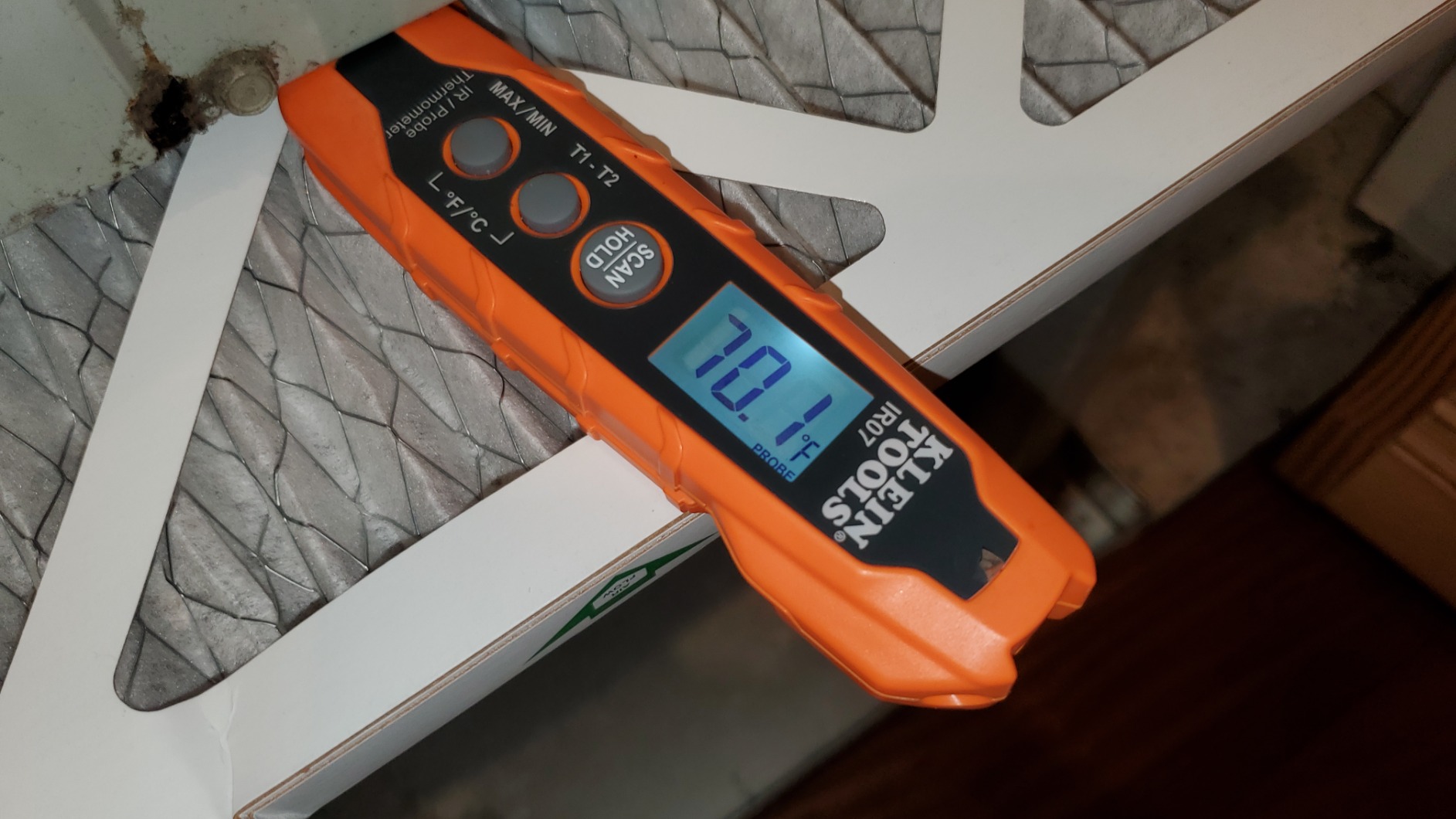
The response time of 500 milliseconds is fast enough to catch a change as you move the probe from supply to return, and the T1 minus T2 differential calculation does the subtraction for you. Temperature range runs from -40F to 752F, which covers supply air, return air, domestic hot water lines and most hydronic work. Optical resolution is 8:1, so you need to be fairly close to a distant target.
Specs-wise it is a compact 6.5 inches and 1.44 ounces, packed with a custom pouch and two AAA batteries, and carries a 1 year manufacturer warranty. That combination of AAAs and a pouch is the sort of practical detail that matters on a job, because you can keep one in the truck and one in the service bag.
When the IR07 beats a pure IR gun
Use it whenever the question is about air rather than metal. Register airflow complaints, frozen coil diagnosis where return air temperature tells you about coil heat transfer, and water temperature checks on a tank or hydronic loop all benefit from having a probe in the same body as the IR sensor.
The hanging hook is the quiet hero. Clip the probe into a return vent, walk to the thermostat, and come back to a reading you did not have to hold steady. For a quick airflow sanity check, nothing else in this list is as convenient.
When the IR07 gets in the way
The display is fixed in one orientation, so if you hold the tool in your other hand you will be reading it upside down, and there is no rotation setting to fix that. Reviewers also find the button sequence for switching between min, max and T1 minus T2 modes fiddly enough that some users never use those modes at all.
And the 8:1 ratio is the narrowest here. It is a tool for close work, not for scanning a boiler room from the doorway.
3. Klein Tools IR5 Dual Laser 12:1 Infrared Thermometer – Best for Dual Laser Targeting
Klein Tools IR5 Infrared Thermometer with Dual Targeting Laser, 12:1
Dual laser 12:1 spot
Range: -22F to 752F
Adjustable emissivity 0.1-1.0
2 m drop protection
Pros
- Dual lasers frame the measurement spot
- Adjustable emissivity for painted and foil duct
- Solid heavy-feeling US-made build
- Max min average difference plus high and low alarm
- Protective pouch included
Cons
- Lasers spread wider than the 1 inch spot at 12 inches
- Readings jump if one laser lands on a nearby object
- Short emissivity table in the manual
- No on and off switch and a short 15 second auto off
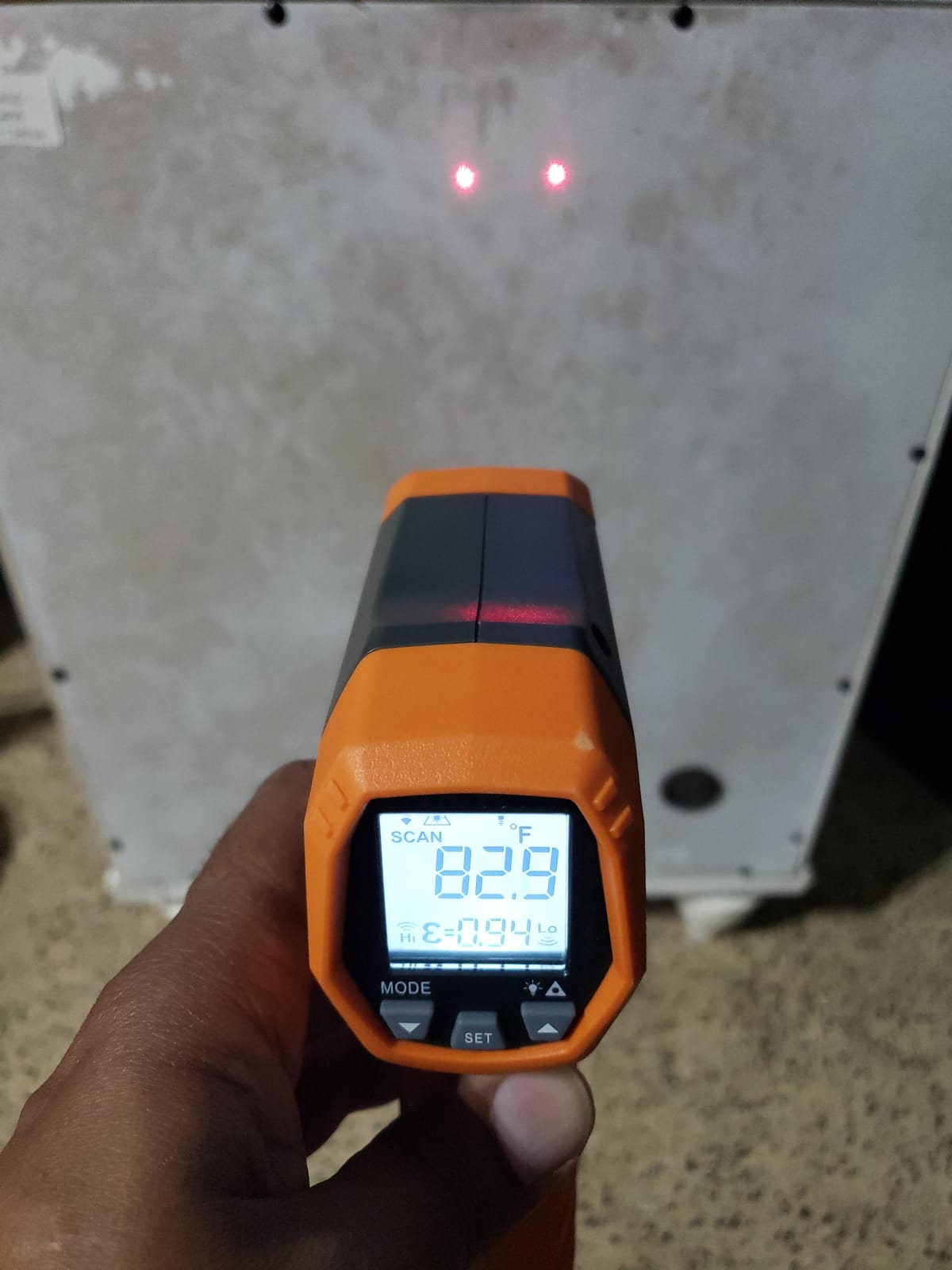
Two lasers instead of one is the entire idea behind the Klein IR5, and it matters more in HVAC than in almost any other application. A single-dot laser tells you where the gun is pointing but not where the sensor is actually looking. The IR5 puts two dots on either side of the real measurement spot, so you can see the edges of the cone and size your distance to fit a small target. On a 4 inch supply register that is the difference between a confident reading and a guess.
Optical resolution is 12:1, a little better than the Fluke 62 Max, and the temperature range runs -22F to 752F. Emissivity is adjustable across 0.1 to 1.0, which matters enormously on painted duct, foil-faced flex duct and any reflective metal. High and low alarms join max, min, average and difference modes, so you can set a threshold and sweep an attic plenum to find the one anomalous run.
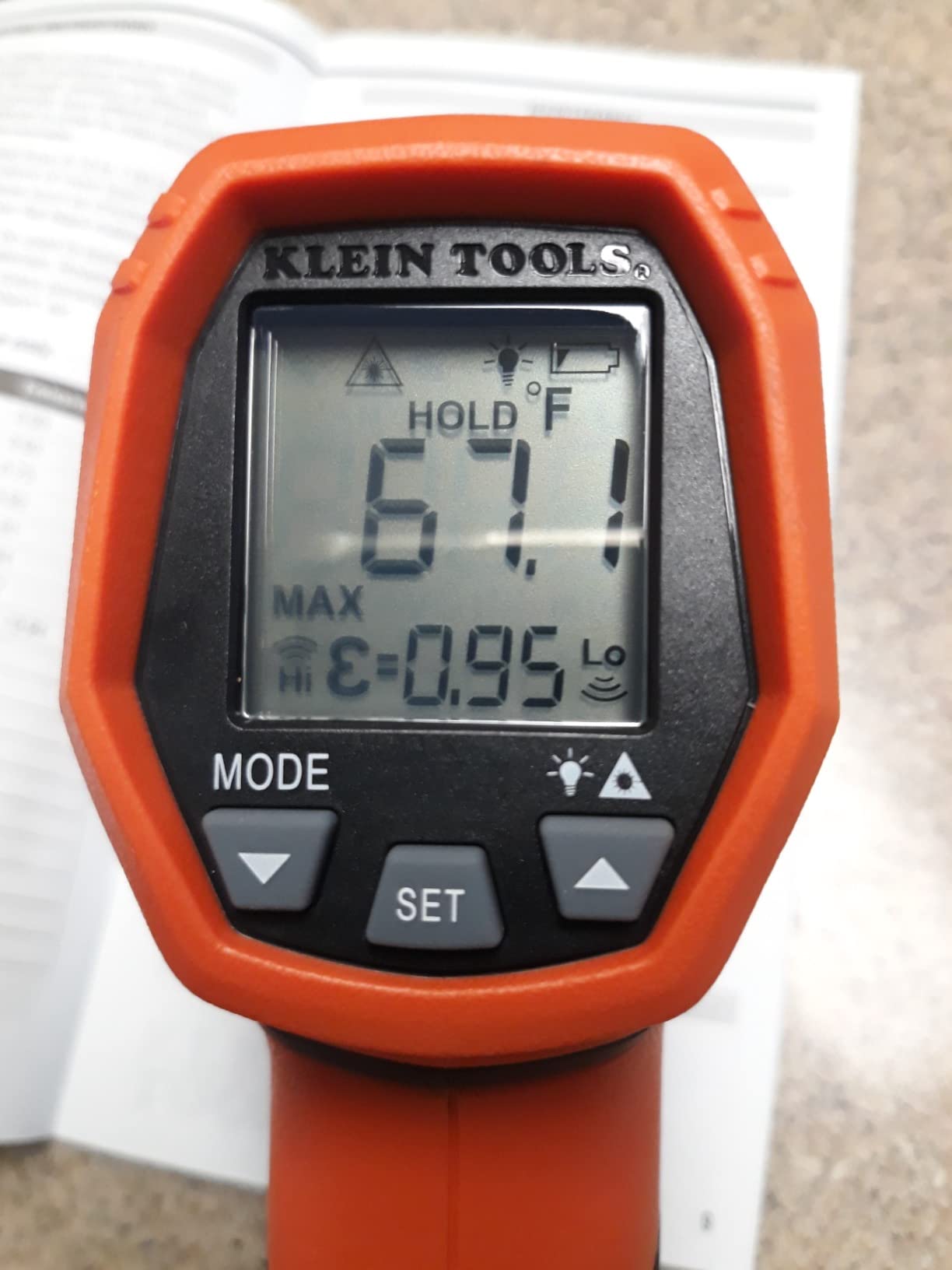
It is built like a tool rather than a gadget. It carries 2 meter drop protection, weighs about 0.3 kg, and comes with a protective pistol-grip pouch and batteries. Technicians who want a second gun alongside a Fluke frequently end up here, and reviewers regularly describe it as good value next to the Fluke 62 once the three-button panel is learned.
Those reviewers also flag the honest weaknesses. The two laser dots spread further apart than the 1 inch sensing spot at 12 inches, so if one dot lands on a nearby surface the reading jumps. There is no manual on and off switch and the auto shutoff is aggressive at roughly 15 seconds, which has eaten batteries for people who set the gun down to write notes. And in one head-to-head comparison it read a few degrees off against a Fluke 62 and responded more slowly.
Why dual laser framing helps on real calls
Most IR mistakes are aiming errors, not sensor errors. When the cone is smaller than a supply register, the reading is trustworthy. When the cone is wider than a suction line, the number is mostly background. The IR5 makes that visible, which reduces the number of readings you have to throw away.
For a duct hot spot sweep, the two dots let you scan a run of flex duct with a consistent standoff distance and get comparable numbers along the whole run. Consistency is what you actually need in a comparative diagnostic.
Where it falls short
The learning curve is real. The three-button panel takes an afternoon, and the manual’s emissivity table is short enough that you will end up looking up fuller values yourself. The aggressive auto off also means you cannot set the gun down mid-task and trust it will still be on when you come back.
If your work is dominated by large flat surfaces, a simpler single-laser unit will serve you just as well and waste less battery.
4. Fluke 59 Max+ Infrared Thermometer – Best for Plant Room and Boiler Spot Checks
Fluke 59 Max+ Infrared Thermometer, Yellow, 59 max Plus, 10:1 DTS Ratio, FLUKE-59 MAX+ NA
Range: -22F to 932F
10:1 distance-to-spot
Single AA battery
IP40 rated
Pros
- Point and shoot simplicity with defaults that suit most materials
- Single AA runs about 12 hours
- Large backlit LCD for dark plant rooms
- Factory calibrated to NIST traceability
- Reliable on boilers radiators vents and compressors
Cons
- Battery door needs a screwdriver to open
- No emissivity presets on the device despite what the manual claims
- Display shows whole degrees only
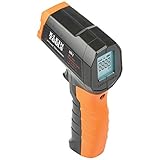
- Only IP40 for airborne contaminants
The Fluke 59 Max+ is the gun you hand to someone learning the trade. It does the same job as the 62 Max at the core accuracy level, reaches the same 932F ceiling, and asks less of the operator. The 10:1 distance-to-spot ratio matches the 62 Max, the display is large and backlit, and the whole thing runs about 12 hours on a single AA battery.
For boilers, radiators, AC vents, compressors and fridge checks, that combination is enough. Energy auditors frequently buy these in pairs because they are simple enough to hand to an assistant and consistent enough to compare readings against each other. Factory calibration to NIST traceability is the detail that matters if you ever need to defend a number to a customer.
This unit has one clear advantage for plant room work and one clear problem. The advantage is the 932F upper range, which gives you real headroom on a flue or a boiler casing. The problem is the battery door, which needs a screwdriver, so on a busy call the cell often comes out between jobs anyway. That adds a step most people will not enjoy.
Reviewers also note that the manual references a built-in emissivity table that is not actually present on the device, so keep the printed table nearby. The display shows whole degrees with no decimal point, which makes it harder to see a 1 degree difference between two similar components. It is rated IP40, which protects against airborne contaminants but not splashing liquid, so keep it out of wet crawlspaces.
Why technicians keep a second 59 Max+ in the bag
Because it is the cheapest way to have a second set of eyes on a temperature. If the main gun gives you a surprising number, a second independent instrument agreeing or disagreeing tells you whether to chase the system or chase the instrument.
It is also the right pick for anyone who does not want to learn emissivity tables. The default settings handle painted duct and most painted metal correctly, which is the majority of what a residential service call touches.
Where it falls short
Whole-degree resolution and a screwdriver-secured battery door are both small things that add up across a full day. And without an adjustable emissivity setting you cannot rescue a reading on foil-faced duct or bare copper, so you will need a second tool for those surfaces anyway.
If your diagnostics lean heavily on reflective lines, spend the extra money on an adjustable-emissivity unit rather than doubling up on this one.
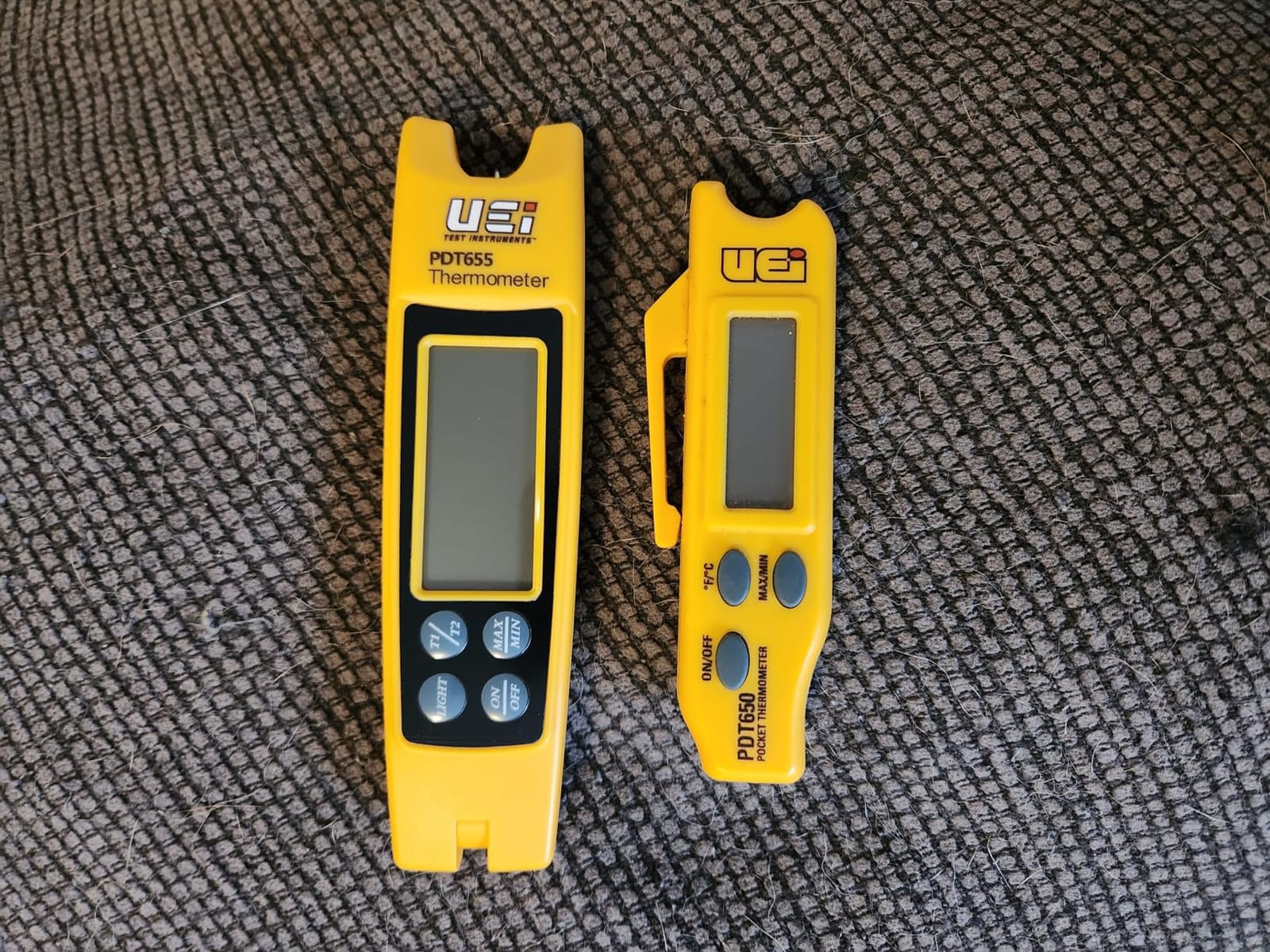
5. UEi PDT655 Differential Folding Pocket Thermometer – Best for Tight Plenum Access
UEi PDT655 Differential Temperature Folding Pocket Thermometer, HVAC Digital Thermometer with Backlit Display and Magnetic Mount, Measures -58 to 572°F
Folding 5 inch probe
T1 minus T2 differential
Magnetic mount
Range: -58F to 572F
Pros
- Smallest tool here for tight plenums and near-slab spaces
- Built-in magnet for hands-free duct and vent readings
- T1 minus T2 is exactly what a temperature rise check needs
- Backlit display with one-second refresh
- 3.2 ounces and pocketable
Cons
- Contact probe only with no infrared lens
- No way to log readings to anything
- Range caps at 572F so high-temp work is out
The UEi PDT655 is the odd one out in this list, and that is precisely why it is here. It is a contact thermometer with a folding probe, a built-in magnet and a differential function, and it weighs 3.2 ounces. There is no infrared lens at all, so it cannot scan for hot spots from across a room. What it can do is get into places a gun physically cannot reach.
Attic plenums, spaces above a dropped ceiling in a near-slab install, the inside of a small cabinet, the back of a unit wedged against a wall: these are exactly the places where a 6 inch gun is useless and a folding probe is the whole job. The 5 inch probe folds into a body that measures 6 by 1.5 by 0.75 inches, and the magnet lets you stick it to duct or vent metal and read it hands-free.
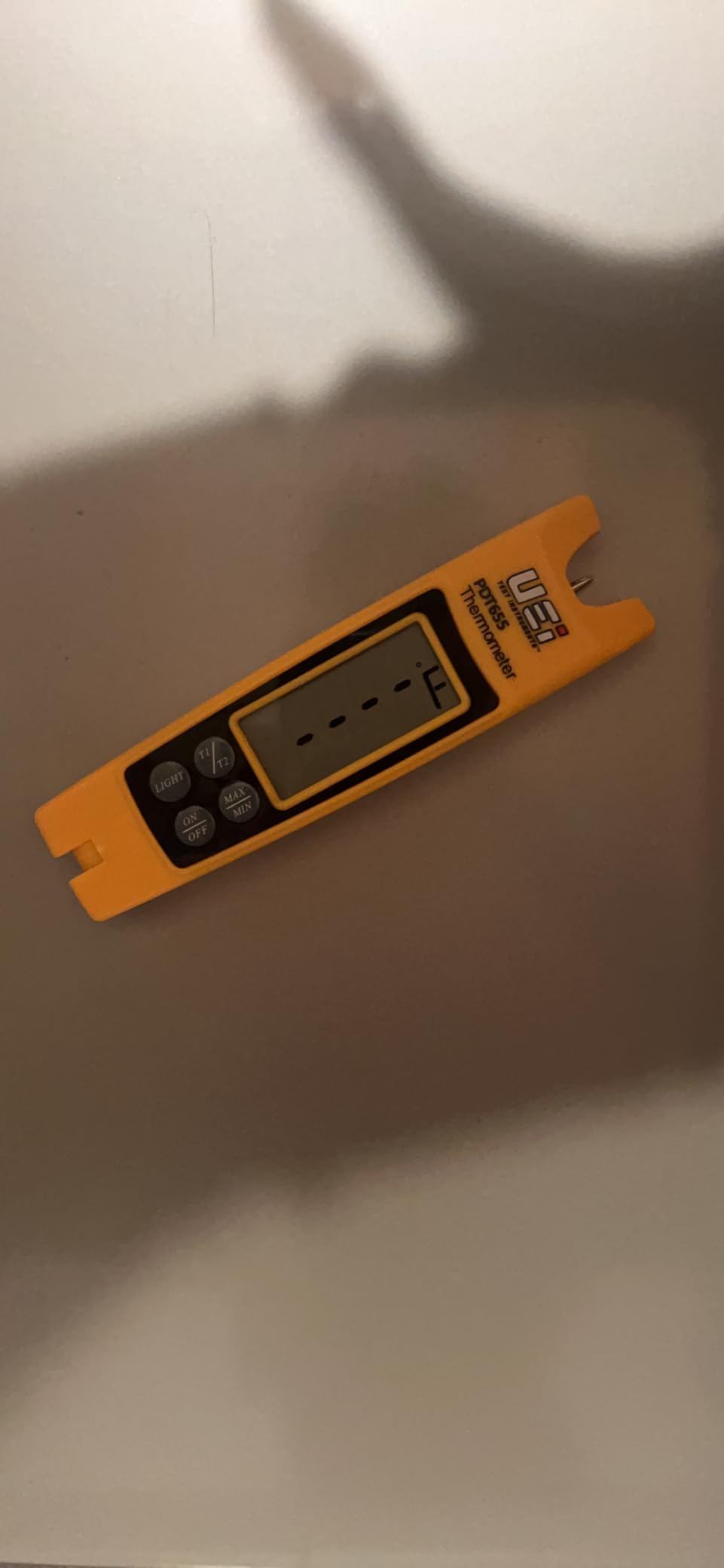
The T1 minus T2 differential calculation is the feature that makes this an HVAC tool rather than a general pocket thermometer. A supply-versus-return temperature rise check is literally a subtraction, and this instrument does it for you from stored readings. The probe refreshes every second, the display is backlit for dim mechanical rooms, and it offers min and max plus auto shutdown and a low battery warning. Range runs from -58F to 572F.
That range is the constraint to think about. 572F is plenty for air, water, and most hydronic return temperatures, and it is nowhere near enough for furnace discharge lines, flue work or high-temperature heat pump checks. If your service work is mostly air-side and comfort diagnostics, that ceiling is rarely a problem.
Why a contact-only tool still earns a slot
Because air-side diagnosis is only half of the picture, and the other half happens where you cannot point a laser. A frozen coil investigation often ends with a probe in a return plenum, and a suspected airflow problem in a tight space is a probe job.
It is also the natural companion to a point IR gun. The IR gun finds the area, the probe confirms the temperature, and the differential mode does the math. Carrying both is a genuinely complete kit for most service calls.
Where it falls short
No infrared lens means no scanning. If your whole routine is walking up to a duct run and sweeping it, this will feel like the wrong tool from the first minute.
There is also no connectivity, so readings live on the device and nothing else. If you need readings in a service report or a phone app, this is not the instrument that gives them to you.
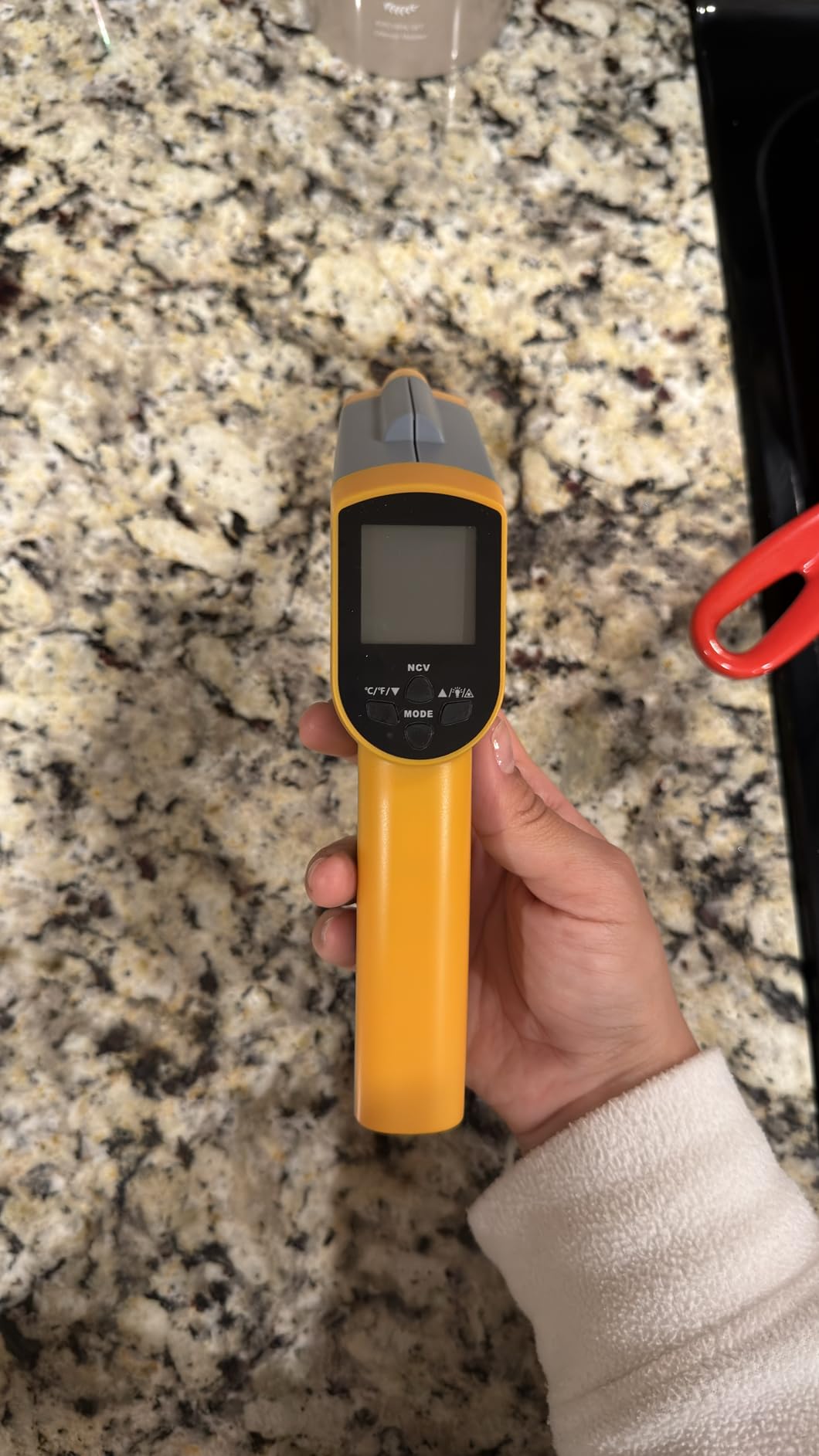
6. DEASOMIYE JD-04 50:1 High Temperature Infrared Thermometer – Best for Long-Range Scanning
-58°F to 2732°F Digital Infrared Thermometer Gun, 50:1 Distance Ratio Laser Temperature Gun with MAX/MIN/AVG Measure and Alarm, Heat IR Temp Gun for Cooking, Griddle, HVAC, Industrial Forging
Range: -58F to 2732F
50:1 distance-to-spot
Dual laser pointers
Max min average with alarms
Pros
- Widest range here so it doubles as a forge and kiln tool
- 50:1 ratio reads a hot header from far safer distances
- High and low alarms plus max min average
- Fast 0.5 second response with dual lasers
- Toolbox and 9V battery included
Cons
- Generic house brand with no calibration pedigree listed
- No adjustable emissivity so shiny metal and duct foil read wrong
- 9V battery rather than the more common AA
- No probe so readings are surface only
Two specifications set this gun apart from everything else in the roundup, and both of them are about reach. The distance-to-spot ratio is 50:1, meaning you can stand roughly 50 inches back for every inch of spot size, and the range ceiling is 2732F. Between them they let you check a boiler header, a furnace heat exchanger, a kiln or a forge from a distance where standing next to the equipment would be uncomfortable.
For long duct runs in a large commercial space, a 50:1 ratio changes how you work. You can sweep an entire overhead main from the floor with the trigger, and use max, min and average together with the high and low alarms to find a single anomalous segment without walking the whole ceiling. Response is 0.5 seconds, and the 6.3 inch body is smaller than the number suggests.
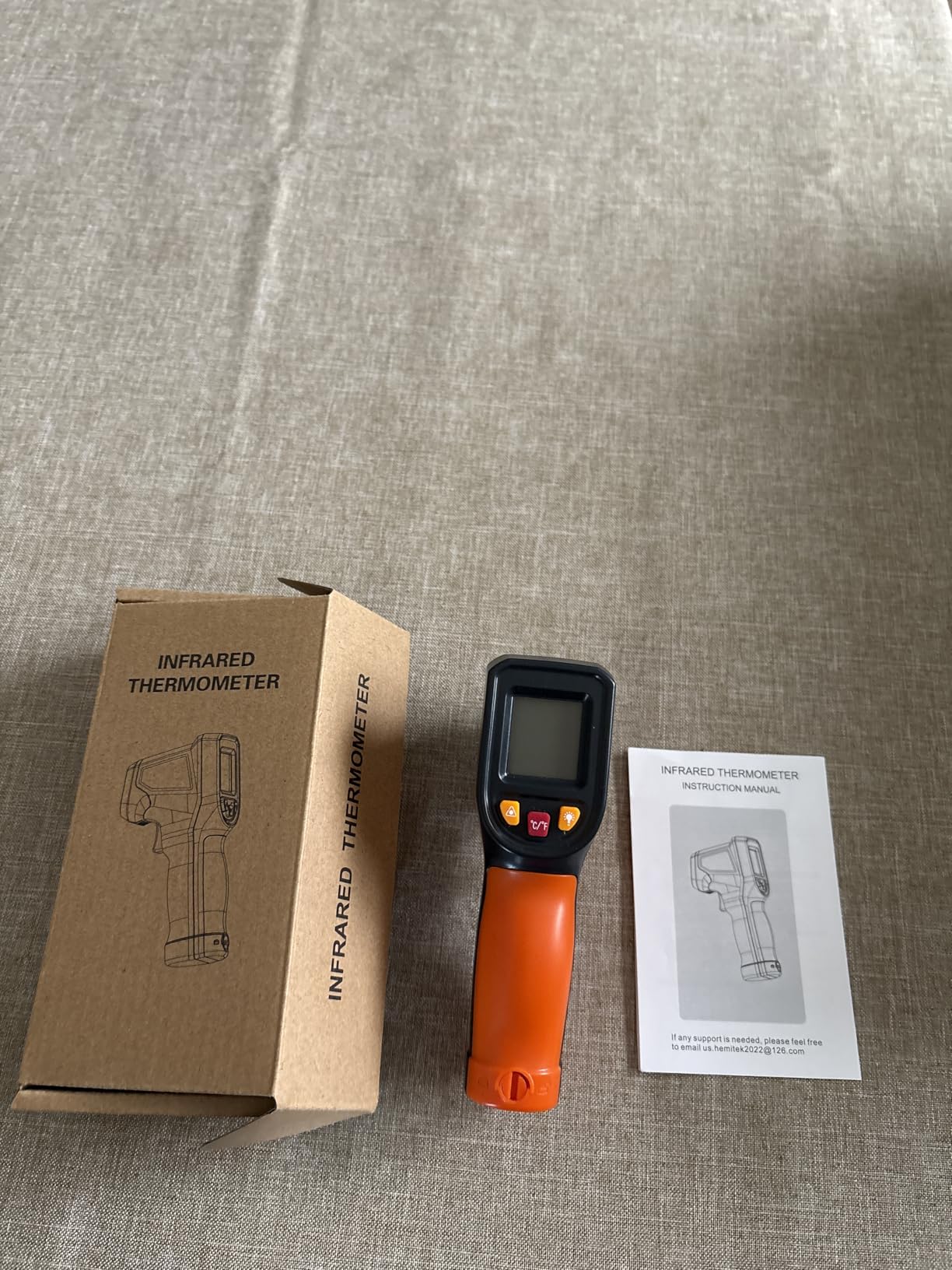
Then there is the part you should weigh carefully. This is a generic house brand with no published calibration pedigree, and emissivity is not listed as adjustable. That second point is not a minor specification for HVAC. Fixed or unverified emissivity means foil-faced flex duct, shiny sheet metal and bare copper will read wrong, and you will have no way to correct the number on the device.
Reviewers are honest about this split. They like the ratio and the range ceiling for griddles, ovens and hot equipment, and skeptics note that readings on reflective surfaces need care. The 9V battery format is another small inconvenience compared with the AAAs and AAs used by most of the field.
The box includes a durable toolbox, a 9V battery and a manual. Just know you are buying optics and range, not a known calibration chain.
Where the 50:1 ratio genuinely changes the job
Rooftop units, boiler rooms and industrial furnaces. When the surface you want to read is genuinely too hot to stand next to, or when the component is 30 feet away, a 10:1 gun forces you into an uncomfortable position and gives you a cone too wide to be useful.
It is also a good attic and crawlspace tool purely because of the standoff distance. You can scan from a safer position and keep the cone tight.
Where it falls short
Non-adjustable emissivity is the deal-breaker for duct diagnostics. The single most repeated complaint from technicians is that infrared readings on shiny surfaces are worthless unless you can tune them, and this unit will not let you.
And with no probe input, every reading is surface only. If you need a refrigerant line number you can defend, this is not the instrument.
7. Etekcity Lasergrip 1080 – Best Value for Adjustable Emissivity
Etekcity Infrared Thermometer Laser Temperature Gun, -58°F~1130°F
Range: -58F to 1130F
Adjustable emissivity 0.1-1.0
12:1 distance-to-spot
2 year warranty
Pros
- Bestselling gun in its category with 45k+ reviews
- Holds about 2 percent accuracy across metal glass plastic and walls
- Fast 0.5 second readings with a max hold
- Adjustable emissivity at this level is unusual
- Backlit display with F and C toggle and laser on off
Cons
- Cheaply molded with a short spongy trigger
- Blue backlight is dim in dark spaces
- Single aiming dot does not match the 12:1 sensing cone
- Surface readings only with no air or water measurement
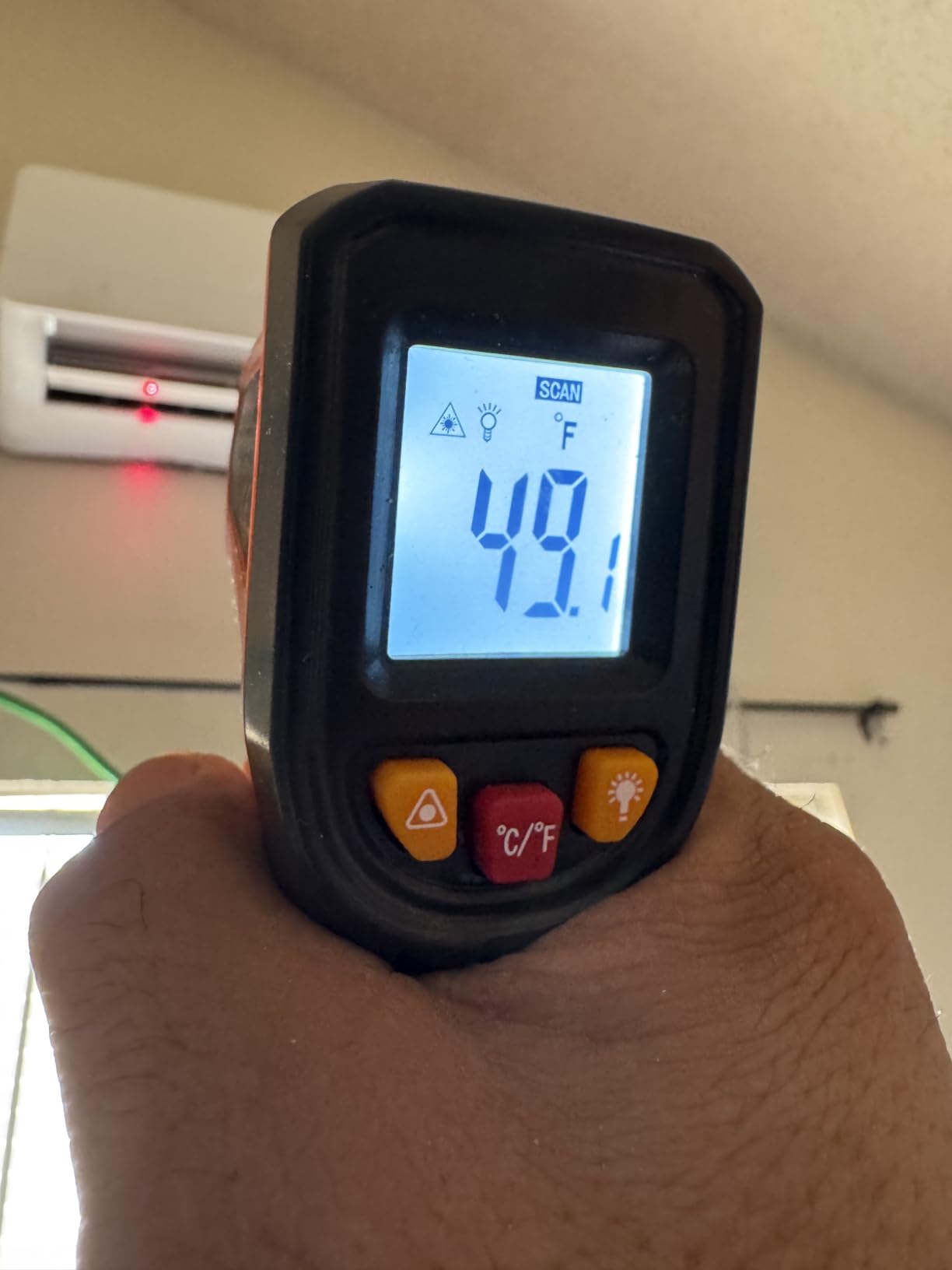
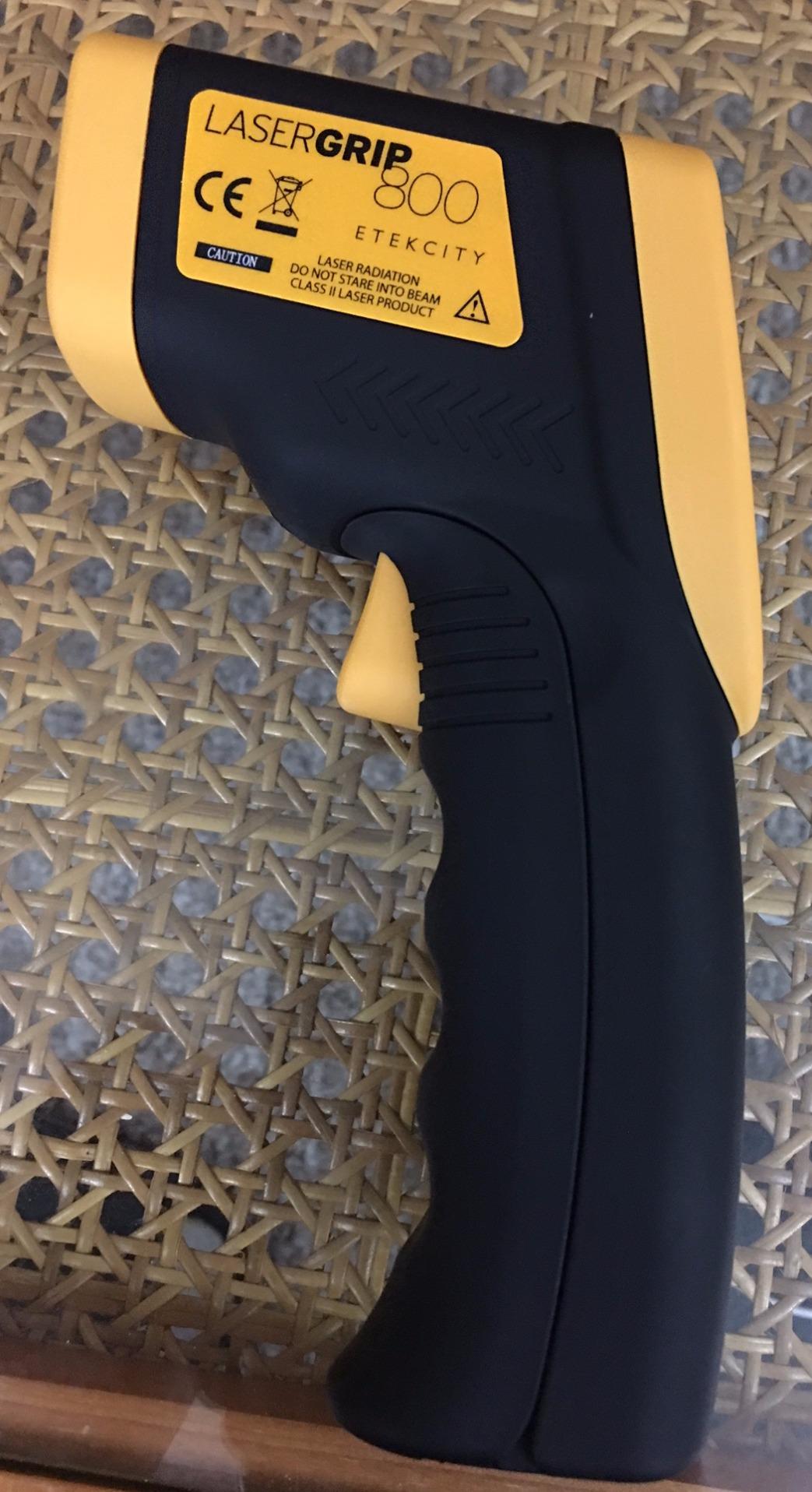
The Etekcity Lasergrip 1080 is the answer to the question of which infrared thermometer is the most reliable in the sense of ownership. With 45k+ reviews behind it, you will always be able to find out how a colleague configured theirs and what they measured with it. The specs are better than the price suggests: 12:1 distance-to-spot, a range from -58F to 1130F, 0.5 second response, and adjustable emissivity across 0.1 to 1.0.
That emissivity range is the headline. Most guns in this roundup either fix it at 0.95 or do not mention it. Being able to dial the setting for painted duct, and for metal when you are checking a compressor or an electrical panel, is what separates a tool you can use for diagnostics from one you can use for a quick sanity check. Add a max hold for scanning a surface for its hottest point, and this becomes a genuinely capable instrument.
It carries a 2 year warranty, includes two AAA batteries, and has a backlit QuickLCD with unit conversion, a 15 second auto off and a low battery indicator, all on the front panel. Reviewers confirm repeatable accuracy within roughly 2 percent against reference thermometers on metal, glass, water, plastic and walls, with decimal resolution that the Fluke 59 Max+ lacks.
On the other side, the construction is plainly budget. It feels cheaply molded with a short spongy trigger, the blue backlight is dim in dark spaces, and the single aiming dot does not tell you where the 12:1 cone actually falls. That last point matters on HVAC work, where a misjudged cone produces a reading that looks authoritative and is not.
Owning several is realistic, and technicians do exactly that: one in the truck, one at the bench, one in the shop. For our purposes it is the best value per unit of capability in the entire roundup, and the reason so many people keep recommending it.
Why the Lasergrip 1080 keeps winning recommendations
Because the combination of adjustable emissivity, a decimal readout and a 2 year warranty is rare in the budget tier, and the review volume means the small failure modes are already documented. Practitioners on r/HVAC repeatedly name Klein and Fluke as their usual answers, and this is the gun that fills the gap between a bare-bones single-laser unit and those two.
For comparative work, where you are checking whether one register is warmer than the others, it is more than adequate. For a documented diagnostic you will have to defend in writing, buy something with a known calibration pedigree.
Where it falls short
The dim backlight is a real problem in a dark mechanical room, where the Fluke 62 Max and the Klein IR5 are both noticeably easier to read. The single laser dot versus cone mismatch will cause you misreads if you are not careful.
And it measures surfaces only. It will not tell you the temperature of the air coming out of a vent, so it cannot replace a probe for comfort complaints.
8. TempPro TempScan TP30 – Best Budget Pick with Adjustable Emissivity
TempPro TempScan Infrared Thermometer Gun for Pizza Oven Griddle HVAC
Range: -58F to 1022F
Adjustable emissivity 0.10-1.00
12:1 distance-to-spot
Plus or minus 1.5 percent accuracy
Pros
- Adjustable emissivity is unusual at this price
- Verified against reference thermometers on boiling and ice water
- 0.5 second readings with a continuous hold mode
- Backlit orange LCD reads well in garages
- Max mode handy for scanning a large surface
Cons
- Readings drift as measuring distance increases
- Max min average panel cannot be switched off
- Battery compartment is tight and needed a tool
- Lightweight plastic compared with Fluke and Klein
The TempPro TempScan TP30 exists because adjustable emissivity is the feature that decides whether an infrared thermometer is useful for HVAC, and almost nobody bothers to include it at the entry level. This one does, across 0.10 to 1.00, and it pairs that with a stated thermopile accuracy of plus or minus 1.5 percent over a -58F to 1022F range. If you need a second gun in a van and you want it to be usable on metal, this is the one to buy twice.
Reviewers verify readings against reference thermometers on boiling and ice water, which is a reasonable independent check for a surface instrument. Response is under 500 milliseconds, resolution is 0.1 degrees F, and the 12:1 distance-to-spot matches the Etekcity and Klein IR5. Continuous mode when you hold the trigger plus max, min and average of the last scan is a useful combination for sweeping a surface.
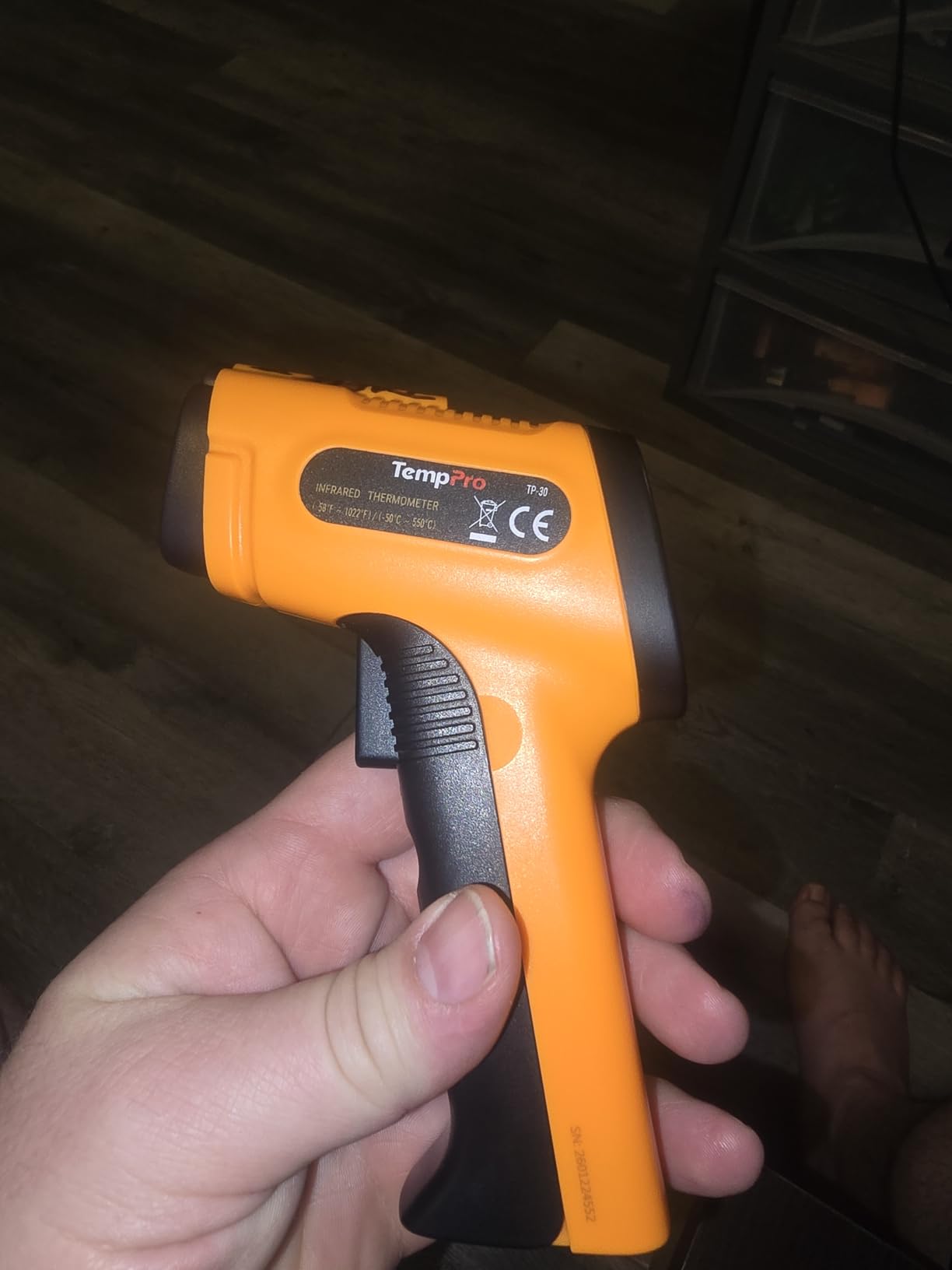
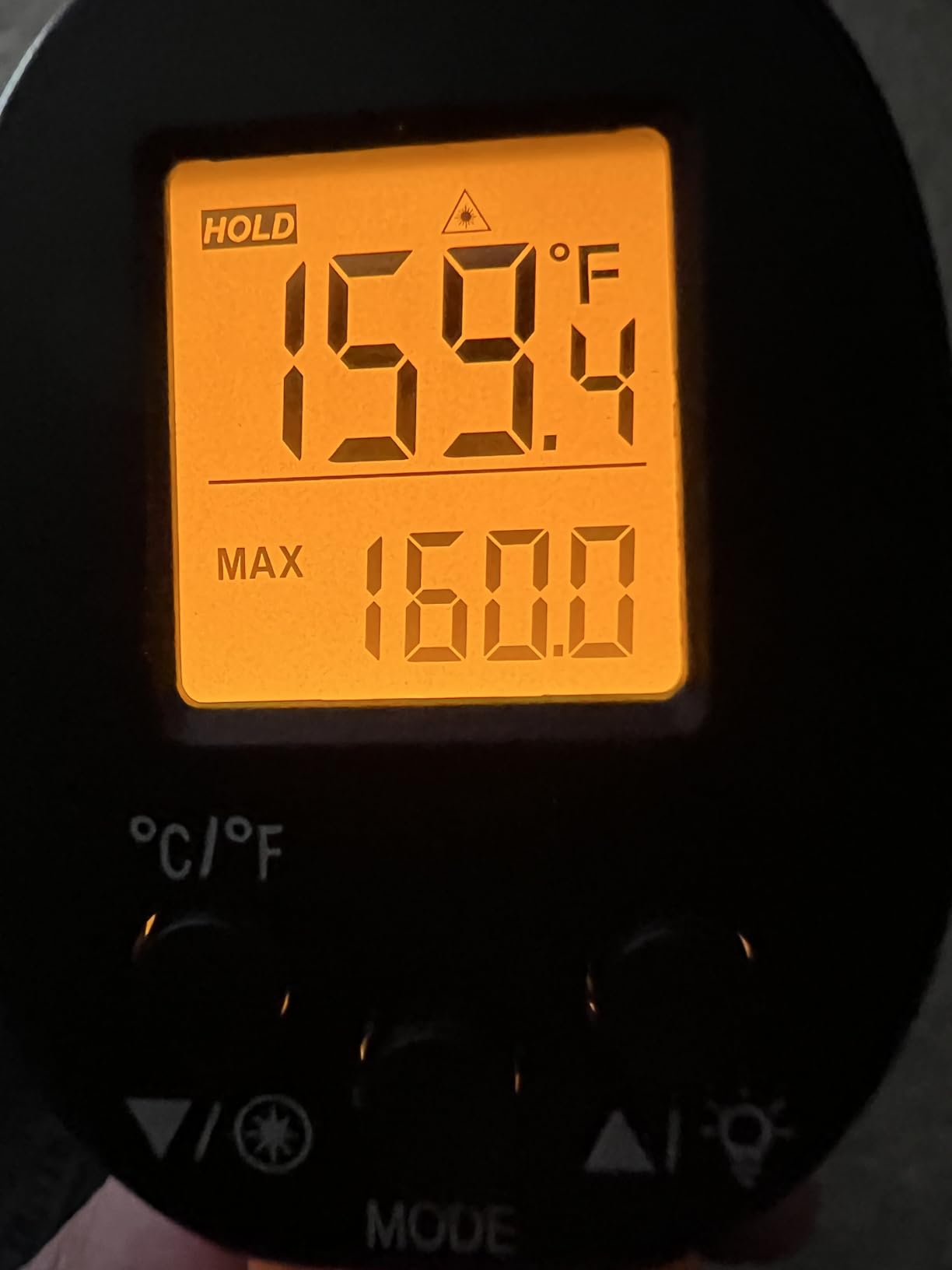
The backlit orange LCD is a small, smart choice. It is easy to read in a garage or a dark crawlspace, and the 90 second auto shutoff is far less aggressive than the 15 second timeout on the Klein IR5, so the gun stays on while you write down the number you just took. Battery life holds up under regular use with two AAA cells, and there are no complaints about drain.
The gripes are consistent. Readings drift if you do not hold a consistent distance, which is really the 12:1 ratio doing what 12:1 does. The max, min and average panel cannot be switched off, so you are always reading two sets of numbers. The battery compartment is very tight and reportedly needed a tool the first time. And the plastic body feels light next to the Fluke and Klein units.
Why this is the smart starter gun
Because it teaches the right habit. The first thing a technician needs to learn is that emissivity is a setting you choose, not a constant of nature, and a gun that exposes that control from day one builds the habit properly.
It is also small at 3.74 inches and light at 128 g, so it disappears in a pocket. For HVAC students, home inspectors doing a quick envelope check, or anyone who wants a gun per vehicle, that combination of capability and size is hard to argue with.
Where it falls short
It is not the gun for a precise diagnosis. A light plastic body, a fixed display panel you cannot turn off and distance-sensitive accuracy are all acceptable for comparative work and questionable for anything you have to defend.
And like every IR gun here, it measures surfaces only. Air temperature still requires a probe.
9. Temirup IR05B-RED 50:1 IR and K-Type Probe Thermometer – Best for Verification Readings on Hot Work
Infrared Thermometer Temperature Gun, -40℉-3632℉, Non Contact Digital Laser Thermometer Pyrometer 50:1 High Temp with Color LCD Display for Industrial HVAC Forge Metal Smelting
IR range -40F to 3632F
K-type probe to 932F
50:1 distance-to-spot
Color backlit display
Pros
- Combines a non-contact laser and a K-type probe to verify readings
- Highest ceiling in the roundup for furnaces and forging
- 50:1 ratio plus dual lasers capture hot spots from far back
- High low and difference alarms catch anomalies
- Color backlit screen with data storage
- AA batteries rather than 9V
Cons
- No-name brand with no published calibration certification
- Largest and heaviest body at 8 inches
- Emissivity settings and menus poorly documented
- Ships with no pouch or case
The single most useful thing about the Temirup IR05B-RD is that it answers its own question. It has a non-contact infrared channel and a K-type contact probe, and because the probe measures 14F to 932F, you can shoot a surface and then stick the probe onto the same spot to see whether you trust the number. Very few guns let you do that, and on diagnostic work it is worth a great deal.
On top of that it has the highest ceiling in the roundup at 3632F, a 50:1 distance-to-spot ratio with dual laser targeting, and 0.5 second readings with min, max, average and difference modes plus high, low and difference alarms. The difference alarm is a nice touch for anomaly detection, essentially telling you when a scanned surface deviates from the pattern you have been reading. The colorful backlit large screen includes data storage, which matters if you want to keep a log.
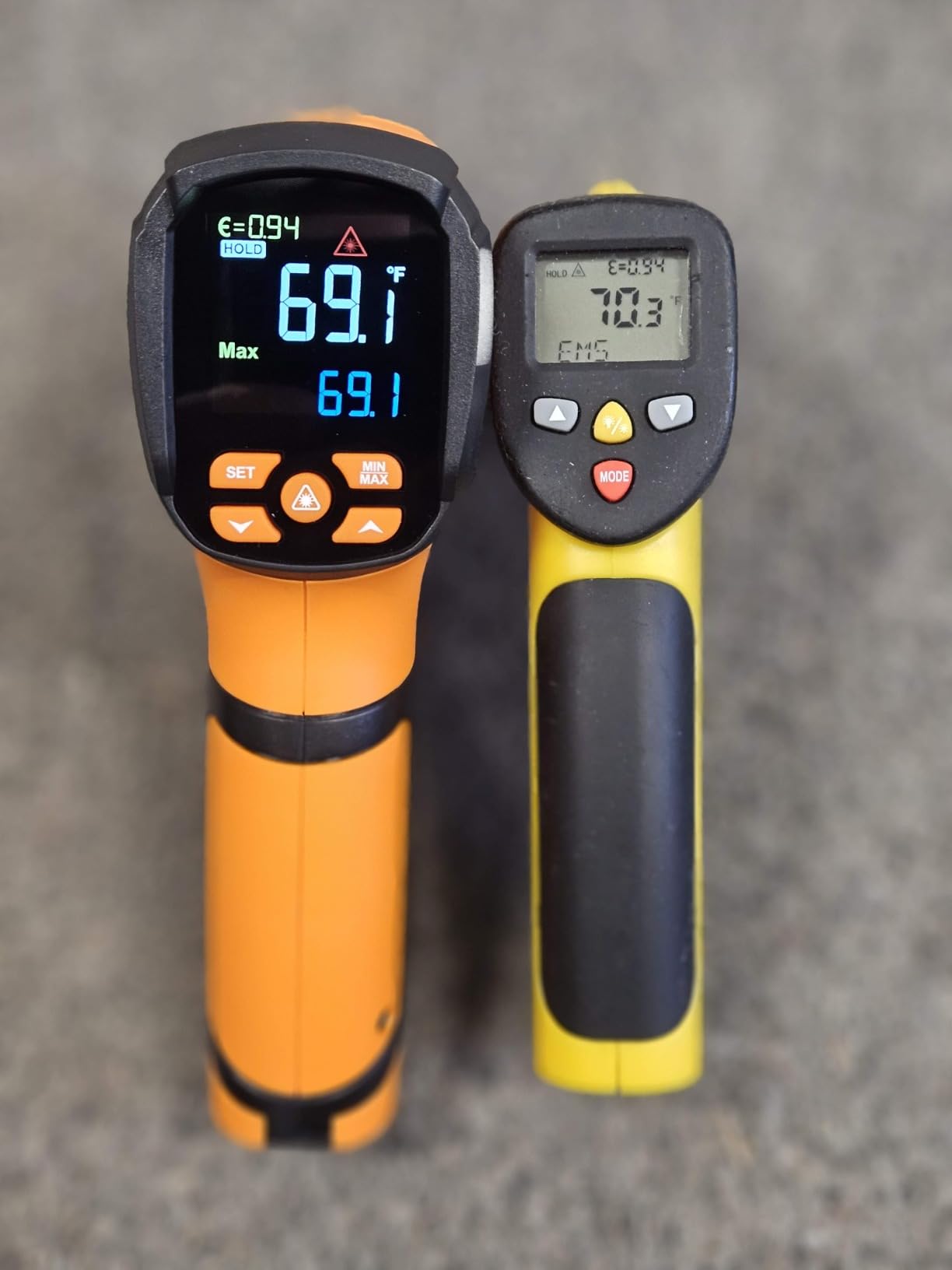
It runs on two AA batteries rather than a 9V, which is the kind of detail that shows somebody thought about field use. The stated accuracy is about 2 percent for the infrared channel and about 1.5 percent for the K-type probe range, with 0.1 degree F resolution.
Against that, the reservations are real. It is a no-name brand with no published calibration certification, and if you are documenting results for a customer dispute or a compliance check, that is a real limitation. The 8 inch body is the largest here and less pocketable as a result. Emissivity settings and menu navigation are poorly documented, which is a recurring source of confusion, and it ships without a pouch or case.
Reviewers like the probe-plus-laser combination as a way to confirm a suspect reading, and value the ceiling for forge and industrial work. The complaints center on brand credibility, documentation and bulk.
Why the K-type probe matters on hot work
Because a surface reading on a glowing hot component is exactly the situation where emissivity is hardest to reason about. When you can put a probe on the same metal and read both, you stop arguing with theory and start measuring. The same applies to bare refrigerant lines with insulation stripped back.
For a technician working boilers, forges, kilns or high-temperature heat pumps, having both channels in one body removes the need to carry a second instrument, and the data storage keeps a record for the service file.
Where it falls short
No published calibration pedigree. If your work involves certifying a temperature, pick a brand with a traceable calibration chain instead.
The 8 inch housing is bulky for a van tool, the menus are not well explained, and there is no carrying case, so you will want to solve that problem yourself.
10. Klein Tools IR1 Infrared Thermometer – Best for No-Setup Spot Checks
Klein Tools IR1 Infrared Thermometer with Targeting Laser, Auto-Hold, More
Range: -4F to 752F
Fixed 0.95 emissivity
10:1 distance-to-spot
Auto-hold and 2 m drop rating
Pros
- Fixed 0.95 emissivity means no setup and repeatable readings
- Auto-hold keeps the reading on screen at high vents
- Fast 0.5 second response and quick startup
- Covers supply air return air and attic plenum ranges
- Solid plastic housing with a storage pouch
- 2 m drop protection
Cons
- Fixed emissivity cannot be tuned so metal and foil read off
- Awkward multi-press C and F toggle
- Laser is fiddly to aim at very small targets
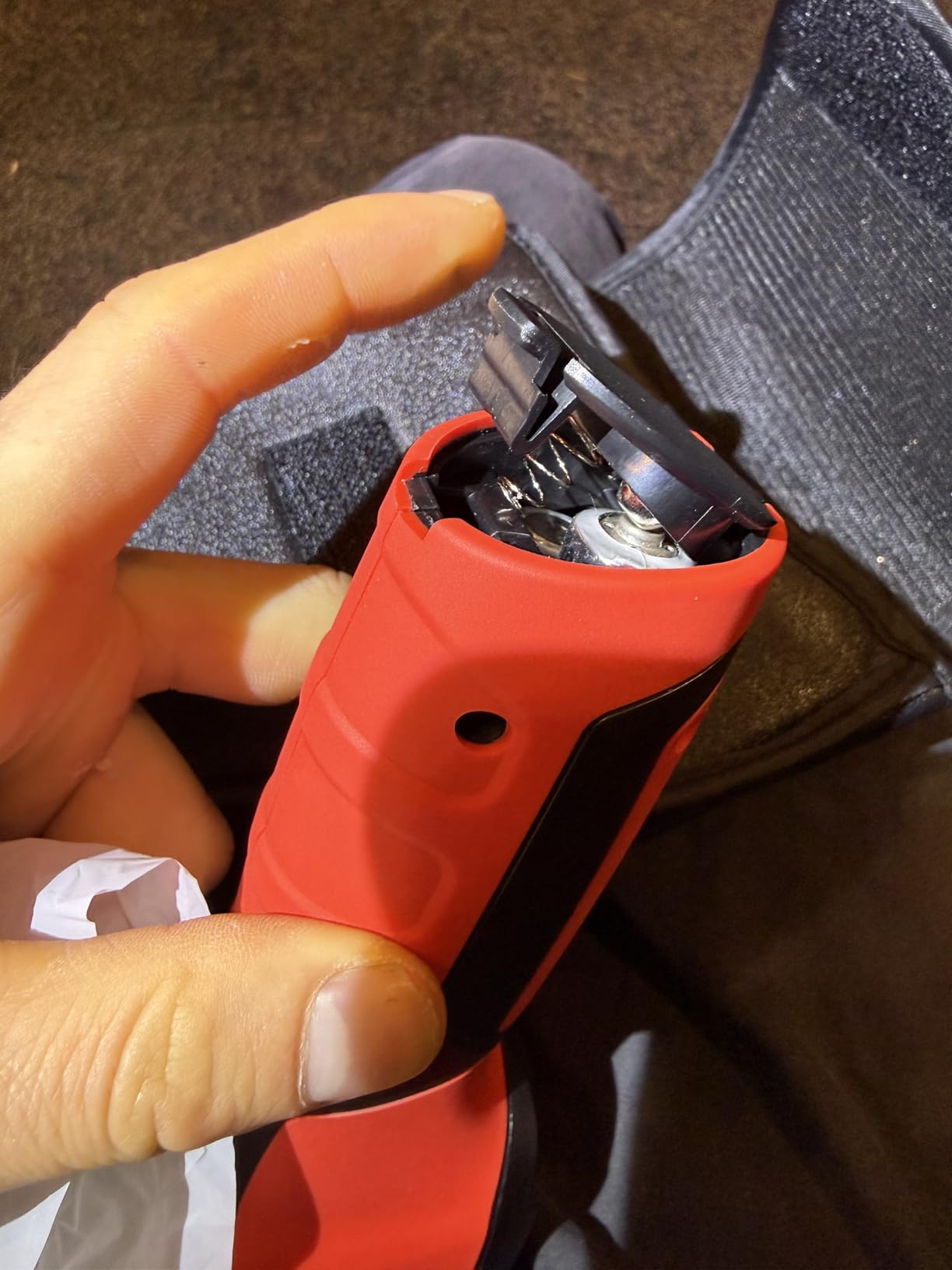
- Uses a 9V battery despite the spec block showing AA
- Readings drift a few degrees versus higher-end meters
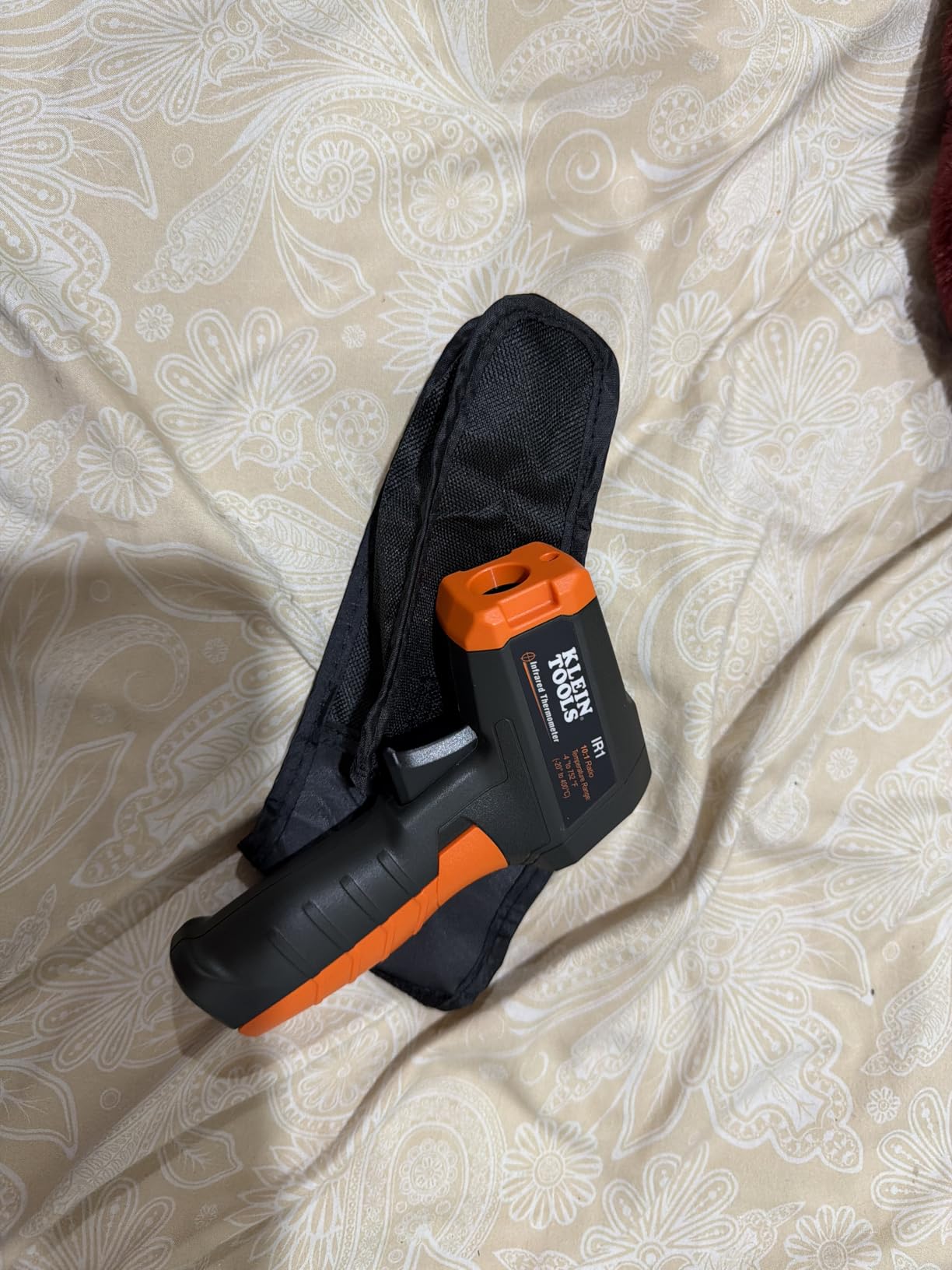
The Klein IR1 is the gun to hand to someone who will not read a manual. Emissivity is fixed at 0.95, which is correct for the painted and matte surfaces that make up most residential HVAC equipment, so the tool produces repeatable numbers with zero setup. It turns on within a second of the trigger, responds in 0.5 seconds, and holds the last reading on screen so you do not have to stand under a ceiling vent watching it.
That auto-hold is more valuable than it sounds. Most of what a homeowner or a property manager wants to know is whether a vent is delivering air at a reasonable temperature, and that check happens in a hallway with a ladder against the wall. Range is -4F to 752F, which covers supply air, return air, attic and attic plenum work, and 2 meter drop protection handles a service truck.
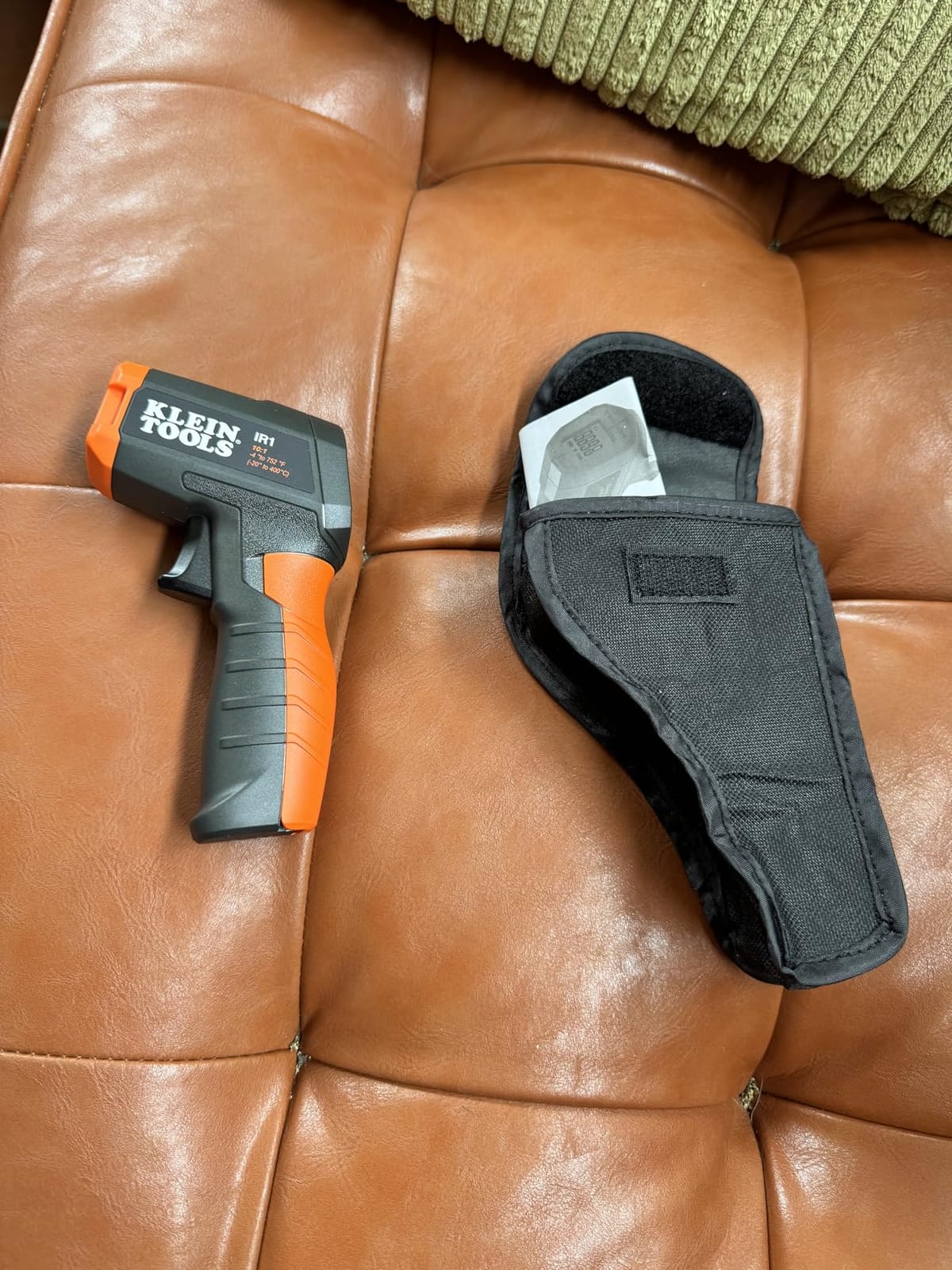
With 3592 reviews, the pattern of feedback is very consistent. Users like that it is ready to use immediately, fast, and packed in a pouch. Accuracy is described as reasonable rather than excellent, with readings drifting a few degrees against higher-end meters, which is fine for rough checks and not fine for a documented diagnosis.
The fixed emissivity is the central limitation and it is a hard one. Shiny metal, foil-faced duct and copper all read off, with no way to correct the reading on the device. The Celsius and Fahrenheit toggle is an awkward multi-press sequence, the laser is fiddly on very small targets, and the 9V battery contradicts the AA shown in the spec block, with at least one reviewer receiving a dead cell.
It is also worth being blunt about something the forums raise constantly. Cheap guns are not useless, they are simply not calibrated instruments. r/HVAC users report units that are accurate within a couple of degrees for discharge air temperature comparisons when used cautiously, which is enough for relative checks and not enough for absolute values. That is exactly the scope of this Klein IR1.
When the IR1 is the right answer
When the job is quick, comparative and repetitive. Checking a run of supply vents to find the one that is noticeably warmer than the rest, confirming that a duct run near a window is losing heat, or handing a maintenance person a tool they will actually use rather than avoid, are all strong cases for a fixed-emissivity gun.
It is also the natural second gun. Many technicians keep a simple one for drive-by checks and a capable one for real diagnostics, which is cheaper than carrying one expensive tool everywhere.
Where it falls short
On bare or shiny metal, and specifically on the carbon steel and copper surfaces that show up constantly in refrigeration work. r/HVAC users say it plainly: infrared thermometers are not accurate on bare carbon steel, and a fixed-emissivity unit cannot do anything about it.
So for refrigerant line temperatures, buy an adjustable-emissivity gun or a pipe clamp. This one is for the air side.
How to Use These Tools on Real HVAC Faults
An infrared thermometer is fast because it does one thing. The technicians who use it well know exactly which measurements are trustworthy and which ones are only comparative, and they pick the right instrument before they pick up the gun.
For a supply and return air temperature split, aim at the air stream leaving a supply register and at the return grille rather than at the duct metal. The surface of a duct will read warmer than the air inside it, so a duct reading is not a split. Take several readings at each, hold the same distance, and let the value settle before you record it. A large delta between supply and return on a cooling call usually points at airflow or charge, and a small one on a heating call points at a blocked or short-cycling system. Compare the numbers against the manufacturer’s expected range for the equipment rather than against a number you remember.
For a duct hot spot, walk the run slowly with the trigger held and use max or average mode. A single isolated hot patch on a long flex run usually means damaged insulation or a crushed section. A hot patch that repeats at regular intervals usually means a support strap or hanger conducting heat, which is a different repair. Keep the standoff distance constant, because an inconsistent distance is the most common reason two readings of the same spot disagree.
For electrical panels, a temperature differential across a breaker or a bus bar tells you far more than any single number. Scan all phases and compare. Do not open a panel to do this, and do not rely on a gun with unverified emissivity to diagnose a bare bus bar, because polished copper reads badly wrong.
For refrigerant lines, be honest about the limits. A surface reading on the suction or liquid line is affected by the line diameter, the insulation, the ambient temperature and the emissivity of any coating. It is useful for spotting a starved evaporator or a failed filter drier by comparison, and it is not a substitute for a clamp-on thermocouple when the number has to be right.
HVAC Emissivity Settings by Surface
Emissivity is the single largest source of error in an infrared thermometer reading, and it is a property of the surface, not the instrument. Emissivity 1.0 is a perfect black body. Anything less reflects some of the infrared energy away from the sensor, and a gun set for the wrong value under-reads. Use the table below as a starting point, and remember that paint colour and surface age move these numbers.
White or light painted duct board sits around 0.90 to 0.95. Black or dark painted metal is similar, commonly 0.90 to 0.95. Bare copper tubing is much lower, around 0.02 to 0.05, and a gun that cannot be adjusted will read it very wrong. Galvanized sheet and aluminium are low too, commonly 0.10 to 0.30. Foil-faced flex duct is among the worst, often under 0.10. Black rubber pipe insulation and moulded plastic are high, roughly 0.90 to 0.95. Moulded rubber and ceramic surface coatings tend to sit in the 0.90 to 0.95 band as well.
The practical fix for anything low-emissivity is to put a patch of known high emissivity on the surface. A strip of matte black electrical tape, or a dab of matte black paint, makes the reading trustworthy in one step. Wait for the patch to reach thermal equilibrium with the metal underneath, which takes a few seconds, then read the patch rather than the surface. This single technique is worth more to your diagnostic accuracy than upgrading to a more expensive gun.
A warning sign that emissivity is wrong: the same surface reads a noticeably different temperature depending on the angle or distance you hold the gun. Reflective surfaces change what the sensor sees as you move, and a stable reading on a flat painted surface is what a correct setup looks like.
Buying Guide: What to Look For in an Infrared Thermometer for HVAC Troubleshooting
Adjustable emissivity is the first filter, and it is the one the forums hammer on hardest. A fixed setting means a fixed set of surfaces you can trust, and HVAC equipment is full of surfaces you cannot control. If your work touches foil-faced duct, bare copper or polished sheet metal at all, do not buy a fixed-emissivity gun as your only instrument.
Accuracy specification is the second. Look for something like plus or minus 1.5 percent of reading or plus or minus 1.5 degrees C, and understand what that means: the error grows with the reading. A 2 percent error on a 600 degree discharge line is 12 degrees, which is a wide band to be making decisions with. A stated accuracy of 1.5 percent is a common, workable field figure.
Distance-to-spot ratio tells you how close you have to stand. A 10:1 ratio gives a one inch spot at 10 inches, and 12:1 gives a one inch spot at 12 inches. A 50:1 ratio is what you want for boilers, forges, rooftop equipment and long overhead mains. Note that this number is about the cone, not the laser dot, and dual or circle lasers help you see the cone’s edges.
Laser configuration is a preference that becomes a habit. Single lasers are simple. Dual lasers frame the spot and reduce aiming errors on small registers. There is no accuracy difference, only a confidence difference.
Temperature range should cover your highest realistic surface. Most air-side work stays under 200F, but furnace discharge, flue, boiler and forge work pushes past 700F and sometimes well past 1000F. A -4F to 752F gun is an air-side gun. A gun reaching past 1100F covers combustion and high-temperature heat pumps.
Build and ingress protection matter in real service environments. Attics, crawlspaces and rooftops mean drops, dust and occasional water, so 2 meter drop protection and an IP54 rating are worth paying for. A backlit display readable in a dark mechanical room and in full sun is a comfort you will notice every day.
Battery format is a small decision with real consequences. AAA and AA cells are cheap and available anywhere, and 9V batteries are a nuisance in a van. An auto power-off that cuts out after 15 seconds is worse than one at 90 seconds, because you will constantly set the gun down mid-task.
On brands, the names that recur across professional forums are Fluke, Klein, Testo, Fieldpiece, UEi and Milwaukee. Practitioners on r/HVAC repeatedly name Klein as the best price-to-quality balance and treat Fluke as the professional standard, while r/BuildingAutomation users lean toward FLIR when accuracy and visualising a problem area matter more than a single number. Whichever brand you choose, check that it offers a K-type probe input or a contact companion, because the pairing is where real diagnostics happen.
One last piece of advice: buy the gun you will actually carry. A calibration-grade instrument in a bag at home helps nobody, and a decent adjustable-emissivity gun in your pocket changes how many calls you close on the first visit.
IR Gun vs Pipe Clamp vs Thermocouple Meter
The rule technicians operate by is simple. An IR gun is for relative comparison, and a clamp or thermocouple is for absolute temperature. Violating that rule is what turns a quick check into a misdiagnosed compressor.
An IR gun measures the skin of a surface through a coating, with an error stack of emissivity, spot size, distance, angle, sun contamination and surface condition. It is superb at answering is this register warmer than that one, and unreliable at answering what is the exact temperature of this suction line.
A pipe clamp thermometer or K-type thermocouple makes physical contact and, when it is properly seated and insulated, gives a number you can write into a service report. It is slower, it needs a stable mounting, and it cannot see across a room. BuiltWithTools, the one competitor on this SERP that treats the topic as HVAC rather than cooking, makes the same point: dual channel T1 and T2 simultaneous measurement is what lets you calculate a delta while the system is running.
Thermometers like the Klein IR07 and the UEi PDT655 sit in between. They carry contact capability alongside or instead of infrared, and the differential mode on each is designed for exactly this arithmetic. The Temirup pairs an IR channel with a K-type probe so you can verify one against the other at the same point.
Thermal imaging sits above all of these. It is a different category of tool, and it is the right answer to a different question.
When an IR Gun Is Not Enough
A point thermometer gives you one number at one spot. As soon as the question becomes where is the problem across a wall, a duct run, an attic or a ceiling, you need a thermal imaging camera that returns a full colour map of surface temperature differences.
That is the upgrade path for envelope work. Finding missing insulation, a leaky duct connection, a thermal bridging problem at a rim joist or a failing ceiling register is a pattern-recognition job, and r/BuildingAutomation users consistently describe moving from point thermometers to FLIR-style cameras for exactly that reason. r/Tools consensus runs the same direction: point guns are sufficient for spot checks, thermal imaging for anything involving accuracy and visualising a problem area.
The practical rule is to escalate when the fault is defined by its location rather than its temperature. A frozen coil is a temperature problem. A cooling room with one warm corner is a location problem. If you have to crawl through the attic taking a reading every two feet, a camera that can photograph the whole bay in one frame will pay for itself quickly.
Until you get there, an IR gun with dual lasers and a 50:1 ratio gets you closer than a cheap unit with a 10:1 ratio, because it reduces the number of positions you have to visit to find the anomaly.
Frequently Asked Questions
What is the best thermometer for HVAC technicians?
The Fluke 62 Max is the strongest all-round choice for HVAC service work, combining plus or minus 1.5 percent accuracy, adjustable emissivity, min max difference and average modes and an IP54 drop-rated body. For vent and duct air readings specifically, the Klein IR07 adds a contact probe with a hanging hook. For simple comparative spot checks, the Etekcity Lasergrip 1080 offers adjustable emissivity at a lower outlay.
Which infrared thermometer is the most reliable?
Reliability comes from a documented accuracy specification, adjustable emissivity and a known calibration pedigree rather than a brand name alone. The Fluke 59 Max+ is factory calibrated to NIST traceability, and the Fluke 62 Max and Klein IR5 both carry documented accuracy with adjustable emissivity. A further step is verifying your own unit in an ice bath before a job.
How to tell if an infrared thermometer is accurate?
Fill a cup with crushed ice and water, stir it, and aim the gun at the centre of the mixture. A correctly set gun reads about 32F or 0C. Set emissivity to 0.95 for ice, take several readings and average them. Repeat at a second reference such as warm tap water compared with a contact thermometer. Readings more than a few degrees off point to a dirty lens, a wrong emissivity setting or a failing sensor.
What is the most accurate thermometer for measuring HVAC temperatures?
For absolute surface temperatures on refrigerant lines and hydronic piping, a pipe clamp thermometer or K-type thermocouple is the accurate choice because it makes physical contact. An infrared thermometer is the accurate choice for surface scanning and for comparing supply and return air across many registers. Many technicians carry both and use a dual-channel meter to calculate the difference in real time.
How do I calibrate the Fluke 62 Max IR thermometer?
Treat calibration as a field verification rather than a factory procedure. Set the emissivity value to match the surface, place a strip of matte black tape on the metal and read the tape after it settles. Confirm the instrument in a stirred ice and water bath at about 32F, and compare a second reading against a contact thermometer. If the unit is out of tolerance, Fluke offers a three year warranty on this model.
Final Verdict
The best infrared thermometers for HVAC troubleshooting are not the ones with the longest specification list. They are the ones whose emissivity you can set, whose spot you can see, and whose readings you can repeat in the same spot tomorrow. Our 2026 roundup puts the Fluke 62 Max first for whole-system field work, the Etekcity Lasergrip 1080 first for value, and the Klein IR5 first for dual laser framing on small registers.
Add a contact tool to whatever you choose. The Klein IR07 or the UEi PDT655 covers the air and confined-space side, a pipe clamp covers absolute refrigerant line temperatures, and the black tape trick fixes any low-emissivity surface in seconds. Check the reviews, set the emissivity to match your ductwork, and take the reading twice.