
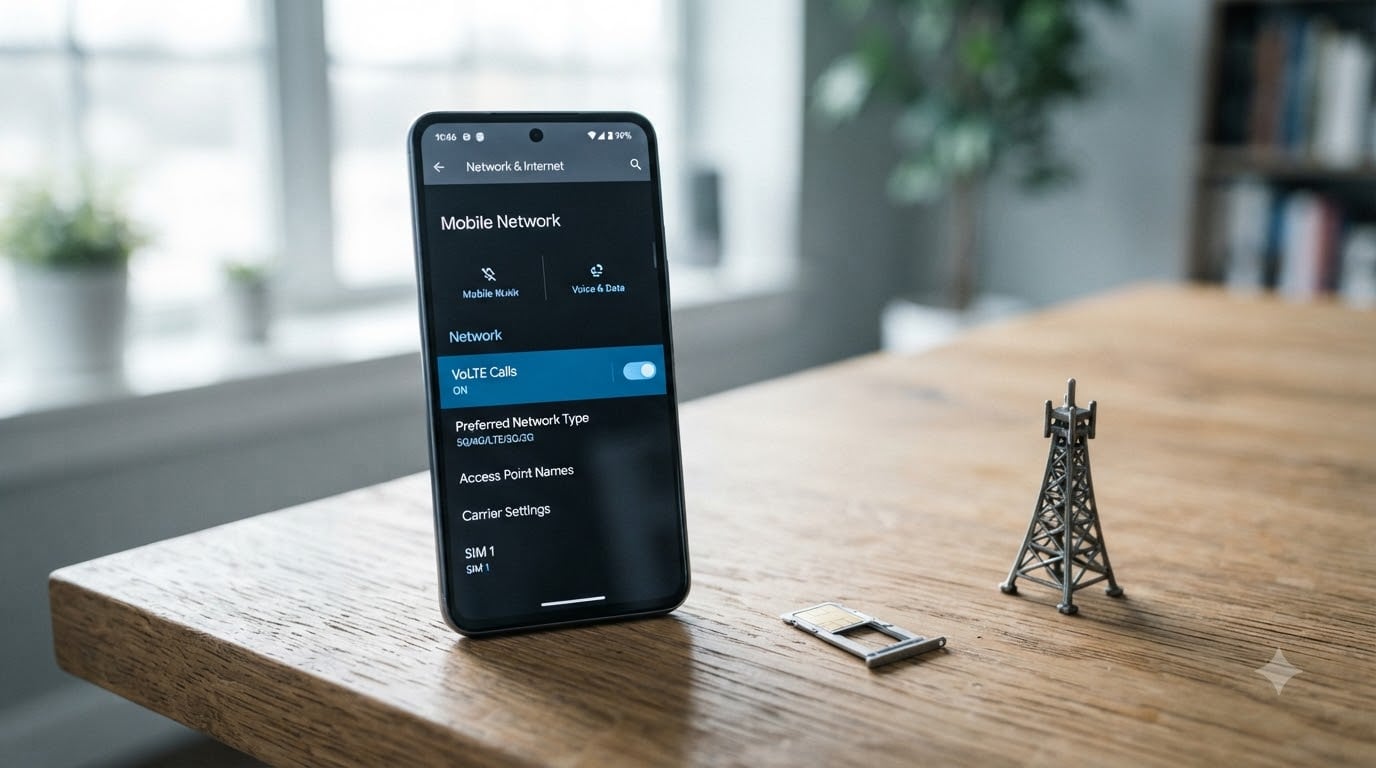
VoLTE (Voice over LTE) is a technology that lets your phone make voice calls over a 4G LTE data network instead of falling back to older 2G or 3G circuits. It’s the reason modern smartphones can keep your data connection alive during a call, deliver HD voice quality, and stay connected as carriers retire legacy networks.
But here’s the frustrating reality millions of users hit every year: a phone advertised as “VoLTE capable” still refuses to make or receive voice calls when you insert a SIM from a specific carrier. I have seen this personally across imported Xiaomi phones, factory-unlocked Samsung devices, and even some Pixel models that should technically “just work.” In 2026, the problem is getting worse rather than better, because carriers are actively shutting down 3G and the rules for who gets VoLTE access are scattered across handset makers, chip vendors, and carrier certification teams.
This guide breaks down exactly why VoLTE-capable phones still won’t work on certain carriers, who is responsible for each piece of the puzzle, and what you can actually do about it. By the end, you’ll know whether the issue is your phone, your carrier, or just an unfinished handshake between the two.
Table of Contents
What Is VoLTE and Why Does It Matter in 2026?
VoLTE is a voice-calling standard that runs on the same LTE (Long-Term Evolution) network your phone uses for mobile data. Instead of dropping down to a 3G or 2G voice channel when you place a call, the call stays on 4G and gets transmitted as small IP packets, similar to how a streaming song or a video call works.
Carriers care about VoLTE in 2026 because it lets them reuse their LTE spectrum for both data and voice. The old circuit-switched voice networks (2G and 3G) were expensive to maintain and used valuable spectrum that could otherwise deliver faster mobile data. As carriers retire 3G towers, VoLTE stops being a “nice-to-have” feature and becomes the only way to place a voice call at all.
How VoLTE works on the network side
When you dial a number on a VoLTE-enabled phone, your device contacts an IMS (IP Multimedia Subsystem) core on the carrier’s network. The IMS is what authenticates your device, sets up the call session, negotiates codecs, and routes the audio packets. Without IMS registration, the phone can usually still browse the web and send texts, but it cannot place a regular voice call.
What changed with the 3G sunset
Most major US carriers now require VoLTE for any device on their network. AT&T turned off most of its 3G in 2022. T-Mobile followed through 2023 and 2024, with a hard cutoff for non-VoLTE devices. Verizon finished its 3G sunset in 2023. Smaller carriers and MVNOs have been racing to follow suit. In 2026, if your phone cannot complete VoLTE registration, you may find yourself unable to make or receive voice calls even with full LTE signal bars.
How VoLTE Works on a 4G LTE Network?
From your phone’s perspective, making a VoLTE call looks like any other call. Behind the scenes, though, it’s a multi-step dance between the device, the LTE radio, and the carrier’s IMS core.
The IMS handshake
First, your phone attaches to the LTE cell tower using a normal LTE data session. The IMS client in the modem then sends a SIP (Session Initiation Protocol) REGISTER message to the carrier’s IMS server. If the carrier recognizes your device’s IMEI (unique identifier) and its provisioned profile, the server responds with a 200 OK. Only after that registration is complete is your phone allowed to set up a voice call over LTE.
Profile and policy bits
Carriers embed their network settings into a tiny “VoLTE profile” file, sometimes called an IMS configuration or a carrier policy blob. This file tells the modem which IMS servers to contact, what codec to use, which emergency call routing to prefer, and whether features like video calling or WiFi calling are allowed. Each carrier writes its own profile, and handset makers must integrate it into the device firmware for it to take effect.
Why Some VoLTE-Capable Phones Still Won’t Work on Certain Carriers
If a phone has a working IMS client and a modern LTE modem, why would it still refuse to connect? The short answer is that “VoLTE capable” only tells you what the hardware can do, not what it’s allowed to do. Getting voice on a specific carrier requires alignment between four groups, and any one of them can break the chain.
The four parties that must agree
Handset makers (Apple, Samsung, Xiaomi, Motorola, Google) decide which carriers and which features their devices ship with. SoC vendors (Qualcomm, MediaTek, Unisoc) decide which IMS stacks their modems ship with and which features they certify. Network platform vendors (Ericsson, Nokia, Huawei) provide the IMS equipment that carriers run. And the carrier itself decides which devices get added to its provisioning list. If even one party doesn’t include your device in their stack, the call won’t go through.
The Role of Handset Makers in VoLTE Compatibility
Handset makers are responsible for taking a working modem and turning it into a working phone on a specific carrier. That process is surprisingly manual and expensive. Each new carrier integration requires lab testing, field testing, and an official certification cycle.
Why brands skip some carriers
A small phone brand selling in 10 countries may choose to certify with the top three US carriers but skip regional MVNOs or prepaid brands. The cost of certification, including lab time, regulatory paperwork, and per-carrier feature regression testing, can run into the low six figures per device. When the manufacturer decides the carrier’s user base isn’t big enough to justify that cost, the device ships without that carrier’s IMS profile baked in.
This is one of the most common reasons imported phones fail. A Xiaomi phone bought from AliExpress may have full LTE band support and a working IMS client, but Xiaomi simply never added US carrier profiles. The phone sees the network, attaches for data, and then fails silently at the IMS registration step.
How SoC Vendors Affect VoLTE Support?
The chip inside your phone quietly controls more of this experience than most people realize. Qualcomm’s Snapdragon modems and MediaTek’s Helio/Dimensity modems each ship with their own IMS implementations, and each one must be customized per carrier.
Qualcomm versus MediaTek versus Exynos
Qualcomm modems tend to have the deepest carrier coverage because Qualcomm works directly with US carriers on reference designs. MediaTek has historically lagged in carrier certification, particularly for US LTE bands and IMS, which is why many budget phones using MediaTek chips struggle on AT&T and Verizon. Samsung’s Exynos modems mostly handle their own Galaxy devices and some international markets.
If your phone uses a MediaTek chipset and you’ve been told it isn’t “on the carrier list,” the chip vendor is often the deeper reason. The carrier simply doesn’t have a certified IMS build for that modem on that OS version, so the handset maker cannot include it no matter how much they want to.
Carrier Certification and Whitelisting Issues
Even after the handset maker and SoC vendor complete their work, the carrier still has the final say. Through a process called IMEI whitelisting, the carrier decides which devices it will provision IMS service to.
What whitelisting actually checks
When you power on your phone with a new SIM, the IMS server can check the device’s IMEI against an approved list. If your IMEI isn’t on that list, the server rejects the registration. The radio part of the call still works, you still see full bars and may still get data, but the voice portion silently fails. This is why a phone can browse the internet but cannot place a single call.
The whitelist exists for legitimate reasons. Carriers want to make sure devices meet minimum voice quality and emergency-call standards. But the practical effect is that any device the carrier hasn’t formally tested and approved is excluded by default. Fairphone discovered this the hard way: the Fairphone 4 technically supports VoLTE on dozens of networks, but several carriers refuse to whitelist it.
Why some devices get blocked from a specific carrier
Carriers also reserve the right to block phones that haven’t paid certification fees, that use unsupported bands, or that lack features the carrier considers mandatory (like specific emergency location protocols). The block usually surfaces as either no dial tone at all or calls that fail the moment they’re placed.
Why MVNOs Often Struggle With VoLTE?
MVNOs (Mobile Virtual Network Operators) are carriers that piggyback on the major networks: think Cricket on AT&T, Mint Mobile on T-Mobile, or Spectrum Mobile on Verizon. Because they don’t own their own IMS core, they depend on the host carrier’s whitelist. That dependency is the root cause of MVNO VoLTE issues.
The provisioning problem
Several MVNOs have publicly stated that their pre-paid and reseller accounts are not provisioned for VoLTE even on phones the major carrier accepts. Public Mobile, Fido, and Smarty users on Reddit and forum threads regularly report phones that previously worked on the host network suddenly failing once they switch to the MVNO. The most common cause: the SIM is provisioned as a “data-only” or “legacy 3G fallback” account, and the IMS server is told not to register voice for that device.
Sometimes the workaround is just asking the MVNO to reprovision the SIM with full VoLTE flags. Other times the limitation is structural: the MVNO literally does not have access to add new IMEIs to the host network’s whitelist, so even with a perfect phone, voice service stays blocked.
The 3G Sunset and What It Means for VoLTE?
The 3G sunset is the single biggest reason this topic matters in 2026. Carriers didn’t turn off 3G to make life difficult. They did it because the spectrum is worth more as 4G and 5G capacity than as legacy voice. But the practical consequence is that millions of older 4G phones, including some that “support VoLTE on paper,” are now stuck with no way to make calls.
Timeline at a glance
AT&T completed its 3G sunset in 2022. T-Mobile followed through 2023 and 2024, retiring both its own 3G and the legacy Sprint network. Verizon closed its 3G CDMA network in 2023. US Cellular and several Canadian carriers are in the middle of similar shutdowns. Each phase pushes more devices into the “VoLTE only” bucket, and any device that can’t complete IMS registration on a specific carrier stops working as a phone.
What this means for older devices
A phone that worked fine on a carrier two years ago can suddenly stop working in 2026 after a network update. If you have an older handset, the first thing to verify is whether it’s on the carrier’s current approved device list. Many 2018-2020 era phones were certified under older IMS versions and are no longer on the active list.
How to Check if Your Phone Supports VoLTE on Your Carrier
Before assuming your phone is broken, run through this checklist. It usually pinpoints the issue within a few minutes.
Dial
*#06#to get your IMEI, then check it against your carrier’s official “approved device” list on their website.Look in Settings for a “VoLTE” or “4G calling” toggle. If it’s there and greyed out, your phone hardware may support VoLTE, but your carrier profile is missing.
Place a voice call with WiFi turned off. If the call drops immediately or fails after ringing, IMS registration isn’t completing.
Check your account type. Some MVNO prepaid and reseller accounts are not eligible for VoLTE even when the device is.
Try the SIM in a different phone that’s on the carrier’s approved list. If that phone works fine, the issue is your device, not the network.
Forums like Reddit’s r/Android and r/tmobile threads often list specific models that have stopped working after major carrier updates. Searching your exact model plus the carrier name will usually surface recent reports.
Steps to Enable VoLTE on Your Phone
Once you confirm your phone and carrier both support VoLTE, enabling it usually takes less than a minute.
On Android
Open Settings, then tap Connections or Network & internet.
Tap Mobile network, then look for VoLTE, 4G calling, or Enhanced 4G LTE.
Toggle it on and restart the phone.
If the toggle is missing, your carrier profile isn’t installed. Contact your carrier or insert an active SIM and wait 15 minutes for the profile to push.
On iPhone
Open Settings, then tap Cellular or Mobile Data.
Tap Voice & Data, then select LTE, VoLTE, or 5G (depending on iOS version).
If the option is greyed out or only shows 3G, your iPhone is locked to a carrier that doesn’t allow VoLTE on that device, or your carrier profile is outdated.
If the toggle doesn’t appear at all, your handset may not have the carrier-specific IMS profile installed. US carriers removed VoLTE activation through USSD codes like *#*#4636#*#* years ago because of abuse. Today, activation almost always has to come from the carrier’s provisioning server.
Emergency Services and VoLTE Reliability Concerns
There’s a less-discussed angle worth raising. VoLTE handles 911 and emergency calls differently than 3G did. In the 3G era, any phone that could register on the network could usually place an emergency call, even without an active plan. With VoLTE, the path from “phone sees network” to “911 call placed” runs entirely through IMS registration. If registration fails, the phone may fail to place an emergency call even with full signal.
Regulators have noticed. The FCC has required US carriers since 2021 to test and report on their VoLTE E911 performance, and similar requirements exist in Canada and the EU. If you rely on a phone for medical alerts, lone-worker safety, or any kind of emergency communication, it’s worth confirming with your carrier that the device is on the current whitelist rather than relying on legacy 3G fallback.
Frequently Asked Questions
Why does my VoLTE-capable phone still not work on a specific carrier?
The hardware may support VoLTE, but it requires cooperation between four groups: the handset maker, the SoC vendor, your carrier’s IMS core, and the carrier’s whitelist of approved devices. If any one of them hasn’t integrated or approved your specific model, IMS registration fails and voice calls won’t go through.
Do all 4G LTE phones support VoLTE?
No. Having an LTE radio only means the phone can use 4G for data. VoLTE requires an IMS client integrated with your carrier’s profile. Many older 4G phones shipped without VoLTE, and several budget phones still do today.
What happens if my phone is not VoLTE compatible?
In 2026, most US carriers have shut down or are shutting down 3G, which was the fallback for voice calls. A phone without working VoLTE may still browse the web and text, but it cannot place or receive voice calls and may not reach 911.
How do I enable VoLTE on my phone?
On Android, go to Settings u0026gt; Network u0026amp; internet u0026gt; Mobile network and toggle on VoLTE or 4G calling. On iPhone, go to Settings u0026gt; Cellular u0026gt; Voice u0026amp; Data and choose LTE or VoLTE. If the option isn’t visible, your carrier profile is missing or outdated.
Can an imported phone ever get VoLTE on a US carrier?
Sometimes, but only if the handset maker has shipped a US-specific firmware build with the carrier’s IMS profile. Once a phone is on the carrier’s whitelist, IMS registration works the same as for any other device.
Why does my phone work on one MVNO but not another?
MVNOs inherit the host carrier’s IMS whitelist but may have different provisioning rules. Prepaid and reseller accounts on some MVNOs are not flagged for VoLTE, which causes registration to fail even when the underlying network does support the device.
How can I tell if VoLTE is actually working on my phone?
Place a voice call with WiFi off. If the call connects and stays connected while your data session remains active (no drop to 3G icon), VoLTE is working. Many phones also show a small VoLTE or HD icon in the status bar during the call.
Final Thoughts on Why Some VoLTE-Capable Phones Still Won’t Work on Certain Carriers
The mystery of why some VoLTE-capable phones still won’t work on certain carriers comes down to coordination rather than capability. The hardware is usually fine, but somewhere in the chain between the handset maker, the chip vendor, the IMS core, and the carrier whitelist, the device never gets full permission to place a voice call on that specific network.
If you’re troubleshooting your own phone, start by checking the carrier’s approved device list with your IMEI, confirming your account is provisioned for VoLTE, and making sure your firmware carries the carrier’s IMS profile. Most of the time, one of those three things is the missing link. With the 3G sunset now mostly complete in the US and rolling out in other markets in 2026, getting this resolved isn’t just about convenience. It’s about keeping basic calling, including emergency calling, working on the phone you already own.