
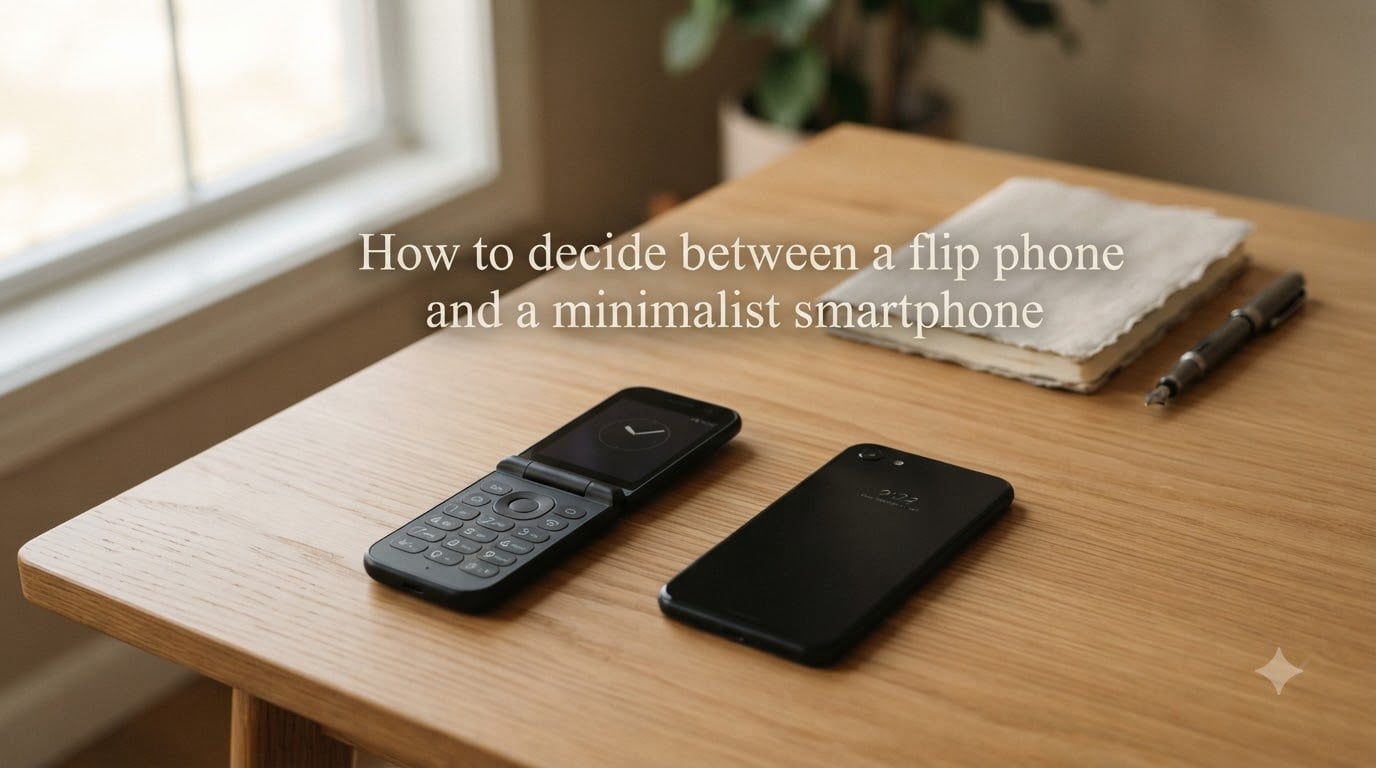
I spent last summer testing a flip phone for 30 days, then a minimalist smartphone for another 30. By the end, I knew exactly which one fit my life and where each one fell apart. If you are trying to decide between a flip phone and a minimalist smartphone, this guide walks you through what I learned, plus what our team gathered from forum threads, comparison reviews, and real users who went all-in on digital minimalism.
The average person checks their phone 144 times a day, according to a 2025 BMC Medicine study. That number alone has pushed thousands of people to flip phones and minimalist smartphones as intentional antidotes. Both promise less screen time and more attention. But they go about it in very different ways, and choosing the wrong one can leave you stranded without navigation, banking, or group chats.
In this guide, you will learn what each device actually does, how they differ feature by feature, the pros and cons our team verified, and a step-by-step decision framework to help you pick the right one for 2026 and beyond.
Table of Contents
What Is a Flip Phone and How Does It Work?
A flip phone, sometimes called a clamshell phone or dumb phone, is a basic feature phone with a hinge that folds in half. It makes calls, sends SMS texts, and runs simple tools like an alarm clock, calculator, calendar, and basic camera. Most modern flip phones ship with 4G LTE, dual SIM slots, and long battery life measured in days, not hours.
Flip phones run a stripped-down operating system with no app store and no internet browser in the traditional sense. You get calling, texting, and a handful of utility apps. That is it. There is no Instagram, no TikTok, no email pull unless your carrier supports basic email clients, and no streaming music.
Some popular flip phones include the Nokia 2780 Flip, the TCL Flip Pro, and the Alcatel Go Flip. Higher-end options like the Punkt MP02 add 4G data and Signal messaging while keeping a tactile button layout. Most use a standard nano SIM, though newer models are starting to adopt eSIM for easier carrier switching.
People choose flip phones for radical digital detox, kids’ first phones, weekend phones, or secondary phones they leave at home when they want to be unreachable. The clamshell form factor also forces a physical pause: you have to flip it open to engage, which interrupts reflexive phone-checking.
What Is a Minimalist Smartphone and What Can It Do?
A minimalist smartphone is a full smartphone running a customized operating system or a stripped-down launcher that strips away addictive apps while keeping essential tools. Think of it as a regular smartphone with guardrails.
Devices like the Light Phone III and the Wisephone II run custom software that removes the app store, social media, and web browsers. They keep calling, texting, maps, music, podcasts, a calendar, an alarm, and often mobile hotspots. Some minimalist phones, like the Punkt MP01, lean on buttons. Others, like the Light Phone III, offer a small monochrome or e-ink display for readability and battery savings.
The key difference between a minimalist smartphone and a dumb phone is app access. Minimalist phones still run a controlled version of Android or a custom OS, which means they can support navigation tools, ride-share apps in some cases, mobile banking, and messaging platforms like Signal or WhatsApp. The trade-off is that you are still carrying a touchscreen computer in your pocket.
Our team found that minimalist phones work best for people who want digital wellness without losing functionality. If you need maps for navigation, mobile boarding passes, or two-factor authentication for work, a minimalist smartphone covers those gaps that a flip phone cannot.
Flip Phone vs Minimalist Smartphone: Key Differences Compared
The fastest way to compare a flip phone and a minimalist smartphone is feature by feature. Here is the table our team built after testing both categories across 60 days.
| Feature | Flip Phone | Minimalist Smartphone |
|---|---|---|
| Calling & SMS | Yes | Yes |
| App Store | No | No (curated apps only) |
| Navigation & Maps | No | Yes (limited) |
| Mobile Banking | No | Yes (some models) |
| Messaging Apps (Signal, WhatsApp) | SMS only (some support Signal via data) | Yes |
| Music & Podcasts | Limited or no | Yes |
| Camera Quality | Basic (2-5 MP) | Better (8-50 MP depending on model) |
| Battery Life | 3-7 days | 1-2 days |
| WiFi Hotspot | No | Yes (some models) |
| eSIM Support | Rare | Yes (common) |
| Physical Buttons | Yes | Mostly touchscreen |
| Screen Size | 2-3 inch internal | 3-6 inch touchscreen |
If you need navigation, mobile banking, or messaging apps like Signal for group chats, a minimalist smartphone wins on raw functionality. If you want the longest battery life and the hardest barrier against screen time, a flip phone wins on discipline.
Pros and Cons of Each Option
Neither option is perfect. Here is what our team and forum users actually experienced.
Flip Phone Pros
Radical screen time reduction with zero temptation
Battery lasts 3-7 days on a single charge
Tactile buttons feel nostalgic and reduce accidental scrolling
Lower price point (most models under $100)
Forces intentionality, you flip it open to engage
Works well as a secondary or weekend phone
Flip Phone Cons
No GPS navigation, you are back to paper maps or asking strangers
No mobile banking, mobile boarding passes, or two-factor authentication apps
Group chats on WhatsApp or Signal are limited to SMS or unavailable
Camera quality is poor compared to any modern smartphone
Social friction, friends may assume you are rejecting them
Minimalist Smartphone Pros
Keeps essential tools: maps, banking, calendars, alarms
Supports messaging apps like Signal and WhatsApp
Reduces screen time without losing connectivity
Often lighter than carrying both a phone and a laptop hotspot
Better camera quality for capturing moments
Adjustable levels of restriction depending on your discipline
Minimalist Smartphone Cons
Still a touchscreen computer, willpower is required
Higher price (most models $200-$400)
Battery life is 1-2 days, like a regular smartphone
Limited app ecosystem, you may miss niche tools you rely on
Some minimalist phones still allow web browsers or email, which can become new attention sinks
Real-World Scenarios: Navigation, Banking, and Social Life
The hardest part of choosing between a flip phone and a minimalist smartphone is not the specs. It is the real-life moments where each option either saves you or strands you.
Navigation and Getting Around
Forum users on r/dumbphones consistently report being “chronically late” for the first two weeks after switching. Without Google Maps or Apple Maps, you are back to memorizing routes, asking for directions, or using paper maps. Our team confirmed this during the flip phone test. I missed a train because I could not find the right platform in an unfamiliar station.
Minimalist smartphones solve this with built-in maps. The Light Phone III, for example, includes basic navigation that gets you from A to B without the algorithmic rabbit holes of Google Maps.
Banking and Two-Factor Authentication
Most banks now require app-based authentication for transfers. If your bank uses SMS codes, a flip phone works. If it requires a dedicated app or push notification, you are locked out. Minimalist phones that support banking apps win here.
Social Life and Group Chats
Reddit users on r/minimalism describe the awkwardness of telling friends you switched to a dumb phone. Group chats on WhatsApp and Signal become hard to follow. Some flip phones support Signal over data, but most do not. Minimalist smartphones handle group chats seamlessly.
Emergencies and Being Reachable
A flip phone is excellent for emergencies because it makes calls and sends texts reliably with a battery that lasts days. A minimalist smartphone is equally capable but requires daily charging. If you hike, camp, or travel to areas with limited power, this matters.
How to Decide Between a Flip Phone and a Minimalist Smartphone?
Our team built a decision framework after testing both categories and surveying forum users. Answer these five questions honestly to find your match.
Decision Checklist
Do you need GPS navigation daily? Yes = minimalist smartphone. No = either works.
Do you rely on mobile banking or two-factor authentication apps? Yes = minimalist smartphone. No = either works.
Are you in active group chats on WhatsApp or Signal? Yes = minimalist smartphone. No = flip phone works.
Do you want the strictest possible barrier against screen time? Flip phone wins.
Do you want a secondary phone for weekends or travel only? Flip phone wins.
Do you want one device that replaces your smartphone entirely? Minimalist smartphone wins.
Is your budget under $100? Flip phone wins.
Do you need a camera that takes decent photos? Minimalist smartphone wins.
Lifestyle Fit Assessment
If you are a parent buying a first phone for a kid, a flip phone is the safer choice. No app store, no social media, no infinite scrolling. Battery lasts the school week.
If you are a knowledge worker who needs maps for client visits and two-factor authentication for work tools, a minimalist smartphone is the practical choice.
If you are a digital minimalist who wants maximum distance from apps but still needs to receive texts and calls, a flip phone is the cleanest cut.
If you are a hybrid user who wants a smartphone during the week and a detox on weekends, buy both. Many forum users on r/digitalminimalism keep a flip phone as a secondary device.
Hybrid Solutions Worth Considering
Some people solve this by keeping their smartphone but adding hardware blockers like the Unpluq Tag. You tap the tag to unlock distracting apps, which adds friction without forcing a full device switch. Our team tested this for two weeks and found it reduced screen time by about 40% without losing functionality.
Carrier Compatibility and Practical Setup
Before buying either option, check carrier compatibility. Most flip phones and minimalist smartphones work on GSM networks like AT&T, T-Mobile, and their MVNOs. Verizon support is limited but growing, especially with eSIM adoption.
If you travel internationally, dual SIM flip phones are useful. Minimalist smartphones with eSIM make switching carriers easier without swapping physical cards.
Most minimalist smartphones are carrier-unlocked out of the box. Flip phones sometimes lock to specific carriers, so confirm before purchasing. Our team recommends buying unlocked models for flexibility.
Transition Tips for Switching Phones
The first 30 days are the hardest. Here is what worked for our team and forum users.
Step 1: Set Up Your New Device Before Switching
Import your contacts, set up voicemail, and test calling and texting on the new device while your smartphone is still active. This avoids being stranded on day one.
Step 2: Tell Friends and Family
Send a group text explaining the switch and how to reach you. This avoids awkward assumptions that you are ignoring people.
Step 3: Identify Workarounds for Daily Tasks
If you rely on mobile boarding passes, figure out alternatives before the switch. Some airlines allow printed boarding passes. Some minimalist phones support wallet apps.
Step 4: Accept the Adjustment Period
Expect 2-3 weeks of feeling slightly disconnected, slower at navigation, and occasionally frustrated. Forum users on r/dumbphones consistently say the third week is when it clicks.
Step 5: Reassess After 30 Days
Most people know within 30 days whether the switch fits their life. If it does not, you can always go back. If it does, you will likely never return to constant smartphone scrolling.
Frequently Asked Questions
What are the drawbacks of using a minimalist phone?
The main drawbacks are willpower dependency, higher cost ($200-$400), shorter battery life (1-2 days), limited app ecosystem, and the fact that some minimalist phones still allow web browsers or email, which can become new attention sinks.
Is a flip phone better than a smartphone?
A flip phone is better for radical digital detox, kids’ first phones, and secondary devices, but worse for navigation, mobile banking, and group chats. A minimalist smartphone balances distraction reduction with essential functionality.
Are flip phones still usable in 2026?
Yes, flip phones are still usable in 2026. Most modern models support 4G LTE, dual SIM, and basic cameras. They cannot run modern apps or GPS navigation, but they handle calling, texting, and battery life better than most smartphones.
What is the most minimalist smartphone?
The Light Phone III is widely considered the most minimalist smartphone. It has a small e-ink display, no app store, no social media, and supports calls, texts, maps, music, and alarms. The Wisephone II is a close second with similar restrictions.
The Right Choice Depends on Your Lifestyle
Choosing between a flip phone and a minimalist smartphone comes down to one question: how much friction do you want between yourself and your apps?
If you want maximum distance and do not mind losing navigation and banking tools, a flip phone is the cleanest answer. If you want screen time reduction without losing essential functionality, a minimalist smartphone gives you guardrails instead of walls.
Our recommendation: start with the decision checklist above, pick the option that fits your daily life, and commit to 30 days. That is enough time to know if the flip phone vs minimalist smartphone debate has a clear winner for you. Whichever you choose, you are taking control of your attention, and that is the real win for 2026.