
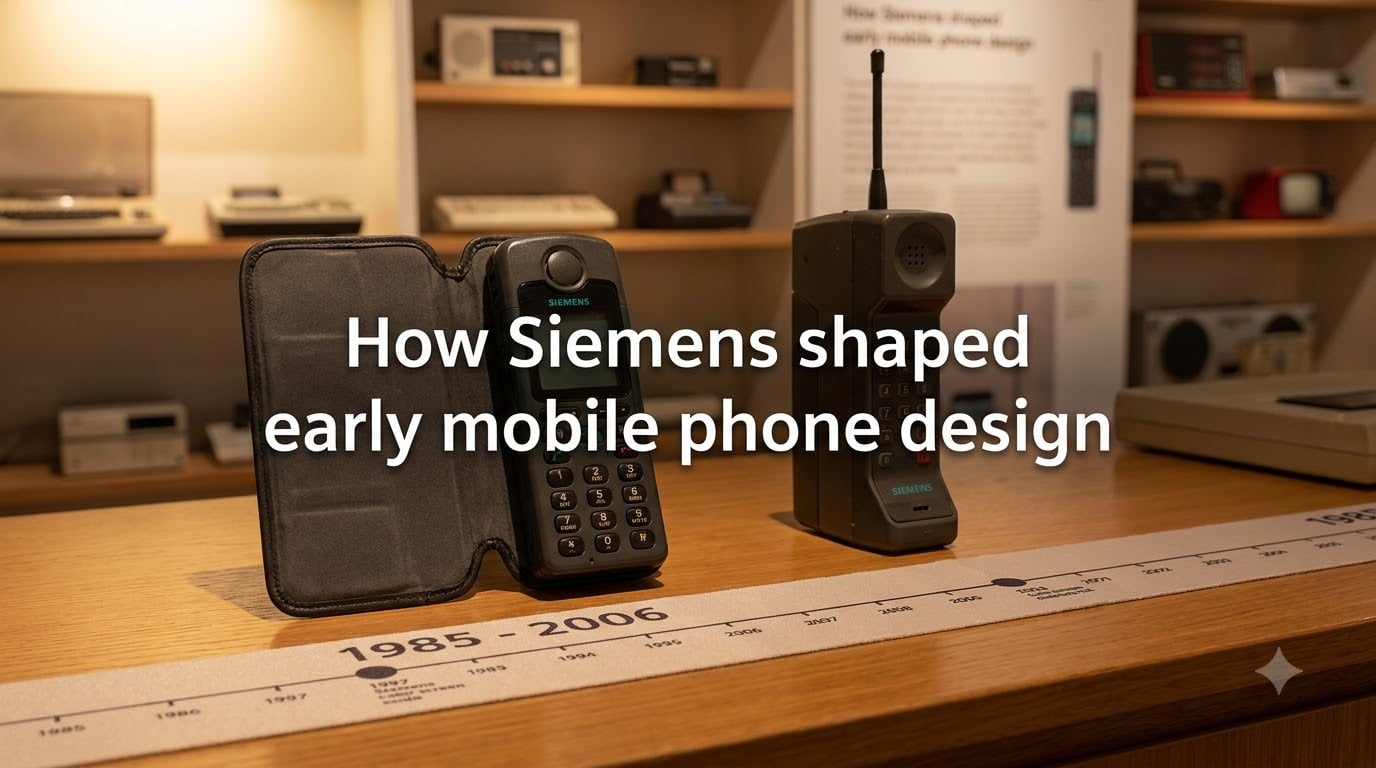
When we talk about how Siemens shaped early mobile phone design, we are really telling a story about a German engineering giant that consistently pushed the industry forward from the mid-1980s through the early 2000s. Siemens Mobile introduced the first commercial color screen phone, the first MP3 phone, and one of the most unusual smartphone designs of the Symbian era, well before the brand quietly exited the market in 2006.
I have spent weeks digging through old press releases, archived Siemens product catalogs, and collector forums to put together a complete picture of how this company earned its place in mobile history. In this guide, you will learn which Siemens phones truly changed the industry, what design philosophy drove them, and why collectors still hunt for these devices today.
Table of Contents
How Siemens shaped early mobile phone design from 1985 to the mid-1990s
Siemens entered mobile communications in 1985, when the German firm began building cellular car phones for the nascent C-Netz network in Europe. The company’s name itself signals its heritage. Siemens is named after founder Werner von Siemens, who established the firm in 1847. “Siemens” is a German surname, and the company carried that engineering pedigree into every mobile phone it produced.
The first true handheld Siemens mobile phone was the Siemens C1, launched in 1992. It weighed around 460 grams, looked like a brick compared to today’s devices, and ran on the new GSM 900 standard. Compared to the legendary Motorola DynaTAC 8000X, the C1 was sleeker and marked Germany’s first major contribution to consumer mobile hardware.
Siemens treated every phone as a piece of precision equipment. The C1 featured a monochrome LCD with green backlighting, a pull-out antenna, and a NiMH battery that delivered roughly an hour of talk time. By the standards of the early 1990s, this was a serious piece of industrial design.
Siemens C1: German engineering in your pocket
The C1 stood out because Siemens refused to follow the bulky American designs coming from Motorola. Engineers in Munich designed the C1 with rounded edges and a textured grip that made it easier to hold during long calls. Reviewers at the time consistently praised the build quality, noting that the phone could survive being dropped on concrete, a trait that would become a hallmark of Siemens devices throughout the 1990s.
By 1994, Siemens had released the S1, which introduced the context-sensitive soft keys that we now take for granted on every smartphone. The S1 placed two buttons below the screen that changed function based on the menu you were viewing. This was a small change on paper, but it fundamentally improved how people navigated mobile menus.
The Siemens S10 introduced the world’s first color screen phone in 1997
No discussion of how Siemens shaped early mobile phone design is complete without the S10. In 1997, Siemens released the S10, which was the world’s first mobile phone with a color screen. It used a passive matrix STN display that could show red, green, blue, and white pixels across a 97×54 pixel grid. The result was a phone that felt like science fiction next to the monochrome competition.
Before the S10, every mobile phone in the world used simple monochrome LCDs. Nokia’s 5110, Motorola’s StarTAC, and Ericsson phones of the era all relied on black-and-white displays. Siemens took a commercial risk on color, and the gamble paid off. Consumers who bought the S10 could now distinguish contacts by color, see color icons for battery and signal strength, and personalize their phone in ways that simply weren’t possible on competing devices.
Why the S10’s color screen changed everything
The S10’s display was small by today’s standards, but it rewrote consumer expectations overnight. Once buyers saw color on a Siemens display, they expected color on every subsequent phone they bought. The industry took notice. Nokia introduced its first color screen in the 9210 in 1999, and Ericsson followed in 2001. Siemens had a two-year head start on a feature that became standard within five years.
Collectors often recount that the S10 felt like carrying a tiny piece of the future. The phone still offered SMS messaging, voice dialing, and a contact book for 50 entries, but the color display made every interaction feel modern. It was the moment Siemens proved that mobile phones could be more than communication tools. They could be expressive personal devices.
How Siemens shaped early mobile phone design with the SL45 MP3 phone
In 2000, Siemens released the SL45, which was the first mobile phone with built-in MP3 playback. The phone shipped with a 32MB MMC card that could hold roughly eight songs in compressed MP3 format, and it included a set of stereo headphones in the box. For the first time, you could carry your music library and your phone book in the same device.
The SL45 was technically a slider phone, with the keypad sliding down to reveal the numeric buttons. It also supported polyphonic ringtones, which meant your phone could play actual musical tones rather than the simple beeps used by earlier devices. The combination of MP3 playback, expandable memory, and polyphonic audio made the SL45 the most versatile entertainment device of its year.
SL45 features that set a new standard
Beyond MP3 playback, the SL45 introduced Java MIDP support, allowing developers to build downloadable apps and games. This was years before the App Store era and gave Siemens users early access to mobile productivity tools. The phone also supported voice recording, infrared data transfer, and WAP browsing for early internet access.
Forum users from the era remember the SL45 as the device that made their friends jealous. One collector on mobilecollectors.net described using the SL45 to play full albums during long train rides, a use case that simply didn’t exist on any other phone in 2026 summer 2000. That kind of consumer experience is exactly what shaped early mobile phone design. Siemens understood that phones would become personal entertainment hubs, not just calling devices.
Siemens Symbian smartphones pushed design boundaries in the early 2000s
By 2003, Siemens was ready to compete in the smartphone era. The company chose the Symbian platform with Nokia’s Series 60 interface for its flagship, the SX1. The result was one of the most unusual smartphone designs ever produced. Instead of placing the keypad at the bottom of the device, Siemens put the numeric keys on the left and right sides of the phone, with a five-way navigation pad in the middle.
The SX1 ran Symbian OS 7.0, supported Java, and could handle email, web browsing, and multimedia playback. It also included a built-in VGA camera, which was rare for smartphones in 2003. The unusual keypad layout was a calculated risk. Siemens wanted to differentiate its device from the Nokia 6600 and the upcoming Sony Ericsson P800, and the side-mounted keys made the phone instantly recognizable.
Siemens S55: bringing cameras to the mainstream
Before the SX1, Siemens had already made waves with the S55 in 2002. The S55 was one of the first mainstream camera phones with a color display, and it could capture photos at VGA resolution. It supported Java games, polyphonic ringtones, and MMS messaging, which was the new standard for sending pictures between phones.
The S55 sold in large numbers across Europe and Asia, and it helped establish the camera phone as a must-have feature. Within two years, every major manufacturer was shipping camera phones as standard. Siemens had once again helped define how the industry evolved.
Siemens design philosophy still influences how modern phones look and feel
Three design principles drove every Siemens mobile phone from 1985 to 2006: durable construction, user-centric interfaces, and bold innovation. The German engineering culture that built railways and power plants translated into handsets that felt solid in the hand. Reviewers consistently noted that Siemens phones could take falls and rough handling that would crack competing devices.
Collectors still praise Siemens for trying things other manufacturers avoided. The SL45’s MP3 playback, the SX1’s side keypad, and the S10’s color display were all commercial risks that paid off culturally even when they didn’t always win at the cash register. These designs proved that mobile phones could be fun, expressive, and technologically ambitious.
In 2005, Siemens sold its mobile phone division to BenQ, a Taiwanese electronics company. The joint brand BenQ-Siemens produced a handful of devices in 2006 before the division collapsed. For collectors, this BenQ-Siemens era represents the final chapter of a remarkable design story. Original Siemens phones have become sought-after items, especially working SL45 and S10 units that frequently appear in vintage electronics auctions.
When we look at how Siemens shaped early mobile phone design, we see a clear pattern. The company consistently chose innovation over safety, launching the first color screen phone, the first MP3 phone, and one of the most uniquely designed Symbian smartphones.
Every modern smartphone with a color display, music player, and downloadable apps owes something to the design bets that Siemens made two decades ago.
FAQs
Who designed the first mobile phone?
The first handheld mobile phone was the Motorola DynaTAC 8000X, designed by a team led by Martin Cooper at Motorola in 1973. However, Siemens shaped early mobile phone design by building the first European GSM phone, the C1, in 1992, and by pioneering consumer features like color screens and MP3 playback in the late 1990s and early 2000s.
What was the Siemens phone in the early 2000s?
In the early 2000s, Siemens released several landmark phones including the SL45 (first MP3 phone, 2000), the S55 (one of the first mass-market camera phones, 2002), and the SX1 (a Symbian Series 60 smartphone with a unique side-mounted keypad, 2003). These devices defined how Siemens shaped early mobile phone design during that era.
What does Siemens mean in German?
Siemens is a German surname belonging to Werner von Siemens, who founded the company in 1847. The name has no direct translation but carries deep associations with German engineering excellence and industrial innovation, which carried through to every mobile phone the company produced.
What did the first cell phone look like?
The first cell phone, the Motorola DynaTAC 8000X from 1983, was a large brick-shaped device weighing about 2.5 pounds with a small LED display. Siemens shaped early mobile phone design by creating more compact alternatives like the 1992 C1, which weighed just 460 grams and introduced a more pocket-friendly form factor to European consumers.
What is the history of Siemens mobile phones?
Siemens mobile phone history began in 1985 with car phones for the C-Netz network and progressed through the C1 (1992, first GSM phone), S10 (1997, first color screen phone), SL45 (2000, first MP3 phone), S55 (2002, early camera phone), and SX1 (2003, Symbian smartphone). In 2005, Siemens sold its mobile division to BenQ, ending the original Siemens phone brand by 2006.
Final thoughts on Siemens’s lasting influence
How Siemens shaped early mobile phone design comes down to a willingness to take risks that other manufacturers avoided. From the first color screen phone in 1997 to the first MP3 phone in 2000, Siemens introduced features that the rest of the industry adopted within a few years. The BenQ-Siemens era ended the original brand, but the design DNA lives on in every modern smartphone that ships with a color screen, a music player, and a downloadable app store.
If you want to explore Siemens mobile history further, start with the S10 and SL45. Both phones are widely documented in collector communities, and original units still appear on vintage electronics marketplaces. They are the clearest examples of how Siemens shaped early mobile phone design, and they remain surprisingly usable today.