
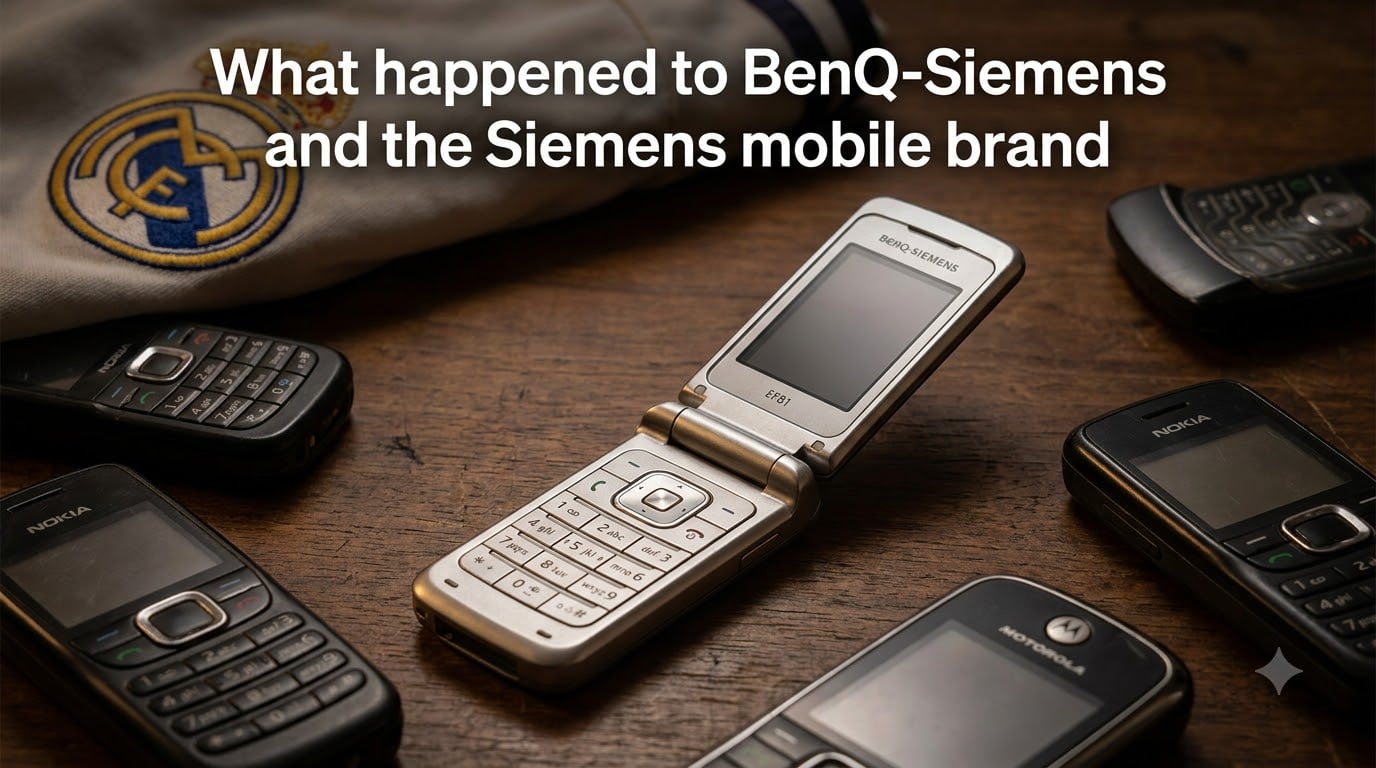
BenQ-Siemens was a short-lived mobile phone brand created when Taiwanese electronics company BenQ acquired Siemens’ loss-making mobile phone division in 2005. Operating from October 1, 2005, until its bankruptcy on January 30, 2007, the brand lasted barely 16 months before collapsing entirely.
If you have ever wondered what happened to BenQ-Siemens and the Siemens mobile brand, the short answer is one of the most dramatic failures in mobile phone history. A German industrial giant sold its handset division to a Taiwanese upstart, and within a year the whole venture went under.
Our team has dug through the historical record, collector communities, and business case studies to piece together the full story. We want to explain not just the timeline but why this acquisition failed so spectacularly and what remains of both brands today.
This matters because the BenQ-Siemens collapse cost 3,000 people their jobs, destroyed billions in value, and ended one of Europe’s most recognizable phone brands. It also serves as a cautionary tale about cross-border tech acquisitions that business schools still study.
Whether you are a vintage phone collector, a tech history buff, or a business student researching acquisition failures, this guide walks you through every stage of the BenQ-Siemens story from rise to ruin.
Table of Contents
The Rise of Siemens Mobile
Siemens AG entered the mobile phone market in the mid-1990s and quickly became one of the top handset manufacturers in the world. By the late 1990s, Siemens Mobile was the fourth-largest mobile phone maker globally, trailing only Nokia, Motorola, and Ericsson.
The German engineering giant brought its reputation for quality and reliability to consumer electronics. Siemens phones were known for solid build quality, practical features, and innovative designs that appealed to business users and everyday consumers alike.
Models like the Siemens C35, S35, and the iconic SL55 slider phone earned real followings. The Siemens SX1, a quirky smartphone with media keys on the sides of the screen, showed the company could experiment with unusual form factors.
Siemens Mobile reached its peak market share around 2003, holding roughly 8 percent of the global handset market. But the landscape was shifting fast as camera phones, color screens, and multimedia features became the new baseline.
By 2004, Siemens was bleeding money on its mobile division. The company lost hundreds of millions of euros as competitors like Nokia and Samsung ramped up production and slashed prices. Siemens phones were seen as increasingly dated compared to flashier rivals.
Internal reports showed that Siemens’ handset division was losing money on every phone it shipped at certain points. The German conglomerate faced a stark choice: invest heavily to compete or cut its losses and exit the market.
In early 2005, Siemens CEO Klaus Kleinfeld made the decision to sell. The mobile phone division had become a financial drag that distracted from Siemens’ core industrial and infrastructure businesses. The search for a buyer began.
The 2005 Acquisition That Created BenQ-Siemens
Who bought Siemens Mobile division? The answer is BenQ Corporation, a Taiwanese electronics company founded in 1984. BenQ was primarily known for monitors, projectors, and digital displays but had ambitions to become a major player in mobile phones.
The deal was announced in June 2005 and completed on October 1, 2005. BenQ acquired Siemens’ entire mobile phone division, including manufacturing facilities, R&D centers, and approximately 6,000 employees across Germany and other countries.
The financial structure of the acquisition was unusual. Siemens paid BenQ to take the division off its hands, contributing at least 250 million euros in cash. Siemens also took a 2.5 percent stake in BenQ Corporation as part of the agreement.
BenQ established a new subsidiary called BenQ Mobile, headquartered in Munich, Germany. The company would produce phones under the dual brand name BenQ-Siemens, leveraging Siemens’ established reputation while injecting BenQ’s design philosophy.
The strategy made sense on paper. BenQ gained instant credibility, a European manufacturing base, an established distribution network, and patents. Siemens escaped a money-losing division while retaining a small financial interest in its successor.
At the time, industry analysts were cautiously optimistic. The combined entity would have ranked among the top five handset makers globally. BenQ’s CEO K.Y. Lee promised to invest aggressively and return the division to profitability by 2006.
The first BenQ-Siemens branded phones launched in January 2006, just three months after the acquisition closed. The company showcased an ambitious lineup at trade shows, positioning itself as a design-forward alternative to Nokia and Motorola.
What Happened to BenQ-Siemens: Timeline of Collapse
The BenQ-Siemens collapse unfolded with startling speed. What looked like a promising venture in early 2006 was dead by early 2007. Here is the timeline of how it all fell apart.
October 1, 2005: BenQ Mobile officially begins operations after acquiring Siemens’ handset division. The new company employs roughly 6,000 people.
January 2006: The first BenQ-Siemens phones hit the market at the Consumer Electronics Show. The brand launches with significant media attention and ambitious sales targets.
First half of 2006: Sales fall dramatically short of projections. The phones struggle to gain traction against entrenched competitors. BenQ Mobile burns through cash at an alarming rate.
August 2006: BenQ Corporation in Taiwan announces it will stop funding its German mobile subsidiary. The parent company decides to cut its losses rather than continue pouring money into the failing venture.
September 29, 2006: BenQ Mobile files for insolvency protection in a Munich court. The filing sends shockwaves through the German tech industry and triggers immediate layoffs.
Late 2006: A frantic search for investors to rescue BenQ Mobile comes up empty. No buyer emerges willing to take on the struggling handset maker.
January 30, 2007: BenQ Mobile is officially declared bankrupt and dissolved. The company ceases all operations, and remaining employees are let go.
The human toll was devastating. Approximately 3,000 workers in Germany lost their jobs, primarily at facilities in Munich and Kamp-Lintfort. The closures hit communities hard and became a political issue in Germany.
The speed of the collapse stunned the industry. From launch to bankruptcy, BenQ-Siemens lasted just over a year. It stands as one of the fastest flameouts of a major consumer electronics brand in modern history.
Key BenQ-Siemens Phones Worth Knowing
What phones did BenQ-Siemens make? During its brief existence, the company released a surprising number of devices. Several earned recognition for design and innovation, even if commercial success eluded them.
The BenQ-Siemens EF81 was the flagship model and probably the best-known device from the brand. It was a sleek clamshell phone with a metal body, aimed directly at competing with the Motorola RAZR. Some collectors referred to it as a RAZR wannabe, but it earned respect for its premium build quality and HSDPA connectivity. The EF81 won an iF Design Award, cementing the brand’s reputation for industrial design.
The BenQ-Siemens S68 was a slim candybar phone focused on simplicity and elegance. It targeted business users who wanted a reliable, no-nonsense device with good call quality and battery life.
The BenQ-Siemens S88 featured a 2-megapixel camera and an OLED display, which was cutting-edge technology at the time. It showed that BenQ-Siemens could compete on multimedia features, not just design.
The BenQ-Siemens P51 was a Windows Mobile 5.0 smartphone with a QWERTY keyboard and GPS functionality. It was aimed at enterprise users and represented the brand’s attempt to compete in the emerging smartphone space.
The BenQ-Siemens CL71 was a slider phone that collectors consider innovative for its IPS display technology. Some prototype versions generated particular excitement among enthusiasts.
The company also continued producing budget-oriented phones that carried over from the Siemens era. In total, BenQ Mobile released around 35 phone models during its existence, though many were updates or regional variants of existing Siemens designs.
The brand’s design credentials were genuine. BenQ-Siemens phones won multiple iF Design Awards and Red Dot Design Awards during 2006. Critics praised the aesthetic quality even as sales figures disappointed.
Why Did BenQ-Siemens Fail
The reasons behind the BenQ-Siemens failure go deeper than just financial losses. Multiple compounding factors doomed the venture from the start, and understanding them helps explain why the collapse happened so quickly.
Integration challenges topped the list. Merging a German manufacturing culture with a Taiwanese corporate structure created friction at every level. Decision-making slowed, communication broke down, and the two organizations never truly merged into a cohesive unit.
Brutal market competition made recovery nearly impossible. Nokia controlled roughly 35 percent of the global handset market in 2006. Samsung and Motorola were fighting for second place with aggressive pricing and massive marketing budgets. BenQ-Siemens simply could not match their scale.
The smartphone transition caught the company flat-footed. While BenQ-Siemens released a few Windows Mobile devices, the bulk of its lineup consisted of feature phones. The market was shifting toward smartphones, and the brand had no competitive answer.
Brand confusion hurt sales. The BenQ-Siemens name was unfamiliar to consumers who had known and trusted Siemens phones for years. The dual-brand strategy created uncertainty rather than confidence at the point of sale.
Distribution gaps plagued the launch. Retailers and carriers were reluctant to commit shelf space to an unproven brand, especially when established players offered better margins and more reliable supply chains.
Financial pressure from the parent company was relentless. BenQ Corporation in Taiwan had its own financial struggles and could not sustain the massive losses at its German subsidiary. When the funding stopped, the end came quickly.
Cultural and geographical distance between Taiwan and Germany made oversight difficult. Management missteps compounded as executives in Taipei struggled to fully understand the European market dynamics and operational realities on the ground.
Business schools have since used the BenQ-Siemens case as a textbook example of how cross-border acquisitions can fail. The combination of cultural mismatch, market timing, and financial strain proved fatal.
The Real Madrid Sponsorship and Brand Marketing
One of the most memorable aspects of the BenQ-Siemens era was its sponsorship of Real Madrid, the legendary Spanish football club. Siemens Mobile had begun the sponsorship deal, and BenQ-Siemens inherited it as part of the acquisition.
The sponsorship put the BenQ-Siemens brand in front of millions of football fans worldwide. Real Madrid’s jersey prominently displayed the BenQ-Siemens logo during matches, creating massive global visibility for the fledgling brand.
For collectors and fans, the Real Madrid sponsorship remains one of the most iconic associations with the BenQ-Siemens name. People who followed football in that era often remember the brand primarily through this connection.
The marketing spend was substantial, but visibility alone could not save a company with fundamental business problems. Sponsorships build awareness, but they cannot fix uncompetitive products or unsustainable cost structures.
When BenQ Mobile went bankrupt, the Real Madrid sponsorship ended. The club moved on to other sponsors, and the BenQ-Siemens logo disappeared from jerseys. For many football fans, that was the moment they realized the brand was gone.
What Happened After the Bankruptcy
The aftermath of BenQ Mobile’s collapse was messy and prolonged. The human cost came first, with 3,000 workers in Germany losing their jobs almost overnight. The layoffs hit Munich and Kamp-Lintfort particularly hard, devastating local communities.
The German government and labor unions pushed back aggressively against the sudden closures. Politicians criticized BenQ for abandoning its German workforce so soon after the acquisition. The incident damaged Taiwan-Germany business relations temporarily.
Legal battles followed. Questions arose about whether BenQ had always intended to shut down the German operations or whether it genuinely tried to make the venture work. Investigators examined the timeline of decisions leading to the insolvency filing.
What happened to BenQ after the mobile division collapse? BenQ Corporation in Taiwan restructured significantly. In 2007, the company rebranded its operations under a new holding company called Qisda Corporation. BenQ continued as a brand focused on monitors, projectors, and display technology rather than mobile phones.
Interestingly, BenQ-branded mobile handsets did resurface in 2008. BenQ Corporation began producing phones again under the BenQ name alone, without the Siemens association. These were primarily aimed at Asian markets and never achieved significant global reach.
What happened to the Siemens side? Siemens AG itself moved on completely from consumer mobile phones. The company focused on its industrial, healthcare, and infrastructure businesses, where it remained a global powerhouse.
The Siemens phone legacy did continue in one form. Gigaset Communications, which had been part of Siemens’ home and office communication division, eventually became an independent company. Gigaset still produces cordless phones and home communication devices today, carrying a small piece of the Siemens telecom legacy forward.
Existing BenQ-Siemens phone owners were left without warranty support or software updates. Forum discussions from the era reveal frustration as customers discovered that their relatively new phones had become orphans overnight. This lack of post-collapse support remains a pain point for collectors today.
Are BenQ-Siemens Phones Worth Collecting Today
Despite the brand’s commercial failure, BenQ-Siemens phones have developed a genuine following among vintage mobile phone collectors. The combination of short production run, distinctive designs, and historical significance gives them real nostalgia value.
Collector communities on Reddit, Facebook groups, and dedicated forums like mobilecollectors.net actively trade and discuss BenQ-Siemens devices. Some enthusiasts have been building collections since 2006, preserving these phones as artifacts of a brief but fascinating era.
The EF81 is widely considered the most collectible BenQ-Siemens model. Its metal clamshell design, design award pedigree, and association with the RAZR-era aesthetic make it the centerpiece of most collections. Working units in good condition command premium prices.
The P51 Windows Mobile smartphone is another sought-after model. Its rarity, QWERTY keyboard, and GPS capabilities make it interesting to collectors who focus on early smartphones. Finding one in working condition is challenging.
Collectors should be aware of some practical challenges. Replacement batteries are extremely difficult to find, as the phones have been out of production for nearly two decades. The EF81 in particular has reported hinge durability issues, with some units developing cracks or stiffness over time.
No official support or warranty exists for any BenQ-Siemens device. Enthusiasts rely on each other for repair advice, parts sourcing, and technical documentation. Online forums are the primary resource for anyone trying to keep these phones functional.
Software support is essentially nonexistent. Anyone attempting to use a BenQ-Siemens phone today will find that no firmware updates, app stores, or official resources remain available. These are display pieces and conversation starters more than practical daily devices.
For collectors, that is exactly the appeal. BenQ-Siemens phones represent a moment in mobile history when anything seemed possible, design was king, and the market had room for ambitious experiments. They are reminders that even spectacular failures can leave behind beautiful objects.
FAQs
Is BenQ part of Siemens?
No, BenQ was never part of Siemens. BenQ is a Taiwanese electronics company that acquired Siemens’ mobile phone division in 2005. The two companies were separate entities that briefly partnered under the BenQ-Siemens brand name from October 2005 until January 2007.
Who bought Siemens Mobile division?
Taiwanese company BenQ Corporation bought the Siemens Mobile division in 2005. The deal was completed on October 1, 2005, with Siemens contributing at least 250 million euros and taking a 2.5 percent stake in BenQ as part of the agreement.
What cell phone companies no longer exist?
BenQ-Siemens, Siemens Mobile, Nokia’s original phone division (later revived by HMD Global), Ericsson mobile phones (merged into Sony Ericsson), Motorola’s independent handset business (acquired by Lenovo), Palm, BlackBerry’s hardware division, and Sagem mobile phones are all defunct cell phone brands. BenQ-Siemens stands out as one of the fastest failures, lasting just 16 months.
What is the history of Siemens mobile phones?
Siemens AG entered the mobile phone market in the mid-1990s and rose to become the fourth-largest handset maker globally by the early 2000s. Known for models like the SL55 slider and SX1 smartphone, Siemens Mobile peaked at roughly 8 percent global market share around 2003 before declining due to losses and competition. Siemens sold its mobile division to BenQ in 2005, ending its presence in consumer mobile phones.
What was the Siemens mobile phone in 2003?
In 2003, Siemens was producing popular models including the SL55 slider phone, the SX1 smartphone, the C55, S55, and M55. The SL55 was particularly notable for its compact slider design and became one of Siemens’ most recognizable devices. This period marked the peak of Siemens Mobile’s market share before the decline began.
When did BenQ-Siemens close?
BenQ-Siemens closed on January 30, 2007, when BenQ Mobile was officially declared bankrupt and dissolved. The company had filed for insolvency protection on September 29, 2006, after BenQ Corporation stopped funding its German subsidiary. The entire venture lasted only 16 months from launch to closure.
Conclusion
The story of what happened to BenQ-Siemens and the Siemens mobile brand is ultimately one of ambition meeting reality. A German industrial giant wanted out of a money-losing business, a Taiwanese company wanted in, and the result was a 16-month catastrophe that cost thousands of jobs and ended a beloved phone brand.
The BenQ-Siemens failure teaches hard lessons about cross-border acquisitions, market timing, and the brutal competitiveness of the mobile phone industry. It also left behind a catalog of well-designed phones that collectors still treasure today.
If you want to explore this piece of mobile phone history further, vintage phone collector communities are your best resource. They keep the memory of BenQ-Siemens alive one device at a time, preserving a brief but fascinating chapter in the story of mobile technology.