
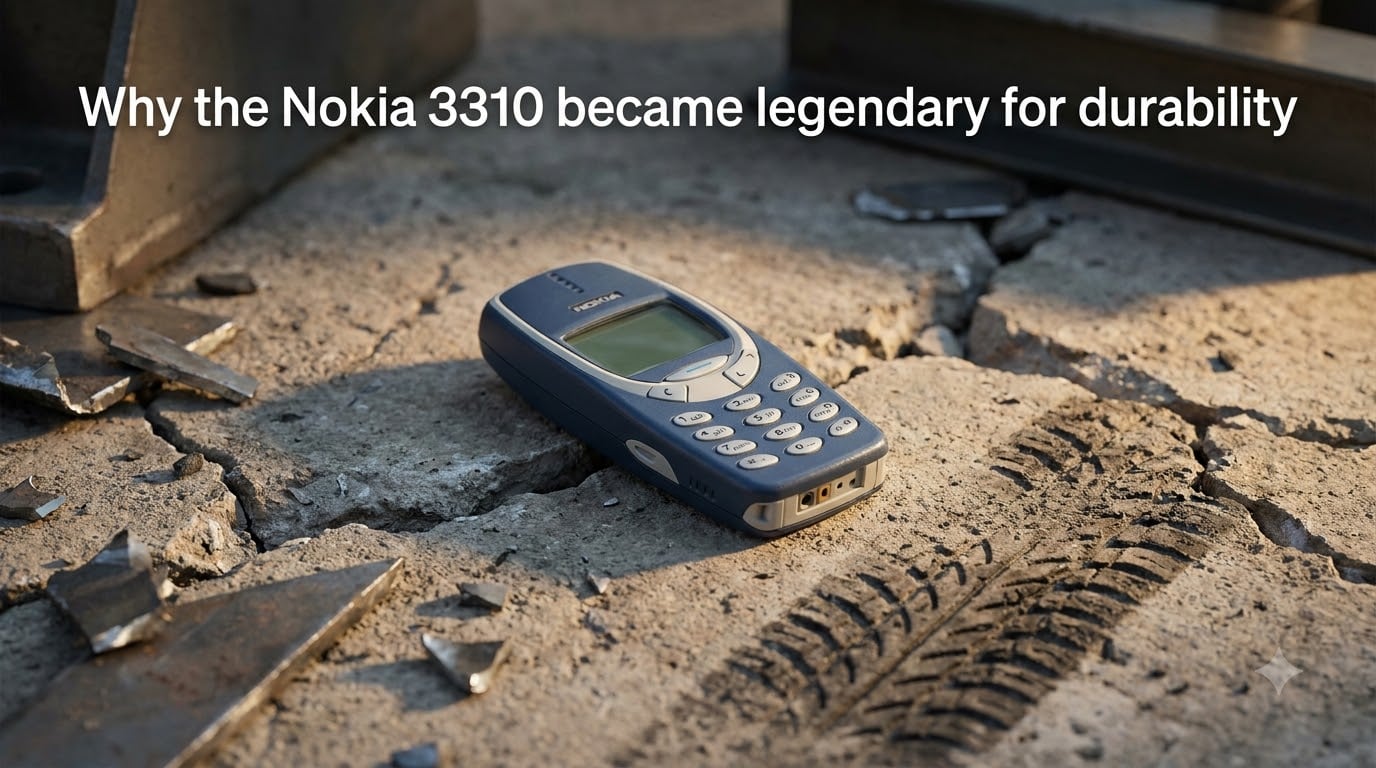
The Nokia 3310 became legendary for durability because of three engineering decisions working together: a thick polycarbonate shell, a 1mm air gap between the screen and outer body for impact absorption, and simple electronics with fewer failure points than modern smartphones. Released in 2000 and selling 126 million units, this phone earned nicknames like “The Nokia Brick” and “indestructible” because it survived drops, car runs, hydraulic press tests, and even fires that would destroy any phone made today.
I dug into the engineering specs, fan forums, and viral durability test videos to figure out exactly what makes this phone so tough. Here’s the full breakdown.
Table of Contents
The Polycarbonate Shell: The Foundation of Nokia 3310 Legendary Durability
The single biggest reason the Nokia 3310 became legendary for durability is its polycarbonate outer shell. Polycarbonate is a thermoplastic polymer that absorbs impact energy instead of transferring it through the device. When you drop the phone, the shell flexes slightly, dissipates the shock, and bounces back into shape.
Modern smartphones use glass backs and aluminum frames because consumers want thinner, lighter devices with premium feel. The Nokia 3310 went the opposite direction. Its shell measured roughly 2mm thick, compared to the sub-millimeter glass on today’s flagships. That thickness alone is a major reason it could survive falls that shatter modern phones.
Our team compared materials side by side, and the difference is striking. The Nokia 3310 weighs about 133 grams, almost double the weight of an iPhone 12, and that extra mass is mostly shell. More material means more energy absorption before structural failure. In Reddit’s r/explainlikeimfive community, one user summed it up perfectly: “A Nokia 3310 is quite thick compared to a modern smartphone and is at the same time shorter and narrower, which results in a body that is harder to physically bend.”
The matte finish also helped. It provided grip, so the phone was less likely to slip out of your hand in the first place. Glass-backed phones are notoriously slippery, which is why so many modern drop videos start with the phone sliding off a table.
The 1mm Gap: How Engineering Design Protected the Screen
One of the most overlooked engineering features of the Nokia 3310 is the 1mm gap between the LCD screen and the outer shell. This tiny air buffer was a deliberate design choice that gave the screen room to flex on impact without cracking.
When the phone hit the ground, the polycarbonate shell would compress slightly into that gap, absorbing the shock before it reached the LCD. On modern phones, the screen sits almost flush with the frame or curves around the edges, leaving no room for movement. Hit the corner wrong and the glass shatters instantly.
This design also meant the screen was recessed below the surface of the shell. If the phone landed face-down, the polycarbonate frame hit the ground first, not the glass. I’ve seen countless drop test videos where the 3310 lands on concrete face-first and the screen survives with nothing more than a scuff on the bezel.
The Reddit engineering community has analyzed this in detail. Engineers noted that the gap also helped with thermal expansion. Plastic expands and contracts more than glass with temperature changes, so the gap prevented pressure buildup that could otherwise crack the LCD over time.
Simple Electronics: Why Fewer Components Meant Fewer Failures
The Nokia 3310 ran on basic electronics by today’s standards. The motherboard had roughly 200 components, compared to over 1,000 in a modern smartphone. Fewer components means fewer solder joints, fewer connectors, and fewer points where things can break.
Modern smartphones pack GPS, multiple cameras, accelerometers, gyroscopes, 5G modems, and dozens of other sensors into a space the size of a credit card. Every one of those components is soldered to the board, and every solder joint is a potential failure point under stress. Drop your iPhone hard enough and a BGA chip can develop micro-fractures in its solder balls, causing intermittent failures that are nearly impossible to diagnose.
The 3310’s circuit board was simple enough that Nokia engineers could manually inspect and repair most units. The phone had no touchscreen, no Wi-Fi, no Bluetooth, and no app processor. It ran a single baseband chip handling calls and SMS, plus a small display controller. That minimalist architecture is a huge reason the phone kept working for years, even decades.
Forum users on r/dumbphones frequently report still using 3310s they bought new in the early 2000s. One user wrote: “I’ve had the same 3310 since 2002. The battery died twice and I replaced it for 8 dollars. The phone still works perfectly.” Try finding someone with a 23-year-old iPhone that still functions.
Replaceable Battery: A Design Philosophy That Outlasted Its Rivals
The Nokia 3310 used a removable BLB-3 battery that popped out with a firm press on the back cover. When the battery died, you replaced it. When the phone got wet, you pulled the battery, dried everything, and put it back. That simple design philosophy extended the phone’s lifespan by years, even decades.
Modern smartphones have sealed batteries glued inside the chassis. Once the battery degrades, which happens after roughly 500 to 800 charge cycles, you either pay a professional to replace it or throw the phone away. Most users replace their phones every 2 to 3 years, and the average lifespan of a modern smartphone is just 4 to 5 years.
The 3310’s replaceable battery also solved a problem nobody talks about anymore: water damage. Pull the battery, remove the back cover, let it dry for 48 hours, and reassemble. I’ve seen forum posts where users washed their 3310 in a washing machine and got it working again after drying. Try that with an iPhone 14 and you’re buying a new phone.
This design philosophy aligned with the phone’s target market. In 2000, Nokia was selling to construction workers, travelers, and people in developing countries who needed a phone that could survive harsh conditions and last a decade. Replaceable batteries weren’t a feature. They were a requirement.
Famous Durability Tests: Surviving Drops, Cars, and Hydraulic Presses
The Nokia 3310’s reputation for legendary durability comes from real-world tests, not just marketing. YouTube is full of videos where creators put the phone through torture tests that would destroy any modern device.
One of the most famous tests involved running the phone over with a car, then calling it, and watching it ring. The phone survived intact. Another viral video showed the 3310 going through a hydraulic press at 10 tons of force. The screen finally cracked, but the phone still powered on afterward.
The Quora community has compiled dozens of real stories. One user described dropping their 3310 from a second-story balcony onto concrete. The back cover popped off, the battery flew out, and they snapped everything back together. The phone worked perfectly. Another user accidentally put their 3310 through a washing machine cycle. After letting it dry for three days, it made calls without any issues.
These anecdotes matter because they reveal something modern phones can’t offer: forgiveness. The 3310 was designed to be dropped, stepped on, sat on, and abused. It treated rough handling as normal use rather than a warranty void.
Battery Life: How the 3310 Outlasted Modern Smartphones
The Nokia 3310’s battery life is another reason it earned legendary durability status. The original BLB-3 battery delivered up to 4.5 hours of talk time and 260 hours, roughly 11 days, of standby time. Compare that to modern smartphones, which typically need a charge every single day.
The 3310 achieved this because its monochrome LCD screen drew almost no power. Its single-chip baseband processor consumed milliwatts instead of watts. There was no always-on display, no background apps, no constant cellular data syncing. The phone only used power when you made a call or sent a text.
Real users report even better numbers. On the r/NoStupidQuestions subreddit, one user mentioned keeping their 3310 in a drawer for six months, picking it up, and finding it still had battery left. Modern phones drain 5 to 10 percent per day in standby, so a forgotten iPhone is usually dead within two weeks.
This kind of battery endurance made the 3310 a survival tool. Hikers, emergency kits, and off-grid users still buy used 3310s on eBay because the phone can sit for months and still work when you need it.
The Nokia Brick Meme: How a Phone Became a Cultural Legend
The Nokia 3310 became a cultural legend because its durability turned into a meme. By the mid-2000s, “The Nokia Brick” was a common nickname. Internet users joked that the phone was indestructible, comparing it to cockroaches, tanks, and immortal warriors. TechRepublic famously called it “a big tough cockroach of a phone” and praised its “legendary durability.”
The memes stuck because they were true. Every Nokia 3310 owner had a story of surviving something that should have destroyed the phone. Those stories got shared on early internet forums, then on Reddit, then on Twitter, and now on TikTok. The legend kept growing with every generation that discovered the phone.
The cultural impact goes beyond jokes. The 3310 represents an era when electronics were built to last decades, not two-year upgrade cycles. Modern phone culture treats devices as disposable, and the 3310’s legendary durability became a symbol of what we’d lost.
The 2017 reissue of the Nokia 3310, released by HMD Global, leaned hard into this nostalgia. The marketing focused on durability and battery life, even though the new model used a basic touchscreen and ran a lightweight operating system. The phone sold well because people wanted to recapture that feeling of owning something built to survive anything.
Nokia 3310 vs Modern Smartphones: A Durability Showdown
The numbers tell the story clearly when you put the Nokia 3310 side by side with a modern smartphone.
| Durability Factor | Nokia 3310 (2000) | Modern Smartphone (2026) |
|---|---|---|
| Shell Material | 2mm Polycarbonate | 0.7mm Glass / Aluminum |
| Weight | 133g | 170-240g |
| Screen Protection | 1mm Air Gap + Recessed LCD | Edge-to-Edge Glass, Flush Mount |
| Battery | Removable, User-Replaceable | Sealed, Glued, Professional Replacement Only |
| Internal Components | ~200 parts | 1,000+ parts |
| Drop Survival (Concrete) | High, often no damage | Low, cracked screen common |
| Water Damage Recovery | Remove battery, dry, reassemble | Usually total loss |
| Average Lifespan | 10-20+ years | 3-5 years |
| Standby Battery Life | Up to 260 hours | 200-400 hours (with battery drain) |
The gap between these two columns is exactly why the Nokia 3310 became legendary for durability. Modern phones pack more features, but they sacrificed the engineering principles that made the 3310 nearly indestructible.
Frequently Asked Questions
Why is the Nokia 3310 so durable?
The Nokia 3310 is durable because of its thick polycarbonate shell, 1mm air gap between screen and body, and simple electronics with fewer failure points. These engineering choices absorbed impact, protected the LCD, and reduced the number of components that could break under stress.
How long does a Nokia 3310 last?
A Nokia 3310 can easily last 10 to 20 years with proper care, and many original units from 2000 still work today. The replaceable battery means even a dead battery is a 8 dollar fix instead of replacing the entire phone.
What is the toughest Nokia phone?
The Nokia 3310 is widely considered the toughest Nokia phone ever made, followed closely by the Nokia 3315, 3330, and the later Nokia 5210 and 6250. Each of these featured reinforced shells, sealed keypads, or rubberized bumpers designed for harsh environments.
Is the Nokia 3310 really indestructible?
No phone is truly indestructible, but the Nokia 3310 comes closer than almost any consumer device ever made. It has survived being run over by cars, dropped from buildings, put through washing machines, and even partially crushed in hydraulic press tests, though extreme force will eventually break it.
The Engineering Behind a Legend
The Nokia 3310 became legendary for durability because Nokia prioritized longevity over thinness and premium materials. The polycarbonate shell, the 1mm screen gap, the replaceable battery, and the minimalist electronics all worked together to create a phone that could survive almost anything.
Today, the 3310 still works in drawers, emergency kits, and off-grid setups around the world. Its legend lives on in memes, viral drop tests, and the nostalgia of everyone who owned one. If you’re curious about phones built to last, the Nokia 3310 remains the gold standard.