
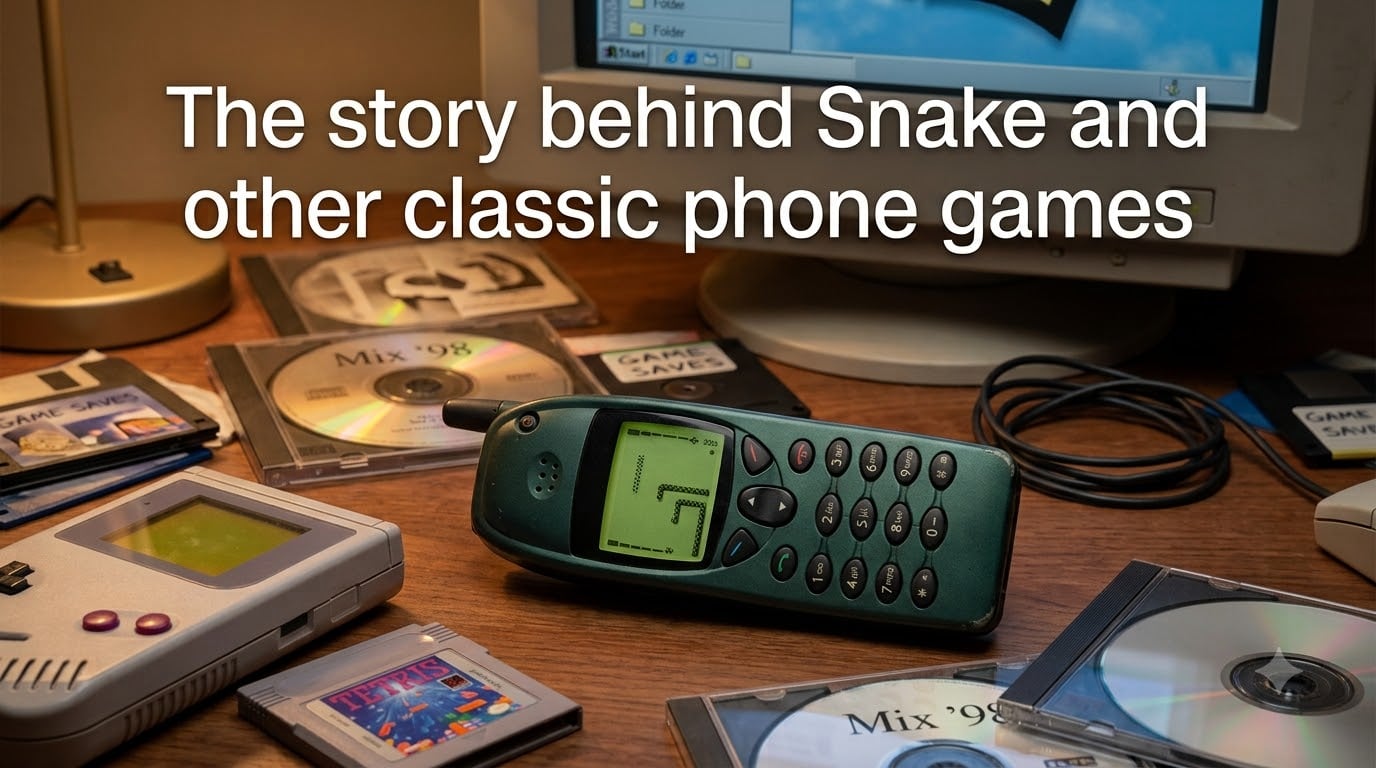
Snake is a classic phone game where players guide a growing serpent around a grid, collecting orbs while avoiding walls and their own tail. The version most people remember was built for the Nokia 6110 in 1997 by Finnish software engineer Taneli Armanto, but its DNA traces back to a 1976 arcade game called Blockade. From that pixelated arcade ancestor to a 350-million-copy mobile empire, Snake didn’t just entertain a generation. It launched the mobile gaming industry and shaped how we play on every device we carry today.
Our team dug into the origins, the developer interviews, and the forgotten siblings of Snake to bring you the complete story. You’ll meet the engineer who coded it in machine language, discover the other Nokia 6110 games that never became household names, and trace Snake’s path from school-bus favorite to MoMA exhibit. Here’s everything that happened before your phone became a game console.
Table of Contents
What is the Snake game and why did it become iconic?
The Snake game is a single-player (sometimes two-player) arcade-style game in which the player controls a line that grows longer with each item collected. Move into a wall or your own body and the round ends. It’s deceptively simple, which is exactly why it worked on a four-directional keypad with no graphics accelerator.
Snake became iconic because it was the first game millions of people ever played on a phone. Before app stores, before touchscreens, before mobile esports, Snake was there. It turned dead time on the school bus, in waiting rooms, and during boring lectures into high-score battles. For an entire generation, Snake wasn’t just a game. It was the reason you owned a Nokia.
Beyond entertainment, Snake proved that phones could be more than communication devices. That single fact pushed handset makers, carriers, and eventually software developers to invest in mobile gaming. By the time smartphones arrived, the groundwork was already laid.
The 1976 Blockade arcade origin that started Snake
The oldest version of Snake is the 1976 arcade game Blockade, developed by Gremlin Industries. Two players controlled lines that grew as they moved, leaving solid trails behind them. Crash into your opponent’s trail or a wall and you lost. The competitive two-player setup made it a perfect arcade attraction, and several clones followed, including Dominos on the HP 2000 and later the hugely popular Nibbler.
Snake’s lineage runs through a chain of titles that borrowed and refined the core idea. In 1982, Atari released Surround for the Atari 2600, adapting the same concept for home consoles. The 1984 BBC Micro version by Peter Adcock introduced single-player play with randomly placed food, which became the template Nokia eventually adopted.
What makes Blockade the true ancestor isn’t just the trail-laying mechanic. It’s the philosophy that games don’t need fancy graphics to be compulsive. That minimalist DNA traveled from arcade cabinets through home computers and finally into the palm of your hand, waiting for the right engineer at the right company to revive it.
Who created Snake? Taneli Armanto’s developer story
Taneli Armanto, a Finnish software engineer working at Nokia in the mid-1990s, invented the Snake game as we know it. He was a young programmer tasked with showing off the Nokia 6110’s new infrared connectivity and graphical capabilities. Rather than build a sterile tech demo, he decided a game would prove the point better than any spec sheet.
Armanto drew on his childhood memories of arcade games to design something simple and instantly playable. He coded Snake in machine language using the C programming language, fitting it into the phone’s tiny memory budget. There was no fancy engine, no graphics library. Just raw code talking directly to a 48 by 84 pixel monochrome LCD display.
In interviews, Armanto has said he never imagined Snake would become so popular. He treated it as a small project that demonstrated what Nokia’s hardware could do. The cultural phenomenon that followed caught him by surprise, much like the developers of other early mobile games who watched their side projects turn into global obsessions.
Armanto’s design choices defined the Snake template still used today. Four-directional movement, food spawning on a grid, instant death on collision, and increasing speed as your snake grows. These weren’t arbitrary rules. They were the simplest possible rules that still created tension, and that simplicity is why Snake ports still ship on new phones decades later.
How the Nokia 6110 launched Snake in 1997?
The Nokia 6110 launched in 1997 as one of Nokia’s flagship business phones. It shipped with Snake alongside two other games, Logic and Memory. The 6110’s monochrome LCD, capable of 48 by 84 pixels, was a step up from earlier Nokia screens and finally allowed something resembling real gameplay graphics.
Nokia sold more than 150 million Nokia 6110 units, and Snake came pre-installed on every single one. That level of built-in distribution was staggering for 1997. The same year, Game Boy was selling millions of cartridges worldwide. Snake didn’t need anyone to buy it separately or download it. You got it the moment you bought the phone.
The phone’s infrared port also enabled a feature few people used but everyone remembered. Two players could connect two Nokia 6110 devices and play Snake head-to-head. It was one of the earliest examples of wireless multiplayer gaming on a phone, and it predated Wi-Fi gaming by years.
The technical constraints shaped the game’s identity. With only one megabyte of memory and a black-and-white screen, Armanto couldn’t add color, sound complexity, or detailed sprites. What he built instead was a game that looked like a wireframe diagram and played like a fever dream. The constraints weren’t limitations. They were the design brief.
How Snake’s gameplay worked on early Nokia phones
Snake’s gameplay loop is brutally simple. You steer a line of pixels around the screen using the 2, 4, 6, and 8 keys. Eat an orb and your snake grows one segment longer. Your score increases, the snake speeds up, and the screen gets more crowded with your own body. Crash into a wall or yourself and the game resets to zero.
Early Nokia Snake ran at a deliberately slow pace, giving players time to plan turns. As scores climbed, the speed levels increased, transforming a casual game into a fingertip endurance test. High-score chasing became the primary motivation, and players compared their best runs the same way teenagers later compared high scores in arcade cabinets.
The pause feature was an unsung hero. Holding a button froze the action mid-game, letting players answer a call or sneak a glance at the teacher without losing their snake. That tiny convenience feature made Snake feel respectful of your time, a quality modern mobile games often forget.
Two-player mode over infrared turned Snake into a social activity. Friends would pull out their Nokia 6110s in the schoolyard, line up the infrared ports, and battle until one ran out of battery. For a generation that grew up without multiplayer mobile games, it was a small miracle.
Other classic phone games that defined the pre-smartphone era
Snake may be the most famous, but it wasn’t alone. The classic phone games era produced a surprising roster of titles that shaped how millions of people experienced mobile gaming for the first time. Most competitors only cover Snake, so this section pulls together the games that shared the spotlight.
Space Impact: Nokia’s homegrown shoot-em-up
Space Impact was another Nokia-developed game, first appearing on the Nokia 6110 in 1997 and refined for later models. Players piloted a small spaceship through scrolling levels, blasting enemies and dodging obstacles. It was the closest the pre-smartphone era got to a Gradius-style shoot-em-up in your pocket.
The game gained serious recognition when it appeared on the Nokia 3310 (2017), giving modern users a chance to experience a forgotten classic. Space Impact proved Nokia understood that gamers wanted diverse experiences, not just one flagship title.
Logic, Memory, and the puzzle game trio
Logic was a Mastermind-style code-breaking game included on the Nokia 6110 alongside Snake. Players guessed a four-color sequence, getting feedback after each attempt. Memory was a tile-matching game similar to the classic Simon toy. Neither game became a cultural phenomenon like Snake, but both showcased how phones could carry mental workouts as well as reflex tests.
Later Nokia phones added more puzzle options, including versions of Tic-Tac-Toe and a sliding-tile game. These titles rarely made headlines, but they gave commuters and waiting-room crowds something to chew on between Snake sessions.
Tetris on Hagenuk and other pre-Nokia experiments
The first known instance of Tetris on a mobile phone appeared on the Hagenuk MT-2000 in 1994, three years before Snake debuted. The Hagenuk was an obscure German handset, but its inclusion of Tetris showed that mobile gaming was technically possible long before Nokia made it mainstream.
Bounce and the rise of platform games on mobile
Bounce, introduced on the Nokia 3510 in 2002, was a red ball platformer that borrowed heavily from Sonic the Hedgehog and classic NES platformers. Players guided a rubber ball through side-scrolling levels, collecting items and avoiding enemies. Bounce was ambitious for a Java-based mobile game and earned a small but devoted following.
The same era saw the rise of Snake clones and puzzle ports on early feature phones. Gameloft and Jamdat Mobile (later acquired by Electronic Arts) launched full game studios dedicated to mobile titles, laying the groundwork for the smartphone app stores that arrived in 2008.
The Snake succession: From Snake II to Snake Xenzia
Snake II arrived in 2000 with the Nokia 3310, the phone that became the global best-seller and turned Snake into a household name. The sequel added multiple levels, walls and obstacles inside the playing field, and a more polished look. Combined with the 3310’s reputation for being nearly indestructible, Snake II became the version most people associate with the franchise.
Snake EX, released on color-screen Nokia phones in the early 2000s, introduced color graphics, varied environments, and worm-like enemies. Snake EX2 expanded the formula further, adding boss fights and more elaborate level designs. By the time Snake III appeared on N-Gage, Nokia’s short-lived gaming handheld, Snake had grown from a tech demo into a full franchise.
The 2017 Nokia 3310 reboot shipped with Snake Xenzia, a modernized take on the original gameplay. The game kept the core mechanics but added subtle color and smoother animation. Snake Rewind, developed by Rumilus Design and released in 2016, offered officially licensed Snake content for modern smartphones with power-ups, multiplayer modes, and global leaderboards.
Google even built its own Snake game hidden inside Google Maps for April Fools’ Day 2019, turning your city streets into a Snake arena. That joke feature, viewed by millions, showed just how deeply Snake lives in the collective memory of anyone who ever owned a Nokia.
Cultural impact and the $100 billion mobile gaming industry
The cultural impact of Snake goes well beyond high scores. In 2017, the Museum of Modern Art in New York added Snake to its collection as part of an interactive design exhibit, recognizing it as a milestone in digital culture. That same year, the World Video Game Hall of Fame inducted Snake as an inductee, placing it alongside Pac-Man, Tetris, and Doom.
Snake also inspired competitive play. The Nokia Snake Championship ran for several years during the 2000s, drawing hundreds of thousands of entrants worldwide. Winners competed on stage, and the event helped establish mobile gaming as a legitimate competitive pursuit at a time when most people still thought of phones as, well, just phones.
On forums like Reddit’s r/nostalgia and r/videogames, users share vivid memories of Snake on school buses, phones confiscated for playing too much during class, and the heartbreak of losing a personal best by crashing into your own tail. Those personal stories are the real measure of Snake’s cultural reach. It wasn’t just a game. It was a shared experience across an entire generation.
The mobile gaming industry that Snake helped birth is now worth over $100 billion globally, larger than console and PC gaming combined. Every modern mobile game, from Candy Crush to Genshin Impact, owes a debt to the engineers and designers who proved that phones were viable gaming platforms. Snake didn’t just survive the smartphone era. It built the foundation for everything that came after.
Where to play Snake today: Modern availability?
You can still play Snake today, on more platforms than ever. The official Snake Rewind app launched in 2016 and remains available on iOS and Android, offering modern Snake gameplay with online leaderboards and daily challenges. Snake ’97, another licensed title, recreates the exact feel of the Nokia 6110 version with optional pay-to-unlock level packs.
Google Snake, available directly in any web browser, lets you play in your choice of classic, slither, or pixel-art styles. It’s free, ad-free, and updates regularly. For purists, the Nokia 3310 (2017) and Nokia 8210 (2024) feature phones still ship with Snake Xenzia installed, giving users an authentic throwback experience.
Emulators and online archives also host Snake, Space Impact, Bounce, and dozens of other classic phone games for browsers and retro handhelds. Whether you want pure nostalgia or a refreshed modern take, Snake is just a download away.
Frequently asked questions about Snake and classic phone games
What is the old snake phone game?
The old snake phone game is the Snake game pre-installed on Nokia phones starting with the Nokia 6110 in 1997. Players controlled a growing line around a grid, collecting orbs while avoiding walls and their own tail. It was created by Taneli Armanto and became the first globally popular mobile game.
Who invented the Snake game?
Taneli Armanto, a Finnish software engineer at Nokia, invented the modern Snake game in 1997. He built it to demonstrate the Nokia 6110’s infrared connectivity and graphical capabilities. The game’s design draws on earlier arcade titles, most notably the 1976 Blockade game by Gremlin Industries.
What was the first Nokia phone with Snake?
The Nokia 6110, launched in 1997, was the first Nokia phone with Snake. It shipped with Snake alongside two other games, Logic and Memory. More than 150 million Nokia 6110 units were sold, giving Snake built-in distribution that no mobile game had ever seen before.
Why was Snake so popular?
Snake was popular because it came pre-installed on hundreds of millions of Nokia phones and was instantly playable with just four keypad buttons. Its simple controls, escalating difficulty, and short session length made it perfect for commuting, classrooms, and waiting rooms. It also helped launch the global mobile gaming industry.
Can you still play old Nokia games today?
Yes, you can still play old Nokia games today through licensed apps like Snake Rewind and Snake ’97, browser-based versions like Google Snake, and modern feature phones such as the Nokia 3310 (2017) and Nokia 8210 (2024), which ship with Snake Xenzia pre-installed.
Final thoughts on Snake and classic phone games
The story behind Snake and other classic phone games is really the story of how mobile devices became gaming platforms. From a 1976 arcade cabinet to a 1997 Nokia tech demo to a $100 billion industry, Snake led the way. The simple joy of guiding a growing line around a grid taught an entire generation what phones could do beyond calls and texts.
Taneli Armanto’s little project, alongside forgotten classics like Space Impact, Logic, Memory, and Bounce, proved that fun doesn’t require cutting-edge graphics. Sometimes a four-direction keypad and a black-and-white screen are all you need. If you want to revisit those early days, fire up Snake Rewind, open Google Snake, or buy a Nokia 3310. The serpent is still hungry, and the high score is waiting to be broken.