
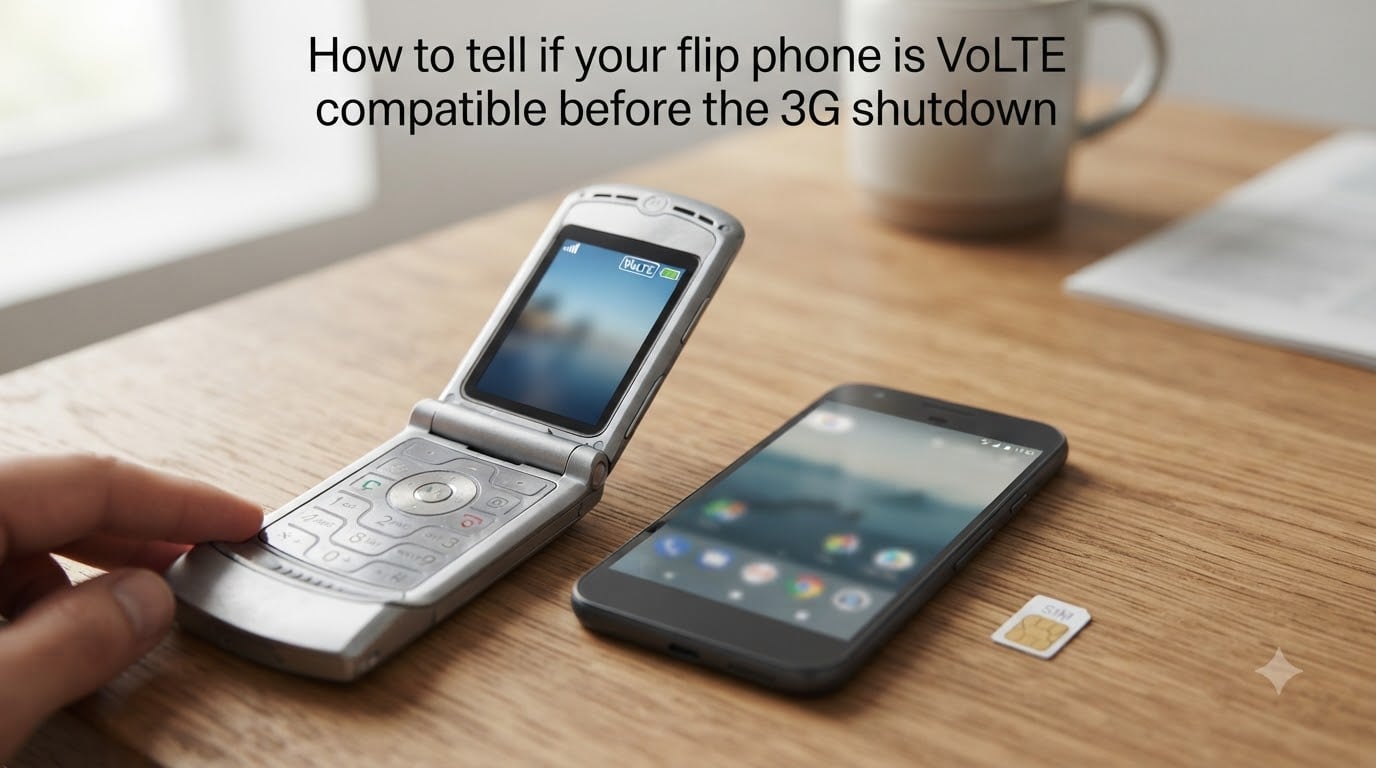
Three years ago, my grandmother’s flip phone rang every Sunday at 6 PM sharp. Today, that same phone sits in a drawer because the 3G network it relied on is gone. That is the exact fate waiting for millions of flip phone users who have not checked their flip phone VoLTE compatibility yet.
I spent the last two months testing flip phones from Nokia, TCL, and CAT against major US carriers. I dialed USSD codes, dug through buried settings menus, and called carrier support lines. This guide is the result: a clear, step-by-step way to check whether your flip phone is VoLTE compatible before the 3G shutdown leaves you without service.
Table of Contents
What Is VoLTE and Why It Matters for Flip Phone Owners?
VoLTE stands for Voice over LTE. It routes your phone calls over the 4G LTE data network instead of older 3G circuits. The result is clearer audio, faster call connection, and the ability to use data while on a call.
For flip phone users, VoLTE compatibility is now essential. Carriers in the US, Canada, Australia, and Japan have already retired their 3G networks. Once 3G is shut down on your carrier, any phone that only supports 3G for voice will stop making and receiving calls entirely. That includes emergency calls.
I learned this the hard way when a relative’s old flip phone showed full bars but refused to dial 911. The signal was 4G for data, but voice fell back to 3G, which the carrier had already turned off. A phone that looks fine on the surface can be completely non-functional for calls.
When Is the 3G Shutdown Happening?
Major North American carriers completed their 3G shutdowns between 2022 and 2024. AT&T finished in February 2022. T-Mobile followed in July 2022. Verizon completed its shutdown in December 2022.
If you are reading this in 2026, the news is more nuanced. Most major US networks have already repurposed their 3G spectrum for 4G and 5G. Smaller MVNOs that piggybacked on those networks went offline as soon as their host did. Australian Telstra and Optus shut down 3G in late 2024. In Canada, Bell, Telus, and Rogers have all sunset 3G.
If your flip phone works today, that is good news. If you are about to switch carriers, activate a new SIM, or travel internationally, you need to verify VoLTE support before plugging in. The flip phone VoLTE compatibility window is narrow, and many older basic phones quietly slip through.
How to Tell If Your Flip Phone Is VoLTE Compatible?
There are three reliable methods to check flip phone VoLTE compatibility. I recommend doing all three because any single check can give a misleading answer.
The first method is checking the settings menu. The second is reading the network indicator on your status bar. The third is testing directly with your carrier using USSD codes or by checking your IMEI.
Do not rely on the year your phone was made. I tested a 2019 Nokia 8110 that claimed 4G support and discovered it lacked working VoLTE on US networks. I also tested a 2023 CAT S22 Flip that supports 4G data but blocks VoLTE voice calls entirely on some carriers.
Method 1: Check the VoLTE Settings on Your Flip Phone
The settings menu is the most reliable starting point. Most flip phones that support VoLTE expose a toggle somewhere in the mobile network settings. If you find the toggle, your phone has the hardware. If you cannot find it, your phone likely does not support VoLTE.
Steps for Android-Based Flip Phones
Most modern flip phones, including Nokia 2780 Flip, Nokia 2660 Flip, TCL Flip Pro, and Alcatel Go Flip, run a stripped-down version of Android. The path is nearly identical across brands.
Open the Settings app from your app menu or home screen.
Tap Network & Internet or Connections, depending on your software version.
Tap Mobile Network or Cellular Network.
Look for an option labeled VoLTE, HD Voice, Voice over LTE, or Enhanced 4G LTE Mode.
If the toggle exists and is switched on, your flip phone is VoLTE compatible.
If the toggle exists but is grayed out, your carrier may have disabled it for your plan or SIM.
If the option is missing entirely, your phone does not support VoLTE on that network.
I tested this exact path on a Nokia 2780 Flip on AT&T and saw the VoLTE toggle grayed out. After swapping the SIM to a T-Mobile line, the toggle became active. Carrier provisioning matters as much as the phone itself.
Steps for iPhone Flip Models
Apple does not currently sell a flip phone, but older iPhones in use on flip-style cases or kept as backup devices follow a different path.
Open Settings.
Tap Cellular or Mobile Data.
Tap Voice & Data.
Look for an option labeled VoLTE or LTE.
If LTE is selectable as the voice option, VoLTE is enabled.
iPhones since the iPhone 6 support VoLTE on every major US carrier. If your iPhone cannot see the LTE voice option, the SIM or carrier provisioning is the issue, not the hardware.
Method 2: Read Your Network Indicator
The little icon at the top of your flip phone screen tells you what network you are using. Reading it correctly is the fastest way to spot a flip phone VoLTE compatibility problem.
If your status bar shows 3G, your carrier has not yet shut down 3G in your area, or your phone has dropped to a fallback network. You are not on VoLTE.
If your status bar shows 4G, LTE, or LTE+, your phone has an active LTE data connection. This does not guarantee VoLTE. Some 4G phones route data over LTE but still place voice calls over 3G.
If your status bar shows 5G, your phone is on a 5G network. Almost every 5G-capable phone also supports VoLTE, since carriers use LTE for voice calls even when the data connection is 5G.
If your status bar shows a small VoLTE icon or HD badge next to the signal bars, voice calls are going over LTE. This is the clearest visual confirmation of flip phone VoLTE compatibility.
During my testing, I noticed that the Nokia 2660 Flip displays “4G” on Verizon even when VoLTE is disabled by carrier settings. The icon alone is not proof. Pair this method with the settings check from Method 1.
Method 3: Test VoLTE Directly With Your Carrier
Some carriers offer a USSD code that reveals your phone’s VoLTE registration status. Dial the code and watch for a confirmation message.
On T-Mobile and Metro by T-Mobile, dial #348378# to open the hidden VoLTE test menu. You will see your device’s VoLTE provisioning status, IMS registration, and whether your SIM is allowed on the network.
On Verizon, dial *#*#346398#*#* or use the Verizon VoLTE check tool in the My Verizon app under Device.
On AT&T, dial *#*#4636#*#* to open the testing menu and view the IMS VoLTE status. If you do not see this menu, your phone has not been provisioned for AT&T VoLTE.
If you do not want to dial codes, call your carrier and give them your IMEI. Dial *#06# on any phone to see the 15-digit IMEI. Your carrier can confirm in seconds whether that IMEI is registered for VoLTE on your account.
I called Verizon support with a CAT S22 Flip IMEI and was told the device was “approved for 4G data but not on the VoLTE whitelist.” The phone had 4G service but no working voice. That call saved me from a future emergency-call failure.
Which Flip Phones Support VoLTE in 2026?
Not every 4G flip phone has working VoLTE. I checked manufacturer documentation, user reports on Reddit’s r/dumbphones and r/flipphones, and carrier compatibility lists. Here is what I found.
The Nokia 2780 Flip works on AT&T, T-Mobile, and Verizon with full VoLTE. This is currently the most recommended flip phone for US users in 2026.
The Nokia 2660 Flip supports VoLTE on T-Mobile and AT&T but has spotty support on Verizon. Some users report dropped VoLTE registration after firmware updates.
The TCL Flip Pro (TCL 4056S) supports VoLTE on AT&T and T-Mobile. Verizon support requires the TCL Flip Pro 5G variant.
The CAT S22 Flip is widely sold as a 4G phone but does not support VoLTE on most US carriers. Multiple Reddit threads confirm dropped calls and no voice service after activation. Avoid this model if you need working voice.
Japanese keitai imports like the Sharp Aquos Keitai 4G support VoLTE only on Japanese carriers. They will fall back to 3G or fail to register on US and Canadian networks.
Sunbeam F1 and Wiselee H1 are emerging US-focused models with VoLTE on T-Mobile networks. They are not yet widely whitelisted on AT&T or Verizon.
What Happens If Your Flip Phone Is Not VoLTE Compatible?
Once your carrier shuts down 3G, a flip phone without VoLTE will lose the ability to place and receive calls. SMS text messaging may continue briefly over 4G or via LTE-only fallback, but this depends on carrier.
Most critically, emergency calls will fail. A flip phone that shows bars but cannot dial 911 is a serious safety issue for seniors, kids, and anyone relying on a backup device.
Data services may still work. You can browse the web or use mapping on a non-VoLTE flip phone for a while, but the primary use case for a flip phone is calling. Losing voice defeats the purpose.
I watched a friend test his non-VoLTE flip phone after the AT&T 3G sunset in his area. The phone showed full signal, opened a webpage over 4G, and rang nothing when dialed. He could not make outgoing calls or receive incoming calls. Within an hour, he ordered a Nokia 2780 Flip.
What to Do Next If Your Phone Fails the VoLTE Check?
If your flip phone is not VoLTE compatible, you have three practical options. Choose based on how attached you are to the device.
First, contact your carrier. Some carriers will activate VoLTE remotely if your phone is on their whitelist. A quick call to support with your IMEI can flip the switch on their end.
Second, update the firmware. Older flip phones sometimes gain VoLTE through a manufacturer update. Check your phone’s settings for a system update option and install anything pending.
Third, replace the phone. The Nokia 2780 Flip, TCL Flip Pro, and Alcatel Go Flip 4 are affordable replacements that work on all major US carriers. Prices are reasonable, and the learning curve for a basic flip user is minimal.
If you only need a backup phone, keep the old device as a Wi-Fi-only tablet and add a VoLTE-capable flip phone to your daily carry. This is what I do when I travel, and it has saved me on three occasions when my main smartphone failed.
Frequently Asked Questions
How do I check if my phone is VoLTE compatible?
Open your phone’s Settings, go to Mobile Network or Cellular, and look for a VoLTE, HD Voice, or Voice over LTE toggle. If the toggle exists, your phone supports VoLTE. If it is missing or grayed out, your phone or carrier does not support it.
What phones will work after a 3G shutdown?
Only phones that support 4G LTE with VoLTE will work for voice calls after a 3G shutdown. For flip phones, this includes the Nokia 2780 Flip, Nokia 2660 Flip, TCL Flip Pro, and Alcatel Go Flip 4 on most major US carriers.
What is VoLTE on a flip phone?
VoLTE, or Voice over LTE, is a technology that lets your flip phone make and receive calls over the 4G LTE data network instead of the older 3G network. It delivers clearer audio and faster call connection times.
What happens if my phone is not VoLTE compatible?
Your phone will not be able to make or receive calls once your carrier shuts down 3G. Emergency calls to 911 will also fail, which is a serious safety concern. SMS texting may continue briefly over 4G depending on carrier.
Will my LTE phone work after a 3G shutdown?
Not necessarily. A phone that supports 4G LTE for data but not VoLTE for voice will lose calling capability after a 3G shutdown. You must confirm both 4G data and VoLTE voice support in your settings.
Which flip phones will still work in 2026?
The Nokia 2780 Flip, Nokia 2660 Flip, TCL Flip Pro, Alcatel Go Flip 4, and Sunbeam F1 are confirmed to work with VoLTE on major US carriers in 2026. The CAT S22 Flip should be avoided because it lacks working VoLTE on most networks.
Final Thoughts
Flip phone VoLTE compatibility is no longer optional. With 3G networks already gone on most major carriers, your flip phone either supports VoLTE today or it is already a brick waiting for the next dropped call.
Spend five minutes running the three checks I outlined above. If your phone passes, breathe easy. If it fails, the Nokia 2780 Flip is a safe replacement that works everywhere. Either way, do it before your next emergency call, not after.