
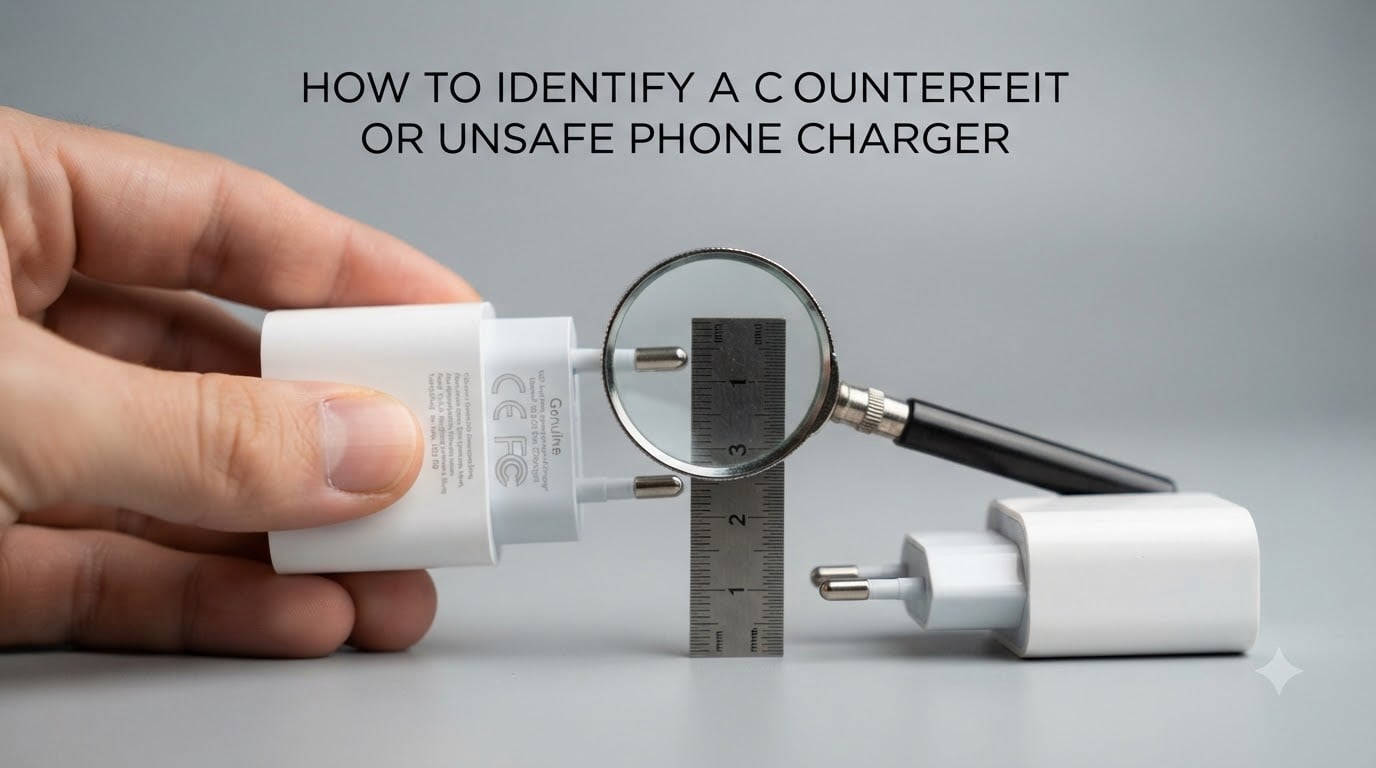
I’ve seen what a counterfeit phone charger can do to a bedroom wall, and I can tell you it isn’t pretty. Charred plastic, melted insulation, and a phone that almost caught fire before its owner smelled the burning.
A counterfeit or unsafe phone charger is a fake or imitation unit that mimics legitimate brands but fails to meet safety standards. It often lacks proper internal insulation, uses substandard components, and omits critical isolation between the mains voltage and the low-voltage output that charges your phone.
This guide shows you how to identify a counterfeit or unsafe phone charger using checks you can do in under five minutes. You’ll learn the 9.5 mm pin spacing rule, what a real CE mark looks like, how to spot USB port defects, and what to do if a charger is already overheating.
By the end, you’ll have a clear checklist you can use before you plug in any charger, plus a few brand-specific tips for Apple, Samsung, and USB-C Power Delivery models.
Table of Contents
Why Counterfeit Phone Chargers Are Dangerous?
The short answer: counterfeit chargers kill phones, burn houses, and shock people. Independent electrical safety testing in the UK found that 98% of fake chargers had the potential to cause a lethal electric shock or start a fire.
The mains voltage coming out of your wall socket is around 230 V in Europe or 120 V in North America. A safe charger steps that down to 5 V or 9 V through a transformer with proper isolation barriers, so the low-voltage side never makes contact with the high-voltage side.
Counterfeit chargers cut those corners. They use thinner insulation, skip the isolation transformer, and cram low-quality capacitors onto a board that was never designed for the heat it generates. When the insulation breaks down, the mains voltage can reach the USB port, your cable, and ultimately your phone.
Three failure modes show up again and again in fire reports:
Thermal runaway – the charger overheats because it can’t dissipate the heat from cheap components.
Arc flash – loose pins or poor contact create a small arc that ignites the plastic case.
Insulation breakdown – over time, the gap between high-voltage and low-voltage sides collapses, energising the USB port.
I treat any unknown charger as suspect until proven otherwise, and I want you to do the same.
Quick Visual Inspection Checklist
The fastest way to start figuring out how to identify a counterfeit or unsafe phone charger is a 60-second visual sweep. Most fakes fail at least one of these checks.
Pin Spacing and Edge Clearance
Look at the plug pins. For UK three-pin plugs, the line and neutral pins must have at least 9.5 mm of clearance from the edge of the charger body to the inner edge of the pin. This isn’t a marketing claim, it’s the BS 1363 standard.
Hold the charger so the pins point toward you. If the line or neutral pin sits within 9.5 mm of the outer edge, the charger is unsafe regardless of what label it carries.
Markings, Fonts, and Labeling
Read every word on the case. Spelling errors, fuzzy printing, or different font weights between two words are classic counterfeit signs. So is a charger that lists a wattage it can’t possibly deliver (a 5 W phone charger that claims 65 W fast charging, for example).
Compare any model number printed on the charger against the official product page on the manufacturer’s website. If the model number doesn’t match, the charger is fake.
USB Port Alignment and Finish
Look straight into the USB port. The plastic tongue inside should be perfectly centred and parallel to the case opening. Reddit users routinely catch fake chargers because the USB port is upside down, off-centre, or set at a slight angle.
Run a fingernail along the seam where the two halves of the case meet. It should feel smooth and even. Sharp edges, gaps, or visible flash (excess plastic from the mould) indicate poor manufacturing.
How to Verify Safety Certification Marks
Every legitimate phone charger sold in the EU or UK must carry specific safety marks. Knowing what those marks should look like is one of the strongest tools for how to identify a counterfeit or unsafe phone charger.
CE Mark Requirements
The CE mark isn’t a quality mark, it’s a legal declaration that the manufacturer claims the product meets EU safety rules. A genuine CE mark has very specific proportions.
The two letters C and E must be the same height, and the mark itself should be at least 5 mm tall. The inner arm of the C and the inner arm of the E should match up. If the letters look stretched, squashed, or spaced too far apart, the mark is fake.
Since Brexit, UK products may also carry a UKCA mark. That mark follows similar proportion rules and must be applied by the manufacturer, not added by the seller.
UL Listing and US Safety Marks
In the United States, a legitimate charger carries a UL mark inside a circle. The letters U and L sit inside a circular border, and a small registration number is printed nearby.
You can verify any UL mark by searching the UL Product iQ database online. Type in the model number and confirm the registration file actually exists. If it doesn’t, the mark is fake.
BS 1363 and Plug-Specific Standards
UK plugs must meet BS 1363. A genuine plug has a partially insulated line and neutral pin, and the earth pin is a fixed, non-moving type. If the earth pin is just a plastic stub or feels flimsy, the plug is non-compliant.
Australian plugs follow AS/NZS 3112, and European two-pin plugs follow CEE 7/16 (Europlug) or CEE 7/17. Each has its own pin dimensions, and knockoffs often get these subtly wrong.
Physical Construction Quality Indicators
Once the labels check out, the next step in how to identify a counterfeit or unsafe phone charger is handling it. A genuine charger feels solid. A fake usually feels hollow.
Weight and Feel
Pick up the charger. A real 5 W or 10 W charger has noticeable weight because it contains a proper transformer, Y-capacitors, and an isolation barrier. A counterfeit often weighs 30% to 50% less.
Forum users regularly report that two visually identical chargers from different sellers had a 20 g difference in weight. The lighter one was fake.
Moulding Defects and Seams
Examine the seam that runs around the charger. On a genuine unit, the seam is either invisible or very fine. On a counterfeit, you’ll see flash, gaps, or uneven joining where the two mould halves met.
Look at the corners. They should be smooth and consistent. Sharp corners, sinks marks (small dimples in the plastic), or discoloured areas are all signs of low-grade manufacturing.
Loose Pins and Wobbly Plugs
Gently wiggle each pin. There should be zero movement. Pins that shift or rotate indicate the internal contacts are not properly crimped or soldered.
For UK plugs, try the shutter mechanism inside the socket opening. It should move smoothly. Stiff, sticky, or absent shutters are non-compliant.
Brand-Specific Verification Tips
Apple and Samsung both publish detailed authentication guidance. Here is the condensed version of how to identify a counterfeit or unsafe phone charger for the most-searched brands.
Apple iPhone Charger Verification
Apple sells two main charger types: the 5 W USB-A brick and the 20 W USB-C brick. Both should have the text “Designed by Apple in California” followed by either “Assembled in China” or “Assembled in Vietnam”.
The model number starts with A for the 5 W unit (for example A1385) and with A for the 20 W unit (for example A2305). You can verify the model number on Apple’s support page.
The USB port on a genuine Apple charger has a uniform grey or white plastic insert. Fakes often have a darker, off-centre, or uneven insert.
Samsung Charger Verification
Samsung’s Super Fast Charging chargers (25 W and 45 W) use USB-C with Power Delivery. Genuine units have the Samsung logo cleanly embossed on the front, and the print on the back is sharp and consistent.
Common Samsung fakes ship with the Super Fast Charging label but only deliver standard 5 V charging. If your phone is showing “Charging slowly” even on a supposed 25 W or 45 W brick, the charger is likely fake.
USB-C Power Delivery Chargers
USB-C Power Delivery (PD) chargers negotiate voltage and current with the phone. A real 30 W or 65 W PD charger must have a proper protocol chip on the board.
Counterfeit USB-C PD chargers often skip the protocol chip. They fall back to 5 V at 1 A or 2 A, which is why your laptop or tablet charges at a crawl even though the brick claims 65 W.
If a USB-C charger has no e-marker chip on the cable and the brick feels light, treat it as suspect until you can test it.
How to Test a Charger With a USB Tester
A USB tester is a small inline device that displays voltage, current, and protocol information. It’s the most accurate way to confirm a charger actually delivers what it claims.
Plug the tester between the charger and a known-good cable, then plug in a phone. A genuine 20 W USB-C PD charger should report a 9 V or 15 V rail at roughly 2 A. A fake usually sticks at 5 V no matter what.
Look at the protocol screen. If the tester reports “PD 3.0” or “QC 4.0” the negotiation is working. If it shows “DCP 5V 1.5A” only, the charger is using the older, slower charging mode and may be a fake.
A USB tester costs roughly the price of a coffee. If you regularly buy second-hand chargers or use third-party brands, it’s a worthwhile investment.
What to Do With a Suspect or Failing Charger?
Once you’ve decided a charger is unsafe, the right next step is to stop using it and dispose of it safely. Throwing it in the general bin is fine, but you can also drop it off at any electrical retailer that accepts e-waste.
Don’t just toss it in a drawer “in case it’s useful”. If you identified a real defect, that defect won’t go away.
If a charger starts to overheat, smell like burning plastic, or pop and hiss, unplug it at the wall immediately. Don’t touch the charger itself, and don’t pour water on it. Move any flammable items away and let it cool in a safe place.
If a fire starts, evacuate the room and call the emergency services. Don’t try to fight a charger fire with a regular extinguisher unless it’s rated for electrical fires.
Where to Buy Genuine Chargers
The simplest way to avoid counterfeit chargers is to control where you buy them. Direct from the manufacturer is always the safest option.
Apple, Samsung, Google, Anker, Ugreen, and Belkin all sell through their own websites and through authorised retailers. Buying from the official store removes most of the risk of receiving a fake.
Major retailers like Best Buy, Argos, Currys, and John Lewis vet their supply chains. Amazon itself sells genuine chargers, but third-party Marketplace sellers are a different story, and that’s where most counterfeits show up.
Price is a useful indicator. If a 20 W USB-C PD charger that retails for around 25 dollars is on sale for 6 dollars with free shipping, something is wrong. The cost of a genuine USB-C PD chip alone is more than that.
Look for these signals before you click “buy”:
The seller’s name matches an authorised distributor list on the brand’s site.
Packaging has a serial number you can verify on the manufacturer’s site.
The product description matches the official listing word for word.
Customer reviews show photos of the actual item, not stock images.
If a deal looks too good to be true, it almost always is.
FAQs
How to know if a charger is unsafe?
A charger is unsafe if it has loose pins, less than 9.5 mm of edge clearance on the line and neutral pins, missing or malformed CE/UL marks, moulding defects, a USB port that isn’t centred, or it gets unusually hot during use. Phone overheating warnings or slow charging on a fast-charge brick are also strong warning signs.
Are counterfeit chargers safe?
No. Independent testing has found that the vast majority of counterfeit chargers fail basic electrical safety tests. They can deliver a lethal electric shock, overheat, catch fire, or damage your phone’s battery. Treat any unverified charger as unsafe until proven otherwise.
How do I verify a charger is genuine?
Verify a charger by checking the model number on the manufacturer’s site, inspecting the CE or UL mark for correct proportions, measuring the pin spacing, weighing the unit, and ideally testing it with a USB tester to confirm it delivers the advertised voltage and protocol.
Conclusion
Knowing how to identify a counterfeit or unsafe phone charger is mostly about slowing down for 60 seconds before you plug in. Check the pin spacing, inspect the safety marks, weigh the unit, and look at the USB port.
If anything looks off, the charger goes in the bin, not the wall socket. And if you regularly buy second-hand or third-party chargers, a USB tester is the single best investment you can make.
Stay safe, and never trust a charger just because it has a brand name printed on the case.