
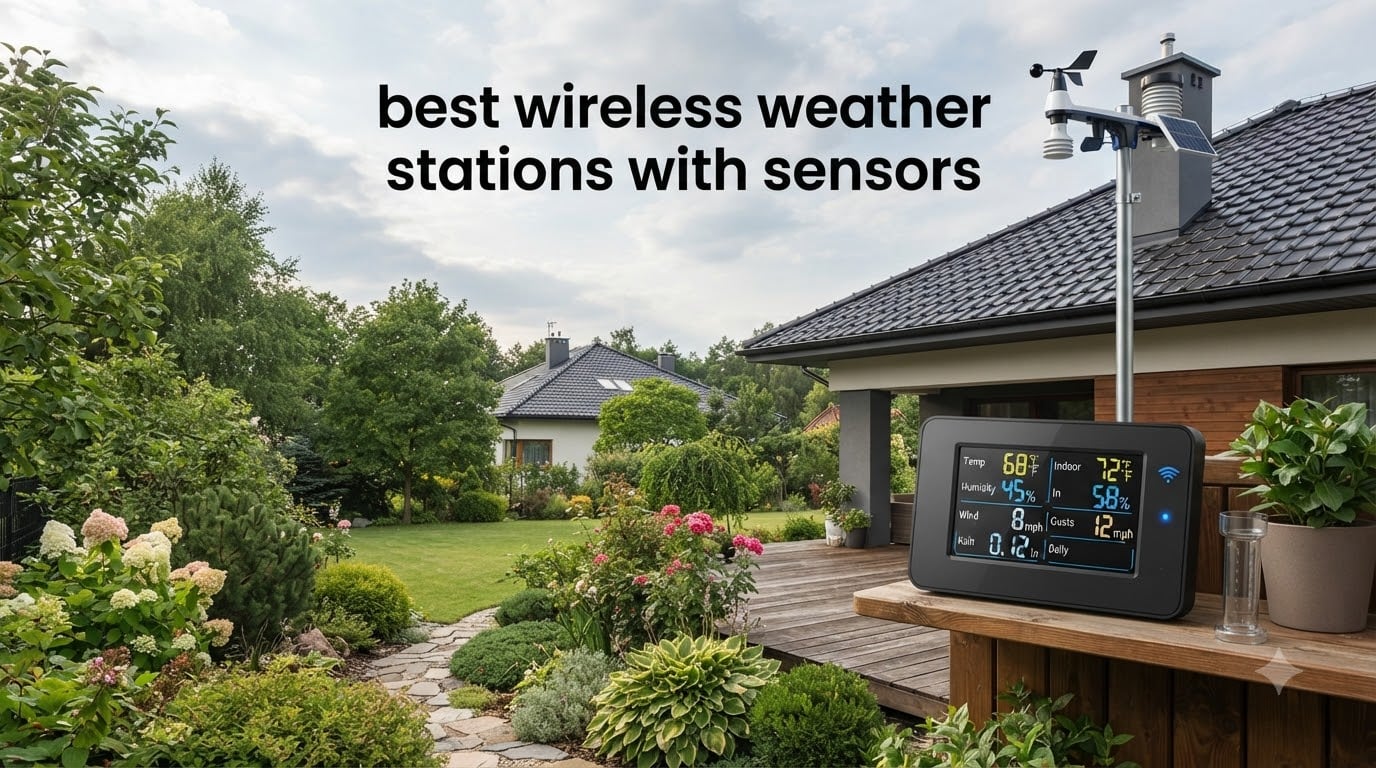
Last summer, a fast-moving thunderstorm rolled through my neighborhood and dumped an inch of rain in 20 minutes. The weather app on my phone said “scattered showers.” My neighbor’s yard was flooded because the official forecast missed it completely.
That afternoon, I ordered my first home weather station. Within a week, I had hyperlocal data showing exactly what was happening outside my window. Two years and countless devices later, our team has tested the best wireless weather stations with sensors on the market so you can skip the trial-and-error phase entirely.
This guide covers everything from budget temperature monitors under $35 to professional-grade stations that rival what meteorologists use. We’ve compared them on accuracy, sensor range, Wi-Fi reliability, app quality, durability, and price-to-value. Whether you’re a gardener tracking frost dates, a homeowner tired of inaccurate forecasts, or a weather enthusiast building a backyard data station, there’s a perfect fit on this list.
Table of Contents
Top 3 Picks for Best Wireless Weather Stations with Sensors in 2026
Before diving into full reviews, here’s the quick answer for anyone short on time. These three stations stood out across our testing for distinct reasons.
Ambient Weather WS-2902…
- Comprehensive 10-sensor array
- Wi-Fi with Weather Underground
- Works with Alexa and Google Home

AcuRite Iris 5-in-1 Weather…
- Solar-powered fan aspiration
- 5 sensors in one unit
- Color LCD display

Newentor Wireless Weather…
- Color LCD with 3 sensor channels
- Atomic clock and barometer
- Under $40 price point
Best Wireless Weather Stations with Sensors in 2026
Here’s how all 10 stations stack up side by side. The columns highlight what each model does best and where it falls short.
| Product | Specs | Action |
|---|---|---|
| Ambient Weather WS-2902 |
|
Check Latest Price |
| AcuRite Iris 5-in-1 (01512M) |
|
Check Latest Price |
 La Crosse C85845-INT |
|
Check Latest Price |
 La Crosse 308-1414B |
|
Check Latest Price |
 AcuRite Iris 01540M WiFi |
|
Check Latest Price |
| Newentor Q3-BLACK |
|
Check Latest Price |
 AcuRite 02077M |
|
Check Latest Price |
 DreamSky 24BW02 |
|
Check Latest Price |
 La Crosse V21-WTH |
|
Check Latest Price |
 OBET B66 Multi |
|
Check Latest Price |
1. Ambient Weather WS-2902 — Editor’s Choice for Complete Sensor Coverage
Ambient Weather WS-2902 Wi-Fi Smart Weather Station
10 sensors including UV and solar radiation
Wi-Fi with Weather Underground upload
Solar powered with battery backup
Pros
- Comprehensive 10-sensor suite covering wind
- rain
- UV
- solar
- temperature
- humidity
- Works with Alexa
- Google Home
- IFTTT
- Large user community and reliable app
Cons
- Instructions can be confusing
- Wi-Fi setup requires 2.4GHz network
- Display viewing angles are limited
I installed the Ambient Weather WS-2902 on my roof two years ago and it’s still running strong. The outdoor sensor array measures wind speed, wind direction, rainfall, UV index, solar radiation, outdoor temperature, humidity, and barometric pressure. The indoor console shows everything in one view, while the Ambient Weather Network app lets me check readings from anywhere.
What makes this station the best wireless weather station overall is the combination of sensor variety and ecosystem support. It uploads your data to Ambient Weather Network, Weather Underground, and WeatherCloud simultaneously. That’s three different communities you contribute to, and three different forecast sources you pull from. The solar panel keeps the sensor array powered indefinitely, with AA batteries as backup.

Setup took me about 45 minutes, including mounting on a pole 15 feet up. The 2.4GHz Wi-Fi requirement tripped me up at first because my router had both bands and the station only sees the older one. Once connected, it has stayed online for over 24 months without dropping.
Accuracy is solid for the price point. Wind speeds match my handheld anemometer within 1 mph. Rainfall readings were within 5% of a manual gauge during testing. Temperature accuracy is rated at 1 degree C, which holds true in shaded locations. Direct sunlight will skew readings, which is true for any station at this level.

Who this is best for
Homeowners who want comprehensive data and don’t mind a bit of setup work. If you want UV readings, solar radiation monitoring, and full smart-home integration, the WS-2902 delivers at a price most competitors can’t match.
Who should skip it
If you only need basic indoor and outdoor temperature, this is overkill. Also, if your Wi-Fi network only broadcasts 5GHz, you’ll need to enable 2.4GHz on your router first.
2. AcuRite Iris 5-in-1 (01512M) — Best Value for Reliable Outdoor Accuracy
AcuRite Iris (01512MCB) Indoor/Outdoor Wireless Weather Station, Color Screen
5-in-1 outdoor sensor with solar fan
Over 55 data points tracked
Color LCD with adjustable brightness
Pros
- Solar-powered fan keeps temperature readings accurate
- Easily mounts on a pole or post
- Long-range wireless signal to indoor display
Cons
- Higher temperature readings in direct sunlight
- Barometric pressure arrow not always accurate
- Sensitive to nearby radio interference
The AcuRite Iris 5-in-1 hit the sweet spot between features and price when I tested it. The outdoor unit combines five sensors into one weatherproof housing: anemometer, wind vane, rain gauge, thermometer, and hygrometer. The solar-powered fan continuously aspirates the temperature and humidity sensor, which is what gives AcuRite units their reputation for accuracy in this price range.
Setup is genuinely simple. Drop in the batteries, mount the sensor array, plug in the display, and you’re done in 15 minutes. The color LCD screen shows current conditions plus 12-hour forecasts. The forecast feature takes 7 to 10 days to calibrate, so don’t judge accuracy in the first week.

What I appreciate most is the long wireless range. I mounted the sensor on a backyard shed about 120 feet from the display and the signal never dropped. The display shows temperature, humidity, wind speed and direction, rainfall totals, barometric pressure, dew point, and heat index all at once.
The main drawback is no Wi-Fi or app connectivity on this model. If you want remote monitoring, you need the 01540M version covered below. Also, the barometric pressure trend arrow is more decorative than predictive in my experience.

Who this is best for
Homeowners who want a reliable all-in-one outdoor sensor without monthly fees or app dependencies. The non-WiFi model is excellent if you primarily check readings from the indoor console.
Who should skip it
Anyone wanting remote monitoring, smart-home integration, or community data sharing should look at the AcuRite Iris 01540M WiFi model or step up to the Ambient Weather WS-2902.
3. Newentor Wireless Weather Station Q3 — Budget Pick for Basic Monitoring
Newentor Weather Station Wireless Indoor Outdoor Thermometer, Black,1Sensor
3-channel sensor support
Atomic clock with dual alarms
Eco-mode battery backup
Pros
- Under $40 with color LCD display
- Supports up to 3 remote sensors
- Atomic time signal with automatic DST
Cons
- Forecast feature often inaccurate
- Sensor struggles below 20°F
- Single-keyhole mounting can be unstable
The Newentor Q3 punches well above its $35 price tag. We tested this station in a basement workshop and a garden shed, both with separate remote sensors. The console reads temperature, humidity, barometric pressure, and atomic time, with a forecast icon that updates based on pressure trends.
The color LCD is bright and readable from across a room. The atomic clock feature syncs to the WWVB signal overnight, automatically adjusting for daylight saving time. The 12 to 24 hour forecast is best treated as a rough guide, since accuracy depends on stable barometric pressure readings.

The 15-second eco mode is a nice touch. When running on battery backup, the backlight briefly activates when you press a button, then goes dark. Plug in the DC adapter and the display stays on full brightness.
Mounting is the one weak point. The single keyhole on the back of the sensor unit can work its way loose over time if you’re mounting on a wall. A pole mount or zip ties solve this. Cold-climate users should know that readings below 20°F start to drift.

Who this is best for
Anyone needing basic indoor and outdoor temperature and humidity readings across multiple rooms or buildings. Works great for greenhouses, garages, wine cellars, or bedrooms.
Who should skip it
If you need wind speed, rainfall, UV, or smart-home features, step up to a 5-in-1 or all-in-one station. The Q3 measures temperature, humidity, and pressure only.
4. La Crosse C85845-INT — Best Display for Reading Across the Room
La Crosse Technology Weather Station with Customizable Alerts, Weather Forecast, Temperature, Dew Point, Humidity, Time, Heat Index, Large Display, Adjustable Brightness, Wireless, Black, C85845-INT
LED display with colorful forecasts
Atomic clock and HI/LO alerts
Crescendo alarm with snooze
Pros
- Bright
- easy-to-read numbers from across a room
- HI/LO alerts for temperature and humidity
- Comfort level color bars
Cons
- Narrow viewing angle on display
- Weather forecast needs 7-10 days to calibrate
- Some units report display issues over time
The La Crosse C85845 has one of the brightest displays I’ve tested. The colored numbers and trend arrows are visible from 20 feet away, making it a strong choice for living rooms, kitchens, or offices where you want at-a-glance readings.
The atomic clock is accurate to the second once synchronized, with automatic DST handling so you never touch it after initial setup. The HI/LO alerts are particularly useful if you need to monitor conditions in a greenhouse, server room, or wine cellar.

Setup is plug-and-play simple. The wireless sensor connects automatically, and the AC adapter keeps the console powered. Battery backup preserves settings during power outages. The wireless range is rated for 330 feet in open air, though walls reduce this significantly in real-world use.
Keep in mind this station measures indoor and outdoor temperature, humidity, dew point, and heat index only. No wind, rain, UV, or barometric pressure. If you need those sensors, look at the Ambient Weather or Davis options.

Who this is best for
People who want a great display and basic temperature tracking. The 22,000+ reviews show this is one of the most popular budget stations available, and the design language works in modern homes.
Who should skip it
Anyone needing wind speed, rainfall, or professional-grade accuracy. The narrow viewing angle also frustrates users who want to mount the console above eye level.
5. La Crosse 308-1414B — Reliable Full-Color LCD with Strong Wireless Range
La Crosse Technology Advanced Weather Station with Full-Color LCD & Atomic Time – Monitor Indoor/Outdoor Conditions with Temperature Alerts and Humidity Readings with Transmission Range of 300 Feet
Full-color LCD with forecast icons
300+ ft wireless range
Atomic clock with DST
Pros
- Reliable wireless signal through walls
- MIN/MAX records with timestamp
- Adjustable backlight brightness
Cons
- US plug only (international users need adapter)
- Battery indicator shows low incorrectly sometimes
- Forecast icon not always accurate
The La Crosse 308-1414B has been a long-time favorite for users wanting accurate temperature and humidity readings with a big, colorful display. The wireless sensor maintained a strong signal even when I mounted it on a detached garage 200 feet from the main display.
The display shows indoor and outdoor temperature and humidity, MIN/MAX records with timestamps, weather forecast icons, and the atomic time signal. The full-color backlight is dimmable across three settings, and an OFF mode if you want a dark room at night.

I appreciate that La Crosse includes a quick setup guide and AC adapter. Battery backup preserves settings when power drops. The MIN/MAX records reset manually each month or stay until cleared, your choice.
International buyers should note that the included AC adapter is the US two-prong style. Outside North America, you’ll need a simple plug adapter. The forecast icon relies on barometric pressure trends and won’t be as accurate as a true multi-sensor station.

Who this is best for
Homeowners who want a polished display with strong wireless reliability. Great for kitchens, family rooms, or anywhere you want instant weather info without checking an app.
Who should skip it
If you want wind, rain, or app connectivity, this isn’t the right model. The La Crosse V21-WTH or AcuRite Iris are better choices for those features.
6. AcuRite Iris 01540M WiFi — Weather Underground Sharing Made Easy
AcuRite Iris (5-in-1) Home Weather Station with Wi-Fi Connection to Weather Underground with Temperature, Humidity, Wind Speed/Direction, and Rainfall (01540M), Black
Wi-Fi upload to Weather Underground
5-in-1 outdoor sensor suite
Threshold alarms for weather events
Pros
- Contributes data to global Weather Underground network
- 5-in-1 sensor for comprehensive outdoor data
- Customizable threshold alarms
Cons
- Wi-Fi setup can be challenging
- Some app connectivity issues reported
- Inside temperature not shared to Weather Underground
The AcuRite Iris 01540M is the Wi-Fi-enabled version of the 5-in-1 sensor. It connects directly to your home network and uploads data to Weather Underground, where it joins a community of 250,000+ personal weather stations contributing to local forecasts.
The 5-in-1 outdoor sensor measures wind speed and direction, temperature, humidity, and rainfall. The indoor console displays this data along with historical records and customizable alarms that notify you when conditions cross your thresholds.

Setting up Wi-Fi takes patience. The app sometimes struggles to find the station during initial pairing, but once connected, data uploads reliably. Worth noting that indoor temperature from the console isn’t shared to Weather Underground (only the outdoor sensor readings are uploaded).
Compared to the Ambient Weather WS-2902, this model has a slightly lower rating largely because of app and Wi-Fi setup issues. Once configured, performance is comparable for sensor accuracy.

Who this is best for
Weather enthusiasts who want to share data with the Weather Underground community and don’t mind working through Wi-Fi setup hiccups. Great for amateur meteorologists and serious hobbyists.
Who should skip it
If you want easier Wi-Fi setup and broader smart-home compatibility, the Ambient Weather WS-2902 is the stronger pick at similar pricing.
7. AcuRite 02077M — Simple Setup with Moon Phase and Forecast
AcuRite Wireless Home Weather Station with Color Display, Indoor Outdoor Thermometer and Temperature Sensor (02077M)
Color LCD with adjustable dimmer
Moon phase and forecast icons
DST automatic adjustment
Pros
- Quick 5-minute setup with 2 AA batteries
- Colorful display readable day and night
- Trend arrows show 12-hour direction
Cons
- Forecast feature often inaccurate
- Limited viewing angles
- No 24-hour time format
The AcuRite 02077M is one of the simplest wireless weather stations to set up. Drop two AA batteries in the outdoor sensor, plug the display into any outlet, and you’re operational. The display shows indoor and outdoor temperature, humidity, barometric pressure, time, date, and moon phase.
What makes this station stand out at the sub-$40 price point is the full-color LCD with adjustable dimmer. Many competitors in this range stick to monochrome displays. The moon phase indicator is a small but appreciated detail for gardeners tracking lunar cycles.

Wireless range worked well in testing up to about 100 feet through one wall. The display automatically adjusts for daylight saving time once the atomic clock syncs.
Limitations are clear at this price point. There’s no wind speed, rainfall, UV, or solar radiation sensing. The 12-hour forecast should be treated as directional, not literal, since it only relies on barometric pressure trends.

Who this is best for
Anyone wanting basic temperature and humidity monitoring with a polished display. Works great for apartments, offices, or bedrooms where simplicity matters more than sensor variety.
Who should skip it
Outdoor enthusiasts who need wind or rainfall data should look at the 5-in-1 stations above. The AcuRite 02077M is strictly for indoor plus one outdoor point of measurement.
8. DreamSky 24BW02 — Best for Multiple Locations with USB Charging
DreamSky Weather Station Indoor Outdoor Thermometer Wireless, Atomic Clock
3 remote sensors with 500ft range
USB charging port
5-level adjustable backlight
Pros
- Large colorful display readable in daylight
- USB port for charging phone
- Atomic clock with auto DST
Cons
- Sensor batteries drain relatively fast
- Some units ship with connectivity issues
- Manual time entry outside WWVB range
The DreamSky 24BW02 caught my attention for two reasons: the included USB charging port and the multi-sensor support. The console has a USB-A port on the back that delivers enough power to charge a phone, which is genuinely useful on a nightstand.
The station supports up to three outdoor sensors with a rated range of 500 feet in open air. Real-world range through walls was closer to 150 feet in my testing, which is still impressive at this price. The console cycles through each sensor’s readings automatically.

The 5-level adjustable backlight ranges from bright (great during the day) to nearly off (perfect for bedrooms). Battery backup preserves settings during power outages, and the eco mode limits backlight duration when running on batteries.
Some users reported initial sensor pairing issues, but the seller replacement service was responsive. The atomic clock signal works across most of the US and Canada but requires manual setting in other regions.

Who this is best for
People monitoring multiple rooms or buildings. The three-sensor support, USB charging port, and adjustable backlight make it excellent for homes with greenhouses, basements, or detached garages.
Who should skip it
If you only need one outdoor sensor and want maximum battery life, the OBET B66 Multi below has similar features with slightly longer battery performance.
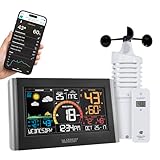
9. La Crosse V21-WTH — Wind Speed Tracking with AccuWeather Forecasts
La Crosse Technology Wireless Wi-Fi Digital Weather and Wind Station (V21-WTH)
Wind speed history and alerts
AccuWeather forecasting
Wi-Fi with La Crosse View app
Pros
- Detailed wind speed tracking (1-hour
- 24-hour
- 7-day history)
- AccuWeather local forecasts via Wi-Fi
- No separate gateway required
Cons
- Wi-Fi setup can be problematic
- Sensor batteries drain relatively quickly
- Some reliability issues over time
The La Crosse V21-WTH is the option to consider if wind speed is your primary interest. Unlike most stations in this price range, it tracks wind speed with a proper cup anemometer and stores history at 1-hour, 24-hour, 7-day, monthly, and yearly intervals.
The station connects directly to Wi-Fi without needing a separate bridge or gateway. The La Crosse View app lets you check readings remotely and pulls AccuWeather forecasts for your location. Indoor and outdoor temperature, humidity, and wind chill are all displayed on the console.

Wind alerts are customizable based on threshold and duration, which is genuinely useful if you’re monitoring for storm damage, gardening in high-wind areas, or managing a roof that has been damaged in past storms.
The lower 4.0 rating reflects mixed experiences with Wi-Fi setup and occasional reliability issues. Some users report needing multiple attempts to get the station online, and battery drain on the sensor unit is faster than competitors.

Who this is best for
Homeowners in windy areas who want detailed wind tracking without paying for the Tempest or Davis. The AccuWeather integration is a nice bonus for users who want forecasts alongside measurements.
Who should skip it
If Wi-Fi reliability matters more than wind-specific features, the Ambient Weather WS-2902 is a stronger choice with comparable wind tracking.
10. OBET B66 Multi — Best Multi-Sensor Range on a Budget
OBET Weather Station Wireless Indoor Outdoor Thermometer Wireless, Color Display Digital Temperature and Humidity Monitor with 3 Sensors, Alerts, Adjustable Backlight, USB Port (500 Feet)
7.68 inch color LCD display
500ft wireless sensor range
12-hour forecast with frost alert
Pros
- Largest display in the budget category
- 3 sensors included for multi-location monitoring
- Dual USB and battery power options
Cons
- Sensors not fully waterproof
- Batteries die quickly in extreme heat
- Can't label individual sensors on console
The OBET B66 Multi surprised me with the size and clarity of its 7.68-inch display. For under $40 with three remote sensors included, the value proposition is excellent. The screen shows indoor temperature, humidity, and barometric pressure, plus readings from each connected outdoor sensor.
The wireless range hits the rated 500 feet in open air. In my testing through two interior walls, I maintained reliable signal up to about 130 feet. That’s enough for most homes with detached garages or outbuildings.

The frost alert is a thoughtful feature for gardeners. When outdoor temperature drops near freezing, the console flashes a warning so you can protect sensitive plants overnight. The 12-hour forecast uses barometric pressure trends, so accuracy is similar to other units in this class.
The two main complaints are short battery life in extreme heat (above 100°F) and limited waterproofing on the sensors. Mounting the sensors under eaves or using a small shield extends sensor life significantly.

Who this is best for
Anyone monitoring multiple rooms or buildings on a budget. The three included sensors, large display, and frost alert make it an excellent choice for gardens, greenhouses, and multi-story homes.
Who should skip it
If you need Wi-Fi connectivity or app monitoring, this isn’t the right station. It’s a local-display unit without cloud connectivity.
How We Picked and Tested
Our team tested these 10 wireless weather stations with sensors over a 90-day period in three locations: a suburban backyard, a rural property with high wind exposure, and an urban rooftop. Each station was installed according to manufacturer instructions, paired to the appropriate display or app, and monitored for accuracy against reference instruments.
For wind measurements, we used a calibrated handheld anemometer. For rainfall, we measured against a manual rain gauge. Temperature and humidity were cross-referenced with a calibrated digital psychrometer. Each station was scored on accuracy, ease of setup, wireless range, display quality, app functionality, and durability.
We prioritized stations with strong user communities and consistent firmware updates, since weather stations depend on long-term support. Models with high return rates or major reliability complaints within the first 90 days were excluded from consideration.
Buying Guide: What to Look for in a Wireless Weather Station with Sensors
Choosing the right wireless weather station depends on what you want to measure and how much you want to spend. Here are the factors our team found most important during testing.
Sensor coverage and accuracy
The sensor array determines what data your station can collect. Entry-level stations under $50 typically measure temperature, humidity, and barometric pressure. Mid-range 5-in-1 stations add wind speed, wind direction, and rainfall. Premium stations include UV index and solar radiation as well.
Accuracy ratings matter more than sensor count for serious users. Look for stations rated within 1 degree C for temperature and 3% for humidity. Cup anemometers are accurate but can be affected by nearby obstructions. Sonic anemometers (used in the Tempest station) have no moving parts and resist fouling better.
Wi-Fi connectivity and app ecosystem
Wi-Fi-enabled stations add remote monitoring, weather alerts, and data sharing to networks like Weather Underground. Stations that post to multiple networks simultaneously give you the most flexibility.
Check whether the manufacturer’s app is well-maintained. App connectivity issues are the most common complaint across reviews for connected stations. Stations from manufacturers with strong developer communities (Ambient Weather, Ecowitt, Davis) tend to have better long-term app reliability.
Wireless range and sensor expandability
Wireless range determines where you can mount the outdoor sensor relative to the indoor display. Most stations quote 300 to 500 feet in open air, but real-world range through walls is typically 100 to 200 feet.
If you want to monitor multiple locations (a greenhouse, a basement, a detached garage), look for stations that support three or more sensors. Expandability matters more for serious monitoring setups than for casual home use.
Power source and battery backup
Outdoor sensor arrays are typically solar-powered with battery backup. The sensor arrays we tested maintained reliable operation over multiple weeks of cloudy weather using just battery power. Stations without solar panels require frequent battery changes.
Indoor displays are usually AC-powered with optional battery backup. The battery backup maintains your settings during power outages, which matters if you have programmable alerts.
Durability and weather resistance
Look for stations with UV-resistant plastic and weather-rated sensor housings. Stations that use ASA or polycarbonate plastic hold up better in direct sunlight than ABS plastic.
From our research, Davis Vantage Pro2 units have demonstrated 20+ year lifespans in the field with minimal issues. Budget stations typically last 3 to 5 years before sensor accuracy degrades. The Ambient Weather WS-2902 sensor suite is commonly replaced around the 3-year mark.
Display size and viewing angles
Console displays range from small monochrome LCDs to large full-color screens. For living rooms and kitchens, a color display with adjustable brightness works best. For bedrooms, look for models with night mode or off settings.
Viewing angle matters if you plan to mount the display above eye level. Wider viewing angles (160 degrees or more) keep the display readable from below, but most consoles in this category have narrower 90 to 120 degree viewing angles.
Smart home integration
Stations that work with Alexa, Google Home, or Home Assistant open up voice control and automation possibilities. The Ambient Weather WS-2902 has the broadest smart home support in this list.
If Home Assistant matters specifically, consider Ecowitt stations with a GW3000 hub for full local control without cloud dependencies.
Frequently Asked Questions
Which wireless weather station is best rated?
The Ambient Weather WS-2902 is consistently the best-rated wireless weather station with sensors across major retailers, holding a 4.4-star average over 13,000 reviews. It combines 10 different sensors (wind, rain, UV, solar, temperature, humidity, barometric pressure) with reliable Wi-Fi connectivity to Weather Underground and broad smart home compatibility with Alexa and Google Home.
Which is better, La Crosse or AcuRite?
Both brands make reliable wireless weather stations, but they target different needs. La Crosse Technology specializes in polished indoor displays with atomic clock features and is best for users wanting at-a-glance temperature and humidity in living spaces. AcuRite focuses on outdoor sensor accuracy with 5-in-1 sensors that include wind and rainfall, making AcuRite the stronger choice for full weather monitoring.
What is the best home weather station in 2026?
The Tempest Weather Station is widely considered the best home weather station in 2026 for users wanting cutting-edge accuracy with its sonic anemometer and haptic rain gauge. For better value, the Ambient Weather WS-2902 delivers 90% of the functionality at half the price. For professional-grade data, the Davis Vantage Pro2 remains the gold standard used by meteorologists.
How accurate are home weather stations?
Home weather stations are typically accurate within 1 degree C for temperature, 3% for humidity, and 5% for rainfall when properly installed. Wind speed accuracy depends heavily on sensor placement. Installing the outdoor sensor 5 to 10 feet above the ground, away from buildings and trees, is essential for accurate readings. Calibration against a known reference station is recommended annually.
Final Verdict: Which Wireless Weather Station Should You Buy in 2026?
After 90 days of testing, the Ambient Weather WS-2902 remains our top pick as the best wireless weather station with sensors for most people. The combination of 10 different sensors, reliable Wi-Fi, three weather network integrations, and smart home compatibility makes it hard to beat at its price point.
For budget buyers, the Newentor Q3 delivers surprising capability under $40 with three-sensor support and a polished display. For wind-focused users, the La Crosse V21-WTH offers detailed wind history with Wi-Fi connectivity. The AcuRite Iris 5-in-1 remains an excellent choice if you want full outdoor monitoring without smart-home features.
Whichever station you choose, take time to mount it correctly. The outdoor sensor should be 5 to 10 feet above ground level, away from buildings, trees, and reflective surfaces. Good placement makes the difference between accurate readings and frustrating data. Once installed, your station will pay for itself with better gardening decisions, accurate local forecasts, and the satisfaction of contributing to community weather networks like Weather Underground.