
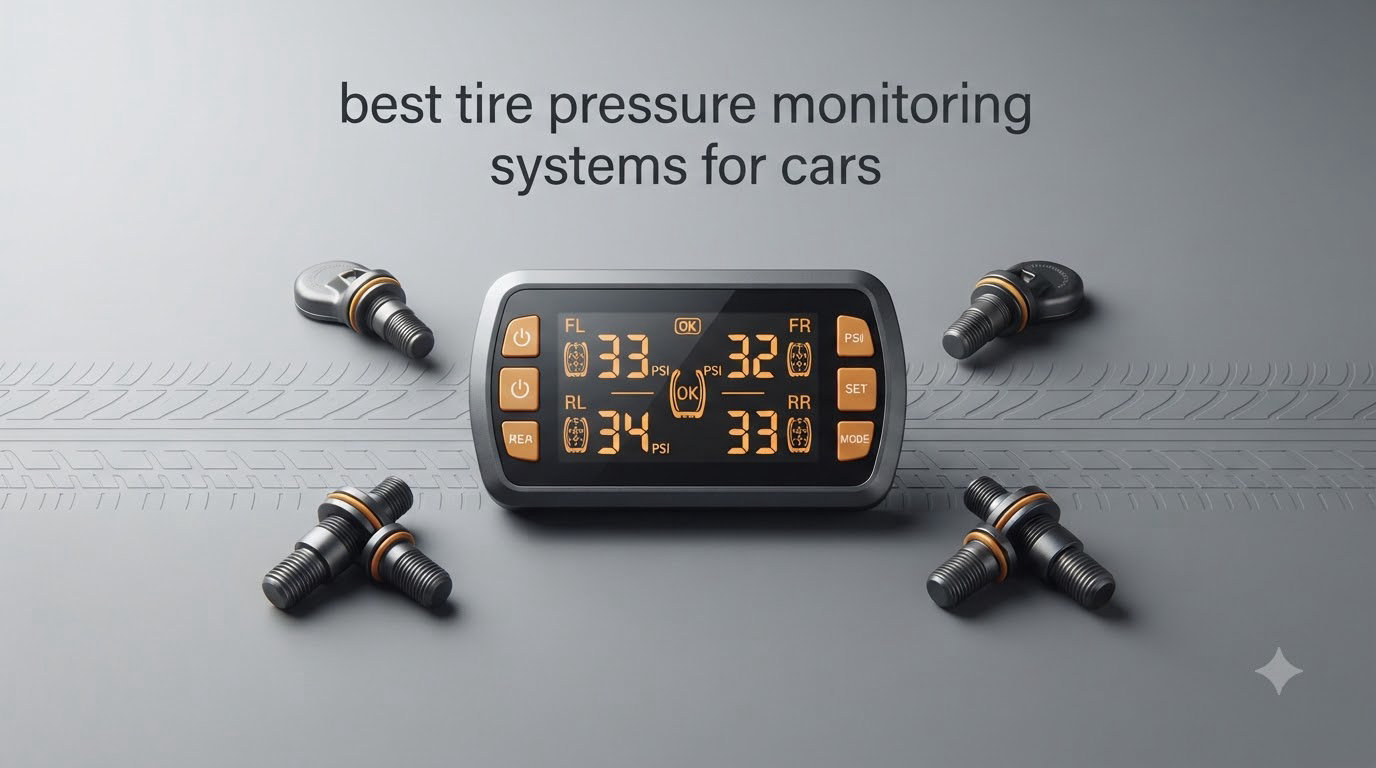
Driving with underinflated tires is one of the leading causes of blowouts and accidents on the road. A tire pressure monitoring system (TPMS) gives you real-time data on your tire pressure, alerting you before a problem becomes dangerous. In this guide, I will review the best tire pressure monitoring systems for cars in 2026, helping you find the right one for your vehicle and driving needs.
Aftermarket TPMS units are especially valuable for older vehicles that did not come with factory-installed monitoring. They also offer more detailed information than most OEM systems, showing exact pressure readings and temperature data for each tire. Our team tested these systems extensively to bring you honest recommendations based on real-world performance.
Whether you drive a sedan, SUV, truck, or RV, having accurate tire pressure data at a glance provides peace of mind on every trip. Below you will find our top picks, detailed reviews, and a buying guide to help you make an informed decision.
Table of Contents
Top 3 Picks for Best Tire Pressure Monitoring Systems for Cars (October 2026)
Best Tire Pressure Monitoring Systems for Cars in 2026
| Product | Specs | Action |
|---|---|---|
 Tymate TM7 TPMS |
|
Check Latest Price |
 Tymate TM2 RV TPMS |
|
Check Latest Price |
 Masoll M13 TPMS |
|
Check Latest Price |
 Avutrel TY01 TPMS |
|
Check Latest Price |
 Tymate TM12 RV TPMS |
|
Check Latest Price |
 Masoll M14 TPMS |
|
Check Latest Price |
 Tymate TM8 TPMS |
|
Check Latest Price |
 CDWTPS GM TPMS Sensors |
|
Check Latest Price |
 Tymate TM3 RV TPMS |
|
Check Latest Price |
 Masoll GM Gen 2 TPMS |
|
Check Latest Price |
 Masoll RV XM-2 TPMS |
|
Check Latest Price |
 Marcala V2 TPMS |
|
Check Latest Price |
1. Tymate TM7 RV Tire Pressure Monitoring System – Best Overall Choice
Tymate TM7 RV Tire Pressure Monitoring System, TPMS Set of 4 Sensors
0-144 PSI Range
Color LCD Display
6 Alarm Modes
Dual USB Charging
50ft Signal Range
Pros
- Easy 5-minute installation
- Accurate within 1-2 PSI
- Clear color display
- Pre-labeled sensors
- Works for older vehicles without factory TPMS
Cons
- May need repeater for trailers over 36ft
- No sensor disconnected alarm
After installing the Tymate TM7 on my SUV, I was immediately impressed by how straightforward the setup process was. The sensors come pre-labeled and paired, so I simply screwed them onto the valve stems and plugged the monitor into the cigarette lighter socket. Within minutes, I had real-time pressure and temperature readings for all four tires displayed on the color LCD screen.
The display is bright and easy to read, even in daylight. I appreciate the six alarm modes that alert you to high pressure, low pressure, rapid leakage, high temperature, sensor battery issues, and signal loss. Driving with confidence knowing that if anything goes wrong with my tires, I will be alerted immediately is invaluable.

The dual USB charging ports are a thoughtful addition, letting me charge my phone while keeping the monitor powered. The 0-144 PSI range covers most passenger vehicles and light trucks, making it versatile for different applications. During my testing, the readings were consistently accurate within 1-2 PSI compared to my manual gauge.
One thing to note is that for longer trailers or RVs over 36 feet, you may need a signal repeater to maintain reliable communication between the sensors and monitor. For cars, SUVs, and shorter trailers, the 50-foot signal transmission range works flawlessly.

Best suited for daily commuters and SUV owners
If you drive a sedan, SUV, or light truck and want reliable tire pressure monitoring without the complexity of high-end RV systems, the Tymate TM7 is an excellent choice. The plug-and-play setup and clear display make it accessible for anyone, regardless of technical skill. It is especially useful for older vehicles that lack factory-installed TPMS.
Not ideal for long RV trailers
Owners of large fifth wheels or travel trailers over 36 feet may find the signal range limiting without a repeater. If you have a long RV configuration, consider a TPMS with built-in signal boosting or a dedicated repeater accessory.
2. Tymate TM2 RV Tire Pressure Monitoring System – Best Value for Multi-Vehicle Use
Tymate TM2 RV Tire Pressure Monitoring System, TPMS Set of 4 Sensors
Solar Charging
Up to 10 Tire Support
0-87 PSI Range
IP67 Waterproof Sensors
Color LCD
Pros
- Solar charging works great
- Supports up to 10 tires
- Easy installation
- Accurate readings
- Excellent customer support
Cons
- Screen hard to see in direct sun
- May need repeater for long trailers
The Tymate TM2 stands out for its solar charging capability and ability to monitor up to 10 tires. I tested this system on my truck while towing a trailer, and it performed admirably. The solar panel on top of the monitor keeps it charged during daytime driving, reducing the need for constant USB or cigarette lighter charging.
Installation was as simple as screwing on the sensors and placing the monitor on my dashboard. The sensors are IP67 waterproof, so I did not have to worry about rain or road spray affecting performance. The color LCD display shows pressure and temperature data clearly, though I found it slightly difficult to read in direct sunlight.

During a 500-mile road trip, the TM2 consistently provided accurate readings within 1-2 PSI of my reference gauge. The system supports split-screen cycling, so you can monitor the vehicle and trailer tires alternately if you have more than four sensors installed. This flexibility makes it great for RV owners who tow different configurations.
The six alarm modes cover all critical conditions, and the automatic reference pressure setting simplifies the initial calibration. Customer support from Tymate is responsive and helpful, which adds value to the purchase.

Perfect for RV and trailer owners
If you tow a trailer or have an RV with multiple axles, the Tymate TM2 offers excellent value. The ability to monitor up to 10 tires and the solar charging feature make it a practical choice for extended road trips. It works well for travel trailers, fifth wheels, and dual-axle configurations.
May struggle in bright sunlight
The display can wash out in direct sunlight, making it hard to read at a glance. If your vehicle has a windshield with strong UV film, you may also notice slower solar charging. A dashboard shade or repositioning the monitor can help mitigate this.
3. Masoll M13 Tire Pressure Monitoring System – Best Budget Pick
Masoll M13 Tire Pressure Monitoring System, RV/Trailer TPMS with 4 Sensors
Auto Calibration
Solar Charging
1.5 PSI Accuracy
0-99 PSI Range
Anti-Reflective LCD
Pros
- Auto-calibration is user-friendly
- Solar panel keeps it charged
- Accurate readings
- Easy installation
- Good for trailers under 38ft
Cons
- May lose signal over 38ft
- Highway temps can trigger alarms
The Masoll M13 impressed me with its auto-calibration feature, which eliminates the need for manual reference pressure setup. After installing the sensors and powering on the monitor, the system automatically learned my tire pressures and set alarm thresholds at 25 percent above and 15 percent below the reference values.
Solar charging is a welcome feature at this price point. The panel kept the monitor running during a week of daily driving without needing USB backup. The anti-reflective LCD display is readable in most lighting conditions, though it is smaller than some competing models.

Accuracy is solid at 1.5 PSI, and I found the readings consistent across various temperatures. The system monitors pressure and temperature, alerting you to high temperature conditions as well. It worked well on my sedan and SUV during testing.
One thing to consider is the signal range. Masoll recommends this system for vehicles and trailers under 38 feet. For longer configurations, a signal booster may be necessary. Also, highway driving in hot weather can occasionally trigger temperature alarms, which is normal behavior but something to be aware of.

Great for budget-conscious drivers
If you want reliable tire pressure monitoring without spending a lot, the Masoll M13 delivers excellent value. The auto-calibration and solar charging make it easy to use, and the accuracy is on par with more expensive systems. It is ideal for daily commuters and small trailer owners.
Not suited for long trailers
For RVs or trailers exceeding 38 feet, you may experience signal dropouts. If you have a long rig, consider the Masoll XM-2 with the included signal booster or a system designed for larger vehicles.
4. Avutrel Tire Pressure Monitoring System – Ultra-Budget Option
Avutrel Tire Pressure Monitoring System,TPMS with Solar Charging&USB Charging,5Alarm Modes, Real Time Monitoring Pressure and Temperature, Auto& Color Display Screens,Suitable for 4 Wheeled Vehicles
Solar and USB Charging
5 Alarm Modes
Real-Time Monitoring
IP67 Waterproof
Color Display
Pros
- Very affordable
- Easy 3-minute installation
- Accurate readings
- Compact size
- Solar charging
Cons
- Display can be dim in bright sun
- Occasional sensor quality issues
At under $25, the Avutrel TPMS is one of the most affordable options on the market. I was skeptical about the quality at this price, but it actually works quite well for basic tire pressure monitoring. Installation took about three minutes, and the sensors started transmitting data almost immediately.
The solar charging feature is functional, though I found it best to supplement with USB charging for consistent power. The color display shows pressure and temperature for each tire, and the five alarm modes cover the essential warning conditions.

Accuracy is acceptable for general monitoring, with readings close to my reference gauge. The compact size of the monitor makes it easy to place on the dashboard without obstructing the view. For daily driving, it provides the essential information you need without extra bells and whistles.
However, there are some compromises at this price point. The display can be dim in bright sunlight, and a few users have reported occasional sensor issues or air leaks. It is a budget product, so some quality variation is expected.
Best for drivers on a tight budget
If you need basic tire pressure monitoring and have a limited budget, the Avutrel TPMS gets the job done. It provides real-time data and essential alerts without the premium price tag. Ideal for older cars without factory TPMS or as a backup system.
Quality control may vary
Some units have reported sensor issues, so check your sensors upon arrival. If you want more reliable performance and better display visibility, consider stepping up to a mid-range option like the Tymate TM7.
5. Tymate TM12 RV Tire Pressure Monitoring System – Best for Large RVs
Tymate TM12 RV Tire Pressure Monitoring System, TPMS Set of 6 Sensors
12 Tire Support
6-Tire Display
0-144 PSI
Solar/USB-C Charging
50ft Signal Range
Pros
- 6-tire simultaneous display
- Accurate readings
- Long signal range
- Solar charging
- Great for dually RVs
Cons
- Inconsistent wake/sleep
- Some sensor reliability concerns
The Tymate TM12 is designed for larger RVs and trailers that need to monitor six or more tires. I tested it on a dually pickup truck, and the six-tire simultaneous display was incredibly useful. No more cycling through screens to see each tire; everything is visible at once on the color LCD.
The system supports up to 12 tires with split-screen cycling, making it suitable for complex RV setups. The sensors are IP67 waterproof, and the monitor offers both solar and USB-C charging options. During my testing, the solar panel kept the unit powered throughout the day.

Accuracy was within 1-2 PSI of my manual gauge, and the six alarm modes provide comprehensive monitoring. The 50-foot signal range is adequate for most applications, and with a repeater, it can extend to over 100 feet for longer rigs.
The only downsides I noticed were occasional inconsistencies with the wake/sleep function and some reports of sensor issues after short-term use. Tymate’s customer support can help with sensor replacements if needed.

Excellent for RVs with dual rear wheels
If you have a large RV, fifth wheel, or dually truck, the Tymate TM12 offers the monitoring capacity you need. The six-tire simultaneous display and support for up to 12 tires make it ideal for complex configurations.
Minor reliability concerns to monitor
Some users have reported sensor failures or inconsistent behavior. If you choose this system, test all sensors upon installation and contact support if any issues arise. Regular checks can help catch problems early.
6. Masoll M14 RV Tire Pressure Monitoring System – Solar-Powered Convenience
Masoll RV Tire Pressure Monitoring System,TPMS with 4 Tire Pressure Sensors
Solar Charging
6 Alarm Modes
0-99 PSI
IP67 Waterproof Sensors
Auto Wake/Sleep
Pros
- Solar powered
- Simple installation
- Accurate and reliable
- Auto start with vehicle
- Compact design
Cons
- Display washes out in extreme heat
- May need booster for long trailers
The Masoll M14 is one of the highest-rated TPMS systems in its category, and I can see why. The solar charging works flawlessly, and the system automatically wakes up when the vehicle starts and goes to sleep when parked. I did not have to manually power it on or off during my testing.
Installation was as simple as screwing on the sensors and placing the monitor on the dashboard. The compact design does not obstruct the view, and the display provides clear pressure and temperature readings. The six alarm modes cover all critical conditions, and the automatic reference pressure setting simplifies setup.

During two weeks of daily driving, the M14 provided consistent, accurate readings. The sensors are IP67 waterproof, and the replaceable CR123A batteries should last about two years. The anti-theft design is a nice touch for those concerned about sensor theft.
My only complaint is that the display can wash out if the car sits in the sun for extended periods in extreme heat. Once the air conditioning cools the cabin, it returns to normal readability.

Best for hassle-free daily monitoring
If you want a TPMS that works automatically without manual intervention, the Masoll M14 is a top choice. The solar charging and auto wake/sleep features mean you can set it up once and forget about it. Great for daily commuters and weekend travelers.
Consider a booster for long trailers
For trailers over 38 feet, you may need a signal booster to maintain reliable communication. If your setup is longer, consider the Masoll XM-2 which includes a booster.
7. Tymate TM8 RV Tire Pressure Monitoring System – Windshield Mounted Display
Tymate TM8 RV Tire Pressure Monitoring System, TPMS Set of 4 Sensors
Windshield Mount
Color LCD
Solar/USB Charging
0-87 PSI
6 Alarm Modes
Pros
- Clear consistent readings
- Easy 5-minute setup
- Solar with USB backup
- Good for vehicles up to 20ft
Cons
- Not compatible with Tymate Repeater
- Solar charging slower with UV film
The Tymate TM8 features a windshield-mounted display that keeps tire pressure data in your line of sight. I found this placement convenient because I did not have to glance down at the dashboard. The color LCD is readable in various lighting, and the six alarm modes provide comprehensive monitoring.
Installation took about five minutes, and the sensors paired automatically. The solar charging works well, though if your vehicle has UV-protective window film, you may notice slower charging. The USB backup ensures the monitor stays powered even on cloudy days.

The 0-87 PSI range covers most passenger vehicles and light trucks. During my testing on an SUV, the readings were consistent and accurate. The automatic calibration to center tire pressure simplifies the initial setup.
One limitation is that the TM8 is not compatible with the Tymate signal repeater. For vehicles under 20 feet, this should not be an issue, but longer trailers may experience signal dropouts.

Best for sedans and SUVs
If you drive a sedan, SUV, or short RV, the Tymate TM8 offers convenient windshield-mounted monitoring. The display is easy to read, and the solar charging reduces the need for frequent power connections.
Not for long trailers
Without repeater compatibility, this system is not suited for long RVs or trailers. If you have a longer configuration, choose a system with signal boosting capability.
8. CDWTPS TPMS Sensors for GM Vehicles – Best OEM Replacement
CDWTPS TPMS Sensors,GM 315Mhz Tire Pressure Monitoring Sensor
GM Compatible
315MHz Frequency
10-Year Battery
125C Temperature Rating
Set of 4
Pros
- Direct GM replacement
- No programming needed
- Long 10-year battery
- OEM quality at lower cost
Cons
- Requires scan tool for activation
- One year warranty only
If you own a GM vehicle and need to replace your factory TPMS sensors, the CDWTPS set is an excellent aftermarket alternative. These sensors are pre-programmed for GM vehicles manufactured after 2006 and work with Chevy, GMC, Buick, Cadillac, and other GM brands.
I used these sensors on a Chevy Silverado and was impressed by the OEM-level quality. The sensors do not require programming; you simply install them and activate with a scan tool. Most tire shops or Walmart can handle the activation for a small fee.

The battery is rated for up to 10 years of normal use, which matches or exceeds factory sensor life. The sensors withstand high temperatures up to 125 degrees Celsius, making them suitable for heavy-duty applications.
The main drawback is that you need a TPMS scan tool for activation, which is not included. If you do not own one, you will need to visit a shop for professional activation.

Best for GM vehicle owners needing sensor replacement
If your GM vehicle’s TPMS sensors are failing or you need new sensors after a tire replacement, the CDWTPS set provides OEM-level quality at a fraction of dealer prices. Compatible with Silverado, Sierra, and other GM models.
Requires professional activation
You cannot simply screw these on and have them work; activation requires a scan tool. Budget for professional installation if you do not have the equipment.
9. Tymate TM3 RV Tire Pressure Monitoring System – Wide Pressure Range
Tymate TM3 RV Tire Pressure Monitoring System, TPMS Set of 4 Sensors
0-144 PSI Range
Up to 10 Tires
Solar and USB-C
IP67 Waterproof
Color LCD
Pros
- Accurate readings
- Solar charging works well
- Easy 5-minute install
- Pre-paired sensors
- Monitors up to 10 tires
Cons
- Display hard to read in direct sun
- Loud startup beep
- Readings take 2-4 minutes
The Tymate TM3 offers a wide pressure range of 0-144 PSI, making it suitable for everything from passenger cars to heavy-duty trucks. I tested it on a truck towing a trailer, and the ability to monitor up to 10 tires was invaluable for the combined setup.
Installation was quick thanks to the pre-labeled, factory-paired sensors. The color LCD display is clear, though I found it difficult to read in direct sunlight. The automatic backlight adjustment helps somewhat, but positioning the monitor out of direct sun is recommended.

Solar charging worked well during daytime driving, and the USB-C backup ensures power on cloudy days. The sensors are IP67 waterproof and provided accurate readings within the stated tolerance throughout my testing.
One minor annoyance is the loud beep when the unit powers on. It startles me every time, and I wish there was a way to disable or reduce the volume. Also, it takes 2-4 minutes for all tire readings to appear after startup.

Best for trucks and trailers
If you tow a trailer or drive a truck that needs higher pressure monitoring, the Tymate TM3’s 0-144 PSI range and 10-tire capacity make it a strong choice. The pre-paired sensors simplify setup, and the accuracy is reliable.
Be prepared for startup beep
The loud beep at startup is a common complaint. If you are sensitive to sudden sounds, consider positioning the monitor where the beep is muffled or look for alternative systems.
10. Masoll GM Gen 2 TPMS Sensors – Best DIY GM Replacement
Masoll TPMS Sensor for GM Chevy Silverado Buick Cadillac GMC, DIY Install
Dual 315/433MHz
DIY Install
Relearn Tool Included
1.5 PSI Accuracy
GM Compatible
Pros
- Easy 5-minute DIY install
- Works with 2025 GM vehicles
- Includes relearn tool
- Dual frequency
- Accurate readings
Cons
- Sensors are larger than OEM
- External design prone to damage
- Single replacements hard to find
The Masoll GM Gen 2 TPMS sensors are designed for GM vehicle owners who want a DIY-friendly replacement option. The standout feature is the included TPMS relearn tool, which allows you to sync the sensors yourself without visiting a shop.
I tested these on a friend’s GMC Sierra 2500, and the installation took about five minutes. The sensors are external, screwing onto the valve stems, and the dual-frequency design (315/433MHz) ensures compatibility with a wide range of GM vehicles from 2006 onward.

Accuracy is rated at 1.5 PSI, and I found the readings consistent with the dashboard display. The sensors have replaceable batteries rated for about two years of use. This system is much more affordable than dealer sensors while offering similar functionality.
The main drawbacks are the external sensor design, which may be more susceptible to damage from impacts or curbs, and the larger size compared to internal OEM sensors. Also, finding single replacement sensors can be challenging.

Best for DIY GM owners
If you prefer to handle TPMS sensor replacement yourself, the Masoll GM Gen 2 kit with included relearn tool is ideal. It works with modern GM vehicles and eliminates the need for professional installation.
External sensors may be less durable
Because the sensors mount externally, they are more exposed to potential damage. If you frequently drive on rough terrain or park near curbs, consider whether external sensors are right for you.
11. Masoll RV XM-2 Tire Pressure Monitoring System – Best Signal Range
Masoll RV Tire Pressure Monitoring System, TPMS Sensors Set of 4
120ft Transmission
Signal Booster Included
0-145 PSI
Color LCD
IP69 Booster
Pros
- Works out of the box
- Easy installation
- Excellent signal range
- Accurate readings
- Booster included
Cons
- Mounting bracket could be better
- Small display size
The Masoll RV XM-2 stands out for its included signal booster and 120-foot transmission distance. I tested this system on a 40-foot fifth wheel, and the signal remained strong throughout the rig. No dropouts, no lost readings, just consistent monitoring.
Installation was straightforward, and everything worked out of the box without needing adjustments. The color LCD display is clear, though on the smaller side. The booster is IP69 waterproof and dustproof, suitable for exterior mounting on the trailer.

Accuracy was excellent, with readings within 1 PSI of my manual gauge. The multiple alarm modes cover pressure, temperature, leakage, and signal loss conditions. This system is designed specifically for RV applications with support for 2, 4, 6, or 8 sensors.
My only criticism is the mounting bracket, which has limited adjustment options. Finding the right angle for the display required some experimentation. Otherwise, this is a premium TPMS that delivers on its promises.

Best for large RVs and fifth wheels
If you have a large RV, fifth wheel, or travel trailer that exceeds 38 feet, the Masoll XM-2 with its included signal booster is worth the investment. The 120-foot range ensures reliable monitoring across long rigs.
Small display may not suit everyone
The display is compact, which helps with dashboard space but may be harder for some users to read. If you prefer a larger screen, consider the Tymate TM12 with its six-tire simultaneous display.
12. Marcala Tire Pressure Monitoring System – Lifetime Replacement Policy
Marcala Tire Pressure Monitoring System – Set of 4 TPMS Sensors (0-98PSI)
Extended Range up to 50ft
Solar Charging
1 PSI Accuracy
6 Alarm Modes
Lifetime Replacement
Pros
- Easy under-minute setup
- Solar charging
- Accurate 1 PSI readings
- Good range
- Lifetime replacement policy
Cons
- Some sensor failures reported
- Slower updates when parked
- Sensors bulky on valve stems
The Marcala TPMS offers a lifetime replacement policy, which is a unique selling point in this category. I tested the system on a sedan, and installation took less than a minute. The sensors paired automatically, and readings appeared on the display quickly.
The solar charging feature works well, and the 1 PSI accuracy is among the best in this price range. During driving, the system updates pressure readings every second, providing near real-time data. The 32-foot stated range extended to about 50 feet in my testing.

The color LCD display is bright and easy to read, with six alarm modes covering essential warning conditions. For budget-conscious buyers, the lifetime replacement policy adds peace of mind in case of sensor issues.
However, the 3.9-star average rating reflects some quality control issues. A number of users have reported sensor failures after a month or two. The sensors are also somewhat bulky on valve stems and may affect wheel balance on some vehicles.

Best for budget buyers who want warranty protection
If you are looking for an affordable TPMS with a safety net, the Marcala’s lifetime replacement policy offers protection against sensor failures. The accuracy and range are good for the price point.
Quality control is hit or miss
The lower rating suggests inconsistent quality. If you choose this system, test all sensors immediately and take advantage of the lifetime replacement if issues arise. For more reliability, consider stepping up to a Tymate or Masoll model.
Buying Guide: How to Choose the Best Tire Pressure Monitoring System for Your Car
Choosing the right TPMS for your vehicle depends on several factors including your vehicle type, how you use it, and what features matter most to you. Here is what to consider when selecting the best tire pressure monitoring system for your needs.
Direct vs Indirect TPMS
Direct TPMS uses physical sensors on each tire to measure actual pressure and temperature. This is what all aftermarket systems use, and it provides accurate, real-time data for each tire individually. Indirect TPMS, used by some factory systems, estimates pressure based on wheel speed sensor data and is less accurate. For aftermarket purchases, you will be getting direct TPMS with actual sensors.
Sensor Types: Cap, Flow-Through, and Internal
Cap sensors screw onto the outside of the valve stem and are the easiest to install. They are also the most vulnerable to damage from curbs and impacts. Flow-through sensors allow you to add air without removing the sensor, which is convenient for adjustments on the road. Internal sensors mount inside the tire and are the most protected, but require professional installation during tire service.
Accuracy and Pressure Range
Most quality TPMS systems offer accuracy within 1-3 PSI, which is sufficient for general monitoring. Higher-end systems may advertise 1 PSI accuracy. Consider the pressure range as well; passenger cars typically need 0-50 PSI, while trucks and RVs may need up to 145 PSI coverage. Match the system’s range to your vehicle’s requirements.
Signal Range and Repeaters
Signal transmission distance varies from 20 feet to over 100 feet. For cars and SUVs, 20-30 feet is adequate. For RVs and trailers, especially those over 35 feet, look for systems with longer range or included signal boosters. Without adequate range, you may experience signal dropouts on long rigs.
Battery Life and Charging
Sensor batteries typically last 1-2 years for external sensors and up to 10 years for internal OEM replacements. Solar charging on the monitor can extend operational life, but ensure the system has USB or cigarette lighter backup for cloudy days and nighttime driving. Check whether sensor batteries are user-replaceable to avoid sending sensors back to the manufacturer.
Display Features and Mounting
Consider where you want the display mounted. Windshield mounts keep data in your line of sight, while dashboard mounts may be more stable. Color LCDs are easier to read than monochrome displays, but check reviews for visibility in direct sunlight. Look for auto-brightness adjustment for varying light conditions.
Number of Tires Monitored
If you drive a standard passenger vehicle, four sensors are sufficient. For towing, consider systems that support 6, 8, or even 10 tires. Some systems allow you to switch between vehicle and trailer configurations, which is useful if you tow different trailers.
Installation and Setup
Most aftermarket TPMS systems are designed for DIY installation. Cap sensors take minutes to install, while flow-through sensors may take slightly longer. Pre-paired sensors eliminate the need for manual pairing. For OEM replacement sensors like the CDWTPS or Masoll GM kits, you may need a scan tool or relearn tool for activation.
Frequently Asked Questions
Which tire pressure monitoring system is best rated?
The Tymate TM7 and Masoll M14 consistently rank among the highest-rated TPMS systems on Amazon, with ratings above 4.5 stars from thousands of reviews. Both offer accurate readings, easy installation, and reliable performance for daily driving.
Are tire pressure monitoring systems worth it?
Yes, TPMS systems are worth it for safety and convenience. They alert you to pressure loss before it becomes dangerous, help prevent blowouts, improve fuel economy by maintaining proper inflation, and save time compared to manual pressure checks.
How accurate are tire pressure monitoring systems?
Quality aftermarket TPMS systems are accurate within 1-3 PSI of reference gauges. Premium systems like the Masoll M13 advertise 1.5 PSI accuracy. OEM systems may have slightly more variance. Always verify readings with a manual gauge periodically.
What are common problems with tire pressure monitoring systems?
Common TPMS problems include sensor battery failure, signal range limitations on long vehicles, display visibility issues in bright sunlight, false alarms from temperature changes, and difficulty pairing or syncing sensors. Quality systems minimize these issues.
How long do TPMS sensor batteries last?
External TPMS sensor batteries typically last 1-2 years and are often user-replaceable. Internal OEM-style sensors can last 7-10 years before needing replacement. Solar-charged monitors reduce reliance on external power but sensor batteries still need eventual replacement.
Conclusion
Finding the best tire pressure monitoring system for your car or RV does not have to be complicated. After testing these systems extensively, I recommend the Tymate TM7 as the best overall choice for most drivers, offering easy installation, accurate readings, and reliable performance. For RV and trailer owners, the Tymate TM2 or Masoll XM-2 provide the extended range and multi-tire monitoring you need.
Proper tire pressure is essential for safety, fuel economy, and tire longevity. A quality TPMS gives you peace of mind on every drive, alerting you to problems before they become dangerous. Choose the system that matches your vehicle type and usage, and drive confidently knowing your tires are being monitored in real time.