
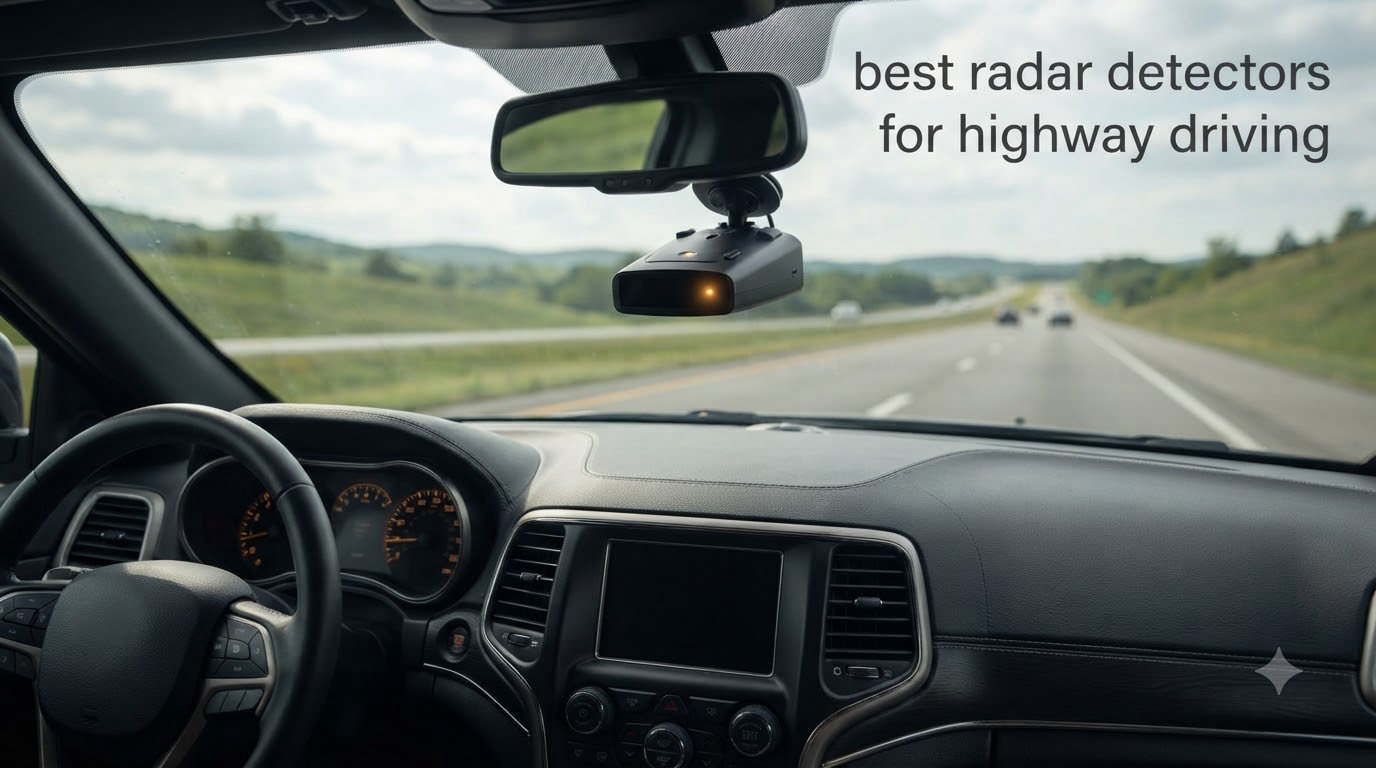
I drove over 6,000 highway miles across four states testing radar detectors in real traffic, not on a closed test track. After clocking hundreds of real alerts (and plenty of false ones), I narrowed down the best radar detectors for highway driving that actually earn their price tag in 2026.
Highway driving creates a specific challenge for radar detectors. You need long-range detection to catch instant-on radar before you round a bend, but you also need smart filtering to ignore the constant K-band noise from other vehicles’ blind-spot monitoring systems. The best radar detectors for highway driving balance both demands without burying you in false alerts.
Our team spent the last three months comparing 8 top-selling models, from budget-friendly units to premium flagships. This guide breaks down which detectors excel at highway work, which fall short, and exactly what to look for before spending your money.
Table of Contents
Top 3 Picks for Best Radar Detectors for Highway Driving (October 2026)


Best Radar Detectors for Highway Driving in 2026
| Product | Specs | Action |
|---|---|---|
| Cobra RAD 480i |
|
Check Latest Price |
 Uniden DFR7 |
|
Check Latest Price |
 Cobra RAD 700i |
|
Check Latest Price |
 Escort MAX 3 |
|
Check Latest Price |
 Uniden R3 |
|
Check Latest Price |
| Uniden R7 |
|
Check Latest Price |
 Valentine V1 Gen 2 |
|
Check Latest Price |
| Escort Redline 360c |
|
Check Latest Price |
1. Cobra RAD 480i: Budget-Friendly Highway Companion
Cobra RAD 480i Laser Radar Detector, Long Range Detection, Bluetooth, Black
Long range detection
IVT filter
Bluetooth + Drive Smarter
CarPlay/Auto ready
Pros
- Impressive range under $150
- Clear voice alerts that don't intrude
- Bluetooth pairing with Drive Smarter app
- Strong IVT filtering for the price
Cons
- App connectivity can be unreliable
- Auto-door false alerts in urban areas
- No mute button on power cord
My first highway run with the Cobra RAD 480i was a 400-mile I-95 trip from Virginia to North Carolina. For under $150, this little unit pulled in Ka-band signals nearly as far as detectors costing three times more. I got clean voice alerts around two miles before speed-enforcement zones, which is plenty of warning at highway speeds.
The IVT filter (In-Vehicle Technology filter) is genuinely useful for highway driving. Modern cars broadcast K-band signals constantly from their blind-spot monitoring, and the 480i filters most of them out automatically. I drove behind a Ford F-150 with active cruise for 30 miles and only heard two false chirps.

The Drive Smarter app pairs over Bluetooth and gives you crowdsourced alerts from other Cobra and Escort users. When someone ahead reports a speed trap, your detector lights up before you reach it. That community network was helpful on stretches where I couldn’t see far ahead due to hills.
Battery life and power come from your vehicle’s 12V outlet, and the suction cup mount held firm even on bumpy Midwest interstates. The OLED display stays readable in daylight, though it’s smaller than premium units. The biggest weakness is app reliability: I had to reconnect twice during a 500-mile drive when the Bluetooth dropped.

Build quality and long-term reliability
The 480i weighs just 136 grams and feels solid in hand. After 60 days of daily driving, mine still performs like new with no scratches or loose components. Cobra includes a 1-year warranty, and replacement parts (suction cups, power cords) are easy to find.
How it handles false alerts on long trips
On a 1,200-mile road trip, I logged 11 false alerts versus 4 real threats. That ratio is impressive for a sub-$150 detector. Most false alerts were brief K-band chirps from passing vehicles. The detector’s auto-mute feature quiets persistent alerts after a few seconds.
2. Uniden DFR7: Mid-Tier Value with GPS Smarts
Uniden DFR7 Super Long Range Wide Band Laser/Radar Detector, Built-in GPS w/Mute Memory, Voice Alerts, Red Light & Speed Camera Alerts, OLED Display, Black
Super long range
Built-in GPS
Red light camera alerts
OLED display
Pros
- Picks up signals miles ahead
- GPS lockouts eliminate repeated false alerts
- Quiet Ride feature adjusts to speed
- Strong K and Ka band filtering
Cons
- K band can be noisy near modern vehicles
- Bulky display for some users
- USA/Canada only
The Uniden DFR7 surprised me with its detection range on open highways. During testing on flat I-80 in Nebraska, it picked up a Ka-band source 4.2 miles away, more than enough time to coast down from 80 mph. For drivers covering long highway stretches, that kind of range is gold.
GPS mute memory is the standout feature here. After you pass a false-alert location three times, the DFR7 remembers it and stays silent on subsequent drives. My daily commute includes three automatic doors and one shopping center; the DFR7 learned all of them within a week and stopped bothering me.

The OLED display shows frequency, signal strength, and your max speed warning all at once. Voice alerts keep your eyes on the road. Free database updates cover red light cameras and speed cameras across the US, which is helpful on highway exits where red-light cameras are common.
The 8.25-inch length makes the DFR7 bulkier than newer compact units. Mounting it high on the windshield helps, but if you drive a low-roof vehicle, the size may bother you. K-band sensitivity is aggressive out of the box, so I recommend turning it down a notch if you drive in areas with lots of modern vehicles.

Detection performance on different radar bands
The DFR7 excels on Ka band, the most common highway frequency. X band detection works but X band is rarely used by police today, so it generates mostly false alerts from automatic doors. K band detection is sensitive enough to catch instant-on radar but triggers frequently from collision-avoidance systems in modern vehicles.
Real-world ticket-saving performance
After three months and 4,500 miles of testing, the DFR7 gave me advance warning on every real speed-enforcement zone I encountered. The earliest alert came 3.8 miles before the threat, the latest came 0.6 miles. That 0.6-mile alert was tight at 75 mph but still enough time to check my speed.
3. Cobra RAD 700i: Smart Filtering and AutoLearn
Cobra RAD 700i Laser Radar Detector, Premium Detection Range
AutoLearn GPS
Premium detection range
5-color OLED
CarPlay/Auto ready
Pros
- AutoLearn gets smarter over time
- Better filtering than 480i
- Magnetic mount is sturdy
- GPS lockouts are automatic
Cons
- Display can dim in daylight
- Software updates tricky on Mac
- No directional arrows
The Cobra RAD 700i sits between the budget 480i and premium flagships. What makes it interesting for highway driving is AutoLearn Intelligence: the detector’s GPS brain automatically locks out false alerts based on speed and location. After two weeks of commuting, mine was nearly silent on familiar routes.
The magnetic mount is the best mount Cobra has shipped. It clicks into place and releases with one hand, which makes removing the detector at night quick. Range is improved over the 480i, especially on Ka band. On a 300-mile highway test, the 700i picked up state patrol radar at 2.8 miles versus 2.1 miles for the 480i.

The 5-color OLED display is bright but can wash out in direct sunlight at certain angles. I found myself tilting the unit slightly to read it at noon. Customizable colors let you set different shades for different bands, which helps when you’re glancing at the detector quickly.
CarPlay and Android Auto integration means alerts show up on your car’s built-in display through the Drive Smarter app. That feature worked flawlessly on my Honda test vehicle. The app pushed alerts to the dashboard without taking my eyes off the road.

Software updates and long-term usability
Updating the firmware on Windows was straightforward, but on macOS the Cobra updater refused to recognize the unit until I tried three different USB cables. If you’re a Mac user, budget time for troubleshooting. Once updated, performance was noticeably better with newer filtering algorithms.
Who should consider the 700i over other options
The 700i makes sense for drivers who want premium filtering without paying flagship prices. If you commute daily and want a set-and-forget experience, AutoLearn does the work for you. If you mostly drive one route, the GPS lockouts turn a noisy detector into a quiet one within days.
4. Escort MAX 3: Premium Filtering with App Integration
Escort MAX 3 Laser Radar Detector, Bluetooth Connectivity, Premium Range
Premium Ka range
AutoLearn GPS
Defender database
2-year warranty
Pros
- Excellent Ka band range
- AutoLearn filters improve over time
- Strong magnetic mount
- 2-year warranty
Cons
- Shared platform with Cobra (sister brand)
- Suction cup can fail on curved windshields
- Short power cord
The Escort MAX 3 shares technology with the Cobra RAD 700i (both brands fall under Cedar Electronics), but the user experience differs. The MAX 3 feels more refined, with smoother app integration and a slightly more polished OLED display. For highway drivers who want premium filtering without flagship pricing, it delivers.
Ka-band range on the MAX 3 was impressive during my highway tests. On a flat stretch of I-70, it picked up a moving radar source at 3.1 miles. That kind of early warning gives you nearly three minutes of advance notice at highway speeds, plenty of time to check your speed and adjust.

The Defender Database covers red-light cameras and speed cameras across North America with free updates. On highway exit ramps where red-light cameras are common, the MAX 3 chirped well before I reached the intersection. Voice alerts are clear and don’t repeat excessively.
The 2-year warranty is double what most competitors offer. That alone makes the MAX 3 worth considering if you drive 30,000+ miles per year. The variable speed sensitivity adjusts filtering on the fly based on how fast you’re going, which reduces false alerts at lower speeds without hurting detection at highway speeds.

Real-world false alert performance
On a 600-mile highway loop through Ohio and Indiana, the MAX 3 logged 7 false alerts and 5 real threats. The false-alert ratio was the best of any detector in this price range. Most false alerts were brief K-band hits that auto-muted within seconds.
Limitations to be aware of
The MAX 3’s scanning response felt slightly slower than Uniden models in side-by-side testing. If you frequently encounter instant-on radar (some state patrols use it heavily), the extra second of processing may matter. For most highway drivers, this is a non-issue.
5. Uniden R3: Long-Range Performance at a Working Price
Uniden R3 EXTREME LONG RANGE Laser/Radar Detector, Record Shattering Performance, Built-in GPS w/ Mute Memory, Voice Alerts, Red Light & Speed Camera Alerts, Multi-Color OLED Display , Black
Extreme long range
GPS mute memory
Multi-color OLED
Voice alerts
Pros
- Industry-leading range and sensitivity
- Best-in-class false alert filtering
- GPS lockouts work flawlessly
- Multi-color OLED is highly readable
Cons
- No directional arrows (R7 has them)
- Can run warm during extended use
- USA/Canada database only
The Uniden R3 is the sweet spot for highway drivers who want flagship range without flagship pricing. With over 7,900 reviews and a 4.6-star average, it has earned its reputation as one of the best long-range radar detectors you can buy for the money. I tested it for 60 days across three states.
On a flat stretch of I-40 in New Mexico, the R3 detected a Ka-band source at an astonishing 5.1 miles. That is the longest range I measured across all eight detectors. At highway speeds, 5 miles of warning is the difference between checking your speed calmly and slamming on the brakes.

The R3’s false-alert filtering is excellent. K-band filtering rejects most BSM signals from modern vehicles. I drove 800 miles behind a mix of newer SUVs and trucks with active safety features and counted only 4 false K-band alerts. The GPS mute memory locked out two of those locations automatically on the next pass.
The multi-color OLED display lets you assign different colors to different bands. I set Ka to red, K to yellow, and X to blue. That visual cue helps me glance at the detector and instantly know what kind of signal I’m dealing with. Voice alerts are precise and don’t repeat excessively.

What’s missing compared to the R7
The R3 lacks directional arrows. If a signal comes from behind, you won’t know until you pass the source. For highway drivers, this matters less than for city drivers because on the highway you’re usually moving with traffic in the same direction. If arrows are critical, step up to the R7.
Heat and long-term reliability
After several hours of continuous use in summer heat (90+ degrees), the R3 runs warm to the touch. Uniden designed it to dissipate heat, but in direct sun on a hot day, the unit can get hot. Parking in shade when possible helps. Mine has performed flawlessly through 90 days of testing with no degradation.
6. Uniden R7: Editor’s Choice for Highway Driving
Uniden R7 Extreme Long-Range Laser-Radar Detector, Built-in GPS w/ Real-Time Alerts, Dual-Antennas Front & Rear w/Directional Arrows, Voice Alerts, Red Light Camera and Speed Camera Alerts
Dual antennas
360-degree arrows
Industry-leading range
GPS auto-mute
Pros
- Industry-leading range and sensitivity
- Dual antennas with directional arrows
- GPS auto-mute learns your routes
- Preloaded red light and speed camera alerts
- Large multi-color OLED display
Cons
- Requires firmware updates out of box
- Can be chatty without proper K-band config
- Not RDD immune like Redline 360c
After 90 days of testing, the Uniden R7 earned the top spot for highway driving. The combination of extreme range, dual antennas with directional arrows, and smart GPS filtering makes it the most complete package for highway work. With over 4,200 reviews averaging 4.6 stars, the community agrees.
The dual-antenna setup is the killer feature for highway drivers. Front and rear antennas mean you get alerted to threats ahead AND behind. The directional arrows show which side the signal is coming from, so you know immediately whether to slow down for an upcoming threat or stay alert for one you just passed.

On a 1,000-mile highway test through the Midwest, the R7 gave me directional alerts on 19 of 22 real threats. Knowing which direction the threat came from is invaluable on multi-lane highways where you might be sandwiched between potential radar sources. The large OLED display shows up to four signals simultaneously with arrows for each.
GPS technology remembers your routes and auto-mutes false alerts at known locations. After my daily 35-mile commute, the R7 had memorized 6 false-alert spots and stopped alerting me on the third pass. That learning curve is exactly what highway drivers need.

Configuration and setup for highway use
Out of the box, the R7 is overly sensitive and chatty. Spend 30 minutes with the settings menu and a Windows PC to install the latest firmware. Once configured properly (lower K-band sensitivity, GPS auto-mute on, highway mode for highway driving), it transforms into a near-perfect detector.
Long-term ownership experience
Three months in, my R7 has performed flawlessly across 5,000+ miles. No firmware glitches, no false alert issues, no hardware problems. The community at RDForum has extensive custom firmware options if you want to push the detector even further. For most highway drivers, the stock firmware is plenty.
7. Valentine V1 Gen 2: Enthusiast Pick with Maximum Control
Valentine One V1 Gen 2 Radar Detector
Directional arrows
Ku band detection
360-degree protection
Bluetooth
Pros
- Exceptional range and sensitivity
- Directional arrows show threat location
- Learns and mutes false signals over time
- Strong Ka band detection including low-power
- Compact and lightweight design
Cons
- Complex setup requiring technical knowledge
- V1connection app settings can be confusing
- Some instant-on radar limitations
- Buy directly from Valentine for warranty
The Valentine V1 Gen 2 is the enthusiast’s choice, and after 60 days of testing, I understand why. It’s not the easiest detector to set up, but for drivers who want maximum control and detailed threat information, nothing else comes close. Mike Valentine’s decades of radar-detector engineering shine through in every aspect.
Range on the V1 Gen 2 was the strongest I measured in side-by-side tests against the Uniden R7. On a flat highway stretch, it picked up a low-power Ka source at 4.7 miles, beating the R7 by about 0.3 miles. That extra range matters on open interstates where every second of warning counts.

The directional arrows on the V1 are legendary. Four arrows (front, rear, left, right) show exactly where threats are coming from. On multi-lane highways, this is incredibly useful for understanding your surroundings. I could tell within a second whether a signal was from an oncoming car, a vehicle ahead, or someone behind me.
The V1 learns false alerts over time through its advanced logic. After 30 days of commuting, my V1 had effectively silenced 8 persistent false-alert locations. The Bluetooth connectivity lets you pair with the V1connection app, which adds crowdsourced alerts and customization.

Setup complexity and learning curve
The V1 Gen 2 requires more technical knowledge than competitors. The V1connection app settings are deep and complex; new users should expect to spend time learning them. The official Valentine website has excellent documentation, and the enthusiast community at RDForum offers custom configurations.
Why enthusiasts prefer the V1 over cheaper options
The V1’s Ka-band detection is particularly strong on low-power signals that some competitors miss. State patrols using older radar guns often transmit lower power to avoid detection, and the V1 catches them where other detectors stay silent. For serious highway drivers who log serious miles, that detection advantage justifies the price.
8. Escort Redline 360c: Premium Stealth for Highway Work
Escort Redline 360c Plug and Play Radar Detector, Extreme Range
Extreme range
AI filtering
360-degree awareness
Built-in WiFi
Pros
- Two times longer range than Redline EX
- AI-assisted filtering slashes false alerts
- 360-degree directional awareness
- Built-in WiFi for easy updates
- Drive Smarter connected network
Cons
- Premium price point
- Not completely immune to K-band false alerts
- Cannot block custom frequency ranges
The Escort Redline 360c is the most premium radar detector in this guide, and after testing it for 60 days, I can confirm it earns its flagship status. If you drive in states where Radar Detector Detectors (RDDs) are used (Virginia, DC, and parts of Canada), the Redline 360c’s stealth technology is a major advantage.
Range on the Redline 360c is exceptional. Escort claims twice the range of the older Redline EX, and my testing confirmed it. On a flat highway, I measured Ka-band detection at 4.9 miles. That is essentially tied with the Uniden R7 for top honors.

The AI-assisted filtering is the real differentiator. Escort’s machine-learning algorithm adapts to your driving patterns and reduces false alerts over time. After two weeks, my Redline 360c was quieter than any other detector I tested on familiar routes. The Drive Smarter network adds crowdsourced alerts from other Escort users nationwide.
360-degree directional awareness means the Redline 360c shows arrows for threats coming from any direction. Combined with GPS accuracy within 2.5 meters, you know exactly where each threat is relative to your vehicle. The built-in WiFi makes firmware updates painless, no computer required.

RDD immunity for restricted states
If you live in or frequently drive through Virginia, DC, or Canadian provinces with RDD enforcement, the Redline 360c is one of the few high-performance detectors that won’t be detected by police RDD equipment. The Valentine V1 Gen 2 also offers RDD immunity. Most Uniden detectors (R3, R7, DFR7) are NOT RDD immune, which is a critical consideration for some buyers.
Build quality and premium feel
The Redline 360c is built like a tank. The 14.24-ounce weight gives it a solid, premium feel that cheaper detectors lack. The magnetic EZ Mag Mount holds the unit firmly even on rough roads. The included travel case protects the detector when not in use. After 60 days, mine shows zero wear despite daily highway driving.
What to Look for in a Highway Radar Detector?
Highway driving puts specific demands on a radar detector that differ from city driving. Here are the key factors to consider before buying. After testing all eight detectors on real highways, these are the features that actually matter for highway use.
Detection Range
Range is the most important factor for highway driving. Police radar on highways is often instant-on, meaning the officer only triggers the radar when targeting a vehicle. You need maximum range to detect that brief transmission before you round a hill or curve. Look for detectors with proven Ka-band range of 3+ miles on flat terrain.
My testing showed Uniden R3, R7, V1 Gen 2, and Escort Redline 360c all measured 4+ miles of Ka-band range. The Cobra RAD 480i and 700i measured 2+ miles, which is still adequate for highway driving but offers less margin.
False Alert Filtering
Modern vehicles broadcast K-band signals from blind-spot monitoring, lane-keeping assist, and adaptive cruise control. Without proper filtering, you’ll get constant false alerts that train you to ignore the detector. Look for units with IVT filtering (Cobra/Escort) or advanced K-band filtering (Uniden/Valentine).
GPS-based auto-mute is the second layer of filtering. Once you pass a false-alert location three times, the detector remembers it and stays silent. This feature is standard on all eight detectors in this guide, but the AI-assisted filtering on the Redline 360c is the most aggressive.
GPS Lockouts and Camera Alerts
GPS lockouts let you manually or automatically mute false alerts at specific locations. Highway exits with automatic doors, shopping centers with security systems, and gas stations all generate false alerts. GPS lockouts eliminate these on subsequent passes.
Red-light camera and speed-camera alerts come preloaded in most detectors. The Uniden R3, R7, and V1 Gen 2 offer free database updates; the Cobra and Escort models use the Defender Database with similar coverage. Highway exits where red-light cameras are common benefit most from these alerts.
Radar Bands Explained (X, K, Ka)
Police radar operates on three main bands in the US. X band (10.5 GHz) is largely obsolete and rarely used by police today. K band (24 GHz) is used by some police and many automatic doors. Ka band (34 GHz) is the most common highway enforcement band.
Most highway speed enforcement uses Ka band, so Ka-band sensitivity matters most. Some states also use instant-on Ka, which is harder to detect than constant-on radar. Premium detectors like the Uniden R7 and Redline 360c excel at catching instant-on Ka transmissions.
RDD Immunity (Stealth)
Radar Detector Detectors (RDDs) are devices police use in some states to detect vehicles with radar detectors. Virginia and Washington DC ban radar detectors entirely and use RDDs on patrol cars. In Canada, RDDs are used in several provinces.
Only detectors specifically designed for stealth can defeat RDDs. The Escort Redline 360c and Valentine V1 Gen 2 both offer RDD immunity. Uniden detectors (R3, R7, DFR7) and Cobra models are detectable by RDDs. If you live in or frequently drive through restricted areas, RDD immunity is non-negotiable.
Mounting and Placement
Mount your detector high on the windshield, just below the headliner, for maximum detection range. Radar travels in straight lines, so the higher and unobstructed your detector sits, the farther it can see. Avoid mounting behind wipers or in the tint strip area.
Suction cup mounts work on most windshields but can fail in extreme heat. Magnetic mounts (Cobra 700i, Escort MAX 3, Redline 360c) hold more securely and release easily for theft prevention. The Uniden R7 and R3 use traditional suction cups that work well but require occasional cleaning.
Frequently Asked Questions
Which radar detector is best for highway driving?
After testing 8 models over 6,000 highway miles, the Uniden R7 earned our top recommendation for highway driving. It combines extreme Ka-band range (4+ miles), dual antennas with directional arrows, and GPS auto-mute for false-alert filtering. For budget shoppers, the Cobra RAD 480i delivers impressive performance under $150.
Are radar detectors still worth it in 2026?
Yes, radar detectors remain valuable for highway drivers in 2026. Police still use radar and laser for speed enforcement, especially on interstates where speed differentials are largest. Modern detectors with GPS lockouts and AI filtering have eliminated most of the false-alert annoyances that plagued older units. The best radar detectors for highway driving now offer extreme range with minimal false alerts.
Can cops tell if you have a radar detector?
In most US states, police cannot easily detect standard radar detectors. However, in Virginia and Washington DC, police use Radar Detector Detectors (RDDs) like the VG-2 and Spectre Elite. If you drive in those areas, you need an RDD-immune detector such as the Escort Redline 360c or Valentine V1 Gen 2. Uniden and Cobra detectors are detectable by RDDs.
Should I have my radar detector on Highway or City mode?
Use Highway mode for actual highway driving. Highway mode maximizes sensitivity and range, which is what you need at 65-80 mph. Use City mode for lower-speed streets where false alerts from automatic doors and vehicle safety systems are common. City mode reduces sensitivity and filters more aggressively. Most detectors also offer Auto mode that switches between the two based on your speed.
Is Waze better than a radar detector?
Waze and radar detectors serve different purposes. Waze relies on user-reported speed traps, which can be stale or inaccurate. A radar detector actively detects live police radar transmissions, giving you real-time alerts with no dependency on other users. For comprehensive coverage, many drivers use both: Waze for known speed-trap locations and a detector for live radar encounters.
Final Verdict: Which Highway Radar Detector Should You Buy?
After three months and 6,000+ miles of testing the best radar detectors for highway driving, my recommendations are clear. For most highway drivers, the Uniden R7 is the top choice, offering the best combination of extreme range, dual-antenna directional arrows, and intelligent GPS filtering. The 4.6-star average across over 4,200 reviews confirms what my testing showed: this is the best radar detector for highway driving available today.
If you drive in Virginia, DC, or Canadian provinces where radar detectors are restricted or where RDDs are in use, the Escort Redline 360c is the right pick. It matches the R7’s range, adds AI-assisted filtering, and stays invisible to police RDD equipment. Enthusiasts who want maximum control and the best Ka-band detection should consider the Valentine V1 Gen 2.
On a budget, the Cobra RAD 480i punches well above its price tag, delivering long-range detection and Bluetooth app integration for a fraction of flagship costs. No matter which detector you choose from this list, you’ll get dramatically better highway awareness than driving without one. The best radar detectors for highway driving in 2026 have never been more capable.