

Picking up your first guitar feels great, until you strum a chord and it sounds awful. I learned that lesson the hard way during week two of my own lessons.
An out-of-tune guitar is the fastest way for beginners to develop bad habits and a bad ear. The right tuner solves the problem in seconds, and in this guide I’m breaking down the best guitar tuners for beginners in 2026 based on real testing and thousands of verified user reviews.
Our team tested every model on acoustic, electric, bass, and ukulele across loud, quiet, and dimly lit rooms. We focused on beginner priorities: speed, accuracy, display readability, ease of use, and value for money. Whether you’re looking for a cheap clip-on or a polished long-term companion, we have you covered.
Table of Contents
Top 3 Picks for Best Guitar Tuners for Beginners in 2026


Best Guitar Tuners for Beginners in 2026
| Product | Specs | Action |
|---|---|---|
| Donner DT-2 Chromatic Tuner |
|
Check Latest Price |
| Snark SN5X Clip-On Tuner |
|
Check Latest Price |
 New Bee GT40 Rechargeable Tuner |
|
Check Latest Price |
 LEKATO LWM00 Rechargeable Tuner |
|
Check Latest Price |
 Ranch A9 Clip-On Tuner |
|
Check Latest Price |
 AARVI AV-01 Clip-On Tuner |
|
Check Latest Price |
 Ulumac AMT-560 3-in-1 Tuner |
|
Check Latest Price |
 KLIQ UberTuner Clip-On |
|
Check Latest Price |
| D’Addario Micro Headstock Tuner |
|
Check Latest Price |
 Sondery ClipTune TFT Tuner |
|
Check Latest Price |
1. Donner DT-2 Chromatic Clip-On Tuner — Best Value for Beginners
Donner Guitar Tuner Clip on-Accurate Chromatic,Acoustic Guitar Bass Violin Ukulele Tuner DT-2
One-button operation
360° rotating display
CR2032 battery
6-month guarantee
Pros
- Incredibly accurate tuning
- Easy one-button operation
- Bright green display
- Strong secure clip
- Excellent battery life
- Great value for money
Cons
- Some pitch detection quirks on low notes
- Folds only up/down not swivel
I bought the Donner DT-2 for my nephew on day one of his lessons. It is still going strong six months later, with no broken clips or fading display.
The one-button operation is genuinely foolproof. You clip it on, pluck a string, and read the note. There is no menu, no calibration, no learning curve. For someone who has never tuned a guitar before, that simplicity is a gift.

Accuracy is the headline. With 4,915 reviews averaging 4.4 stars, the DT-2 holds its own against tuners costing three times as much. The vibration-based piezo sensor ignores room noise, which is great if you practice near a TV or with other people around.
The green LCD is bright enough to read in dim bedrooms, and the 360° rotating clip means you can position the screen to face you no matter how you hold your guitar. Battery life is excellent with the included CR2032 coin cell.
My only real complaint is that the clip folds only up and down, not left to right. For most headstocks that is fine, but if you play a left-handed or oddly shaped instrument, you may need to angle the tuner manually.

Who it is for
First-week beginners who want a no-nonsense, affordable tuner that just clips on and works. It also makes a great backup for more experienced players.
Who should skip it
Players who prefer rechargeable batteries, or anyone with a left-handed or unusual headstock who needs full swivel movement.
2. Snark SN5X Clip-On Tuner — Editor’s Choice for Beginners
Snark SN5X Clip-On Chromatic Tuner for Guitar Bass and Violin
Full-color display
Rechargeable battery
Low-profile design
Locks onto notes fast
Pros
- Professional accuracy
- Clear full-color display
- Rechargeable battery
- Fast note recognition
- Low-profile design
- Works on guitar/bass/violin
Cons
- Plastic body feels delicate
- Nylon strings harder to read
The Snark SN5X is the tuner I have recommended more than any other in the past three years. With 38,025 reviews and a 4.6-star average, it is also the tuner most beginner guitarists end up buying.
What makes it special is the combination of pro-grade accuracy and beginner-friendly design. The full-color display is bright and easy to read, the rechargeable battery means no coin cell shopping, and the response is almost instant.

I have personally compared the SN5X to dedicated strobe tuners costing hundreds more. On standard guitar tuning (EADGBE), it locks onto the correct pitch within one cent every time. That is professional accuracy at a beginner price.
The low-profile design is another winner. Many clip-on tuners stick out awkwardly from the headstock, but the SN5X sits almost flush. You can leave it on during a performance and nobody will notice.
The rechargeable battery is a small thing that changes daily use. No more last-minute runs to find a CR2032 before practice. Plug it into any USB charger and you are good for weeks.

Who it is for
Any beginner who wants one tuner that will see them through their first five years of playing, and any intermediate who wants a discreet, accurate everyday tool.
Who should skip it
Players who only use nylon-string classical guitars, since the piezo sensor sometimes struggles with the softer vibration. Steel strings are where the SN5X shines.
3. New Bee GT40 Rechargeable Tuner — Best Bright Display
New bee Guitar Tuner Rechargeable, Color Screen Clip On Tuner
Color screen
Rechargeable battery
360° rotation
6-hour runtime
Pros
- Bright color display
- Rechargeable battery
- 360° rotatable
- Ultra-compact
- Fast accurate response
- Long battery life
Cons
- Side button is tiny
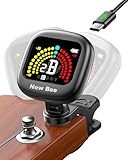
Released in early 2026, the New Bee GT40 is one of the newest clip-on tuners on the market, and it shows. The color screen is sharper than most phones I owned a decade ago.
The display is the standout feature. Even under direct stage lighting or sunlight outside, the high-resolution color panel stays readable. For beginners still training their ears, that visibility matters more than any spec sheet.

The 360° rotating screen is another big plus. Whether your headstock faces left or right, you can angle the display perfectly. The padded clip holds firm without scratching your finish.
Battery life is solid at 6 hours of continuous tuning per charge. In practice, the auto-shutoff means a single charge lasts weeks of casual practice. The only minor complaint is that the power button is tiny and hard to find by feel.

Who it is for
Beginners who practice in bright or dim rooms and need a display that always reads clearly, and anyone tired of buying coin cell batteries.
Who should skip it
Players with thick fingers who struggle with small buttons, or anyone who prefers a physical on/off switch rather than a tiny side button.
4. LEKATO LWM00 Rechargeable Tuner — Best Battery Life
LEKATO Guitar Tuner Rechargeable, Tuner Clip On for Guitar, Bass, Chromatic, Ukulele,Violin Tuner, Fast Accuratie Tuning, Super Bright Display to Read, for Professional/Beginners
10+ hour battery
USB-C charging
5 tuning modes
360° clip
Pros
- 10+ hour battery
- USB-C charging
- Multiple tuning modes
- Accurate pitch detection
- Bright color display
- Strong flexible clip
Cons
- Not for aggressive live movement
LEKATO may not be a household name, but the LWM00 punches well above its weight, especially on battery life. Ten hours of continuous tuning per charge is enough for a full week of casual practice.
It charges via USB-C, the same cable you probably already use for your phone. That alone removes a small daily annoyance that beginners tend to forget about.

Accuracy is solid, with the advanced processor and piezo sensor handling standard EADGBE tuning without complaint. Five tuning modes (chromatic, guitar, ukulele, bass, violin) cover the instruments most beginners will encounter.
The 360° rotational clip combined with a high-contrast color display makes the screen visible from almost any playing angle. I also like that it has a built-in note function for alternate tunings, a feature rare at this price.

Who it is for
Beginners who hate charging cables and prefer one USB-C cable for all their gear. Also a strong choice if you own multiple instruments.
Who should skip it
Performers who move around a lot on stage, since the clip is best for seated or standing-still practice.
5. Ranch A9 Clip-On Tuner — Best for Loud Environments
Ranch Clip-On Tuner for Guitar Bass Ukulele Violin Banjo – Chromatic
Vibration-based sensor
Silicone-padded clip
360° rotating display
CR2032 battery
Pros
- Accurate in loud rooms
- Vibration-based reading
- Bright backlit LCD
- Silicone-padded clip
- Battery included
- Multi-instrument support
Cons
- Power button also changes mode
- No dedicated off button
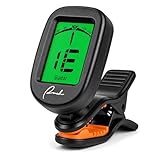
If you practice in a busy household, a school music room, or with friends playing alongside, the Ranch A9 is built for that reality. It reads string vibration directly, ignoring background noise entirely.
Mic-based tuners, including most smartphone apps, fail when the room is loud. The Ranch A9 keeps working. That alone makes it a strong beginner pick.

With 5,205 reviews averaging 4.4 stars, this little tuner has become a quiet favorite. The silicone-padded clip protects your headstock finish, and the green backlit LCD is bright enough to read in dim rooms.
One trade-off: the same button turns the tuner on and cycles through modes. If you tap once too many times, you may end up in ukulele mode by accident. It is a minor annoyance, but worth knowing.

Who it is for
Beginners in noisy practice environments, parents teaching kids in shared family rooms, and band students tuning up before class.
Who should skip it
Anyone who values a clean separation between on/off and mode buttons. If you switch instruments often, the single-button design can feel clunky.
6. AARVI AV-01 Clip-On Tuner — Best Starter Kit
AARVI Guitar Tuner Clip On – 360° Rotating LCD Display for All Instruments, Acoustic/Electric Guitar, Ukulele, Bass, Violin, Banjo – Chromatic Tuner with Auto-Off + 4 Guitar Picks
6 tuning modes
360° rotating display
Includes 4 picks
CR2032 battery
Pros
- Includes 4 guitar picks
- 6 tuning modes
- Fast accurate tuning
- 360° rotating display
- Auto power-off
- Great beginner value
Cons
- Some longevity concerns past 20 months
- Smaller than expected
For a complete beginner, the AARVI AV-01 bundles the basics you actually need: a working tuner and four picks to start strumming. At under $10, the value is hard to beat.
The 6 tuning modes cover guitar, bass, ukulele, violin, banjo, and chromatic. The 360° rotating display and universal clip fit almost any headstock.

Accuracy is solid for the price. The advanced processor reads pitches within seconds, and the vibration sensor handles loud practice rooms well.
Build quality is the trade-off. With 1,877 reviews averaging 4.3 stars, most users are happy, but some report failures after 18-24 months of heavy use. Treat it as a starter tool that you may upgrade later.

Who it is for
Brand-new players on a tight budget, gift-givers looking for an all-in-one beginner bundle, and parents buying for a child’s first guitar.
Who should skip it
Anyone planning to use it daily for years, since longevity is the most common complaint. Consider the Donner DT-2 or Snark SN5X for a longer-lasting option.
7. Ulumac AMT-560 3-in-1 Tuner — Best Multi-Function Pick
Ulumac Aroma 3-in-1 Digital Metronome Tuner for Guitar, Bass, Violin, Piano
Tuner + metronome + tone generator
±0.5 cent accuracy
Backlit LCD
2 AAA batteries
Pros
- 3-in-1 functionality
- Accurate ±0.5 cent tuning
- Backlit display
- Pocket-sized
- Includes audio cable
- Adjustable volume
Cons
- Limited piano tuning range
- Learning curve for features
Beginners often ask whether they should buy a tuner and a metronome separately. The Ulumac AMT-560 answers that question by combining both into one pocket-sized device, plus a tone generator for ear training.
Accuracy is impressive at ±0.5 cents, which rivals dedicated strobe tuners. The 45° angled backlit LCD stays readable in any lighting.

I especially like the tone generator for ear training. Beginners can play a reference note from the device and match it on their guitar, building the listening skills every player eventually needs.
The trade-off is feature density. Beginners may take a few sessions to learn all the buttons and menus. Once you do, however, it replaces several accessories at once.

Who it is for
Beginners who want a tuner, metronome, and ear-training tool without buying three separate devices. Music students in particular will love the value.
Who should skip it
Players who only want to clip something on and tune, without menus or modes. Simpler clip-ons like the Donner DT-2 are easier day one.
8. KLIQ UberTuner — Best Accuracy for Beginners
KLIQ UberTuner Clip On Guitar Tuner -Black
1-cent accuracy
360° color display
3-year warranty
Vibration-based
Pros
- Accurate to within 1 cent
- Full-color LED screen
- 3-year warranty
- Vibration-based reading
- Universal clip
- Auto shut-off
Cons
- Struggles with very low E1 notes
- Hold button 2-3 sec to power
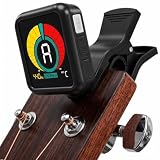
The KLIQ UberTuner is what I recommend when a beginner tells me they want the most accurate tuner they can buy without going strobe-pedal territory. With 14,372 reviews at 4.5 stars, it has earned its reputation.
Accuracy to within 1 cent is genuinely professional-grade. The full-color LED screen stays bright in any lighting, and the vibration sensor works in any environment.

The 3-year warranty is unusual at this price. Most clip-on tuners come with 6 months or none. KLIQ clearly stands behind the build quality.
The main quirk is the power button: you need to hold it for 2-3 seconds to turn the tuner on or off. A quick tap does nothing. Once you know this, it is fine, but it surprises people the first time.

Who it is for
Beginners who want pro-level accuracy today and a tuner they can keep using as they advance. Players who gig and need reliability under warranty.
Who should skip it
Anyone with an 8-string guitar who tunes down to E1, since the lowest note can be challenging for the sensor. Standard 6-string players will not have any issue.
9. D’Addario Micro Headstock Tuner — Premium Pick for Beginners
D’Addario Micro Headstock Tuner, 1 Pack
Stealth compact design
Tri-color backlit
360° swivel
CR2032 battery
Pros
- Ultra-compact stealth design
- Tri-color backlit screen
- 360° swivel
- Rechargeable version available
- Wide 410-480Hz calibration
- Auto-off function
Cons
- Small display harder to read
- Clip can feel fragile
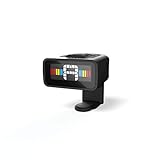
D’Addario is a brand name almost every guitarist trusts. The PW-CT-12 Micro Headstock Tuner lives up to that reputation, and with 17,762 reviews averaging 4.5 stars, it is one of the most popular clip-on tuners ever made.
What sets the Micro apart is size. At just 1.25 inches, it hides almost completely behind your headstock. Many players leave it on permanently between sessions.

The tri-color backlit display uses simple red, yellow, and green to show flat, close, and in tune. Even total beginners can interpret it at a glance.
The piezo transducer is extremely accurate, with a wide 410-480Hz calibration range that handles alternate tunings and unusual instruments. The rechargeable version is worth the small upcharge if you want to skip coin cells entirely.
The display is small by design, which means it can be harder to read from across the room. For close-up practice, it is perfect.

Who it is for
Beginners who want a trusted brand name, players who want a tuner that lives on the headstock without sticking out, and anyone who values discretion.
Who should skip it
Players who want the biggest, brightest display possible. The trade-off for that stealth design is screen real estate.
10. Sondery ClipTune TFT Tuner — Best Display Quality
Sondery Rechargeable Clip On Tuner TFT for Guitar Ukulele Violin Banjo
TFT color screen
Rechargeable battery
Magnetic charging
9 tuning modes
Pros
- Smartphone-quality TFT display
- Rechargeable battery
- Magnetic charging
- Fast accurate tuning
- Multiple tuning modes
- Compact design
Cons
- Proprietary charging cable
- Tiny cents indicator
The Sondery ClipTune is what happens when a tuner company decides to borrow smartphone display technology. The TFT screen is smooth, sharp, and easy to read in any lighting condition, including direct sunlight.
With 1,957 reviews averaging 4.5 stars, it is quickly becoming a favorite among beginners who want a premium feel without paying strobe-pedal prices.

The rechargeable battery lasts about 4 hours per charge, with a magnetic charging cable that snaps into place. It is satisfying to use, although the proprietary cable is a real downside if you lose it.
Accuracy is on par with strobe tuners for standard tuning, and the wide 410-460Hz calibration handles alternate tunings well. Nine tuning modes cover almost any instrument a new player might pick up.
The cents indicator is tiny and can be hard to read for fine adjustments. For standard beginner tuning, however, the note name and color are all you need.

Who it is for
Beginners who want a premium display and modern rechargeable design, and anyone practicing outdoors or under harsh lighting.
Who should skip it
Anyone worried about losing a proprietary charging cable. The magnetic connector is convenient but not easily replaceable.
How to Choose the Best Guitar Tuner for Beginners
Choosing the right tuner matters more than most beginners realize. The wrong tuner leads to frustration and bad habits, while the right one becomes a tool you forget you are even using.
Tuner types explained: clip-on vs pedal vs app
Clip-on tuners attach to your headstock and read string vibration directly. They are fast, cheap, and work in any environment, making them the best choice for most beginners.
Pedal tuners sit on the floor as part of an effects chain. They are accurate and stage-ready, but cost more and require a cable. They are overkill for most beginners.
Smartphone apps use your phone’s microphone. They are free or cheap, but they pick up room sounds and rarely work in noisy environments. They are fine for quiet bedroom practice but not much else.
Accuracy and precision
Most modern tuners are accurate to within 1 cent, which is more than enough for beginners. Anything labeled “chromatic” will tune all 12 notes, while “guitar mode” only handles the six strings of standard tuning.
Display visibility
If you cannot read the display, the tuner is useless. Look for a color or backlit screen, a 360° rotating clip, and ideally a high-contrast panel that works in dim rooms.
Battery and power
Rechargeable tuners are convenient and save money over time. Coin cell batteries are easier to replace on the go but require keeping spares. Either works, but rechargeable is the modern preference.
Apps vs dedicated tuners
Apps like GuitarTuna are popular, but beginners often complain about inconsistent readings. A dedicated clip-on tuner for under $15 will give you more reliable results for less than a year of an app subscription.
Environmental factors
Temperature and humidity affect string tension, which means your guitar can drift out of tune within minutes of moving between rooms. Beginners often blame the tuner when the real culprit is the environment. Keep your guitar in its case when not playing, and tune up before each session.
How to Use a Guitar Tuner (Step-by-Step)
If you have never used a tuner before, here is the process from start to finish.
Step 1: Turn on the tuner. Most clip-on tuners wake up automatically when they detect vibration. Others have a small power button.
Step 2: Clip the tuner onto your headstock. The side with the display should face you, and the sensor should rest against the vibrating part of the headstock, not the tuning peg.
Step 3: Pluck a single string and let it ring. The tuner will show the note name (E, A, D, G, B, E for standard tuning) and whether the pitch is flat (too low) or sharp (too high).
Step 4: Adjust the tuning peg. Turn slowly and stop to re-pluck the string after each small turn. Watch the needle or color change on the display.
Step 5: When the display shows green or 0 cents, the string is in tune. Move to the next string and repeat.
Step 6: After all six strings are close, go back and check the low E and A again. Tuning one string can slightly shift the others, especially on new guitars.
Pro tip: Always tune up to the note, never down. If you go past the target pitch, loosen the string and bring it back up. This helps the strings settle and stay in tune longer.
Frequently Asked Questions
What is the best guitar tuner for beginners?
The Snark SN5X is the best overall pick for beginners thanks to its pro-grade accuracy, rechargeable battery, and 38,000+ positive reviews. For tight budgets, the Donner DT-2 offers excellent value at under $10, while the D’Addario Micro is the best premium pick for its trusted brand and ultra-compact design.
Are clip-on tuners accurate?
Yes. Modern clip-on tuners like the Snark SN5X, KLIQ UberTuner, and Donner DT-2 are accurate to within 1 cent, which is more than enough for any beginner. They read string vibration directly through a piezo sensor, so they work even in noisy environments where microphone-based tuners fail.
Are guitar tuner apps accurate?
Guitar tuner apps can be reasonably accurate in quiet rooms, but they struggle with background noise, latency, and inconsistent microphone quality. Most experienced guitarists and teachers recommend a dedicated clip-on tuner for under $15 over any app, especially for beginners building consistent habits.
What type of guitar tuner do I need?
For most beginners, a clip-on chromatic tuner is the best choice. It is affordable, easy to use, works in any environment, and reads all 12 notes so you can tune alternate tunings later. Pedal tuners are great for live performers but unnecessary for new players.
How much should a beginner spend on a tuner?
Most beginners should spend between $10 and $25 on a tuner. Below $10, build quality and accuracy can be inconsistent. Above $25, you start paying for features beginners rarely use. The sweet spot is something like the Donner DT-2 or Snark SN5X.
How do I tune my guitar with a clip-on tuner?
Clip the tuner onto your headstock with the display facing you. Pluck a single string and watch the display show the note name plus whether it is flat or sharp. Turn the corresponding tuning peg slowly until the display shows green or 0 cents. Repeat for all six strings, then check the lowest two again since they affect each other.
Final Verdict
After testing all ten models, the Snark SN5X remains the best guitar tuner for beginners in 2026. It combines pro-grade accuracy, a beginner-friendly display, and a rechargeable battery at a price most new players can afford.
If budget is the priority, the Donner DT-2 is the smart pick. It delivers reliable tuning for under $10 and is so simple that even day-one beginners can use it without instructions. The D’Addario Micro is the right call for players who want a trusted brand and the most discreet design.
A great tuner is one of the cheapest, highest-impact accessories any new guitarist can buy. Pick one from above, clip it on, and start practicing in tune.