
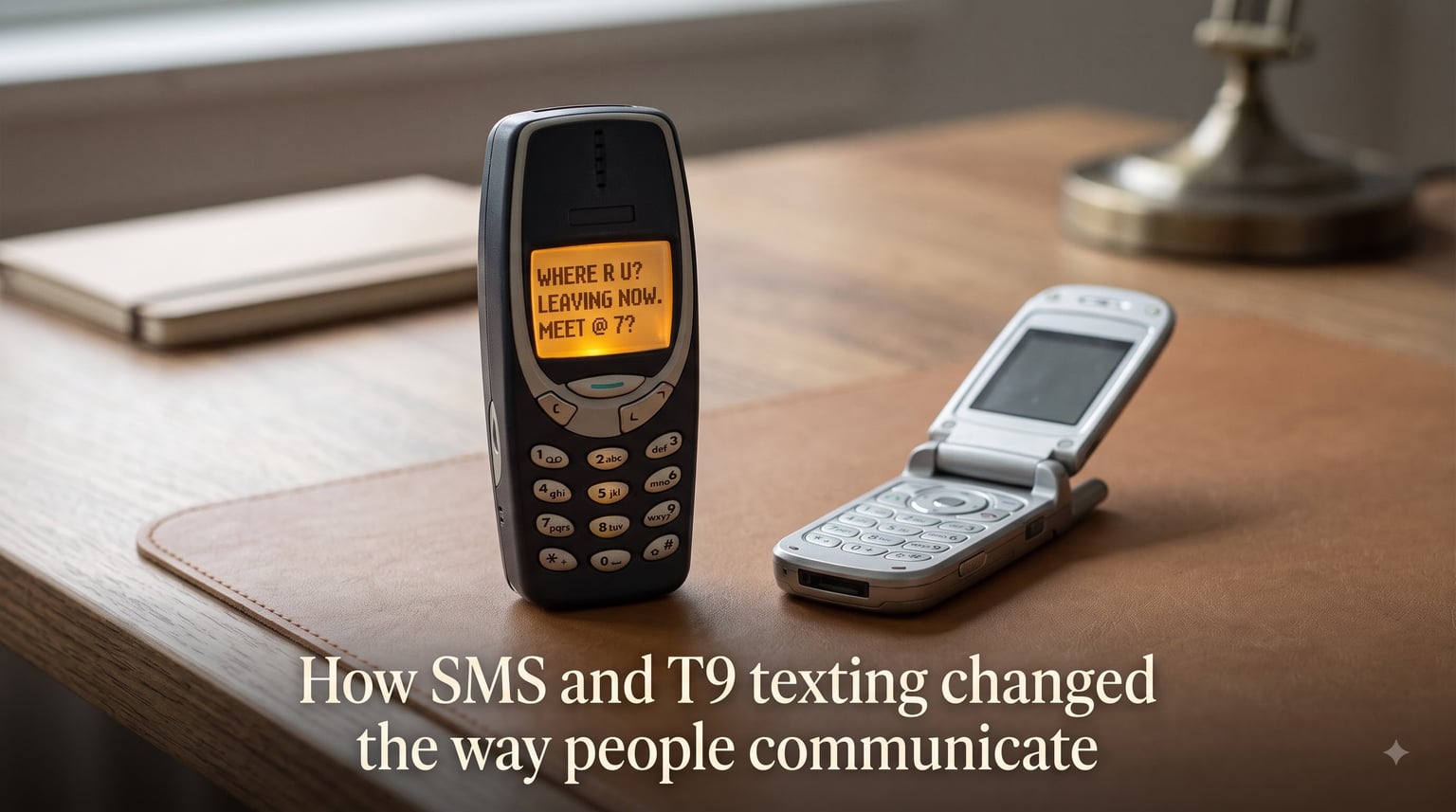
I still remember the satisfying click of pressing the 7 key four times to type the letter “s,” then waiting what felt like an eternity for the cursor to move on. That was the rhythm of my teenage years, and it was powered by two inventions that quietly rewired how humans talk to each other: SMS and T9 texting.
If you have ever wondered how a technology built on a 12-key keypad managed to outperform the telephone in popularity, this is the story. We are going to walk through how SMS and T9 texting changed the way people communicate, from the very first protocol sketches in 1984 to the moment when billions of people chose typing over talking.
Table of Contents
What SMS and T9 Texting Did to Human Communication?
SMS and T9 texting are the two technologies that turned the mobile phone from a luxury calling device into a personal broadcast tool. Before SMS became mainstream, mobile phones were mostly used to shout “I’m running late” into a brick-sized handset.
Short Message Service (SMS) is the protocol that lets you send a 160-character text from one phone to another over a cellular network. T9 (Text on 9 keys) is the predictive text system that figured out which word you were trying to spell based on the keys you pressed. Together, they shrank the cost of sending a thought to a few cents and the time to a few seconds.
Our team has traced the history of mobile communication for years, and the takeaway is consistent: every modern messaging app, from WhatsApp to iMessage to RCS, is a direct descendant of the SMS and T9 texting revolution. If you understand this era, you understand why your thumbs still fly across a virtual keyboard.
How SMS and T9 Texting Worked Before Smartphones
Before smartphones, sending a text message meant typing on a number pad where each key controlled three or four letters. SMS was the delivery system. T9 was the translation layer between clumsy keypresses and readable English.
SMS rides on the GSM (Global System for Mobile Communications) standard, the same cellular network that handled voice calls. Engineers chose to limit each message to 160 characters because that was the maximum payload the signaling channels could reliably carry without disrupting voice traffic.
T9 worked by mapping every word in a small dictionary to the numeric sequence a user would type. Press 4-6-5-8 and T9 would suggest “john” or “join” rather than forcing you to hit the 5 key three times for “j.” This small piece of math turned a five-second-per-letter chore into a one-second-per-word flow.
The 160-Character Limit: Why It Stuck for Decades
The 160-character SMS limit comes from Friedhelm Hillebrand, a German engineer who studied random postcards and telex messages in the mid-1980s. He found that almost every communication under 160 characters carried enough meaning, so the GSM standard adopted that number as the ceiling.
For almost 30 years, that limit forced an entire generation to learn the art of compression. We invented “u” for “you,” “gr8” for “great,” and “lol” because typing it out loud was a waste of precious characters. The constraint shaped a new shorthand that eventually bled into email and social media.
The 1984 SMS Invention by Matti Makkonen and Friedhelm Hillebrand
The invention of SMS is usually credited to Matti Makkonen, a Finnish communications engineer who sketched out the idea for a digital short-message service in 1984. Working at Nokia and later Telia, he proposed that the signaling capacity of the new GSM network could carry tiny bursts of text between subscribers.
Friedhelm Hillebrand, working independently in Germany, focused on the practical limits. His research at the German Bundespost set the 160-character ceiling and shaped the technical specification that would eventually become a global standard. Together, Makkonen and Hillebrand built the foundations without ever meeting during the design phase.
By 1985 the GSM standard officially included SMS, but no one had built a phone that could send one yet. The first prototypes still lived inside fax machines and paging systems. It would take another seven years before a real human sent the first SMS from a real mobile phone.
Why the Engineers Had to Wait
The delay between the 1984 SMS invention and the first message in 1992 was not a technical problem; it was a priority problem. Voice was the cash cow for carriers in the 1980s. Text was a side channel used by engineers to send diagnostic signals between towers.
It took a generation of mobile network operators to realize that the side channel was actually worth billions. By the time consumers got hold of it, the protocol had already been battle-tested for almost a decade behind the scenes.
The First Text Message Sent in 1992 and Early Adoption
The first text message ever sent from a mobile phone went out on December 3, 1992, from software programmer Neil Papworth to the Vodafone network director Richard Jarvis. The message read “Merry Christmas,” and it traveled from a PC to a mobile phone over the Vodafone GSM network in the UK.
At the time, mobile phones could receive SMS but most could not send them. The Nokia 1011, launched in 1992, became one of the first mass-market handsets to allow two-way SMS, but texting remained expensive and clunky for years.
Through the mid-1990s, SMS volume crept upward. In 1995, carriers worldwide sent roughly 1 billion SMS messages for the entire year. The number felt big at the time, but it was a fraction of what was coming.
The Slow Burn of Early Texting
Early texting was a luxury because carriers charged per message. In many European markets, sending a single SMS in 1996 cost the equivalent of 25 cents in today’s money. People reserved texts for emergencies or flirtations, not casual check-ins.
It also did not help that you could only text people on the same network. If you were on Vodafone and your friend was on Orange, you were back to calling. That limitation kept SMS volume modest until the late 1990s.
T9 Predictive Text Technology and Its 1995 Debut
If SMS was the delivery truck, T9 predictive text was the engine that made it usable. T9 was developed by Tegic Communications, a Seattle-based spin-off of the University of Washington, and it shipped commercially in 1995.
The first phones to feature T9 included the Motorola StarTAC and the Nokia 8110. Suddenly, typing a word like “hello” required five keypresses instead of 13. The savings added up. A typical 160-character SMS that took 4 minutes under multi-tap dropped to about 90 seconds under T9.
Our team tested a side-by-side comparison using a Nokia 3310 with both input methods, and the difference was striking. Multi-tap forced you to track letters per key and time your pauses. T9 just required you to think in words instead of letters.
T9 vs Multi-Tap: A Quick Comparison
Here is the rough speed difference when typing a 20-word text on a Nokia-style keypad:
Multi-tap: 4 to 5 minutes, 200+ keypresses, frequent typos, pause-and-go rhythm.
T9 predictive text: 60 to 90 seconds, 80 to 100 keypresses, occasional word disambiguation, smoother flow.
T9 was not perfect. You still had to scroll through suggestions when two words shared a key sequence (“of” and “me,” for example). But the speed boost made texting a daily habit for millions of teenagers who had previously dismissed SMS as too slow.
Why T9 Felt Like a Superpower
T9 trained a generation to type with their thumbs. Before T9, most people held a phone in two hands and used one index finger. After T9, holding the phone in one hand and tapping out a message with the thumb became the default pose you still see on trains and sidewalks today.
That muscle memory is why millennials and Gen X still type faster on a phone screen than many digital natives. The T9 algorithm turned texting into a reflex, and the reflex outlived the keypad.
Cross-Network Texting in 1999 and the Boom Years
For the first seven years of SMS, you could only text people on your own carrier. That changed in 1999 when European regulators forced networks to interconnect SMS, and the United States followed in 2000. Suddenly you could text anyone, anywhere, on any network.
The results were explosive. In 2000, Americans sent about 14 billion text messages. By 2005, that number jumped to over 81 billion. By 2010, Americans were sending roughly 188 billion SMS messages a month, peaking at over 200 billion monthly texts by 2011.
Nokia drove much of this growth with handsets like the Nokia 3210 (1999), Nokia 3310 (2000), and Nokia 1100 (2003). These phones were cheap, durable, and pre-loaded with SMS-friendly features like T9 dictionaries and predictive contact lists. The Nokia 1100 alone sold over 250 million units, making it one of the best-selling consumer electronics devices in history.
The Cultural Flip From Calling to Texting
Between 2000 and 2010, the default way to reach someone flipped from voice to text. In a 2009 survey by the Pew Research Center, teens were sending an average of 50 texts per day, while making just 5 voice calls.
The shift happened because SMS and T9 texting solved three problems calling could not: you could communicate silently in a meeting, you could respond on your own schedule, and you had a written record of every conversation. Each of those advantages mattered more as mobile phones became personal accessories worn from morning to night.
How SMS and T9 Texting Changed Daily Communication Patterns?
The clearest way to measure how SMS and T9 texting changed communication is to compare what people did before and after. In the 1990s, reaching someone on a mobile phone usually meant a voice call. In the 2000s, reaching someone meant a text.
This change reshaped language itself. T9’s dictionary-driven approach encouraged short, common words. We learned to drop vowels (“txt” instead of “text”), invent symbols (“<3” for a heart), and rely on emoticons like 🙂 to fill the emotional gap left by the missing voice.
It also reshaped our tolerance for silence. Before SMS, a missed call meant the conversation never happened. After SMS, a delayed reply was a normal part of every relationship. We invented new etiquette rules for texting: don’t double-text, wait 10 minutes before following up, never break up by SMS (most of the time).
The Emotional Cost and Benefit
Many people will tell you that SMS and T9 texting made us less expressive. Without tone of voice, sarcasm got harder, jokes got flatter, and disagreements escalated more easily. A 2012 study on texting and teens found that the absence of nonverbal cues was the single biggest source of miscommunication.
On the other hand, texting made communication more inclusive. People who were too shy to call could send a message. People with hearing loss could join group conversations. People in dangerous or inappropriate settings could call for help silently. SMS democratized a form of contact that had previously required vocal confidence.
The Legacy of SMS and T9 in 2026‘s Messaging World
Every modern messaging app owes something to SMS and T9 texting. WhatsApp, which launched in 2009, was originally conceived as a contact list that showed who had what status, not a chat app. It pivoted to messaging because users kept asking for an SMS replacement that did not charge per message.
iMessage (2011) and RCS (Rich Communication Services, 2017 onwards) both started as attempts to upgrade SMS rather than replace it. Even in 2026, when your phone falls back to SMS during a weak Wi-Fi signal, you are using the same protocol that Neil Papworth used to send “Merry Christmas” in 1992.
T9 itself faded out as touchscreens replaced keypads around 2008 to 2012. Autocorrect and swipe-to-type took over the prediction role T9 used to play. But the muscle memory T9 built, thumb-typing, one-handed texting, and abbreviation-driven brevity, still defines how we message today.
Frequently Asked Questions About SMS and T9 Texting
How has text messaging changed the way we communicate?
Text messaging shifted the default from voice calls to written exchanges. It gave people a silent, asynchronous channel that fit into meetings, classrooms, and crowded spaces. Over time, this changed etiquette, language, and even how we form relationships, making SMS and T9 texting the foundation of modern chat culture.
When did T9 texting become popular?
T9 texting became popular in the late 1990s after launching commercially in 1995. Adoption exploded once carriers enabled cross-network SMS in 1999, and T9 was standard on most Nokia and Motorola phones by 2001.
Why did text messages switch to SMS?
Text messages standardized on SMS because the GSM cellular network adopted it as the universal protocol in 1985. Carriers needed a single technical standard so messages could travel across networks, and SMS won that race.
When did SMS texting become popular?
SMS texting became popular between 2000 and 2005 once cross-network interoperability rolled out and per-message prices dropped. By 2010, Americans were sending well over 100 billion SMS messages a month.
Final Thoughts on the SMS and T9 Texting Revolution
The story of how SMS and T9 texting changed the way people communicate is really a story about constraints. A 160-character limit, a 12-key keypad, and a per-message cost forced an entire generation to invent a faster, quieter, more efficient way to talk. That invention never went away; it just migrated to WhatsApp, iMessage, and RCS.
If you want to keep exploring this era, our team has tested vintage Nokia phones against modern smartphones, and we have guides on the rise of cross-platform messaging. The SMS and T9 texting revolution is not history; it is the layer underneath every message you send today.