
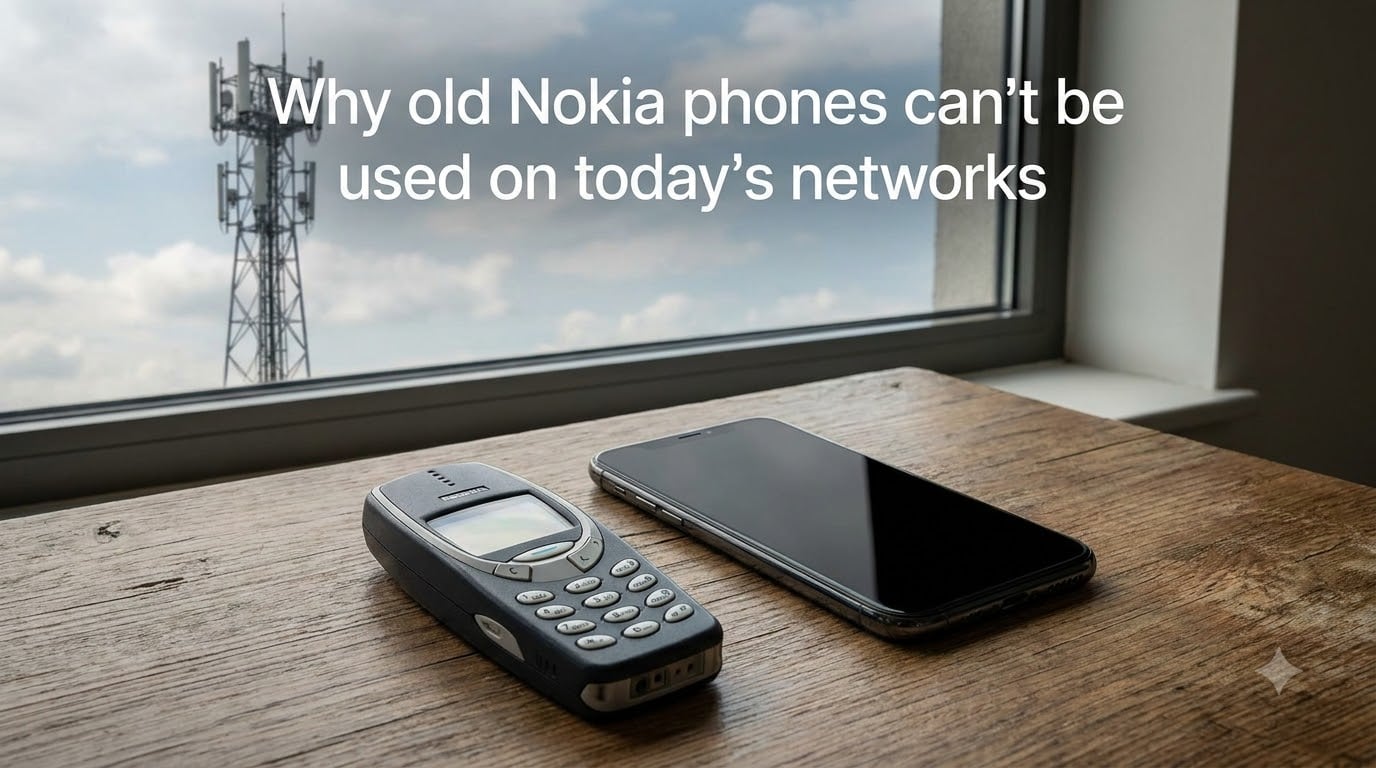
I still have my old Nokia 3310 sitting in a drawer. A few months ago, I charged it up, slipped in a SIM card, and tried to make a call. Nothing. No signal, no service, just a blank icon where the bars should be. If you have tried the same thing, you are not alone, and the phone is not broken. Old Nokia phones can’t be used on today’s networks for a straightforward reason: the cellular networks they were designed to connect to no longer exist in most parts of the world.
Carriers have systematically shut down the 2G and 3G networks that classic Nokia phones rely on. At the same time, the hardware inside those phones simply cannot communicate with modern 4G and 5G infrastructure. This is not a software update issue or a settings tweak. The radio components, frequency bands, and communication protocols built into phones from the late 1990s and 2000s are fundamentally different from what today’s networks use.
In this guide, I will walk through every technical reason why old Nokia phones can’t be used on today’s networks, from network shutdowns and frequency band incompatibility to VoLTE requirements and SIM card changes. Whether you are a collector, a dumbphone enthusiast, or just curious about that old brick phone in your closet, here is the full picture.
Table of Contents
The Short Answer: Why Old Nokia Phones Can’t Connect?
Old Nokia phones cannot connect to modern cellular networks because carriers have decommissioned the 2G and 3G networks those phones were built for, and the phones lack the hardware to access 4G and 5G networks that replaced them.
Think of it like an old radio that only picks up AM signals in a city where every station has moved to FM. The radio still powers on and works mechanically, but there is nothing for it to tune into. A Nokia 3310 from 2000 communicates using GSM (2G) protocols on specific frequency bands that carriers have either shut down or repurposed for newer technology.
This is not a planned obsolescence conspiracy or a carrier plot. Each generation of cellular technology uses radio spectrum more efficiently than the last. Carriers free up valuable spectrum by retiring old networks and redirecting those frequencies to serve vastly more customers at higher speeds. The trade-off is that every older generation of phones becomes obsolete in the process.
Cellular Network Generations Explained: 1G Through 5G
To understand why old Nokia phones can’t be used on today’s networks, you need to understand how cellular technology has evolved. Each generation of mobile networks represents a fundamentally different way of transmitting voice and data over radio waves.
1G, launched in the 1980s, used analog signals for voice calls only. Nokia’s earliest mobile phones, like the Mobira Talkman and Cityman, operated on these analog networks. Every 1G network worldwide has been shut down.
2G arrived in the early 1990s with GSM and CDMA digital standards. This is the generation most classic Nokia phones were built for. The Nokia 3310, 3210, 8110, and the iconic brick phones all use 2G technology. 2G brought digital voice calls, SMS text messaging, and basic data services like WAP browsing.
3G launched commercially around 2001 and added meaningful mobile data capability. Nokia’s Symbian smartphones, including the N-series and E-series, used 3G networks for faster internet, video calls, and app stores. Many later feature phones from the mid-2000s also supported 3G.
4G LTE arrived around 2009 and was designed primarily for high-speed data. Initially, 4G networks did not even carry voice calls; they handled data only. Voice over LTE (VoLTE) was added later to route calls through the data network. This is a critical point for understanding why old phones fail on modern networks.
5G began rolling out around 2019 and operates on entirely new frequency ranges, including millimeter wave bands above 24 GHz. No Nokia phone made before 2019 can access 5G at all. The radio hardware to transmit and receive on these frequencies simply does not exist in old phones.
The 2G and 3G Network Shutdowns: A Timeline
The biggest single reason old Nokia phones can’t be used on today’s networks is the ongoing shutdown of 2G and 3G infrastructure. Carriers call these shutdowns “network sunsets,” and they have been happening worldwide.
In the United States, all three major carriers completed their 3G shutdowns. AT&T turned off its 3G network in February 2022. Verizon followed in December 2022, and T-Mobile completed its 3G sunset in March 2022 with a final 2G shutdown in April 2024. This means that any Nokia phone relying solely on 3G is completely dead on US networks.
For 2G, the situation is nearly as stark. T-Mobile was the last major US carrier maintaining a 2G network, but that too has been wound down. As of 2026, no major US carrier supports 2G-only phones.
In Europe, the timeline varies by country. The UK switched off 3G across all major networks by early 2024, with 2G scheduled for full shutdown by 2025. Germany, France, and other EU nations are following similar paths. Australia shut down its 2G networks starting in 2016 and completed 3G shutdowns by late 2024.
Users on Reddit’s vintage phone and dumbphone communities have reported this firsthand. One user described putting a modern T-Mobile SIM into an old Nokia and getting nothing, even in an area with strong coverage. Another user noted that Nokia phones from 2003 and 2004 stopped working entirely once Sprint and T-Mobile moved to networks that required 4G or 5G capability. These are not isolated incidents; they reflect a global infrastructure change.
The reason carriers shut down these networks is spectrum efficiency. A 2G channel using the same amount of radio spectrum as a 4G or 5G channel serves a tiny fraction of the users at a tiny fraction of the speed. By retiring 2G and 3G, carriers reclaim that spectrum for 4G and 5G, dramatically increasing network capacity.
Frequency Band Incompatibility: The Hardware Problem
Even if a carrier kept an old network running, your vintage Nokia would likely still struggle because of frequency band mismatches. This is the technical detail that most explanations skip, and it is arguably the most fundamental barrier.
Every cellular network operates on specific radio frequency bands, measured in megahertz (MHz) or gigahertz (GHz). A phone must contain a radio transceiver tuned to the exact frequencies a carrier uses in your area. This is not software; it is physical hardware. The antenna design, amplifier circuits, and filters in a phone are built for specific frequency ranges.
Classic Nokia phones were built for the frequency bands assigned to 2G networks. In Europe, that typically meant 900 MHz and 1800 MHz. In the Americas, 850 MHz and 1900 MHz. A Nokia 3310’s radio hardware is physically incapable of transmitting or receiving on the 700 MHz, 1700 MHz, 2100 MHz, or higher bands that 4G LTE networks use.
4G LTE alone uses dozens of different frequency bands worldwide, designated as LTE Band 1 through Band 88 and beyond. 5G adds even more, including sub-6 GHz bands and millimeter wave frequencies above 24 GHz. An old Nokia phone has no hardware to access any of these.
You cannot fix this with a firmware update, a SIM swap, or an adapter. The frequency bands a phone supports are determined by its radio frequency front-end components, which are soldered to the circuit board. There is no way to add new bands to a phone that was never built with them.
This is also why some relatively recent phones have stopped working. Even some 4G phones from the early 2010s lack the specific LTE bands that carriers now rely on. The bands a phone supports matter just as much as the generation of technology it uses.
VoLTE Requirements: Why Voice Calls Need 4G Now
One of the most confusing aspects of the network transition for many users is the VoLTE requirement. VoLTE stands for Voice over LTE, and it is the technology that carries phone calls over 4G data networks instead of the older circuit-switched voice channels.
In the 2G and 3G era, voice calls used a dedicated circuit-switched connection. Your phone established a direct voice channel to the nearest tower, completely separate from any data connection. Old Nokia phones are masters of this technology. It is all they know.
The problem is that when carriers shut down 2G and 3G, those circuit-switched voice channels disappeared. The only way to make a voice call on a modern network is through VoLTE, which encodes your voice as data packets and sends them over the 4G or 5G data network.
Old Nokia phones do not support VoLTE because the protocol did not exist when they were manufactured. They cannot encode voice as IP data packets, and they cannot connect to a 4G network in the first place. Without VoLTE support, a phone literally cannot make or receive calls on today’s networks.
Carriers have gotten strict about this. In the US, Verizon and T-Mobile began requiring VoLTE certification for any phone activating on their networks. If a phone cannot make VoLTE calls, the carrier will not allow it on the network at all, even for emergency calls in some cases. This requirement caught many users off guard, as I have seen reported repeatedly in dumbphone forums.
SIM Card Technology Changes: Size and Protocol
Even if you solved every problem above, there is one more hurdle: the SIM card itself. SIM card technology has changed in two important ways, and both can prevent an old Nokia from working.
The first and most obvious change is physical size. The original Nokia phones from the late 1990s and early 2000s used credit-card-sized SIMs or the mini-SIM format, which is about the size of a postage stamp. Modern phones use nano-SIMs, which are dramatically smaller. If you have a modern SIM from your current carrier, it will not physically fit in an old Nokia’s SIM slot.
SIM adapters exist that let you seat a nano-SIM inside a mini-SIM-sized frame. Some forum users report success with these adapters. However, adapters can be finicky, and forcing a mismatched SIM into an old phone can damage the contacts.
The second and more serious issue is SIM protocol compatibility. Modern SIM cards are provisioned for 4G and 5G networks and include authentication protocols and encryption standards that old phones do not understand. A carrier-issued SIM from 2026 may simply fail to authenticate on a phone that only speaks 2G GSM protocol.
Conversely, if you somehow found an old 2G SIM card, it would not work on a modern network because the carrier’s systems no longer support its authentication method. You are caught in a no-man’s-land where neither the old SIM nor the new SIM works with the old phone.
Specific Nokia Models and Their Network Support
Not all Nokia phones face the same fate. The specific model and its manufacturing era determine what networks it can theoretically access. Here is a breakdown of popular Nokia models and their network compatibility.
The original Nokia 3310, released in 2000, is a 2G GSM phone supporting 900 MHz and 1800 MHz bands (European model) or 1900 MHz (some variants). It has no 3G, 4G, or 5G capability. With 2G networks shut down across most of the world, the original 3310 cannot connect to any major carrier. It is, for all practical purposes, a paperweight with excellent build quality.
The Nokia 8110, the famous “banana phone” from The Matrix, was also a 2G GSM device. The original from 1996 used 900 MHz bands only. Like the 3310, it cannot connect to modern networks. HMD Global, which licenses the Nokia brand, released a 4G version of the 8110 in 2018 that does support VoLTE and 4G LTE bands, but the original is dead.
The Nokia 110 4G and Nokia 2780 Flip are modern feature phones from HMD Global that do support 4G LTE and VoLTE. These work on today’s networks because they contain the right radio hardware. If you want the Nokia experience with modern connectivity, these are the models to look for, not a phone from 2003.
Nokia’s Symbian smartphones from the 2000s, including the N95, N73, and E71, supported 3G networks. Some users reported these working briefly during the transition period when 3G was still active but 2G was being shut down. As 3G has now been sunset in most markets, these phones have also lost connectivity.
Forum users have shared interesting edge cases. One person reported putting a T-Mobile iPhone SIM into an old Nokia and making a call during a brief window when 2G was still active. But those windows are closing fast. As of 2026, the realistic answer is that any Nokia phone built before the 4G era cannot make calls on a major carrier network in the US, UK, EU, or Australia.
What Phones Still Work on Today’s Networks
If you want a phone that works on current networks, it must meet a few minimum requirements. It needs 4G LTE support on the frequency bands your carrier uses. It needs VoLTE capability for voice calls. And it needs a modern SIM card that can authenticate on the current network.
To check if any phone is compatible, look up its model number and check the supported frequency bands against your carrier’s requirements. Most carriers publish their band information online. If the phone does not list the bands your carrier uses for 4G, it will not work, regardless of how good its condition is.
For users who want a simple, durable phone experience similar to old Nokia devices, modern 4G feature phones are the answer. The Nokia 110 4G, Nokia 2780 Flip, and similar devices from other manufacturers offer long battery life, physical buttons, and basic calling and texting, all on networks that actually work.
FAQs
Are old Nokia phones still usable?
Old Nokia phones still power on and function as devices, but they cannot connect to modern cellular networks. Without a network connection, they cannot make calls, send texts, or access any cellular service. They work as alarm clocks, flashlights, and the original Snake game, but not as phones.
Will a Nokia 3310 still work today?
The original Nokia 3310 from 2000 does not work on today’s networks because it only supports 2G GSM, and 2G networks have been shut down in most countries. HMD Global released a reimagined Nokia 3310 in 2017, but even that version only supports 2G or 3G in most variants. A 4G version exists in select markets and may still work where 4G is active.
What is the oldest phone you can still use?
The oldest phones that still work on modern networks are 4G LTE phones with VoLTE support, generally dating from 2014 onward. Any phone that only supports 2G or 3G cannot connect to networks in the US, UK, EU, or Australia as of 2026.
How to connect an old Nokia phone to the internet?
You cannot connect an original 2G or 3G Nokia phone to the modern internet. Even if the phone had WAP or basic GPRS data capabilities, those data services ran on 2G and 3G networks that no longer exist. Modern 4G Nokia feature phones can access basic internet through KaiOS or similar lightweight operating systems.
Which phones won’t work after a 3G shutdown?
Any phone that relies exclusively on 2G or 3G networks will stop working after those networks are shut down. This includes all original Nokia feature phones from the 1990s and 2000s, early smartphones without 4G support, and any device that lacks VoLTE capability. Some early 4G phones without VoLTE may also fail to make voice calls.
Will 2G phones still work after 3G switch off?
2G phones may have continued working briefly after 3G shutdowns in regions where carriers maintained 2G networks alongside 4G. However, most carriers have now shut down 2G as well. As of 2026, 2G-only phones do not work on major networks in the US, UK, most of Europe, and Australia.
Can I still use an old Nokia phone?
You can keep an old Nokia phone as a collector’s item, a display piece, or for offline functions like games and alarm clocks. You cannot use it as an actual phone on modern networks. If you want the Nokia experience with working connectivity, look at modern 4G feature phones from HMD Global, which licenses the Nokia brand.
Conclusion
Understanding why old Nokia phones can’t be used on today’s networks comes down to three irreconcilable differences: the networks they were built for no longer exist, their radio hardware cannot access modern frequency bands, and they lack the VoLTE protocol that carriers now require for any voice call.
This is not something a software update, SIM adapter, or carrier unlock can fix. The gap between a 2G Nokia from 2000 and a 5G network in 2026 is a gap of fundamental hardware and protocol architecture. The phone is not broken; it is simply speaking a language that no tower can hear anymore.
If you love the Nokia experience, the good news is that HMD Global still makes durable, simple feature phones under the Nokia brand with full 4G LTE and VoLTE support. They will not survive a hammer the way a 3310 might, but they will actually make phone calls. And at the end of the day, that is what a phone is for.