
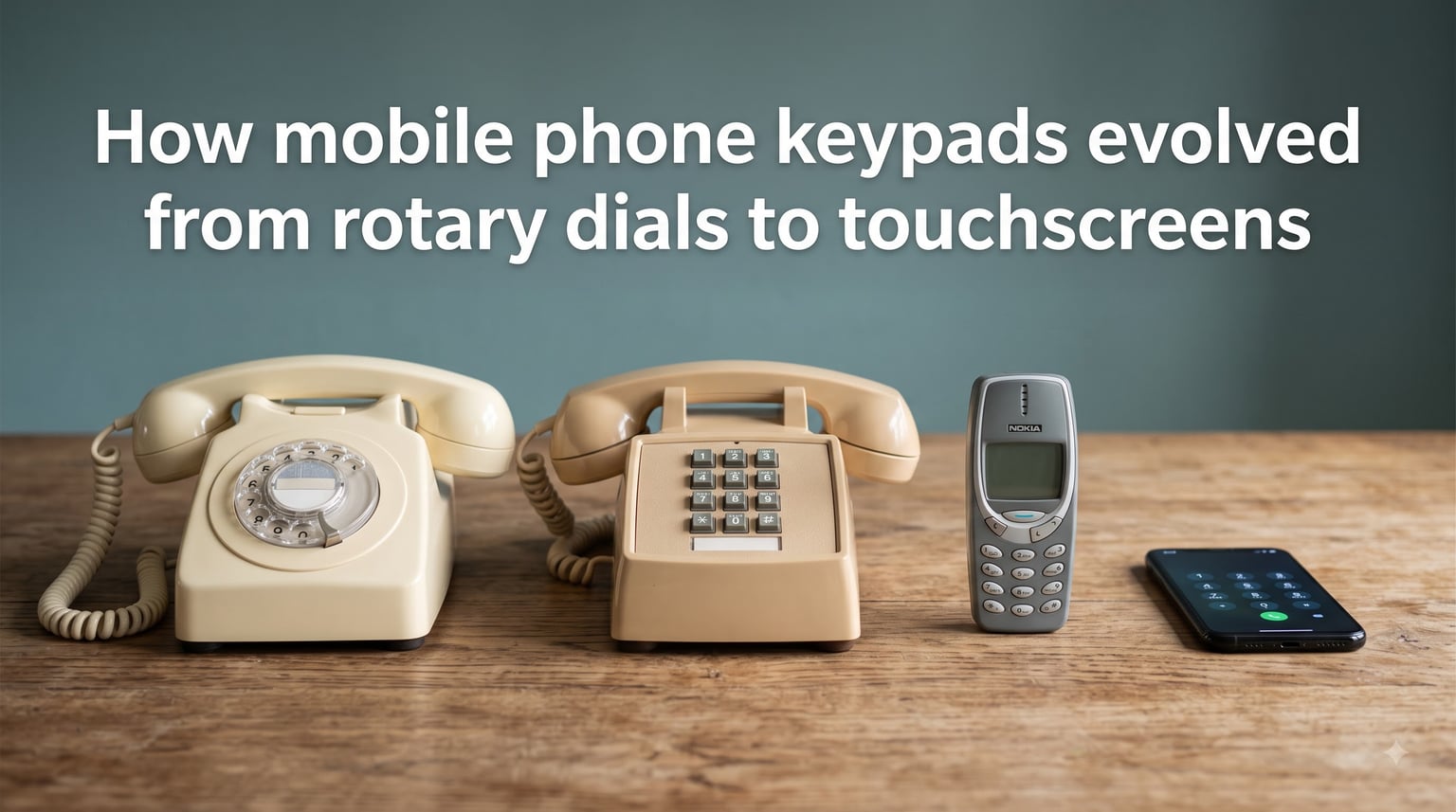
If you have ever wondered how mobile phone keypads evolved from rotary dials to touchscreens, you are really asking about one of the most patient transitions in modern technology. I have spent weeks tracing the timeline, pulling in Bell Labs research notes, and I want to walk you through the full arc – from the spring-loaded finger wheel of 1891 to the haptic-enabled glass slab in your pocket.
This is a story of mechanical constraint, signal processing breakthroughs, and a beautifully stubborn 3×4 grid that outlasted three generations of phone design. Let us start where everything started: the rotary dial.
Table of Contents
The Rotary Dial Era: How Mechanical Phones Worked
The rotary dial phone was an electromechanical solution to a problem that no longer existed once transistors became cheap. Between 1891 and the 1960s, however, it was the only practical way an automated telephone exchange could read a number.
The Electromechanical Finger Wheel
When you put your finger in a rotary dial hole and turned it to the finger stop, a governor inside the device controlled how fast the spring returned to rest. Each number had a different distance to travel, and that distance generated a specific number of electrical pulses.
Dialing “7” sent seven clicks down the line. Dialing “0” sent ten clicks. The exchange counted those pulses and connected you to the right subscriber. It was clever, mechanical, and incredibly slow – a long phone number could take 15 seconds to dial.
Why Rotary Dials Came First
Most people assume the rotary dial came first because it was simpler. The opposite is true. Rotary dials came first because the only way to count a number reliably in 1891 was with a mechanical pulse generator. Push-button signaling required dual-tone multi-frequency circuits, and those required transistors, and transistors did not become reliable and affordable until the late 1950s.
So the rotary dial was not a design choice. It was the only option the technology of the era allowed.
Bell Labs Search for a Better System
By the 1950s, Bell Labs engineers knew rotary dialing was eating up switching time and frustrating customers. They began researching alternatives that would eventually replace the rotary dial entirely.
DTMF Frequency Pairs
The breakthrough came in 1963 when Bell Labs introduced dual-tone multi-frequency signaling, or DTMF. Instead of counting pulses, DTMF assigns each key a unique pair of audio frequencies: one low band tone and one high band tone played simultaneously.
Press “5” and the phone plays 770 Hz plus 1336 Hz. Press “9” and you get 852 Hz plus 1477 Hz. The exchange detects the unique frequency pair and connects the call nearly instantly. This is the same system IVR menus still use today when you “press 1 for sales.”
The 3×4 Grid Decision
Bell Labs ran extensive human-factors tests in the 1950s to decide how to lay out the new push-button keypad. They tested different arrangements with thousands of users and measured dialing speed and error rates. The winning layout placed 1-2-3 on the top row, with 7-8-9 on the bottom – the arrangement we still use today.
The Push-Button Revolution: Touch-Tone Arrives in 1963
The first commercial touch-tone phone hit the market on November 18, 1963, produced by Western Electric for the Bell System. The touch-tone era had officially begun.
Commercial Rollout and Adoption
Early touch-tone phones were expensive, and adoption moved slowly. By 1970 only about 11 percent of Bell System customers had touch-tone service. By 1980 that number had climbed past 40 percent, and by the early 1990s rotary service was no longer offered by most exchanges in the United States.
The last rotary dial phone I am aware of in regular production was the Western Electric 500-series, which received its final manufacturing run in 1984. Some refurbished units remained in service for decades after that, particularly in hotels and rural areas.
Why Keypads Start with 1-2-3 (Not 7-8-9)
This is one of the most-asked questions on forums and Reddit, and the answer is rooted in typewriter design and reading habits. Letters under the numbers on a telephone are grouped by the word they spell. Putting 1-2-3 on the top row means the letters A-B-C sit underneath the 2 key, where they are easy to find and remember.
Calculators, by contrast, were designed for quick mental math, and the natural place for the largest single digit (7) is at the top-left where you can reach it fastest. The two devices served different purposes, so they got different layouts.
The Asterisk and Pound Keys: A Bell System Quirk
The * and # keys were not part of the original 1963 touch-tone design. They were added later in 1968 to support the special services Bell was planning – things like vertical service codes, call blocking, and the precursor to modern IVR menus.
The # key has a fascinating naming controversy. Bell Labs originally called it the “octothorp,” a term invented by engineer Don Macpherson in the 1960s. The name never caught on widely, and most people just call it “pound,” “hash,” or “number.” Different English-speaking countries still use different names – in the UK it is the “hash” key, while Americans almost always say “pound.”
The asterisk above it has been called “star” since its earliest days, though some older telephone operators referred to it as “twinkle.”
Mobile Phones and the Physical Keypad Era
The keypad arrangement survived the move from landline to mobile almost unchanged. When the first true mobile phones arrived in the 1980s, they carried the same 12-key layout Bell Labs had designed 30 years earlier.
Multi-Tap and T9 Predictive Text
Early mobile phones used a system called multi-tap to type letters. Press the 2 key once for “A,” twice for “B,” three times for “C.” Typing a single word could require dozens of key presses. I remember testing a Nokia 5110 in the late 1990s and writing a text message that took nearly a minute to type.
T9 predictive text, introduced by Tegic Communications in 1995, changed everything. You pressed each key only once, and the phone guessed the word you meant. It was the first time the mobile keypad became genuinely fast for text input.
Why Physical Buttons Dominated
Physical keypads dominated mobile phones for two reasons: they gave tactile feedback so you could dial without looking, and they worked reliably in cold weather, with gloves on, and in the dark. Touchscreens had existed in labs since the 1960s, but the technology to make a responsive, durable, consumer-grade touchscreen was not ready until the mid-2000s.
Touchscreens Replace the Physical Keypad
The shift from physical keypads to touchscreens happened almost overnight once the technology matured. Looking back, it happened much faster than any previous dial-to-dial transition.
The iPhone Effect (2007)
When Apple launched the iPhone on June 29, 2007, the virtual keypad was the most controversial feature. Critics said capacitive touchscreens would never replace the feel of physical buttons. Within three years, BlackBerry and Nokia were both pivoting to touchscreens, and the physical QWERTY keyboard was on its way out.
By 2012, fewer than 10 percent of new smartphones shipped with a physical keyboard. By 2016, the percentage was below 1 percent.
Virtual Keypads and Haptic Feedback
Modern virtual keypads solved the biggest complaint about early touchscreens – the lack of tactile feedback. Apple introduced Taptic Engine feedback in 2015, and Android manufacturers followed. Today, most high-end phones simulate a key press through subtle vibration, giving you the responsiveness of a physical button on a piece of glass.
Why Are Phone and Calculator Keypads Different?
Because they were designed for different jobs. The Bell Labs human-factors team in the 1950s prioritized memorability and letter lookup, while calculator designers prioritized fast mental math and number-pattern recognition.
Phone keypads group letters under numbers so you can find words quickly – a critical feature for early “named exchange” phone numbers like “MUrray Hill 5-9975.” Calculator keypads put the largest digits at the top-left because the eye scans top-to-bottom when doing arithmetic, and starting with 7-8-9 keeps the smallest digits (1-2-3) closest to the zero you finish on.
Both designs are correct for their intended use. The reason the question gets asked so often is that almost everyone has used both layouts and noticed the difference, but few people know the historical reason.
What’s Next: Voice Commands and AI
The next chapter in this story is already being written. Voice assistants like Siri, Google Assistant, and Alexa are reducing the need for any physical or virtual keypad. My 7-year-old nephew has never manually typed a phone number – he just asks the voice assistant to call his grandmother.
I expect the visual keypad to fade from primary use over the next decade, just as the rotary dial faded in the 1980s. It will not disappear – ATM keypads, door entry systems, and accessibility hardware will keep it alive for decades. But the way we interact with phones is shifting again, and touchscreens may be the final physical-interface step before voice becomes the universal default.
Frequently Asked Questions
Why did rotary phones become obsolete?
Rotary phones became obsolete because they were slow. Each digit generated a series of electrical pulses, and a long phone number could take 15 seconds to dial. Touch-tone phones, introduced in 1963, replaced pulse dialing with dual-tone multi-frequency signals that connected almost instantly. By the 1990s most telephone exchanges no longer accepted rotary signals.
When did phones change from rotary to push-button?
Touch-tone push-button phones were introduced commercially on November 18, 1963 by Western Electric for the Bell System. Adoption was gradual, and by the early 1990s most U.S. telephone exchanges had stopped supporting rotary dialing entirely.
When was the last rotary dial phone made?
The last widely produced rotary dial phone was the Western Electric 500-series, which received its final manufacturing run in 1984. Some refurbished units remained in service for decades, particularly in hotels and rural areas.
Can a rotary dial phone still be used?
Yes, rotary dial phones can still be used on most modern landline networks, though some VoIP adapters and digital exchanges require a pulse-to-tone converter. Many enthusiasts keep rotary phones working as a hobby.
When did phones get rotary dials?
Rotary dials were developed in the late 1800s and patented in 1891 by Almon Strowger. They were not based on the phone’s first mechanical dial – that came in 1879 with the crank-operated systems used by operators. Rotary dials became widespread in the 1920s as automatic telephone exchanges replaced manual switchboards.
How does a rotary phone work?
A rotary phone works by generating electrical pulses. When you turn the dial to the finger stop and release it, a spring returns it to rest at a controlled speed. Each number has a different distance to travel, and that distance creates a specific number of pulses sent to the exchange. Dialing 7 sends 7 pulses, dialing 0 sends 10 pulses.
Conclusion
The story of how mobile phone keypads evolved from rotary dials to touchscreens is really a story about three different interfaces solving the same problem in different ways. The rotary dial was the only option the technology allowed. The push-button keypad was the most efficient design humans could come up with. The touchscreen was the most flexible design the technology could support.
Each step took roughly 30 years to complete, and each one felt inevitable only in hindsight. My guess is that the next transition – from touchscreen to voice – will follow the same pattern.