
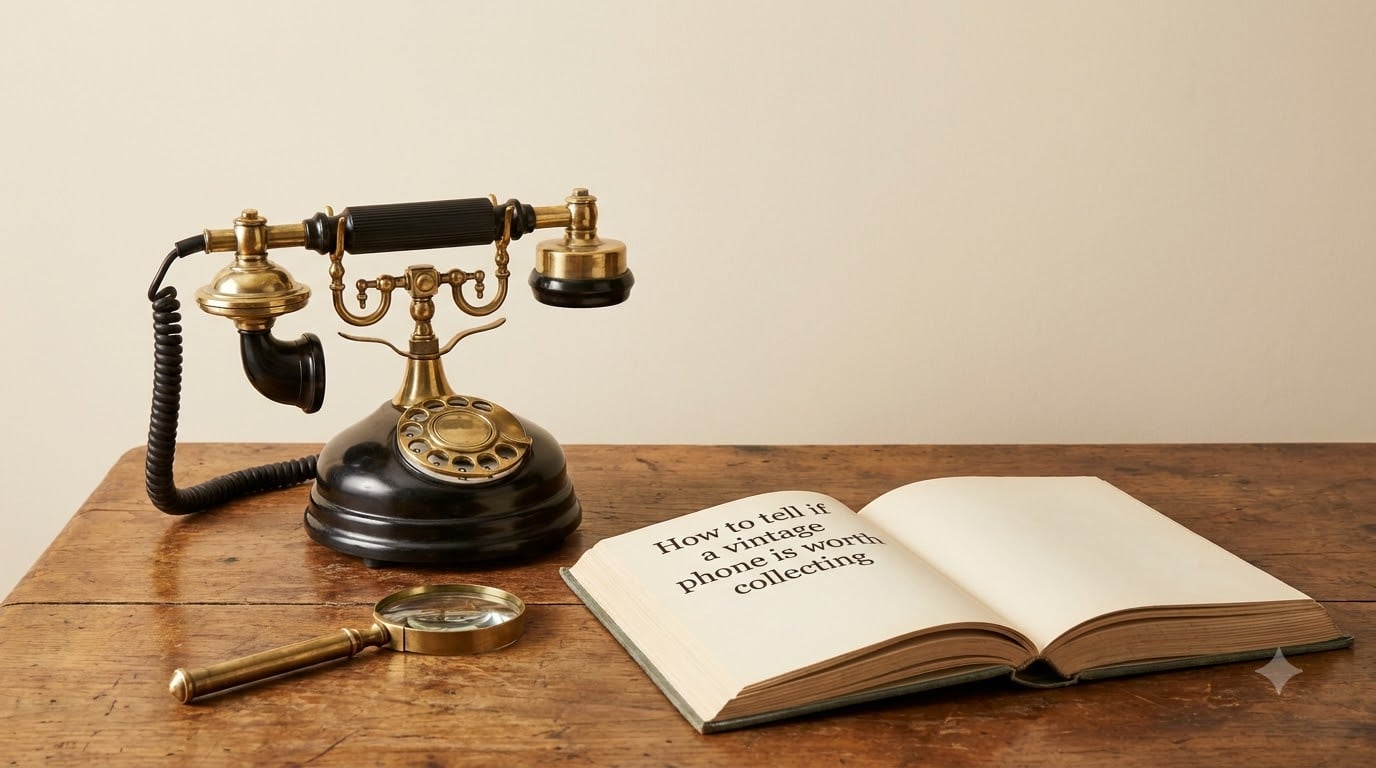
Learning how to tell if a vintage phone is worth collecting can save you from costly mistakes at estate sales, antique shops, and online auctions. Our team has spent years researching the antique telephone market, interviewing collectors from the Antique Telephone Collectors Association, and tracking eBay sold listings to understand what drives value.
Whether you inherited a box of old rotary phones from a relative or spotted a candlestick phone at a flea market, you need a reliable evaluation process. This guide walks you through every factor that matters, from manufacturer markings to condition grading, so you can make confident decisions.
Table of Contents
Quick Evaluation Checklist: Is Your Vintage Phone Worth Collecting?
Before diving into detailed analysis, run any phone through this checklist. If a phone checks four or more of these boxes, it is likely worth collecting or reselling.
Manufacturer identified: Look for Western Electric, Automatic Electric, Kellogg, or Stromberg-Carlson markings on the base or underside.
Original parts intact: The handset, dial, cords, and internal components should match the phone’s era and appear unmodified.
Good structural condition: No deep cracks in the bakelite, no missing pieces, minimal chipping on edges.
Rare or desirable model: Candlestick phones, early wood wall phones, and art deco desk sets carry the strongest collector demand.
Documented provenance: Any history of ownership, original receipts, or documentation adds measurable value.
Working or repairable: Functional phones command higher prices, but non-working phones still have parts value.
This checklist mirrors the criteria that experienced collectors on the r/TelephoneCollecting subreddit use when evaluating finds. Photograph your phone from every angle, including the underside, before moving on to detailed research.
Types of Vintage Telephones Worth Collecting
Not all old phones hold the same value. Understanding the three main collectible categories helps you quickly assess whether a phone deserves your attention.
Candlestick Phones (1900s to 1930s)
Candlestick phones are the tall, single-piece telephones with a mouthpiece on top and a separate earpiece the user held to their ear. These are the most sought-after antique telephones on the market. Prices on eBay range from $75 for common models in rough condition up to $8,000 for rare Western Electric candlesticks in excellent original condition.
Most candlestick phones were produced by Western Electric, Automatic Electric, and Kellogg. The presence of a ringer box (a separate wooden or metal box that housed the bell mechanism) typically increases value, as many were separated from their phones over the decades.
Desk Set Phones (1930s to 1960s)
Desk set phones include the classic rotary dial models most people picture when thinking of vintage telephones. The Western Electric 500 series, introduced in 1949, is the most recognizable. These phones are common, which keeps prices modest, typically ranging from $20 to $150 depending on color, condition, and rarity.
Certain colors and models are exceptions. For example, the Western Electric 302 in original black bakelite or rare colors like ivory, rose, or green can fetch $200 to $500 among serious collectors.
Wood Wall Phones (1880s to 1920s)
Wood wall phones are the oldest collectible telephones, featuring oak or walnut wooden cabinets with exposed magneto cranks and ringer boxes. These command strong prices, with eBay sold listings showing ranges from $85 to $825 for complete, authentic examples.
Original finishes, intact magneto cranks, and matching ringer bells drive the upper end of that range. Reproductions are common in this category, so authentication is especially important here.
What Makes a Vintage Phone Valuable
Five core factors determine whether a vintage phone is worth collecting. Our team ranked these based on data from eBay sold listings, collector forum discussions, and guidance from the Antique Telephone Collectors Association.
1. Completeness
A phone with all its original components, including cords, dials, handset, and internal wiring, is worth significantly more than a phone missing parts. Collectors on the classicrotaryphones.com forum emphasize that finding replacement parts for certain models can take months or years, which makes complete phones far more desirable.
2. Condition
Condition matters more than working status for many collectors. A phone that looks clean with minimal wear, no cracks, and intact original finish carries premium value even if it does not function. Deep cracks in bakelite, repainted surfaces, or heavily worn dials reduce value substantially.
3. Authenticity
Reproductions and franken-phones (phones assembled from parts of different models) flood the market. A phone with matching, period-correct components and verifiable manufacturer markings is always worth more. We cover how to spot reproductions in detail later in this guide.
4. Rarity
Limited production runs, unusual colors, short-lived models, and phones from small regional manufacturers are rare and command higher prices. The Western Electric 500 in standard black is common, but the same model in an unusual color like Mediterranean Blue is scarce.
5. Provenance
Documentation of a phone’s history adds real value. A phone with a story, original purchase receipt, or connection to a notable location or person can sell for multiples of its base value. Neither major competitor in our research covers provenance, but collectors consistently rank it as a meaningful value driver.
Key Manufacturers to Know
Identifying the manufacturer is one of the fastest ways to gauge whether a vintage phone is worth collecting. These are the names that matter most in the antique telephone market.
Western Electric: The dominant American phone manufacturer for most of the 20th century. Western Electric produced the widest range of collectible phones, from candlesticks to the 500 series desk phone. Look for the “Bell System” logo or “Western Electric” stamped on the base.
Automatic Electric: The primary competitor to Western Electric, producing phones for independent telephone companies. Their Monophone series, particularly the AE 40 from the 1930s, is highly collectible. Look for “Automatic Electric” or “AE” markings.
Kellogg: Known for distinctive designs and the switchboard-inspired look of their candlestick phones. Kellogg produced phones from the late 1800s through the mid-1900s. Their marking often appears as “Kellogg Switchboard and Supply Company.”
Stromberg-Carlson: Produced high-quality phones with unique designs. Their wood wall phones and early desk sets are sought after by advanced collectors.
Siemens and Ericsson: European manufacturers whose phones appeal to international collectors. If you encounter a phone with European markings, research the specific model, as values vary widely.
How to Identify Valuable Phones: Step by Step
Follow this process every time you evaluate a phone. These steps come from collector community best practices shared across r/TelephoneCollecting and Facebook vintage phone groups.
Step 1: Photograph every marking. Snap clear photos of the bottom of the base, inside the handset, any paper labels, and stamped numbers on metal parts. The underside contains the most important identification information.
Step 2: Locate the manufacturer stamp. Look for company names, Bell System logos, model numbers, and date codes stamped into the metal or printed on paper labels inside the phone.
Step 3: Identify the model and era. Cross-reference the markings against resources like the Telephone Archive website or ATCA reference guides. Model numbers tell you the production era and whether the phone is rare or common.
Step 4: Check for date codes. Western Electric used date codes consisting of a year and quarter (for example, a code ending in 5B means the second quarter of 1945). These codes confirm whether internal components match the phone’s era.
Step 5: Compare to eBay sold listings. Search for the exact model and filter by sold items. This gives you real market value, not asking prices, which are often inflated.
Step 6: Assess parts originality. Check whether cords, dials, and the handset all carry the same manufacturer markings. Mismatched parts indicate a franken-phone, which reduces collector value.
How to Spot Reproductions vs. Originals?
Reproductions are a real problem in the vintage phone market, especially with wood wall phones and candlestick models. Neither top competitor in our SERP analysis covers this topic well, so here is what to look for.
Check the weight. Original bakelite and metal phones are heavy. Reproductions often use lighter plastics that feel hollow or too light for their size.
Examine the patina. Genuine aging on bakelite shows as a dulling of the surface and minor surface wear in expected contact areas. Reproductions either look too new or have artificially applied aging that appears uneven.
Look for modern components. Peer inside the phone or check the cord. Modern wiring, plastic connectors, or non-period-correct screws are immediate red flags. Original phones used cloth-covered cords and specific wiring types for their era.
Verify markings against known references. Reproductions often have poorly cast or laser-etched markings that differ from the original stamping methods. If a marking looks too clean or too shallow, investigate further before buying.
Restoration vs. Original Condition: What Wins?
This is one of the most debated topics in collector communities. The answer depends on your goal: resale value or personal enjoyment.
For serious collectors, original condition almost always wins. A phone with original finish, even if worn, typically commands a higher price than a restored phone. Collectors value authenticity over appearance, and restoration can sometimes reduce value if it involves non-original parts or modern paint.
However, light cleaning and mechanical repairs are generally acceptable. Replacing a frayed cloth cord with a period-correct reproduction cord, polishing brass contacts, or fixing a stuck dial mechanism will not hurt value and often improves it.
If your goal is a functional phone for home use, restoration makes sense. You can use a pulse-to-tone adapter or VOIP-compatible setup and enjoy a working vintage phone without worrying about collector purity. Just document what you change, in case a future buyer cares about originality.
The cost-benefit of professional restoration rarely works for common models. Paying $150 to restore a phone worth $75 does not make financial sense. For rare models worth $500 or more, professional restoration by a specialist may add value.
Price Range Expectations
Setting realistic price expectations helps you spot deals and avoid overpaying. Based on current eBay sold listings and specialty dealer pricing as of 2026, here is what you can expect.
Candlestick phones: $75 for common models in rough shape, $300 to $800 for good original condition, and $2,000 to $8,000 for rare Western Electric models with ringer boxes.
Wood wall phones: $85 to $825 for authentic complete examples. Phones with original finish and intact magneto cranks sit at the top of this range.
Rotary desk phones: $12 to $150 for most Western Electric 500 series models. Rare colors and early models can reach $200 to $500.
Non-working phones: Still have value for parts. Collectors buy incomplete or non-functional phones for $10 to $50 to restore other phones or complete a set.
Always check eBay sold listings rather than active listings. Active listings show what sellers hope to get. Sold listings show what buyers actually pay.
Modern Compatibility: Can You Actually Use a Vintage Phone?
Many people want to know if a vintage phone is worth collecting for practical use, not just display. The good news is that most rotary phones from the 1930s onward can work on modern phone lines with some adjustments.
For traditional landlines, rotary phones usually still work because most telephone companies still support pulse dialing. However, some newer digital phone services and VOIP systems do not recognize pulse signals.
A pulse-to-tone adapter solves this problem. These small devices convert the rotary pulse signal into the tone signals that modern phone systems require. They plug inline between the phone and the wall jack and typically cost under $30.
For VOIP systems, you may also need to check whether your adapter or service supports the electrical characteristics of older phone ringers. Some old phones need a ringer equivalence number (REN) booster to ring properly on modern lines.
Replacing the old spade-lug line cord with a modular plug cord is a simple, reversible modification that lets you connect a vintage phone to any standard phone jack.
Where to Sell or Appraise Vintage Phones
If you have evaluated a phone and decided to sell, or if you need a professional appraisal, several channels work well depending on the phone’s value and your goals.
eBay: The largest market for vintage phones. Check sold listings to set realistic prices, take clear photos of all markings and any damage, and write detailed descriptions including the manufacturer, model number, and condition. Phones with thorough photography sell faster and for more money.
Antique Telephone Collectors Association (ATCA): Joining ATCA gives you access to a network of serious collectors who can help with identification, appraisal, and direct sales. The community is welcoming and knowledgeable.
Specialty dealers: Businesses like The Olde Telephone Company specialize in vintage phones and can provide appraisals or purchase phones outright. Expect wholesale pricing if selling to a dealer, but the convenience is significant.
Photography tips for selling: Photograph the phone in natural light against a plain background. Capture the front, back, both sides, the handset from multiple angles, the dial face, the underside with markings, and any damage. Good photos are the single biggest factor in getting top dollar.
FAQs
Which vintage phones are worth money?
Western Electric candlestick phones, early wood wall phones, and rare-colored rotary desk sets are the most valuable. Candlestick phones can sell for $75 to $8,000, wood wall phones for $85 to $825, and uncommon colored desk phones for $200 to $500. Phones with documented provenance or complete original parts command the highest prices.
How do I know the value of my old phone?
To determine your phone’s value, identify the manufacturer and model using markings on the base and handset. Then search eBay sold listings for the exact model to see real market prices. Factor in condition, completeness of original parts, rarity of color or model, and any documented history. For high-value phones, contact ATCA or a specialty dealer for a professional appraisal.
Are my old phones worth anything?
Most vintage phones have some value. Even non-working phones sell for $10 to $50 as parts for restoration projects. Common rotary desk phones typically sell for $12 to $150. Rare models like candlestick phones and wood wall phones can be worth hundreds or thousands. The key factors are manufacturer, model rarity, condition, and originality of parts.
How to identify an antique phone?
Turn the phone over and photograph all markings on the underside. Look for manufacturer stamps like Western Electric, Automatic Electric, or Kellogg, along with model numbers and date codes. Cross-reference these against the Telephone Archive website or ATCA resources. Check that all components carry matching manufacturer markings to confirm originality. Western Electric date codes show the year and quarter of production.
Conclusion
Knowing how to tell if a vintage phone is worth collecting comes down to five things: manufacturer identification, model rarity, condition, completeness, and provenance. By following the step-by-step evaluation process in this guide, you can confidently assess any phone you encounter at estate sales, flea markets, or in inherited collections.
Start by photographing all markings, researching the model against eBay sold listings, and joining collector communities like ATCA for expert guidance. The more phones you evaluate, the faster your eye will become at spotting the ones truly worth collecting.