
Last updated: October 2026
A voltage tester is the cheapest insurance in a homeowner’s toolbox, and the difference between a good one and a bad one is whether it tells you the truth when a circuit is half-live. Most outlet problems are not dramatic failures. A neutral that has come loose behind a receptacle still lets the lamp on the table turn on, so the outlet looks fine until you plug in a tool with a metal case. We tested and compared 10 voltage testers built for outlet checks, and the best voltage testers for outlet checks split into two very different groups: plug-in receptacle testers that decode wiring faults, and non-contact pens that screen a circuit before you touch it.
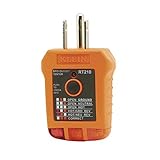
Our top pick is the Klein Tools RT250, a receptacle tester with a backlit LCD that shows real voltage numbers, plain-text fault codes, and the trip time of a GFCI device. It carries a 4.8 rating across more than 11,000 reviews, which makes it one of the most proven devices in this category. For anyone who just wants a yes-or-no answer on a GFCI outlet, the Klein RT210 does the same fault check with no batteries at all.
A word on scope before we get into the picks. Nothing here replaces a licensed electrician, and nothing here licenses you to work inside a panel. If a tester tells you a circuit is dead, treat that as a screening result, not a permission slip. Understanding battery and power handling for the tools around the job is covered in our guide to battery testers for household batteries, and protecting expensive gear from bad supply is covered in our picks for voltage protectors for appliances.
Table of Contents
Top 3 Picks for Outlet Checks in 2026

Klein Tools RT250
- Backlit LCD voltage readout
- Text fault codes
- GFCI trip time display
- Auto-Hold
Klein Tools RT210
- LED fault indication
- Tests GFCI and standard outlets
- No batteries
- 6.6 ft drop rated

Sperry Instruments STK001
- Non-contact pen plus receptacle tester
- 50-1000V AC detection
- Battery self-test
- 10 ft drop rated
The RT250 wins because it removes guesswork. The RT210 wins on simplicity and battery independence. The Sperry kit wins when you want to sweep a whole house without switching tools halfway through.
Best Voltage Testers for Outlet Checks at a Glance in 2026
| Product | Specs | Action |
|---|---|---|
| Klein Tools RT250 GFCI Outlet Tester with LCD |
|
Check Latest Price |
| Klein Tools RT210 Outlet Tester |
|
Check Latest Price |
| Sperry Instruments STK001 Non-Contact and GFCI Kit |
|
Check Latest Price |
 KAIWEETS HT100s Dual Range Voltage Tester KAIWEETS HT100s Dual Range Voltage Tester |
|
Check Latest Price |
 Klein Tools RT110 Outlet Tester Klein Tools RT110 Outlet Tester |
|
Check Latest Price |
 Gardner Bender GTK-2 Safety Kit Gardner Bender GTK-2 Safety Kit |
|
Check Latest Price |
 Southwire 40022S GFCI Receptacle Tester Southwire 40022S GFCI Receptacle Tester |
|
Check Latest Price |
 Fluke ST120+ GFCI Socket Tester Fluke ST120+ GFCI Socket Tester |
|
Check Latest Price |
 nVent Gardner Bender GFI-3501 Tester nVent Gardner Bender GFI-3501 Tester |
|
Check Latest Price |
 DROK AC 80-300V Plug-In Voltmeter DROK AC 80-300V Plug-In Voltmeter |
|
Check Latest Price |
What Is a Voltage Tester?
A voltage tester is a small hand-held tool that tells you whether an electrical circuit is energized. There are three common types, and they answer different questions. A non-contact voltage tester (NCVT) senses the AC electric field around a conductor and beeps or lights up, without touching anything. An outlet tester plugs into a receptacle and lights LEDs or fills an LCD to show wiring conditions. A multimeter gives a numeric measurement but costs more and takes longer to read.
For outlet checks specifically, the receptacle tester is the most direct answer, because it tells you not just that power is present but whether the wiring behind the cover is correct. The pen is a screening tool for the moments before you touch a conductor. The multimeter is for the person who needs an actual number.
One limitation applies to all of them, and it catches people out constantly. Every tester in this list detects AC only. None of them will register DC, and none of them will see a circuit that has been de-energised at the breaker but still carries residual charge on a capacitor. That is why professionals never rely on a single reading.
1. Klein Tools RT250 GFCI Outlet Tester with LCD Display – Best Overall for Outlet Checks
Klein Tools RT250 GFCI Outlet Tester with LCD Display, Electric Voltage Tester for Standard 3-Wire 120V Electrical Receptacles
120V AC
Max and min 120V
4.53 x 1.16 x 2 inches
4.16 oz
CAT II 135V
Pros
- Backlit LCD shows real voltage numbers and text fault codes
- Built-in GFCI test button with trip time display
- Two clear status LEDs easy to read in bright rooms
- Auto-Hold freezes the reading for awkward outlets
- Rated to survive a 6.6 ft drop
Cons
- Needs two AAA batteries for the LCD
- Power button can be pressed by tools resting on it in a toolbox
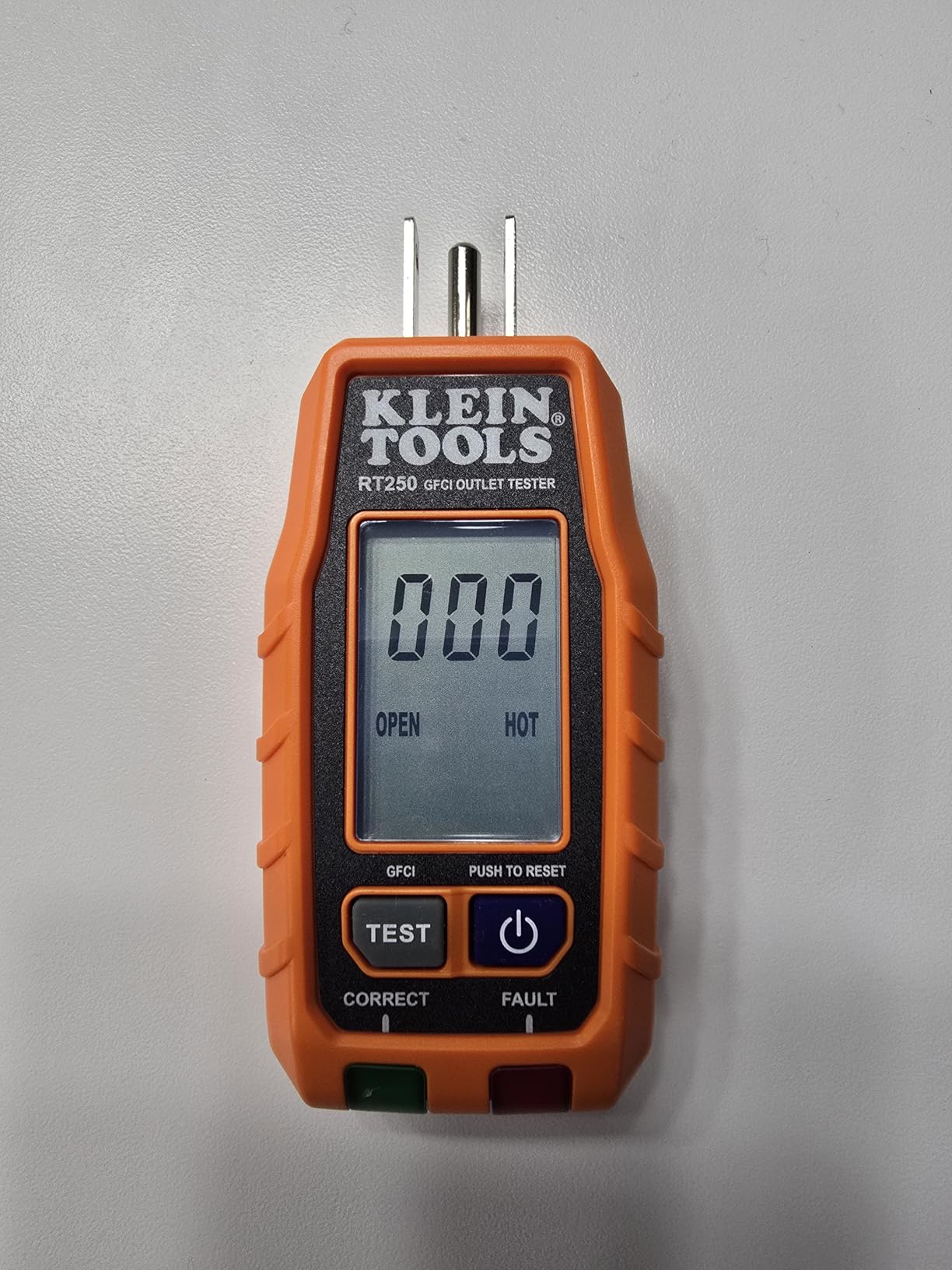
Every one of the best voltage testers for outlet checks boils down to the same question: how confident are you in the result? The RT250 answers that question with numbers instead of blinking lights. Plug it into a receptacle and the backlit LCD shows the actual line voltage, a written fault description when something is wrong, and how long the GFCI took to trip when you press the test button. On a healthy 120V circuit you should see a reading close to 120, and if the number is drifting low or high that is information no LED-only tester gives you.
What I like most is the patent-pending open neutral and open ground detection, which is the one place where receptacle testers have historically let people down. The classic three-light tester reports correct wiring on an unloaded circuit that has a broken neutral, because there is no current flowing to reveal the fault. The RT250 adds a layer of checking designed specifically to catch that. It is not a substitute for a loaded test, which we cover in the outlet-check steps below, but it is meaningfully better than reading lamp patterns.
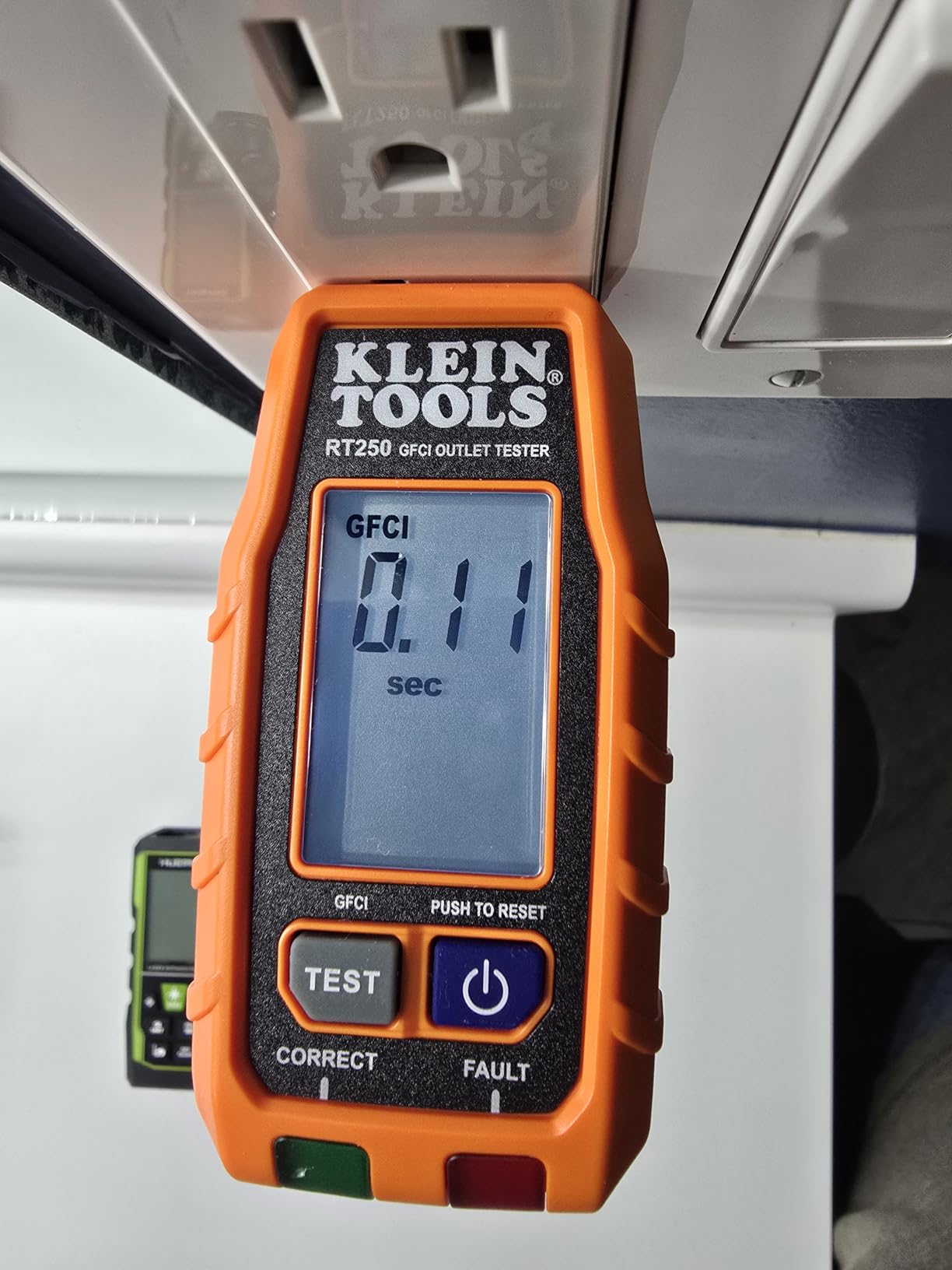
The Auto-Hold function is the sleeper feature. Receptacles behind furniture, in tight wall boxes, or mounted at awkward heights are exactly where you need a reading and cannot hold your eyes on a display for three seconds. The reading freezes, you pull the tester out, and you look at it in the light.
Build-wise it is 4.53 inches long, 1.16 inches wide, 2 inches tall, and 4.16 ounces, which means it disappears into a pocket or a tool bag. It runs on two AAA alkaline batteries that are included, and the operating range tops out at 60 degrees Celsius. The tester is rated to a 6.6 foot drop and carries a CAT II 135V safety rating, which is the correct category for a 120V receptacle in a plug-in-to-wall-box context.
When this tester earns its price over a three-light model
Choose the RT250 when you are troubleshooting rather than surveying. If an outlet misbehaves, if a GFCI keeps tripping, or if you want to know whether a supply is sitting at 105V or 125V, the LCD is what tells you why. A three-light tester can only tell you that something is wrong, which means a second trip to the panel and a guess.
The GFCI trip time display also turns a vague result into a spec check. A healthy residential GFCI device is required to trip within the 6 to 9 mA range, and the RT250 shows you the elapsed time so you can confirm the device meets its rating rather than merely clicking.
When a cheaper tester is the better call
Two things work against it. It needs batteries, and a tester with a power button can sit in a toolbox under a wrench long enough to drain them. Reviewers report exactly this: arriving at an outlet, getting no reading, and replacing batteries before starting.
It is also overkill if you are simply mapping a house. If every plug-in test on the checklist is a yes-or-no wiring check with no follow-up questions, the RT210 does the same job with no power source at all.
2. Klein Tools RT210 Outlet Tester – Best for GFCI Outlet Checks Without Batteries
Klein Tools RT210 Outlet Tester, Receptacle Tester for GFCI / Standard North American AC Electrical Outlets, Detects Common Wiring Problems
110/125V AC 50/60Hz
3-wire outlets
5.3 x 3.8 x 1.5 inches
1.9 oz
6.6 ft drop
Pros
- Hand powered so there are no batteries to fail
- Tests standard and GFCI receptacles in one tool
- Rated to survive a 6.6 foot drop
- Works from 32F to 140F
- Proven Klein durability
Cons
- LED-only so there is no voltage reading or trip time
- Fault legend takes a moment to read at a glance
The RT210 is the tool we hand to someone who wants to check outlets and does not want to think about batteries. It is hand powered, which means the circuit under test powers the indicator itself. Plug it in and it lights. That single design decision removes an entire category of frustration, including the dead-tester-on-a-live-circuit problem that catches people out.
It handles both standard and GFCI receptacles, works on 110/125V AC at 50/60Hz three-wire outlets, and reports faults through a colour-coded LED indication. Operating temperature runs from 32 to 140 degrees Fahrenheit, so a cold garage or a summer attic is not a limiting factor. It weighs 1.9 ounces and measures 5.3 by 3.8 by 1.5 inches.
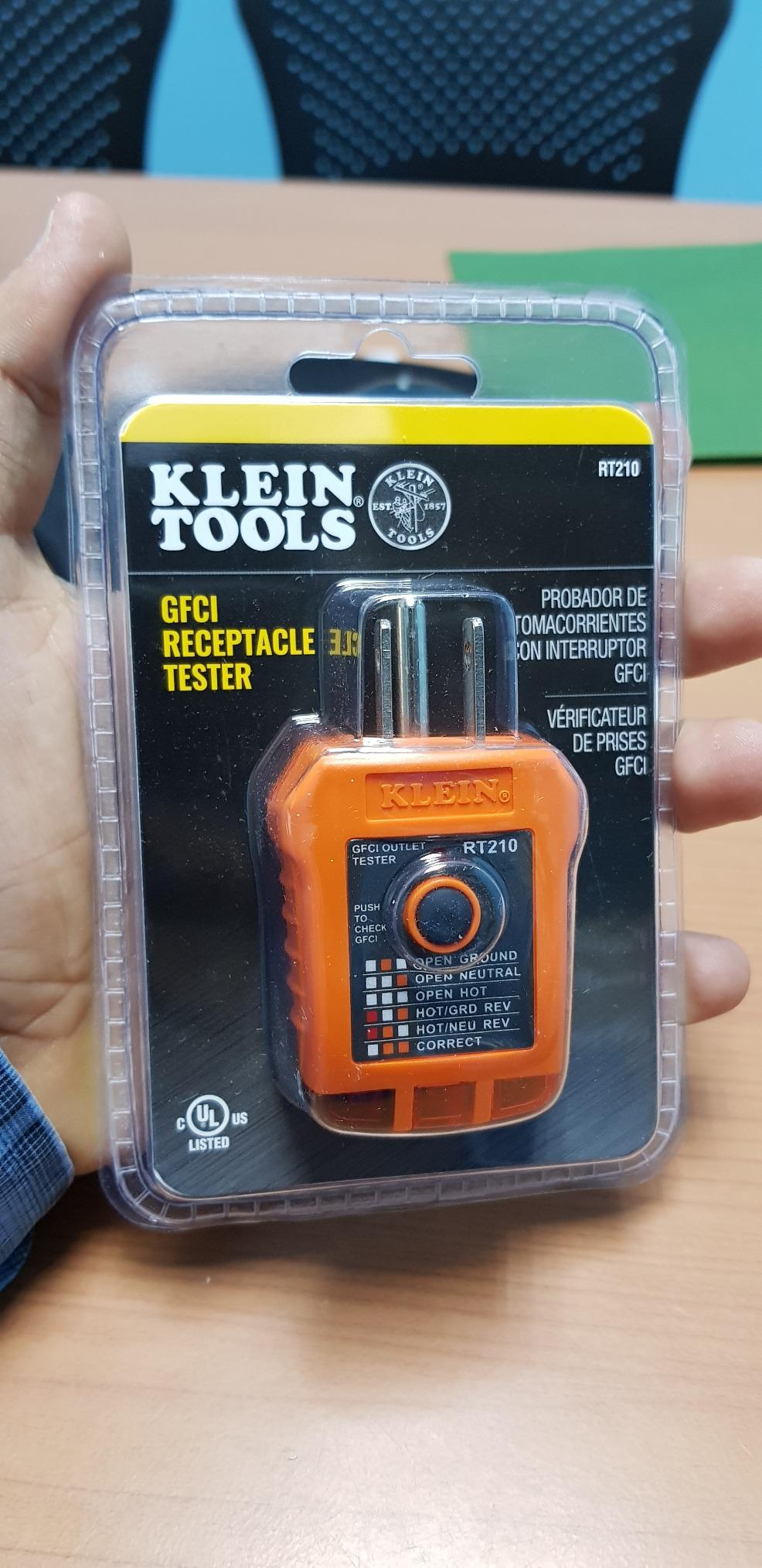
Where it fits in our list of the best voltage testers for outlet checks is simple. This is the first tool we recommend to a homeowner buying exactly one device. It covers the fault conditions that matter in a standard receptacle and confirms that a GFCI device is present and responding, and it will still work in ten years because there is nothing to expire.
The 6.6 foot drop rating is not marketing filler for this category. Receptacle testers get dropped from ladders and knocked off van shelves constantly, and the housing is built for that. Buyers consistently describe it as the same basic tool their electrician used.
What the LED pattern can and cannot tell you
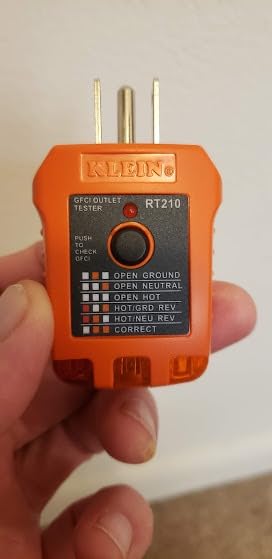
The RT210 is strong on fault identification. It will flag reversed polarity, an open ground, an open neutral on a loaded circuit, and a miswired hot conductor, and the colour coding is consistent enough to learn in a single outlet. The legend printed on the body removes the need for a phone lookup in the middle of a basement.
What it cannot tell you is the actual voltage. If a circuit is sagging to 104V because of a long undersized extension run or a failing breaker, the RT210 will still show a normal-looking result because the circuit is present. Diagnosing that requires a numeric reading, which is where the RT250 takes over.
Where it will disappoint you
It is a plug-in tester, so it needs a three-wire grounded receptacle to work properly. On a two-wire ungrounded box in an older home you will get limited information, and the same is true of most testers in this list. It also cannot measure the trip time of a GFCI device, only confirm that it trips.
If your work is entirely in crawlspaces, attics, and open panels where there is no receptacle to plug into, a non-contact pen is the more useful tool, and that is the next two picks.
3. Sperry Instruments STK001 Non-Contact Voltage Tester and GFCI Tester Kit – Best for Whole-Home Outlet Sweeps
Sperry Instruments STK001 Non-Contact Voltage Tester (VD6504) & GFCI Outlet / Receptacle Tester (GFI6302) Kit, Electrical AC Voltage Detector, Yellow & Black
Pen 50-1000V AC
Receptacle tester CAT III 300V
Pen CAT IV 600V
10 ft drop rated
Limited lifetime warranty
Pros
- Two tools in one kit covers a full outlet sweep
- Patented battery self-test on the pen
- 360 degree visual and audible live wire indication
- 10 ft drop and 250 lb crush rated
- Rubber over-molded grips
Cons
- Lowest average rating here at 4.5 stars
- Some buyers find the two-piece bundle more than they need
- Batteries required for the non-contact pen
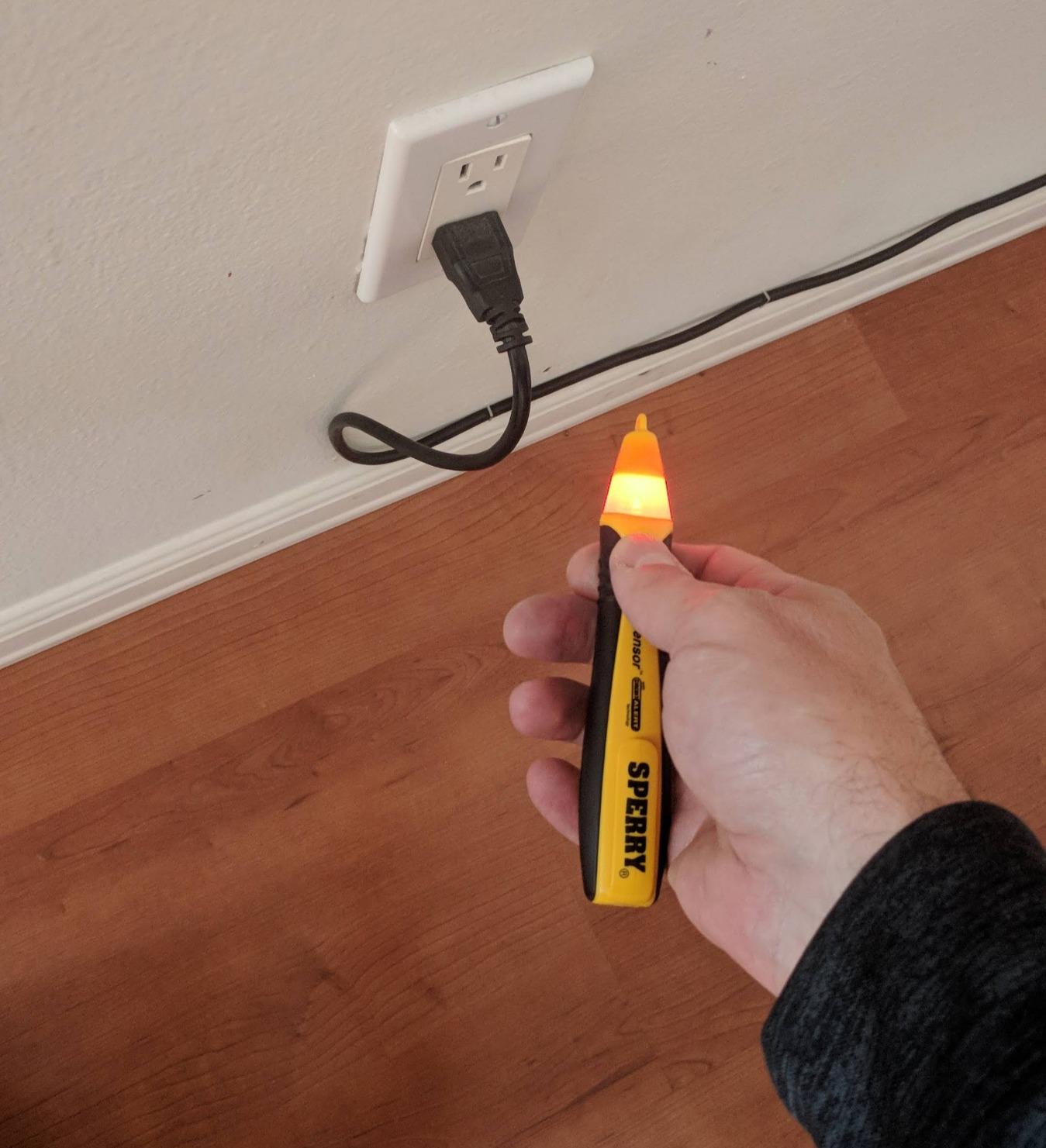
The STK001 is the only pick in this list that pairs a pen with a receptacle tester in one package, and that pairing is exactly what a whole-home check needs. You walk the house with the VD6504 pen to screen conductors and boxes that have no convenient receptacle, and the GFI6302 to decode every receptacle you find. Carrying one kit instead of two devices is the reason this bundle keeps showing up in electrician recommendations.
The pen side detects 50 to 1000V AC and includes a patented battery self-test. That self-test matters more than it sounds, because the single most common question in DIY electrical forums is how you know the tester still works. A pen that will tell you it is alive is worth more than a pen with a marginally better detection threshold. Indication is 360 degree, visual and audible, so you do not have to be looking directly at it.
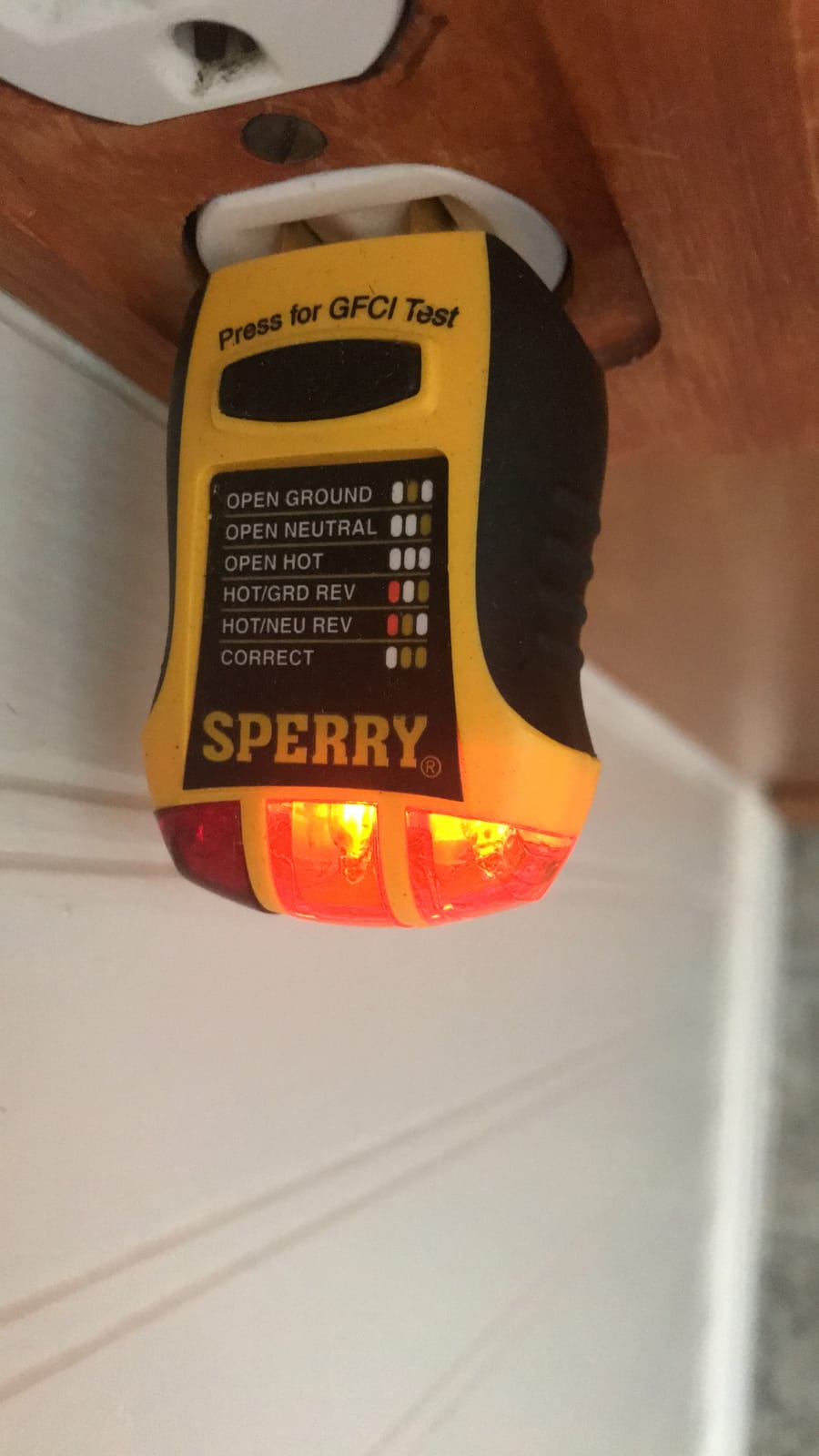
The receptacle tester side, the GFI6302, is rated CAT III 300V and uses bright neon indicator lights for visual indication of wiring condition. Both halves use a hi-impact ABS housing with soft over-molded rubber grips. The kit is rated for a 10 foot drop and 250 pounds of crush, which is the highest drop figure among these picks.
One technical note: the receptacle tester is rated CAT III 300V and the pen is rated CAT III 1000V and CAT IV 600V. Those are not interchangeable, and the difference is why the pen is the safer tool near a service panel.
Why the self-test feature changes how you work
A self-test means you can prove the tool is powered before you trust a negative result. Sequence it this way: switch on the pen, confirm it self-tests, then probe the conductor in question. If the pen does not light, you know the reading was about the tool rather than the wire. This is a small habit that removes a genuinely dangerous failure mode.
The 50V lower threshold is also worth understanding. It means the pen will not detect very low-voltage control circuits, so a doorbell transformer or a thermostat wire will read dead even when it is live. That is a limitation by design, and the KAIWEETS pick below addresses it directly.
When one tool is enough instead of two
If your only task is checking receptacles, the bundle is redundant. Reviewers of this kit say so plainly, and it is why the 4.5 average sits below the other picks here. The pen is the part that earns its place on a work belt; the receptacle tester duplicates something the Klein models already do more legibly.
A second consideration is that batteries are required for the pen, and the kit is a hand-me-down style purchase. If you lose the pen, the receptacle tester is still there. If you lose batteries mid-project, neither half helps you.
4. KAIWEETS HT100s Dual Range Voltage Tester with Signal Percentage – Best for Low-Voltage Circuits
KAIWEETS Voltage Tester/Non-Contact Voltage Tester with Signal Percentage, Dual Range AC 12V/70V-1000V, Live/Null Wire Tester, Electrical Tester with LCD Display, Buzzer Alarm, Wire Breakpoint Finder
12V and 70-1000V AC
CAT III 1000V / CAT IV 600V
5.91 inches long
80 g
36-month service
Pros
- Dual range reaches 12V for doorbells and thermostats
- LCD signal percentage gives a real strength reading
- Loud buzzer audible above workshop noise
- Built-in LED flashlight and auto power-off
- Pointed tip fits outlet slots with a pocket clip
Cons
- Batteries are not included in the box
- Low-voltage mode can pick up ambient static from bundled wires
- Plastic pocket clip can snap with rough handling
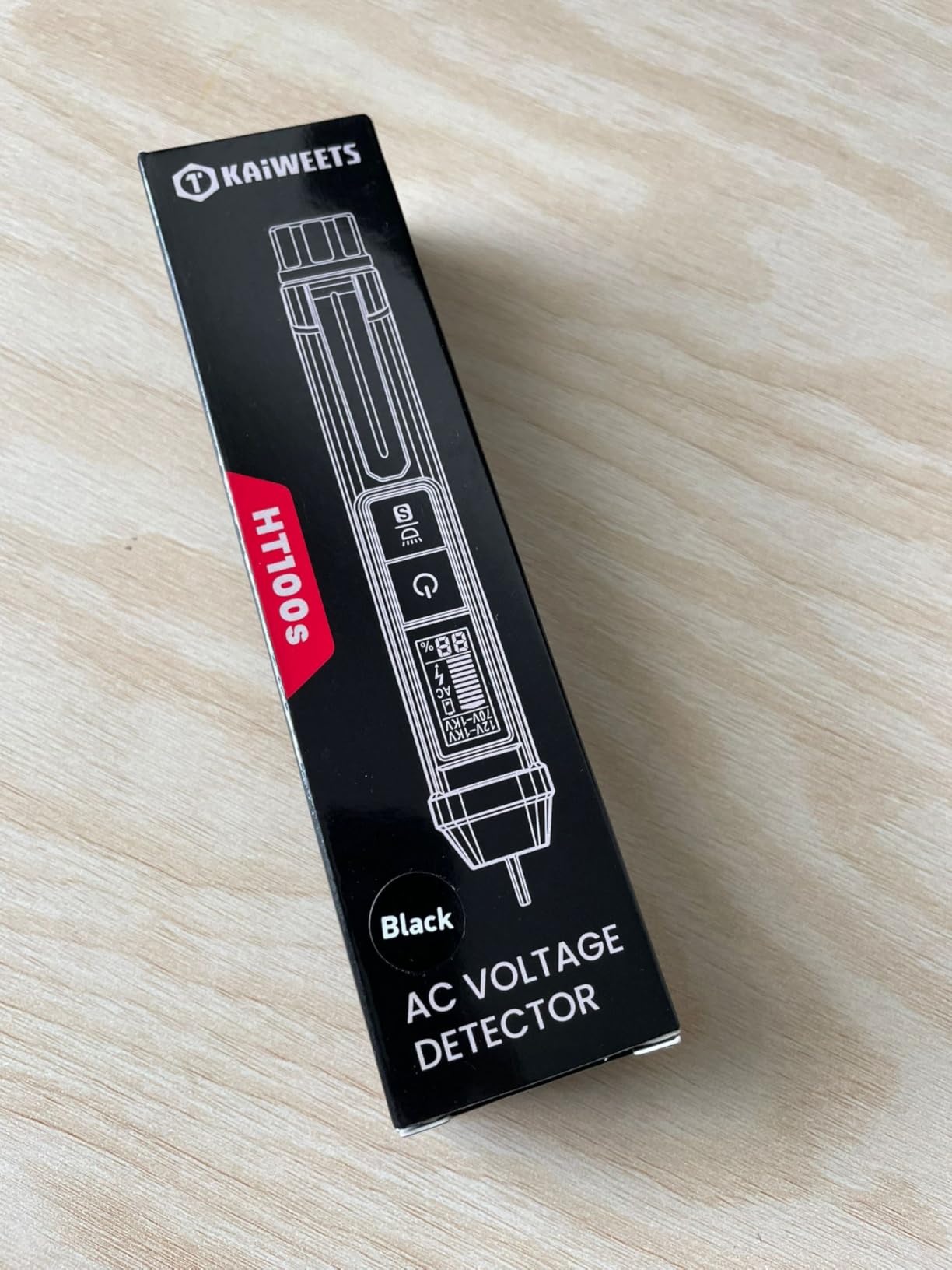
Most pens start detecting at 50V. This one starts at 12V and has a second range that starts at 70V, which is the whole point of it. If you are checking outlets, the 70V to 1000V range does the work. If you are chasing a dead doorbell transformer or a landscape lighting circuit, the 12V range is the only tool on this list that will find it. Press S to switch ranges, and the tool raises a high-voltage alert above 90V.
The LCD signal percentage bar graph is a real improvement over a simple beep. It shows how strong the field is and how close you are, so you can walk the tip along a bundle of cable and watch the signal rise as you approach the conductor. The beep frequency rises with the signal too. Red screen indicates a live or hot wire, green indicates the neutral or null wire, which is genuinely useful when you are tracing which conductor in a box is which.
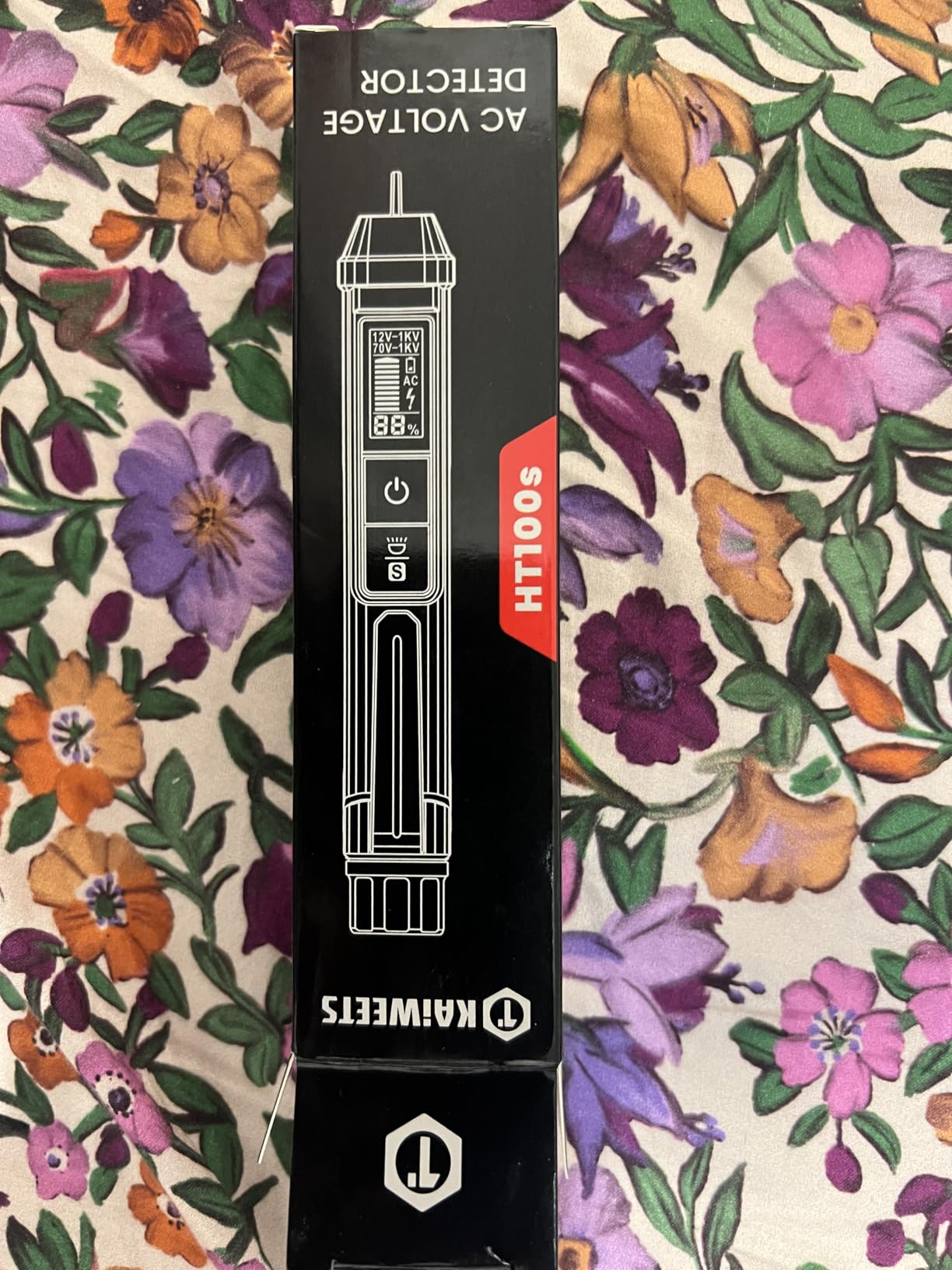
Safety certification is where this tool earns its premium badge. It is double insulated and IEC rated CAT III 1000V and CAT IV 600V, which covers everything from a receptacle up to a service panel. It also carries a built-in LED flashlight, a low-power indicator below 2.5V, and auto power-off after five minutes so the batteries do not die in a pocket. Backed by 36 months of after-sale service.
Dimensions are 5.91 inches long and 0.79 inches square, at 80 grams. The pointed tip is thin enough to enter an outlet slot, which solves the tip-thickness problem that trips up several other pens in tight power strips and older receptacles.
When the extra sensitivity actually pays off
Low-voltage work. Doorbell chimes, thermostats, irrigation control, garage door openers, and lighting transformers all sit below 50V, where a standard pen reports nothing. That is the situation this tool is built for, and it is a real gap in the rest of this list. For a pure outlet check the dual range is nice to have rather than essential.
The signal percentage also makes it the most teachable pen here. You can hand it to someone who has never opened a panel and say watch the bar, walk it up the cable, tell me when it changes. A binary beep gives them nothing to learn from.
When the extra sensitivity becomes a problem
Over-sensitivity is the cost. Reviewers report the low-voltage mode reacting to ambient static when wires are bundled tightly together, which is a false positive rather than a false negative. In practice that direction of error is the safe one, since a pen that errs toward detecting a live conductor will not let you start work on a hot wire. Users consistently state that they would rather have a pen that cries wolf than one that stays quiet.
Two smaller gripes: the batteries are not in the box, and the plastic pocket clip is the first part likely to snap if it gets snagged on a shirt pocket repeatedly.
5. Klein Tools RT110 Outlet Tester – Most Versatile for a First Outlet Check
Klein Tools RT110 Outlet Tester, AC Electrical Receptacle Tester for North American Outlets
110/125V AC 50/60Hz
3-wire outlets
5.5 x 3.5 x 1.8 inches
1.92 oz
UL 1436 and CSA certified
Pros
- Printed light key on the plug itself
- No batteries and no power source
- Conforms to UL 1436 and CSA C22.2 #160
- Rated to survive a 6.6 foot drop
- Works from 32F to 140F
Cons
- LED codes only with no numeric voltage reading
- Instructions are English only
- Does not test GFCI trip function
The RT110 is the simplest tool here and the least likely to disappoint you, because it does one thing: plug in, read the lights, act on the result. The light key is printed on the plug body itself, so you are not looking anything up. If the sequence indicates correct wiring, the outlet is fine. If it indicates a fault, the chart tells you which one and you know whether to flip two wires or call someone.
It is hand powered, works on 110/125V AC at 50/60Hz three-wire outlets, and handles tamper-resistant and three-prong receptacles. Operating range is 32 to 140 degrees Fahrenheit, it is rated to a 6.6 foot drop, and it carries both UL Std 1436 conformance and CSA Std C22.2 #160 certification. Those two standards are the ones written specifically for receptacle testers, which is the certification you should look for on any plug-in tester.
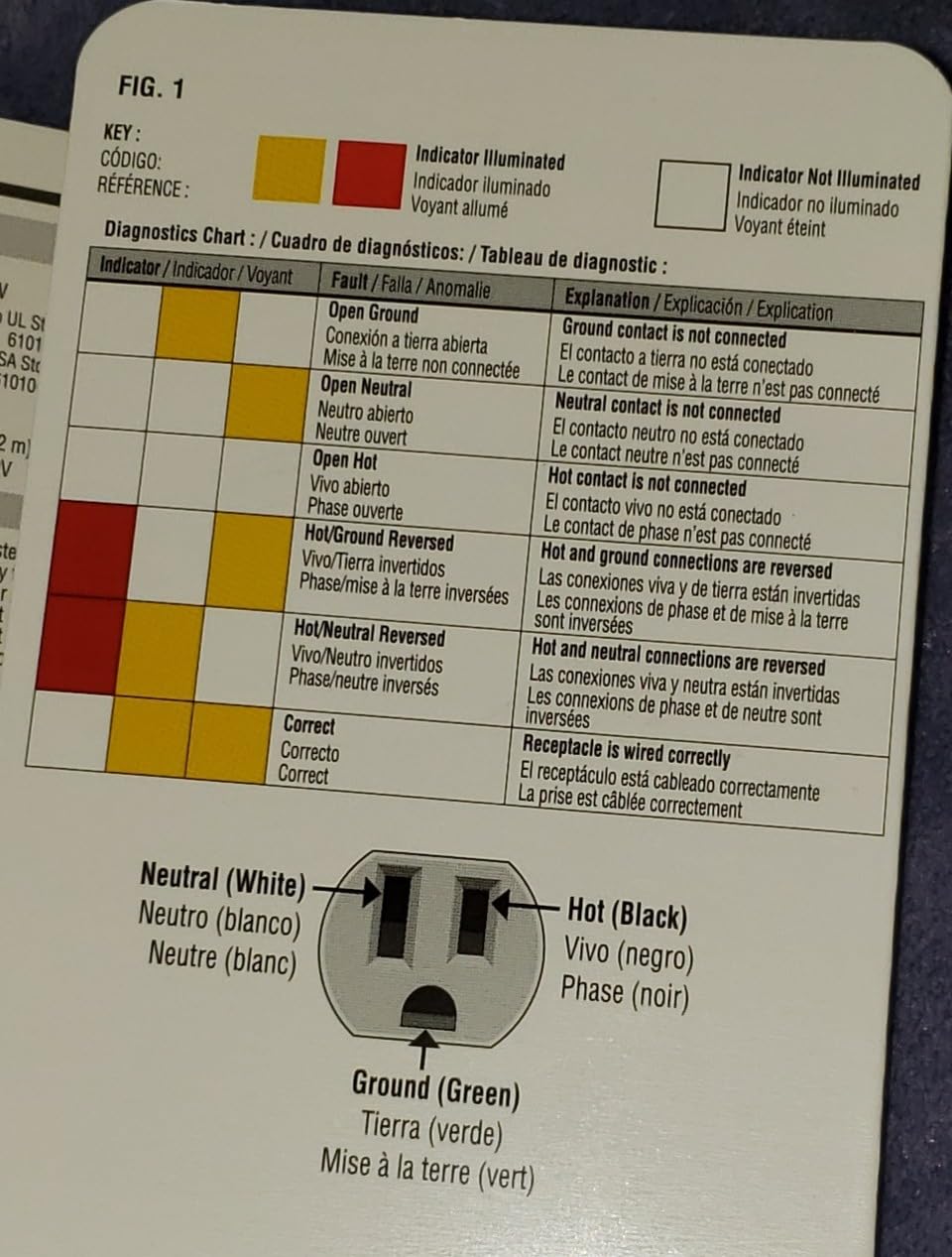
At 1.92 ounces and 5.5 by 3.5 by 1.8 inches, it is the tool we recommend for a first-time buyer who has never owned an electrical tester and just wants to know whether the outlet in the garage is safe. Reviewers describe owners using it to check EV charger outlets, to troubleshoot devices that only work on certain outlets, and to confirm wiring after a DIY project.
It is also the natural companion to any of the pens above. A pen tells you a conductor is live; the RT110 tells you the receptacle behind it is wired correctly. Neither task substitutes for the other.
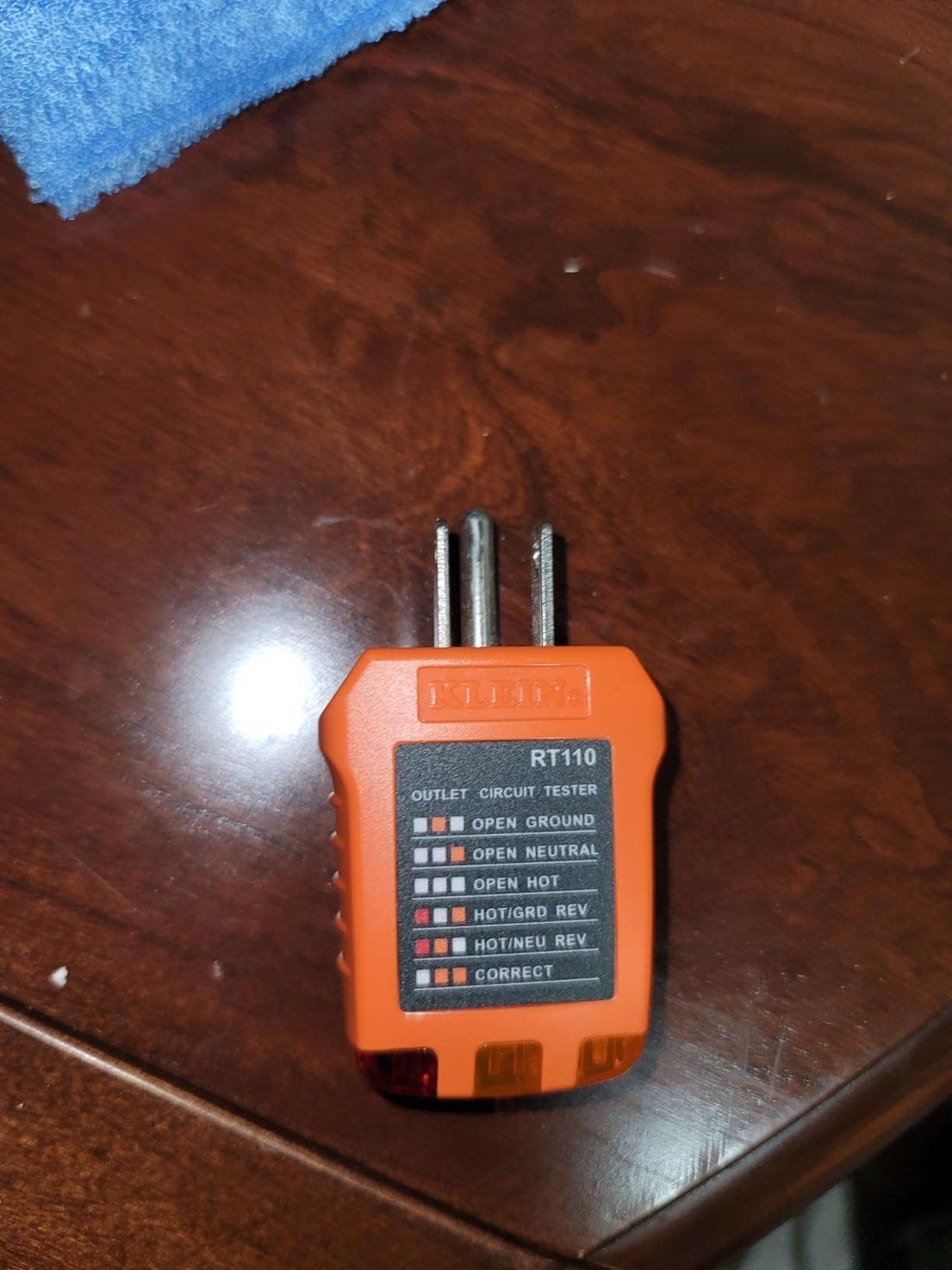
What you can and cannot conclude from the light sequence
You can conclude whether polarity is correct, whether the ground is present, and whether the hot and neutral conductors are reversed. Those three faults account for the overwhelming majority of problems in residential receptacles, and the RT110 identifies all of them.
You cannot conclude anything about GFCI protection, because there is no test button. On a GFCI receptacle the RT110 confirms the wiring is correct, but the trip function itself is a separate question. If verifying GFCI function is on your list, this is the wrong tool and the RT210 is the step up.
When to spend a little more instead
Two situations justify moving up. The first is a house with older wiring, where you want a voltage reading to catch a sagging circuit. The second is recurring nuisance trips on a GFCI, where the trip time display on the RT250 is the feature that answers the question.
The English-only instruction sheet is the one recurring complaint, which matters only if the tester will be used by someone who does not read English. The fault key is printed on the device, so most users never need the manual anyway.
6. Gardner Bender GTK-2 Non-Contact Voltage Tester and GFCI Tester Kit – Best for GFCI Installation Work
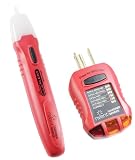
Gardner Bender GTK-2 Safety Kit, GVD-3504 Non-Contact Voltage Tester and GFI-3501 GFI Tester, 2-Piece
Pen senses 50-600V AC
Two piece kit
On-off button and pocket clip
Light key printed both sides
Pros
- Pen and plug-in GFCI tester in one kit
- Consistent readings when installing or replacing GFCI outlets
- Ridged grip helps pull it from tight sockets
- Reference chart printed on both sides
- Buyers rate it level with costlier alternatives
Cons
- Fault code legend is hard to read at a glance
- Non-contact pen tip is too large to fit into an outlet slot
- Batteries not included and the pen is not water resistant
The GTK-2 is the kit to buy if your project is replacing or adding GFCI receptacles. The GFI-3501 half uses indicating lamps to show five common wiring errors, and the light key is printed on both sides of the housing so you can read it whichever way the receptacle is oriented. In a finished wall where the outlet is sideways or upside down, that is a small detail that saves real frustration.
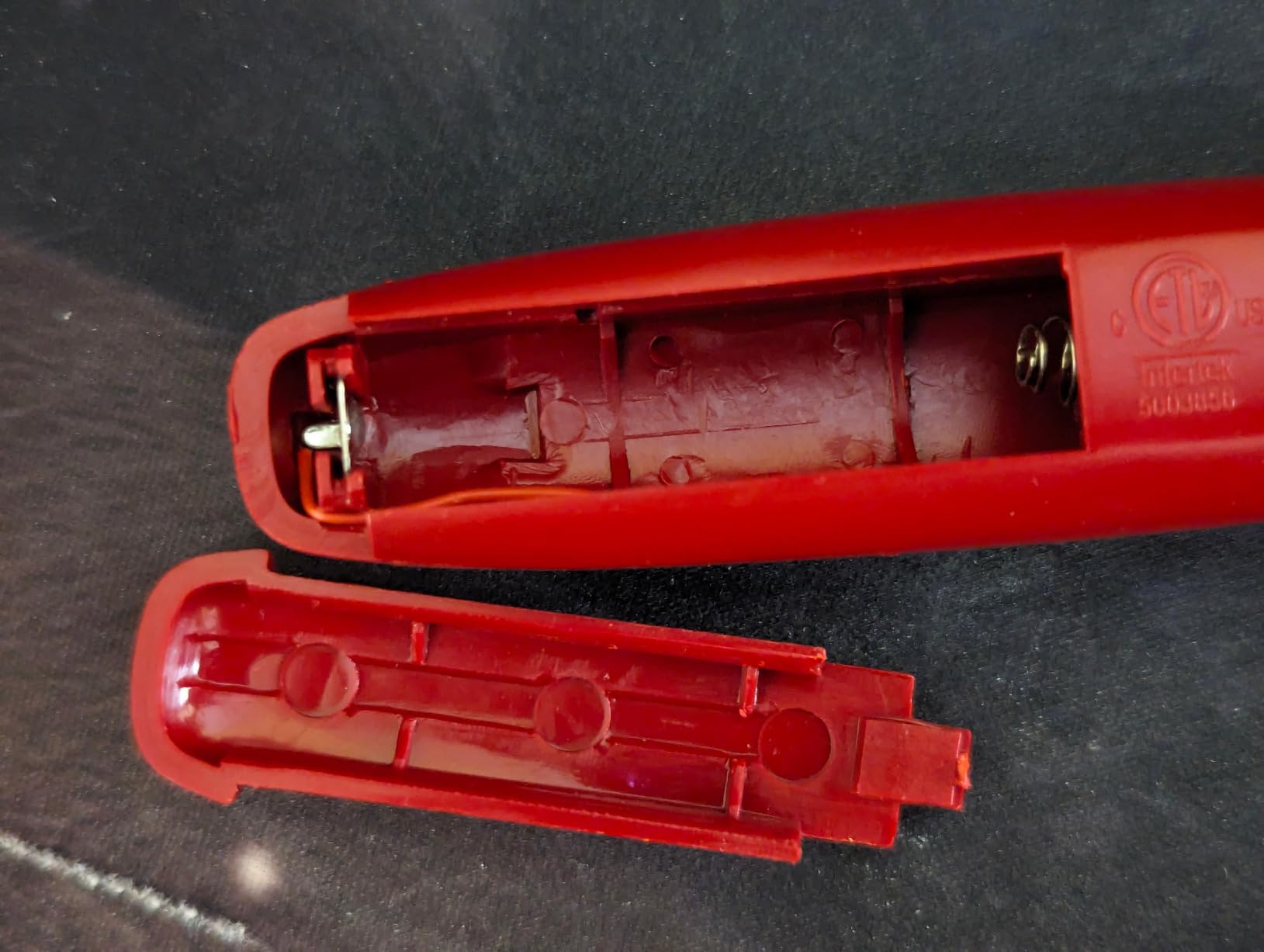
The GVD-3504 pen senses AC voltage from 50 to 600V and has a visual and audible indicator, a pocket clip, and an on-off button. The button is a real difference from twist-on or always-on designs: you power the pen deliberately before approaching a conductor, which is a safer habit than a tool that is live in your pocket all day.
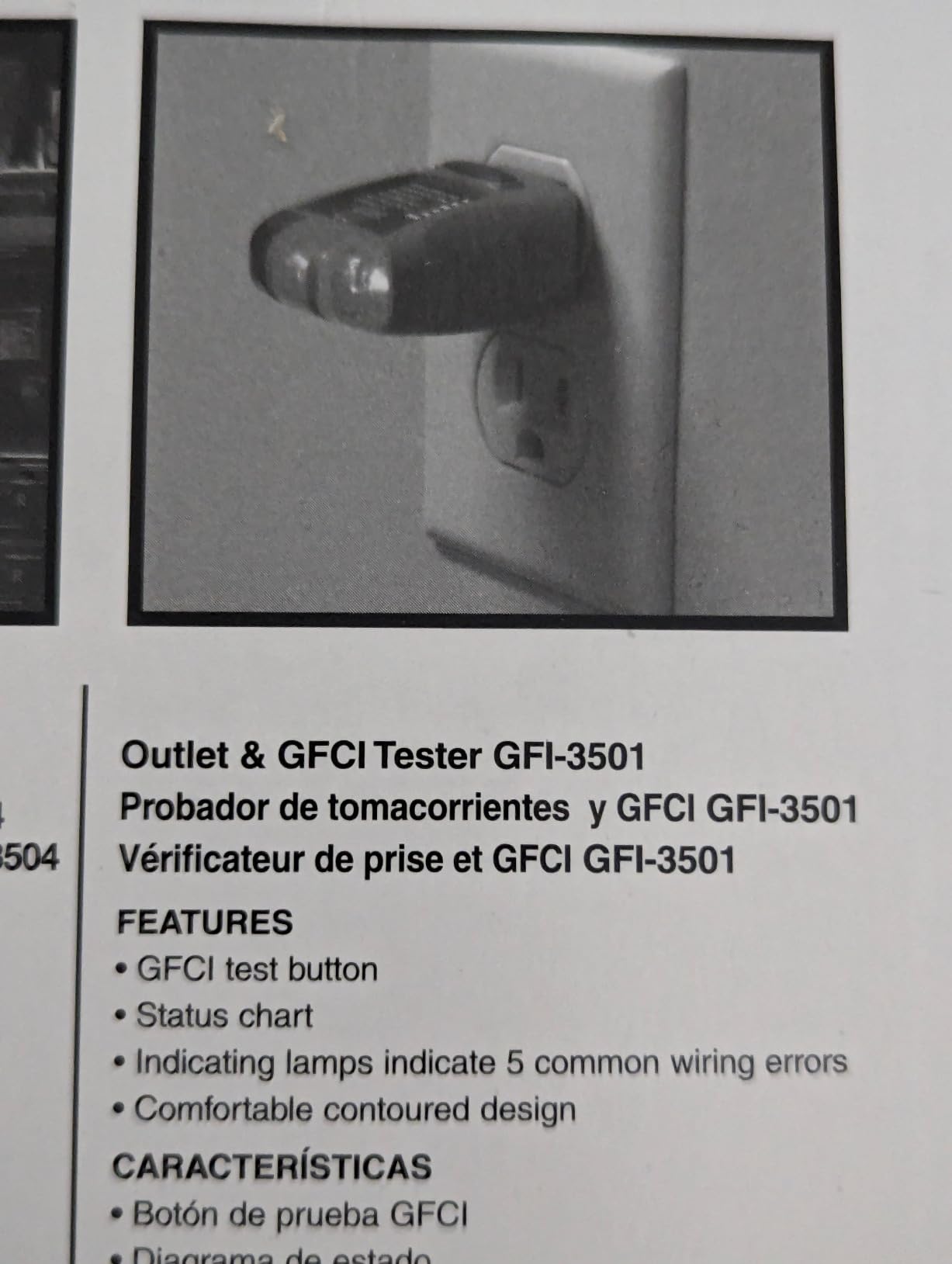
The receptacle tester uses a solid three-prong US plug and a ridged grip, and that ridging is genuinely useful. Old receptacles in older homes have tight springs in the contact slots, and a smooth-bodied tester either will not seat fully or will be hard to pull out. A tester that cannot seat fully gives you a partial reading and a wrong conclusion.
What the reviewers consistently like is the value. Buyers describe finding miswired receptacles during a GFCI replacement that they would otherwise have covered up with a new faceplate, which is exactly the outcome this tool exists to produce.
Where it beats a single-purpose tester
The pen is the differentiator. When you are fitting a new GFCI in a box you have just opened, you want to confirm the incoming conductor is dead before you touch it, and the pen does that from inside the box. The RT110 cannot do this because it needs a finished receptacle to plug into. For install work, the pen is not optional.
The ridged plug and the both-sided chart are the second pair of wins, and both show up in reviews describing cramped, awkward installations.
When the pen tip stops you
The most repeated complaint is that the pen tip is too large to enter an outlet slot. That limits it to probing near a conductor or a bundle of cable rather than inserting it into a receptacle, which is fine for the intended use but rules out the tip-inside-the-slot technique people sometimes expect from a pen.
Water resistance is another limit, and reviewers mention testers dying after a trip through a washing machine. Neither the batteries nor any water ingress protection is included in the box, so treat this as a dry-location tool and keep it out of the laundry room.
7. Southwire 40022S GFCI Receptacle Tester – Best for Fault-Code Sweeps Across a House
Southwire GFCI Receptacle Tester – Push-Button Outlet Tester for Fast & Accurate Wiring Checks – Compact & Durable Housing – 7 Test Functions
120V AC receptacles
7 test functions
1 x 1.7 x 3.6 inches
1.92 oz
EN 61010-1
Pros
- Seven test modes in a compact plug-in body
- Push-button GFCI test plus wiring fault indication
- Light chart printed on both sides
- Detects missing ground and reverse polarity
- Compact grippy housing for tight receptacles
Cons
- One reviewer found an ungrounded outlet was not flagged
- A few reports of reverse-neutral readings across an older installation
- No voltage readout and no audible confirmation
The Southwire tester is the most useful tool in this list for one specific job: finding out which outlets in a house are actually GFCI protected and which are not. That sounds trivial until you move into a home where bathroom and kitchen protection is inconsistent, which is extremely common in houses built across several decades. Seven test functions in a body that is 1 by 1.7 by 3.6 inches is a lot of capability in a package that fits in a shirt pocket.
The push-button GFCI test sits alongside the wiring fault indication, so one tool answers both the protection question and the wiring question. The light chart is printed on both sides of the housing, and the surface is grippy enough to work in a tight receptacle.
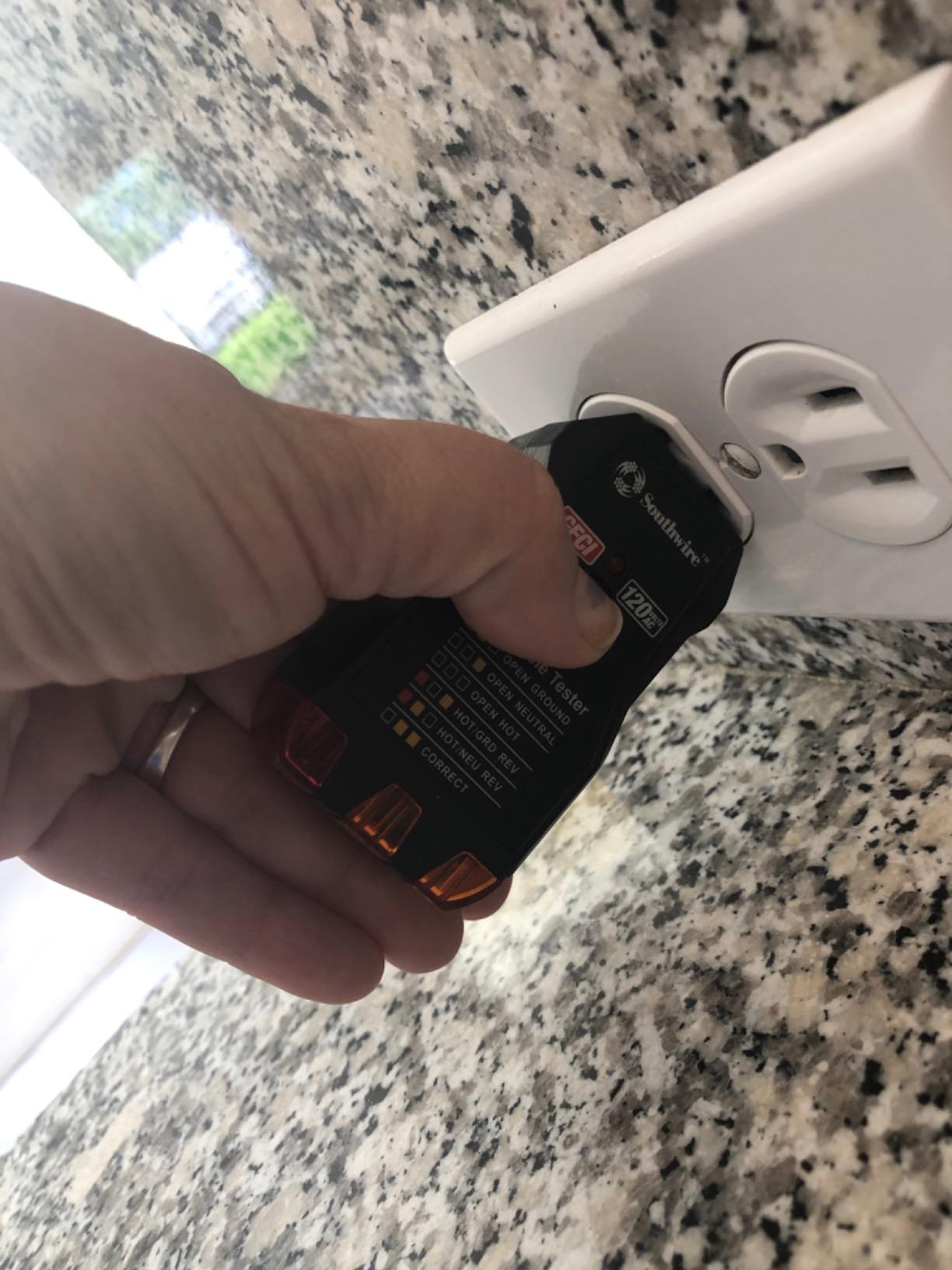
At 1.92 ounces this is one of the lighter tools here, and reviewers describe it as an inexpensive first-line tool that pays for itself the first time it exposes a miswired receptacle. It conforms to EN 61010-1 and operates on 120V AC receptacles, which is the standard household supply in North America.
The practical pattern most buyers settle into is: sweep every receptacle in the house with this tester, note the ones that light up anything other than a normal indication, and then deal with those individually. That is exactly the workflow the best voltage testers for outlet checks should support.
What a seven-function tester tells you
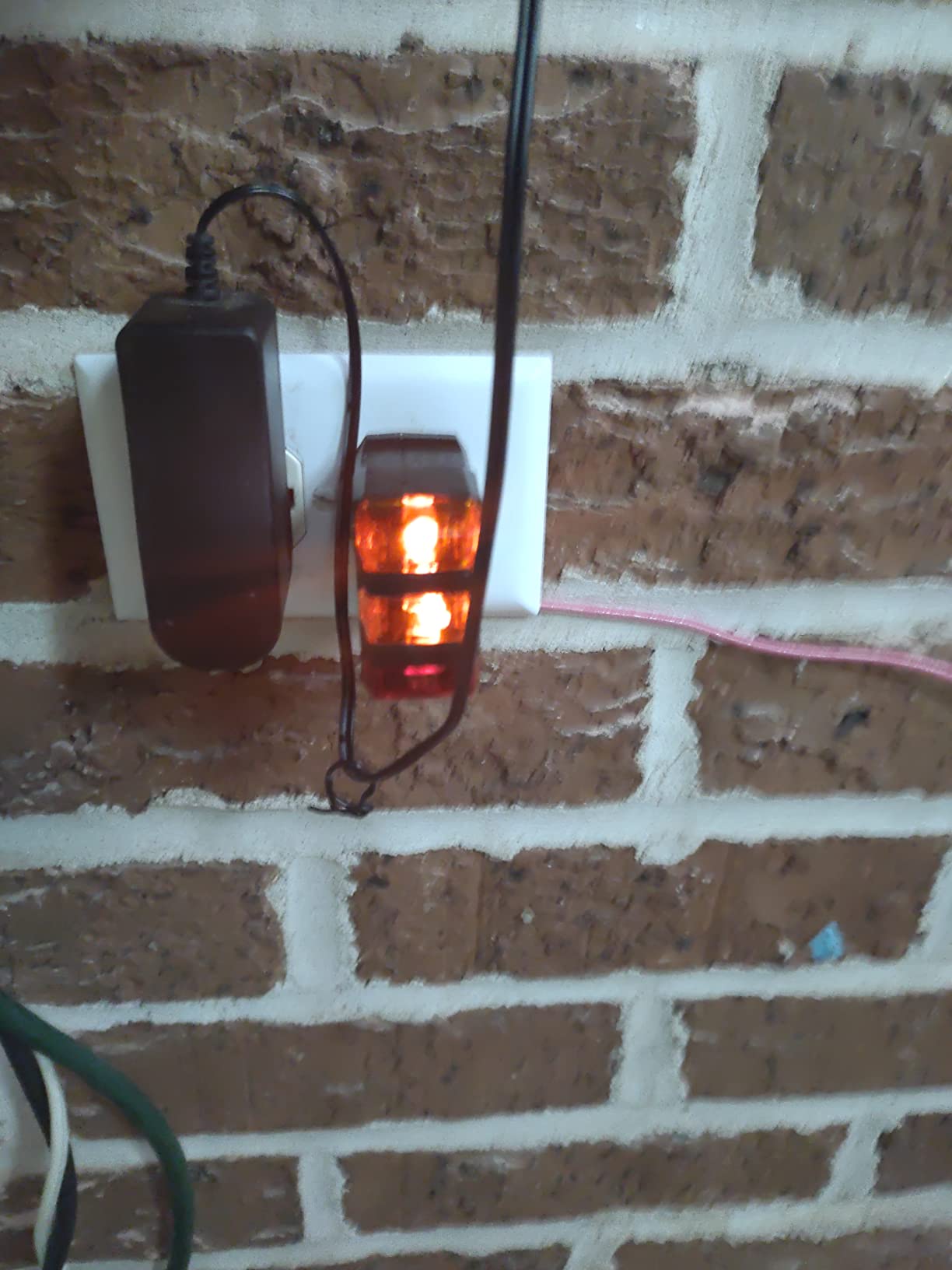
The seven functions cover standard receptacle checks and GFCI testing, which in practice means correct wiring, open ground, open neutral, open hot, and the two reversal conditions, plus the GFCI trip test. That is the same fault set the other plug-in testers here decode, with the added push button.
It can also reveal a GFCI receptacle that trips but has no reset button, which is a real and confusing condition in older installations. Finding that during a sweep saves you from treating a dead bathroom outlet as a wiring fault.
When the accuracy reports give you pause
A small minority of reviews report the tester failing to flag an ungrounded outlet, and a few report reverse-neutral indications across an entire older installation. Both of those are serious enough that you should confirm any fault this tester reports with a second device before you start opening boxes.
There is also no audible confirmation and no voltage readout, so it cannot tell you a circuit is at 104V rather than 120V. For a diagnostic tool rather than a survey tool, the RT250 or a multimeter is the better instrument.
8. Fluke ST120+ GFCI Socket Tester with Audible Beeper – Best for Working Alone
Fluke ST120+ GFCI Socket Tester with Audible Beeper
CAT III 300V
2.28 x 2.9 x 0.98 inches
0.07 kg
Integrated GFCI test button
Pros
- Switchable audible tone confirms a breaker state from across a room
- Integrated GFCI test button finds failing GFCI devices
- Bright large LEDs that are easy to read
- Protective lip around the front panel
- Fluke build quality with CAT III 300V rating
Cons
- Costs more than generic receptacle testers
- Does not fit outlets with protective shielding or weather covers
- One reviewer received a 50 Hz unit incompatible with their supply
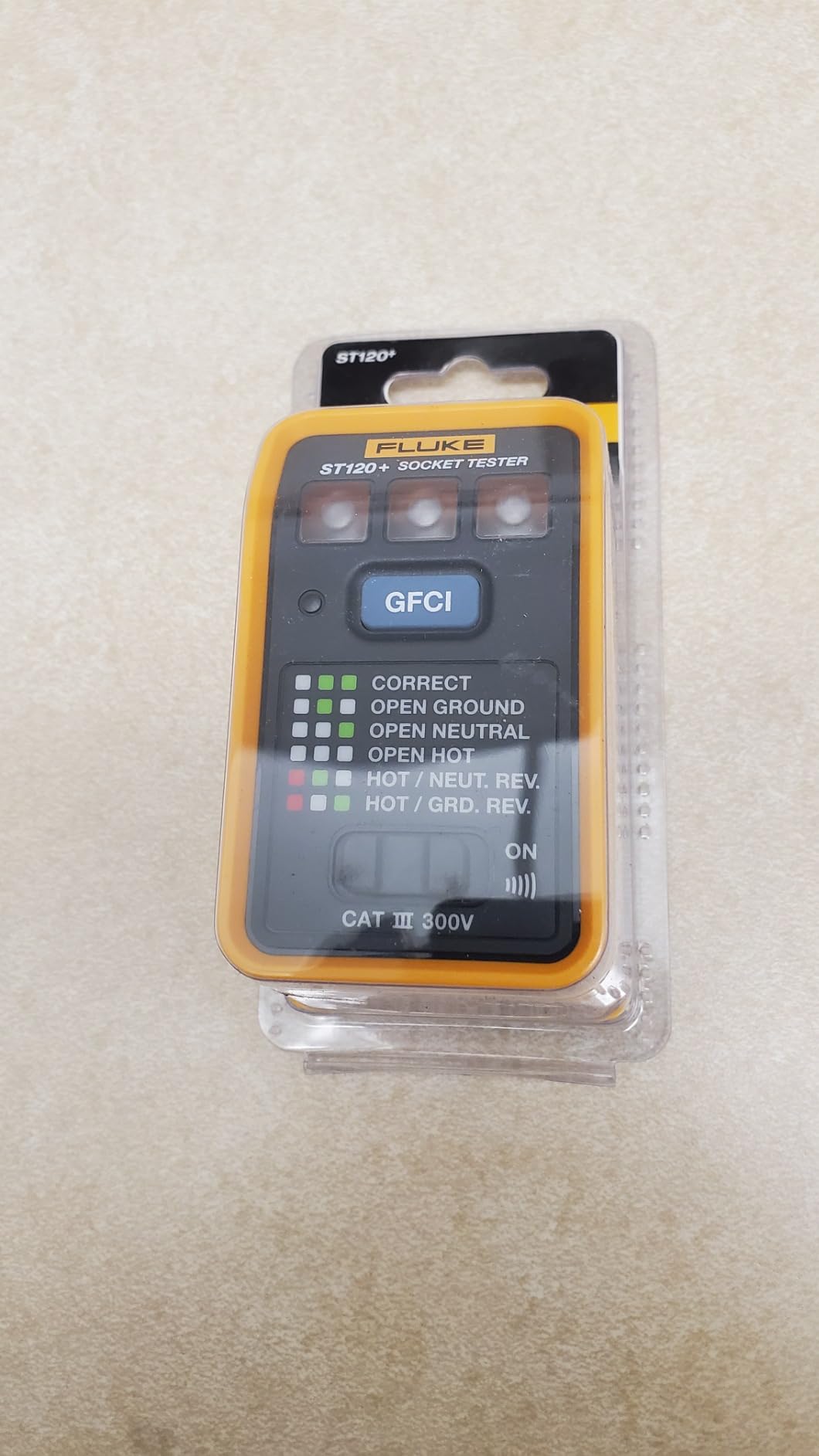
The ST120+ solves a problem no other tool on this list addresses. When you are alone in a basement with the lights off, you cannot see whether a receptacle in the next room is energized, and walking back and forth to the panel to check is how mistakes happen. The switchable audible tone lets you identify the correct breaker from a distance, confirming that a circuit is de-energised without leaving the work area.
The GFCI test button is genuinely diagnostic rather than decorative. Users report pressing it and discovering a defective GFCI device in their own home, a fault that would otherwise have stayed hidden until the device failed to protect someone. Bright LEDs make miswired outlets quick to identify, and the protective lip around the front panel prevents face-down damage when it lands in a toolbox.
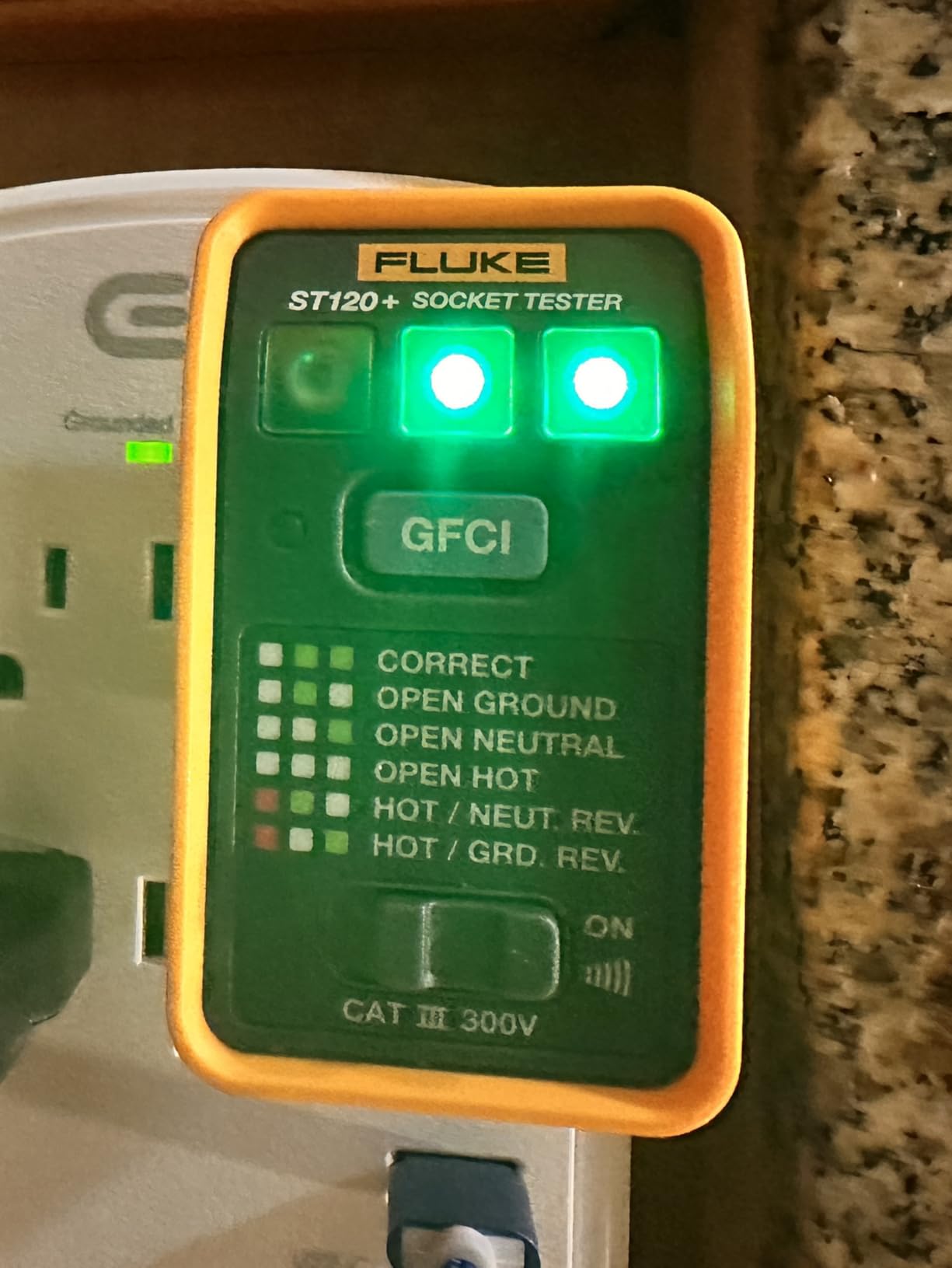
The safety rating is CAT III 300V, which is the correct transient category for a receptacle tester working on a 120V branch circuit. Dimensions are 2.28 by 2.9 by 0.98 inches at 0.07 kilograms, so it is a compact, dense tool rather than a large plug-in block.
For anyone who works on circuits regularly, the beeper alone justifies this pick over a generic tester. The habit it enables is correct: energise the circuit, hear the tone, kill the breaker, confirm the tone stops, and only then touch the conductor.
When the audible tone changes how you work
It removes the assumption step. Most people de-energise a breaker and assume the circuit is dead, then start work. The beeper replaces the assumption with a measurement, from wherever you are standing. For a homeowner working alone in an attic or a garage, that is a safety upgrade with no downside.
The tone is switchable, so you can silence it when you are in a quiet part of the house and still use the LEDs for the reading. That matters in an occupied home where a constant beep would be intolerable.
When it is the wrong choice
It is a plug-in tester, so shielded outdoor receptacles, weather covers, and certain safety plates will physically block it. If your work is at an exterior box or a covered receptacle, this tool simply will not go in, and the North American non-contact pens are a better answer.
There is also no voltage number. If you are chasing a supply problem rather than a wiring fault, the RT250’s backlit readout answers the question and this one cannot. The cost premium over a generic receptacle tester is real, so it earns its place on the work belt of someone who tests circuits routinely, not on a single-check shopping list.
9. nVent Gardner Bender GFI-3501 GFCI Outlet Tester and Circuit Analyzer – Best for Extension Cords
nVent GARDNER BENDER GFI-3501 GFCI Outlet Tester & Circuit Analyzer
110-125V AC
2 x 1 x 3.5 inches
22.68 g
Trips 6-9 mA
One year limited warranty
Pros
- Covers the full set of common wiring faults in one tool
- GFCI trip test works down to the 6-9 mA specification
- Also handles extension cord checks
- Light sequence chart printed on the device
- No batteries needed
Cons
- LED-only output with no voltage reading or audible tone
- Fine fault legend takes practice to read quickly
- No backlight makes it hard to read in dark panels
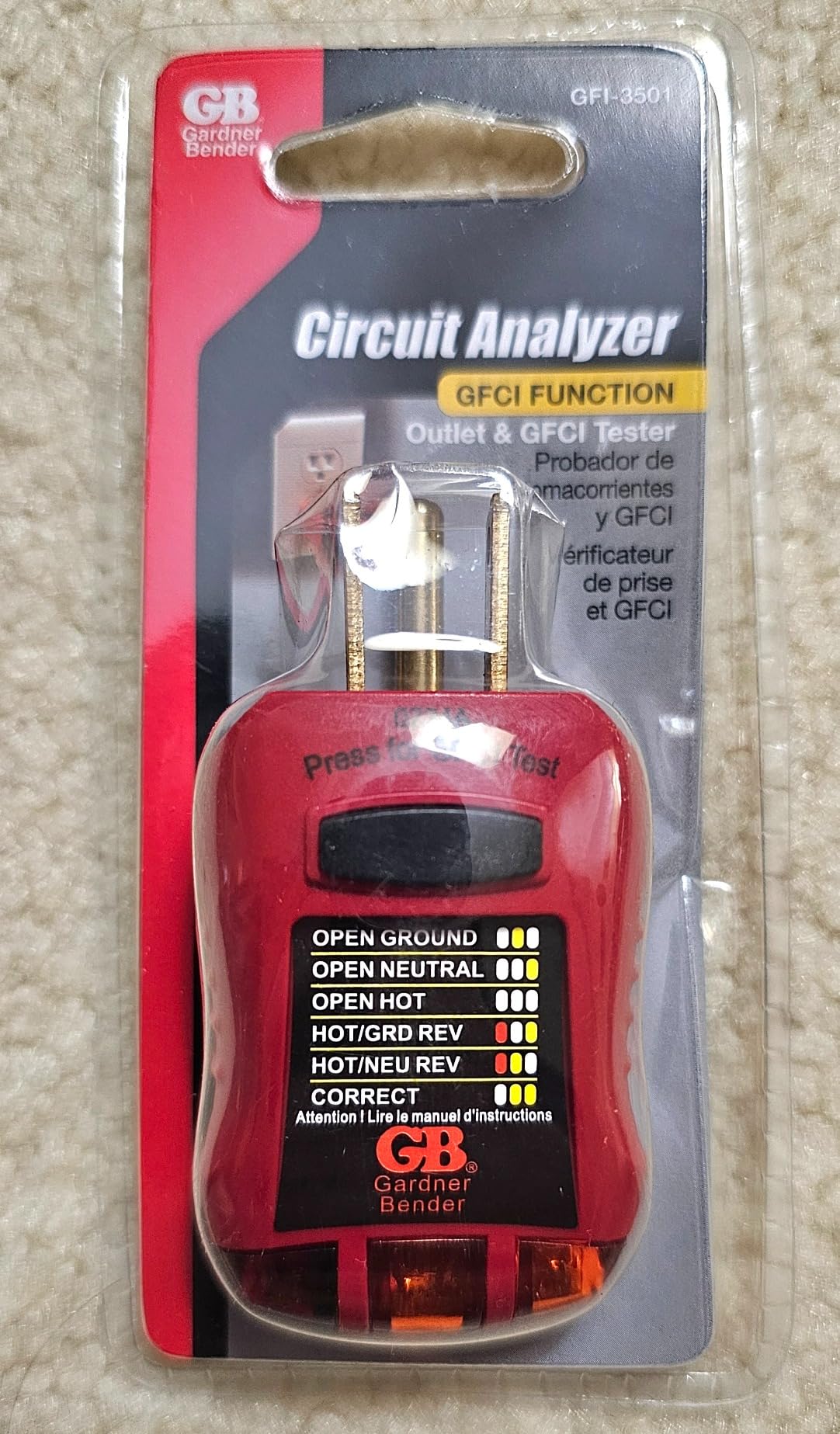
The GFI-3501 is the tool for the job most people never think to do: testing extension cords. A cord is a receptacle on the end of a cable, and it fails in the same ways a wall outlet does, from an open ground at the plug to a conductor that has pulled loose inside the jacket. The manufacturer lists standard outlets, GFCI outlets, and extension cords as the three things it tests, and that third category is where most owners find a real problem.
It detects open ground, open neutral, open hot, hot/ground reverse, hot/neutral reverse, and correct wiring. The GFCI trip function works between 6 and 9 mA, which is the specification range, so a passing result actually confirms the device is protecting within spec rather than merely clicking.
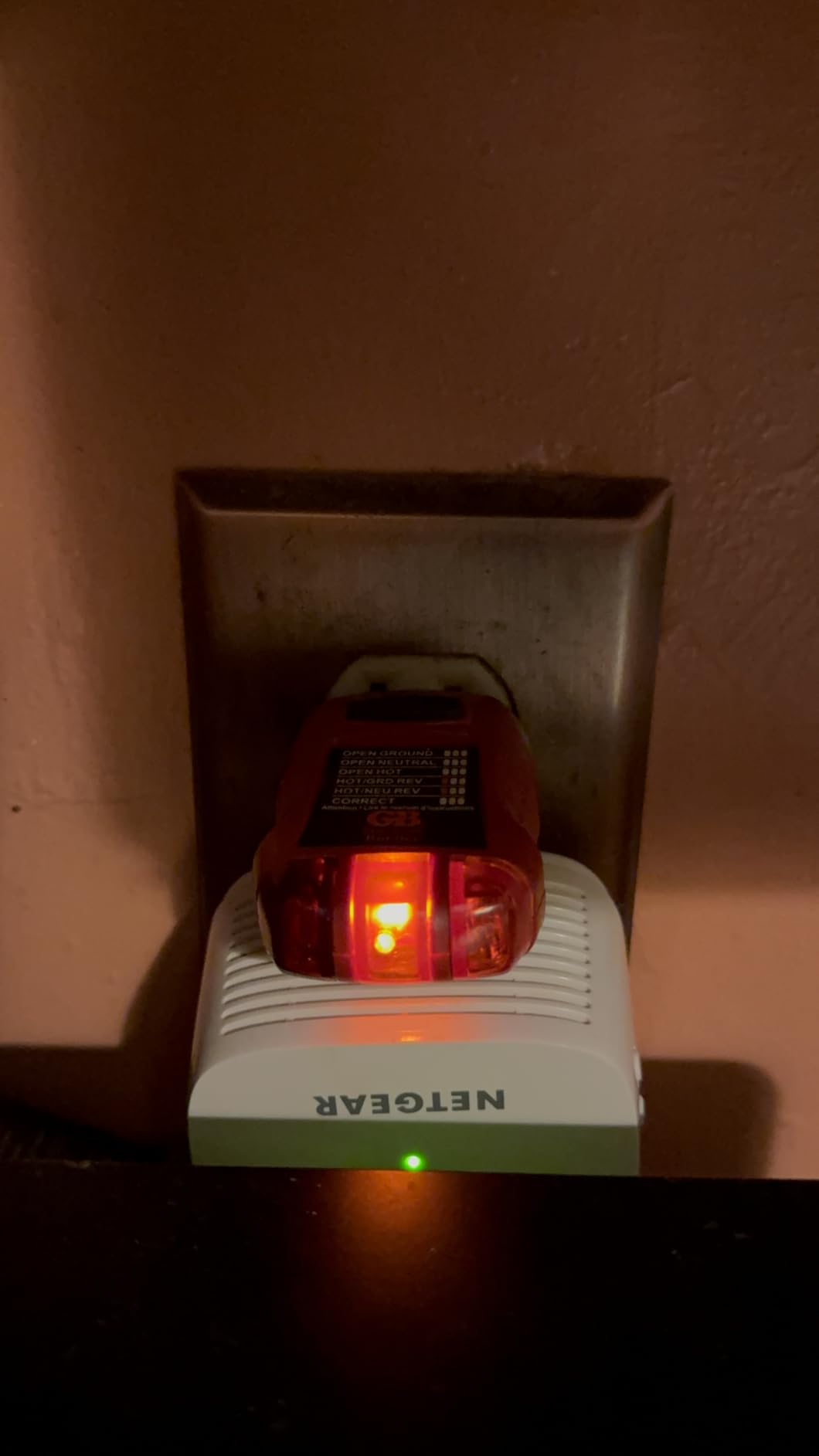
A succession of yellow and red lights indicates circuit status or a specific wiring error, and the chart is printed on the device. At 22.68 grams and 2 by 1 by 3.5 inches it is one of the more compact testers here, with a one year limited warranty.
Owners treat this as a standard-issue tool for both electricians and homeowners. The consistent praise is breadth: one cheap plug-in device covers every fault condition a residential receptacle can present, with no battery to fail.
When testing a cord is worth the ten seconds
Cords fail from foot traffic, kinking at the plug, and being run through doorways. A cord with a compromised ground looks completely normal and energises the metal end of whatever you plug into it. Running a cord through the GFI-3501 before a job is cheap insurance, and the fault list tells you whether it is a wiring problem or the cord is fine.
Because it also trips GFCI devices at the correct threshold, you can use it to confirm that a cord feeding a GFCI-protected tool is not the thing preventing the protection from working.
Where it will frustrate you
There is no backlight. In a dark breaker panel or an unlit basement, a red and yellow LED sequence at that size is genuinely hard to read, and that is the most repeated limitation in reviews. Bring a flashlight, or use the ST120+ if you work in the dark often.
The fault legend is also fine print. It is a full chart of conditions, which means the pattern for one fault looks similar to another at a glance until you have read the chart several times. If you are new to receptacle testing, the RT110 with its larger printed key is easier to learn from.
10. DROK AC 80-300V Plug-In Voltage Meter – Best for Watching a Live Voltage Reading
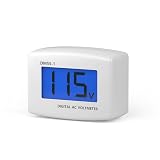
DROK Electric Voltage Tester AC 80-300V, LCD Display Flat Plug Voltmeter Electrical Outlet Tester Plug in Digital Voltage Meter
80V to 300V AC
Under 1W draw
5.1 x 3.8 x 2 inches
UL and IEC 61010-1
Blue backlit LCD
Pros
- Instant plug-in voltage reading with no leads
- Blue-backlit display readable in dim spaces
- Accurately revealed household voltage swinging 101V to 120V
- Doubles as a night light and continuous monitor
- Calibration potentiometer for fine adjustment
Cons
- Measures voltage only and cannot diagnose wiring faults or GFCI function
- 80V minimum means it shows nothing on a severely under-supplied line
- Calibration requires opening the casing with a screwdriver
The DROK is not a wiring tester, and we want to be clear about that before anything else. It is a plug-in voltmeter that reports the magnitude of AC voltage at a receptacle and nothing else. It will never show you a fault code, it will never trip a GFCI, and it will not tell you whether a receptacle is grounded. What it will do is answer one question precisely: what is the actual supply voltage right now.
That question comes up more than people expect. If lights flicker, if a microwave resets, if an older home has a supply that sags under load, the number is the diagnosis. Users report plugging this in and watching household voltage swing between 101V and 120V, which is a range no LED tester would ever reveal.
It measures 80V to 300V AC at under 1W consumption, and the flat plug means no leads to manage. The blue-backlit LCD is readable in dim conditions and doubles as a night light, so leaving it plugged in overnight to monitor an RV park pedestal supply or a generator output is a realistic use. It is certified to UL, IEC 61010-1, CE, and RoHS.
There is also an internal adjustable potentiometer for calibration with a small screwdriver, which is an unusual feature at this level and lets you correct the reading if your supply runs consistently high or low.
When a live readout is the right tool
Brownout and undervoltage problems. A supply that reads 101V under load explains flicker, resets, and slow appliance behaviour in a way that no fault code can. RV park pedestals, portable generators, and any supply where the upstream power is uncertain are the other cases where watching the number over time is the whole point.
It also works as a teaching tool. Leave it in a receptacle and watch the number respond when you switch a large appliance on. That is a much clearer demonstration of what load does to a circuit than any explanation.
When you need a different tool entirely
Two limits are worth stating plainly. The 80V minimum means it will display nothing at all on a severely under-supplied line, so a blank screen tells you the voltage is below 80V but not whether the circuit is dead or the tool is finished. And calibration requires opening the case with a screwdriver, which is not something to do on a tool you are relying on for safety decisions.
For wiring checks, use one of the receptacle testers above. For actual measurement with resistance, continuity, or current, a multimeter is the instrument you need.
How to Check an Outlet Safely With a Voltage Tester
This is the procedure that separates a screening tool from a guess, and it is the same sequence electricians describe as live, dead, live. It works because a tester can fail, a battery can die, and a conductor can be energised by a route you did not expect.
Prove the tester works first. If your pen has a self-test, switch it on and confirm the self-test indication before you go near the circuit. A battery-powered LCD tester should show a reading, not a blank screen.
Prove the circuit is live. Touch the pen to a known-live conductor, or plug the receptacle tester into the outlet in question. You must get an energised indication. If you do not, stop. The circuit is dead, or your tester is not working, and you cannot tell which.
De-energise at the breaker. Switch off the breaker feeding the circuit. If you are unsure which breaker it is, the Fluke ST120+ audible tone is built for exactly this identification step.
Prove the circuit is dead. Re-test the same conductor. Silence, or a dead indication, is a positive result.
Prove the tester still works. Re-test the known-live source. If it lights again, your tester is functioning and the dead reading in step four was real.
Only then touch the conductor. Use insulated tools and keep your hands off bare copper. The live, dead, live sequence is the standard verification electricians insist on before work begins, and they repeat the dead check when the work is finished.
For a receptacle specifically, there is a seventh step that most guides skip. Plug a known load into the outlet, something with a real draw, and watch the tester while the load runs. This is the only way to expose an open neutral, because the fault does not show up on an unloaded circuit. The RT250 flags open neutral and open ground with its own detection, but the load test is what confirms it for any tester on this list.
GFCI and Wiring Fault Codes Explained
Most receptacle testers print a chart of light patterns on the housing. Here is what the conditions mean and how serious each one is.
Correct wiring. The circuit is energized and hot, neutral, and ground are all in the right places. This is the only result where you do not need to act.
Open ground. The ground conductor is disconnected or missing. The outlet still powers your appliances, which is exactly why this fault hides for years. On an appliance with a metal case, a missing ground removes the path that would otherwise trip the breaker during a fault. Serious, and the reason a tester is worth owning.
Open neutral. The neutral conductor has come loose. Lights may still work, but the return path is incomplete, and on many circuits the tester will report correct wiring until you plug a load in. Load-test before you trust a clean result.
Open hot. The hot conductor is disconnected. The outlet reads dead. This is the least dangerous of the faults, though it is often caused by a loose terminal that can arc and overheat.
Hot and neutral reversed. The two conductors are swapped. Most appliances will still run, which is why nobody notices, but a reversed-polarity device can behave unpredictably and some equipment is polarity sensitive.
Hot and ground reversed. A serious miswire. The metal case of a grounded appliance becomes energized whenever it is plugged in. Unplug anything in that outlet and have it corrected.
Two things about the GFCI test button that catch people out. First, pressing it on an ungrounded box does nothing useful, and users routinely read that as a failed GFCI when the real problem is the missing ground. Second, the test button only proves that the device trips; it does not prove the receptacle is wired correctly. You need the fault indication for that, which is why the testers with both functions are the better buys.
How to Choose a Voltage Tester for Outlet Checks
Pen, outlet tester, or multimeter?
A non-contact pen is a screening tool. It answers is this conductor energised, quickly, without contact, which is what you need inside a panel, an attic, or a box with no receptacle. An outlet tester is a diagnostic tool. It answers is this receptacle wired correctly, which is what you need for the outlet-check sub-intent that this article is about. A multimeter answers what is the actual value, and costs several times more. Homeowners doing outlet checks need the middle option; electricians carry all three.
Detection range and the CAT rating
Range matters less for outlets than for the rest of your electrical work. A 50 to 1000V pen covers household circuits comfortably. The 12V lower range on the KAIWEETS is what separates it for doorbells, thermostats, and lighting transformers. Check the maximum too: a 120V receptacle tester is correct for household branch circuits and wrong for a 240V dryer or range outlet.
The CAT rating tells you what transient the tool survives. CAT II 135V and CAT III 300V cover receptacle-level work, which is where outlet checks happen. CAT III 1000V and CAT IV 600V ratings on a pen mean it is safe closer to a service. The STK001 illustrates the point: its pen and its receptacle tester carry different ratings in the same box, because they do different jobs.
LCD, LEDs, or an audible beeper?
LEDs are the cheapest and most robust, and the fault chart on the housing tells you everything. An LCD adds a numeric voltage reading, which is what you need the moment the question becomes why rather than what. An audible beeper adds reach, letting you confirm a circuit state from another room. The strongest answer for a buyer who wants one tool is the LCD, because it covers the most scenarios.
Certification, drop rating, and build
Look for named certification rather than vague professional-grade language. UL Std 1436 and CSA Std C22.2 #160 are the receptacle tester standards, and the RT110 carries both. IEC 61010-1 covers the DROK meter, and EN 61010-1 covers the Southwire tester. Drop rating is a real durability proxy: 6.6 feet is the common figure for plug-in testers, and the Sperry GFI6302 is rated to 10 feet with a 250 pound crush rating.
Battery power, auto shutoff, and pocket clip
Hand-powered testers such as the RT210 and RT110 cannot fail because of a flat battery, which is worth more than it sounds in a basement. Battery-powered pens and LCDs are more capable, so check for a low-battery indicator and auto shutoff. The KAIWEETS shuts off after five minutes and warns below 2.5V, which is the behaviour you want in a pocket. Check whether batteries are included, because several of these do not include them.
One durability warning from real users: non-contact testers are frequently reported dead after a trip through a washing machine. None of the pens on this list carry an ingress rating, so keep them dry. Pocket clips are the other weak point, since the plastic clips on several of these break when snagged repeatedly on a shirt pocket.
When a Voltage Tester Is the Wrong Tool
A voltage tester is a presence detector. Several common jobs fall outside what it can do, and reaching for the wrong one produces a false sense of security.
Measuring current. A voltage tester cannot measure amperage. That requires a clamp meter, which grabs a conductor without opening the circuit, or a multimeter in series. Anyone checking whether a circuit is near its breaker capacity needs a clamp meter.
Testing insulation. Verifying that cable insulation is sound is an insulation resistance tester job, and it is a professional task on most circuits.
240V dryer and range outlets. A 120V receptacle tester will not give you a valid reading on a 240V circuit, and some will not fit the receptacle. These circuits are also where mistakes cause fires rather than shocks. A multimeter rated for the voltage, used by someone who knows what they are doing, is the minimum, and many of these circuits are electrician work by code.
Confirming a circuit is truly dead before work. A non-contact pen is a screen, not a verification. The live, dead, live sequence above is what converts a reading into confidence, and for panel work that sequence on a known source is not optional.
Panel and service work. Inside a panel you want a rated meter, not a pen. The CAT ratings on the pens in this list cover receptacle work, and that boundary is deliberate.
If you find a hot, ground, or neutral reversed, if an outlet tests open ground and you are not certain you can correct it, or if your panel shows damage, call a licensed electrician. Knowing which faults are safe to correct yourself is part of owning a tester, not a substitute for one.
Frequently Asked Questions
What is a good voltage tester for power outlets?
A plug-in receptacle tester is the right tool for outlet checks because it decodes wiring faults rather than just confirming power. Look for one that shows open ground, open neutral, open hot, and both reversal conditions, and that has a GFCI test button if you have protected outlets. An LCD model such as the Klein RT250 adds a real voltage number, which is what you need once the question shifts from what to why.
What is the best brand for a voltage tester?
Klein Tools is the most widely recommended brand among electricians, and its receptacle testers such as the RT110, RT210, and RT250 cover the range from basic fault checking to an LCD readout. Fluke is the other name that comes up repeatedly, with a build quality and audible beeper that suit frequent work. Sperry, Southwire, and Gardner Bender cover the budget and kit options well.
Can you stick a voltage tester into an outlet?
You can plug a receptacle tester into a standard grounded three-wire receptacle, and that is exactly how it is designed to work. A non-contact pen is different: you sweep the tip near the conductor or along a cable rather than relying on contact, and many pen tips are too wide to enter a tight slot anyway. Never insert a meter’s probe into a slot unless the tool is explicitly rated and rated for that voltage.
Why won’t my GFCI outlet trip when I press the test button?
Two reasons are common. The first is an ungrounded receptacle, where the GFCI test button has nothing to work against and users misread the result as a failed device. The second is that a wiring fault such as a reversed hot and neutral stops the test current from following the intended path. Check the fault indication first, and treat a GFCI that will not trip as a device or wiring problem to correct.
How accurate are voltage pens?
A pen reports presence, not a measurement, so accuracy is about detection threshold and false positives rather than numeric precision. Most quality pens are reliable at 50V and above, with some reaching 12V for low-voltage control circuits. False positives around unshielded cables, metal tool chests, and mains hum are normal, and users consistently prefer a pen that errs toward detecting a live conductor.
Do I need a voltage tester or a multimeter?
For outlet checks, a receptacle tester is the better tool and a multimeter is not a substitute. A receptacle tester decodes the fault conditions that matter in a wall outlet, which a multimeter will not tell you by itself. A multimeter is worth adding when you need actual numbers, resistance, continuity, or current, and most professionals carry a pen, a receptacle tester, and a meter.
Which Voltage Tester Should You Buy?
The best voltage testers for outlet checks come down to how you will use them. If you want one tool that answers almost every outlet question, take the Klein Tools RT250, with its backlit voltage readout, text fault codes, and GFCI trip time. It is the pick we recommend to anyone who will diagnose a problem rather than just look at one.
If you only want a yes-or-no wiring check, the Klein RT210 is the better buy, because it needs no batteries and will still work years from now. Add the Sperry STK001 if your work happens inside panels and boxes where there is no receptacle to plug into, and use the KAIWEETS HT100s when you also test doorbells, thermostats, or low-voltage lighting.
Whatever you choose, remember the part that matters more than the model. Prove the tester works, prove the circuit is live, kill the breaker, prove it is dead, then prove the tester still works. Skip that sequence and any of these tools becomes an expensive guess. When a fault points to a hot and ground reversal, an open ground you are not confident fixing, or anything at 240V, stop and call a licensed electrician.