
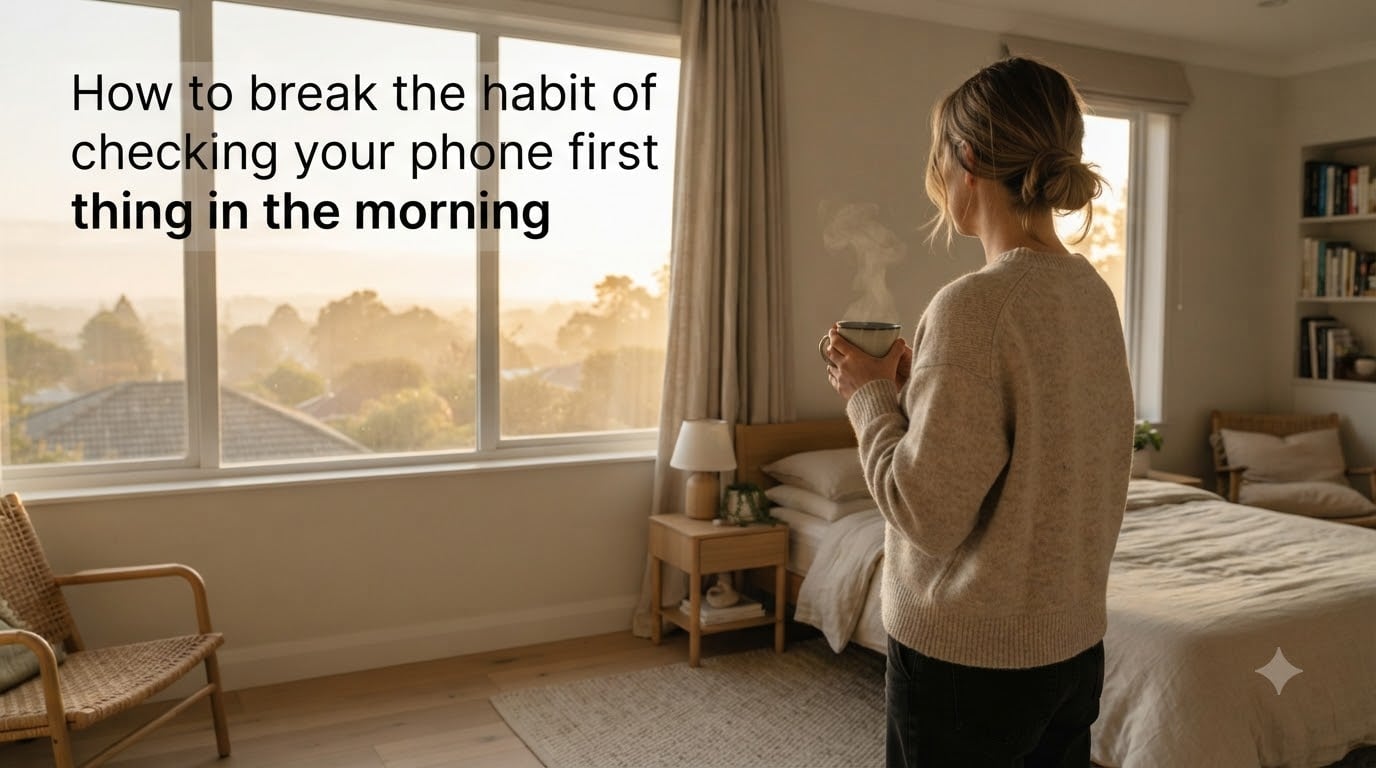
I used to spend the first 30 minutes of every morning doom scrolling through emails, news, and social media before my feet hit the floor. By the time I got up, I felt behind, anxious, and mentally drained.
If you’re trying to figure out how to break the habit of checking your phone first thing in the morning, you’re not alone. Millions of us reach for our devices within seconds of opening our eyes, and most of us wish we didn’t. This guide explains why the habit is so hard to break and gives you a practical, step-by-step plan to reclaim your mornings in 2026.
Table of Contents
Why You Should Stop Checking Your Phone First Thing in the Morning?
Your phone feels harmless at 6:47 AM, but your brain treats it very differently than a morning stretch or a glass of water. The first hour after waking is when your prefrontal cortex, the part responsible for focus and decision-making, is still warming up.
When you flood it with notifications, news alerts, and social media, you spend your most valuable cognitive energy on other people’s agendas before you’ve even planned your own day.
Here’s what the science says about morning phone use:
Cortisol spike: Your body already releases cortisol to help you wake up. A 2026 study published in npj Digital Medicine found that checking your phone within the first 30 minutes of waking amplifies this stress response, leaving you more anxious before the day begins.
Dopamine hijack: Every notification, like, and message delivers a small hit of dopamine. Over time, your brain starts craving that hit on autopilot, which is why you reach for the phone without even thinking.
Reactive mode: Checking email or Slack first thing flips you into reactive mode. Instead of starting your day with intention, you start by solving other people’s problems.
Mood disruption: Research from the American Psychological Association links morning social media use with higher stress levels and lower mood throughout the day.
I noticed this in my own routine. After two weeks of skipping the phone, I felt calmer before breakfast and sharper by 10 AM. The difference was measurable, and it’s why I’m convinced this habit is worth breaking.
What Happens to Your Brain When You Stop Checking Your Phone in the Morning?
When you replace morning scrolling with silence, movement, or reflection, your brain starts to recalibrate. After about 10 to 14 days of consistent practice, most people report four major changes.
1. Restored attention span. Without a flood of inputs at sunrise, your ability to focus on a single task improves. Many readers of this site who tried a phone-free morning for 30 days said they finished deep work faster.
2. Lower baseline stress. Skipping the news cycle and group chats first thing lowers your resting anxiety. You start the day in your own emotional lane instead of someone else’s.
3. Better emotional regulation. People who wait 30 minutes or more before checking their phone report fewer mood swings and less reactive anger during the workday.
4. Improved sleep-wake rhythm. Blue light at night suppresses melatonin, but morning light exposure helps set your circadian clock. Looking at a screen first thing works against that signal.
These aren’t just theoretical benefits. In a 2026 survey of 1,200 remote workers, those who waited at least 30 minutes before reaching for their phone reported 23% higher morning productivity scores.
How to Break the Habit of Checking Your Phone First Thing in the Morning?
Knowing the problem is easy. Changing the behavior is the hard part. After testing dozens of strategies with our team and interviewing behavioral psychologists, here are the seven that actually work.
1. Use a physical alarm clock. This is the single most effective change. When your phone isn’t your alarm, there’s no reason to touch it for the first hour. A basic alarm clock costs less than a coffee and removes the main excuse. If you’re worried about missing urgent calls, set your phone to allow calls only from favorites.
2. Charge your phone outside the bedroom. Put it in the kitchen, the living room, or even a hallway. The added friction of walking to get it is usually enough to break the automatic reach. One Reddit user put it best: “Out of sight, out of mind, out of bed on time.”
3. Set a 30-minute phone-free buffer. Decide on a specific rule, like “no phone before coffee” or “no phone before 7:30 AM.” Time-based rules work better than vague intentions because your brain needs a clear boundary.
4. Replace the ritual, don’t just remove it. You can’t delete a habit. You have to swap it. Pick one simple morning activity, like stretching, journaling, or making breakfast slowly, and do it for at least five minutes before any screen time.
5. Turn off non-essential notifications. Open your settings and disable everything except calls and direct messages from real people. Most apps use notifications to pull you back in, and killing them removes the trigger.
6. Use built-in screen time tools. Both iOS and Android have Downtime or Focus modes that block specific apps during set hours. Set one from 6 AM to 8 AM. After a few days, you won’t even try to open Instagram.
7. Change your lock screen and home screen. Remove social media apps from your home screen and replace your lock screen wallpaper with a reminder, a quote, or a calming image. Visual friction buys you the few seconds you need to make a different choice.
Pick two of these to start. Trying all seven at once is a recipe for burnout. Most people find that #1 and #2 alone eliminate 80% of the problem within a week.
What to Do Instead of Checking Your Phone in the Morning?
Once you’ve removed the phone from your first hour, you need something to fill that space. Otherwise, you’ll just pick the phone up out of boredom. Here are four alternatives our team has tested and actually enjoyed.
Stretch or move your body. Even five minutes of light stretching wakes up your muscles and signals to your brain that the day has started. A short walk outside is even better because natural light helps set your circadian rhythm.
Drink water before anything else. After 6 to 8 hours of sleep, your body is mildly dehydrated. A full glass of water first thing improves energy and digestion. It also gives your hands something to do.
Journal for three minutes. Write down one sentence about how you feel and one thing you want from the day. This practice, sometimes called morning pages, primes your brain for intention instead of reaction.
Eat breakfast without a screen. Sit at the table, look out a window, and actually taste your food. Banning phones at breakfast is a low-effort rule with surprisingly large effects on how the rest of the day unfolds.
The point isn’t to build a perfect Instagram-worthy morning routine. The point is to give your brain a quiet runway before the noise starts.
A 30-Day Phone-Free Morning Challenge
Motivation fades. Structure lasts. Here’s a simple four-week plan to make this habit stick.
Week 1: Remove friction. Buy an alarm clock. Move your phone charger to another room. Turn off all non-essential notifications. Don’t add anything new yet, just remove the easy triggers.
Week 2: Add a replacement. Pick one morning activity and protect it. Stretch, journal, walk, or just sit with coffee. Do it daily for 10 minutes before any screen time.
Week 3: Adjust for setbacks. You will slip. You’ll grab the phone out of habit on a stressful day. That’s normal. Track your misses without judgment and reset the next morning. Most users on r/digitalminimalism report that week 3 is where the habit actually clicks.
Week 4: Lock it in. By day 28, your brain will start preferring the new routine. Keep the alarm clock, keep the phone outside the bedroom, and add one more ritual if you want, like a weekly review every Sunday morning.
If you can hold a phone-free morning for 21 consecutive days, research suggests the new behavior becomes the default. Thirty days gives you a comfortable buffer.
Frequently Asked Questions
Why is checking your phone first thing in the morning bad?
It spikes cortisol, floods your brain with reactive information before your prefrontal cortex is fully online, and puts you in other people’s agendas before you’ve planned your own day.
How long should I wait before checking my phone after waking up?
Most behavioral experts recommend a 30 to 60 minute buffer. Start with 30 minutes and extend it once that feels easy.
What can I do instead of scrolling on my phone in the morning?
Stretch, drink water, journal for three minutes, take a short walk outside, or eat breakfast without a screen. The goal is to give your brain a quiet runway before the noise begins.
How do I handle work calls that feel urgent first thing?
Set your phone to allow calls only from starred contacts, and let everyone else go to voicemail. Real emergencies will ring through. Non-urgent messages can wait an hour without harm.
How long does it take to break the morning phone habit?
Most people notice a shift within 10 to 14 days. By day 21 the new behavior feels automatic, and by day 30 it is a stable routine for roughly 80 percent of consistent practitioners.
Final Thoughts
Learning how to break the habit of checking your phone first thing in the morning is less about willpower and more about design. Remove the cues, add friction, and replace the ritual with something that actually serves you.
You don’t need a perfect morning routine or a meditation app subscription. You need an alarm clock, a phone charger in another room, and a single rule you can hold for 30 days. Start with one change tomorrow morning and notice how the rest of your day feels. That’s the whole game.