
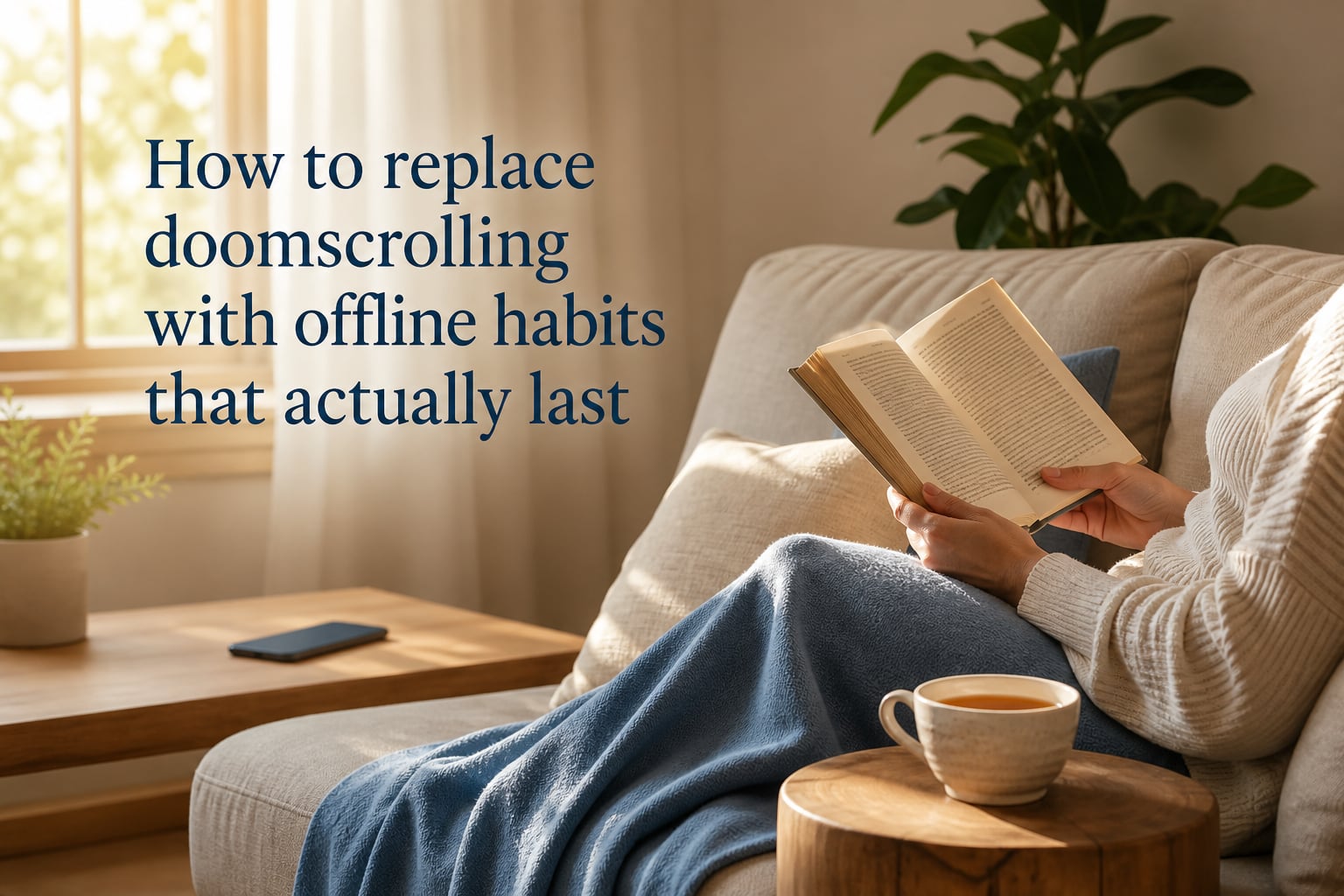
You pick up your phone for “just a minute” and surface an hour later feeling worse than before. The headlines blurred together, your jaw is tight, and you cannot remember a single useful thing you read. That cycle has a name, and in this guide I will show you exactly how to replace doomscrolling with offline habits that actually last.
Our team spent weeks digging through Reddit threads from communities like r/digitalminimalism and r/productivity, comparing what real people say works against what the research actually shows. We also analyzed the top-ranking articles on breaking phone addiction to find the gaps nobody is covering. What follows blends the science of habit formation with concrete strategies you can start tonight.
You will learn why your brain gets hijacked by bad news, how to recognize the warning signs, 15 specific offline replacement activities, a step-by-step method to break the loop, ADHD-specific considerations, and a 7-day starter plan to kick everything off.
Table of Contents
What Is Doomscrolling and Why Your Brain Loves It?
Doomscrolling is the compulsive habit of endlessly scrolling through negative news, distressing social media posts, or alarming content, even when you know it is making you feel worse. The term exploded in popularity during 2020, but the behavior itself predates smartphones by decades. What changed is that the feed never runs out.
Your brain is wired for doomscrolling through a combination of three forces working against you at once.
The first force is negativity bias. From an evolutionary standpoint, missing a threat was far more costly than missing an opportunity. Your amygdala pays outsized attention to alarming information because, to a survival-focused brain, every scary headline might be a tiger in the bushes. You keep scrolling looking for the “all clear” signal that never comes.
The second force is the dopamine loop. Each swipe delivers a tiny hit of novelty. It is not the content itself that feels rewarding, it is the possibility of what might come next. Psychologists call this intermittent reinforcement, the same mechanism that makes slot machines so compelling. The reward is unpredictable, and unpredictable rewards are the most addictive kind.
The third force is the cortisol stress response. Negative content triggers your fight-or-flight system, flooding your body with cortisol. Your brain interprets this arousal as a signal that you need more information to resolve the threat, so you scroll faster. You are not weak-willed. You are caught in a well-engineered loop.
Signs You Have a Doomscrolling Problem
Almost everyone scrolls more than they want to, but there is a difference between casual use and a genuine doomscrolling habit. See how many of these signs resonate with you.
You reach for your phone within five minutes of waking up and lose 20 minutes or more before your day even starts. Morning doomscrolling was one of the most common complaints we found across Reddit, with users describing it as the single biggest destroyer of their daily productivity.
You scroll past your intended stopping point regularly. You tell yourself “one more article” and 40 minutes vanish. The gap between what you intend to do and what you actually do keeps widening.
You feel worse after scrolling than before, yet you do it again the next day. Users on r/selfimprovement describe this as feeling drained, foggy, and vaguely anxious after long sessions.
Your screen time has crept past four, six, or even eight hours daily. Multiple forum users reported weekly phone usage exceeding 70 hours, which is more than a full-time job.
You scroll to escape uncomfortable emotions like boredom, stress, or loneliness rather than to seek specific information. Scrolling has become your default emotional regulation tool.
You have tried to cut back before and relapsed within days. This is not failure. It means the habit loop is still intact and needs a different approach than willpower alone.
If three or more of these signs hit close to home, this guide is built for you.
What Doomscrolling Does to Your Mental Health?
Doomscrolling is not a neutral habit. It actively damages your mental health in measurable ways, and the effects compound over time.
Studies on prolonged negative news exposure show increases in anxiety, depressive symptoms, and rumination. When you spend 45 minutes consuming disaster headlines, your brain does not simply file them away. It reheats that stress every time something reminds you of the content, sometimes for hours afterward.
Sleep takes a direct hit. The combination of blue light, emotional arousal, and delayed bedtime fragments your rest. People who scroll before bed report taking longer to fall asleep, waking more often, and feeling less rested. Poor sleep then weakens your impulse control the next day, making you more likely to scroll again. It is a feedback loop that feeds itself.
Your attention span erodes. Constant rapid-switching between posts trains your brain to expect novelty every few seconds. When you try to read a book, listen to a friend, or focus on deep work, your brain protests the slower pace. Multiple forum users described losing the ability to finish a single chapter without reaching for their phone.
Finally, doomscrolling leaves you emotionally exhausted without giving you anything of value. You absorb hundreds of stories you cannot act on, which breeds helplessness. Staying informed becomes indistinguishable from self-inflicted distress.
15 Offline Habits to Replace Doomscrolling
The key to replacing doomscrolling with offline habits is not just removing the phone. You need a replacement activity ready before the urge hits, one that satisfies the same underlying need. Here are 15 offline habits organized by when you are most likely to need them.
Morning Replacements (For the First 30 Minutes)
1. Read one chapter of a physical book. Keep it on your nightstand where the phone used to be. Even five pages rebuilds your attention span over time.
2. Write a brain dump list. Grab a notebook and dump every thought, worry, and to-do item onto paper. This clears mental clutter the way scrolling pretends to.
3. Do a 5-minute stretch routine. Your body has been still for hours. Movement signals your brain that the day has started without needing a screen to prove it.
4. Make coffee or tea and drink it without any input. Just sit. Boredom is the bridge to presence, and presence is what scrolling blocks.
During Breaks and Downtime
5. Take a 10-minute walk outside without your phone. Light, movement, and air shift your nervous system faster than any app.
6. Doodle, sketch, or color. The hand-eye engagement occupies the same restless energy that drives scrolling, and you produce something real.
7. Call or text a friend something specific and genuine. Connection is often the real need scrolling is masking.
8. Do a 5-4-3-2-1 sensory grounding exercise. Name five things you see, four you hear, three you can touch, two you smell, and one you taste. This technique came up repeatedly in expert recommendations because it interrupts the scrolling loop at the nervous-system level.
9. Tidy one small surface. A single drawer, one shelf, or your desk. Tiny wins build momentum, and clean spaces reduce the stress that fuels doomscrolling.
10. Practice three slow breathing cycles. Inhale for four counts, hold for four, exhale for six. This directly counteracts the cortisol spike that doomscrolling creates.
Evening Replacements (For the Wind-Down Window)
11. Cook something simple from scratch. The sensory engagement of chopping, stirring, and smelling grounds you in the present moment.
12. Journal three lines about your day. Not a diary. Just what happened, how you felt, and one thing you are grateful for.
13. Listen to a full album or podcast with your eyes closed. Passive but intentional rest, which is fundamentally different from mindless scrolling.
14. Do a 10-minute yoga or mobility video, then keep going without the screen. Your body releases tension your mind has been holding all day.
15. Read to someone, or have someone read to you. A partner, a child, even a pet. Shared attention is the opposite of isolated scrolling.
Pick two or three from this list, not all 15. Trying to overhaul everything at once is the fastest path to relapse.
How to Break the Doomscrolling Habit for Good
Willpower fails because you are fighting a designed system with willpower that is finite. Lasting change requires redesigning your environment so the wrong behavior is hard and the right behavior is easy.
Step 1: Remove the trigger from your most vulnerable moments. For most people that means the nightstand and the bathroom. Charge your phone in another room overnight. Forum users called this the single most effective strategy they tried. If the phone is not within arm’s reach at 6 AM, you cannot scroll at 6 AM.
Step 2: Add friction to the apps that hook you. Delete them from your phone and use them only on a desktop. Or install them inside a folder three screens deep. Every extra tap gives your conscious brain a chance to intervene.
Step 3: Turn off all non-human push notifications. News alerts, social media pings, and app badges exist to pull you back. Silence them and check on your own schedule instead of the app’s.
Step 4: Switch your phone to grayscale mode. Without color, feeds lose their grip. It sounds trivial until you try it and suddenly find yourself putting the phone down after two minutes because it is boring.
Step 5: Pre-commit your replacement habit. Decide the night before exactly what you will do when the urge hits. Write it on a sticky note. The decision needs to be made before willpower is required.
Step 6: Track your screen time honestly for one week without judging yourself. The data alone changes behavior. Users who watched their weekly hours tick past 70 reported that the number itself became motivation.
Step 7: Expect relapse and plan for it. You will have a bad day and scroll for two hours. That is not failure, it is the process. Restart the next morning without the guilt spiral, which is itself a trigger for more scrolling.
Special Considerations: ADHD Brains and Doomscrolling
If you have ADHD or suspect you might, doomscrolling hits differently. This was one of the most underrepresented topics we found in competitor content, yet it came up constantly in forums like r/adhdwomen.
ADHD brains are starved for dopamine by default. The rapid novelty of a scrolling feed delivers exactly the stimulation your brain is seeking, which makes the habit significantly harder to break through willpower alone. This is not a character flaw. It is neurochemistry.
The standard advice to “just put your phone down” often fails for ADHD brains because it removes the only dopamine source without replacing it. You need replacement activities that provide genuine stimulation, not just calm. High-engagement options like learning a physical skill, fast-paced exercise, hands-on creative projects, and structured novelty like a new recipe or route often work better than meditation or stillness.
Body doubling helps too. Doing an offline activity alongside another person, even virtually, provides the accountability and presence that ADHD brains struggle to generate internally. Consider partnering with a friend for a daily walk or cooking session.
Medication timing matters. If you take ADHD medication, schedule your hardest habit-breaking work during your peak effectiveness window, usually 1 to 3 hours after your dose. Do not attempt a phone-free morning before your brain has the support it needs.
Your 7-Day Starter Plan to Replace Doomscrolling
Big overhauls fail. Small daily commitments stick. This 7-day plan gives you one focus per day so you are never overwhelmed. By the end of the week you will have a working system you can repeat and refine.
Day 1: Audit without judgment. Check your screen time and write down the number. Note which apps eat the most minutes. Do not change anything yet. Just see clearly.
Day 2: Move the phone. Charge it in another room tonight. Notice what happens when you wake up and it is not there. Sit with the discomfort for two minutes before reaching for your replacement habit.
Day 3: Kill the notifications. Turn off every push notification except calls and direct messages from real people. Feel the silence. It is supposed to feel strange at first.
Day 4: Pick two replacement habits. Choose one morning habit and one evening habit from the list of 15 above. Write them on paper and place the note where your phone used to sit.
Day 5: Go grayscale. Switch your phone screen to black and white for the entire day. Notice how much less appealing the feed becomes without color.
Day 6: Have a screen-free block. Pick a two-hour window, ideally your worst scrolling time, and keep the phone in another room. Fill it with one of your replacement habits plus whatever else emerges.
Day 7: Review and commit. Check your screen time again and compare it to Day 1. Write down what worked, what did not, and which two habits you will keep for week two.
Repeat this cycle with refinements. Most people see meaningful drops in screen time within two to three weeks and report feeling more present, more rested, and more in control within a month.
Frequently Asked Questions
What are some things I can do instead of doomscrolling?
Strong alternatives include reading a physical book, taking a short walk without your phone, journaling a brain dump, doing a 5-4-3-2-1 grounding exercise, calling a friend, cooking, stretching, or simply sitting with a cup of tea and no input. Pick two or three that fit your routine rather than attempting them all at once.
What habit can I replace scrolling with?
The best replacement depends on the underlying need scrolling is meeting. If you seek novelty, try learning a new skill or cooking a new recipe. If you seek escape, try a walk or a grounding exercise. If you seek connection, text a friend something genuine. Match the replacement to the need, not just the time slot.
How long does it take to break a doomscrolling habit?
Research suggests breaking a habit takes anywhere from 18 to 254 days depending on the person and the behavior, with an average of about 66 days. Most people notice meaningful improvement in screen time and mood within two to three weeks of consistent environmental changes, especially removing the phone from the bedroom.
Why can’t I stop doomscrolling even when I want to?
Doomscrolling exploits three built-in brain systems working against you: negativity bias that fixates on threats, an intermittent dopamine loop that rewards unpredictable novelty, and a cortisol stress response that drives you to seek more information to resolve perceived danger. Willpower alone rarely wins because you are fighting a designed system. Environmental changes like removing the phone from arm’s reach work far better.
Breaking the doomscrolling cycle is not about becoming a different person. It is about redesigning your environment so your default behavior stops hurting you and starts serving you. Start with Day 1 tonight. Move the phone, pick one replacement habit, and let the silence do its work. You already know scrolling does not make you feel better. Now you have a plan to replace doomscrolling with offline habits that actually last.