
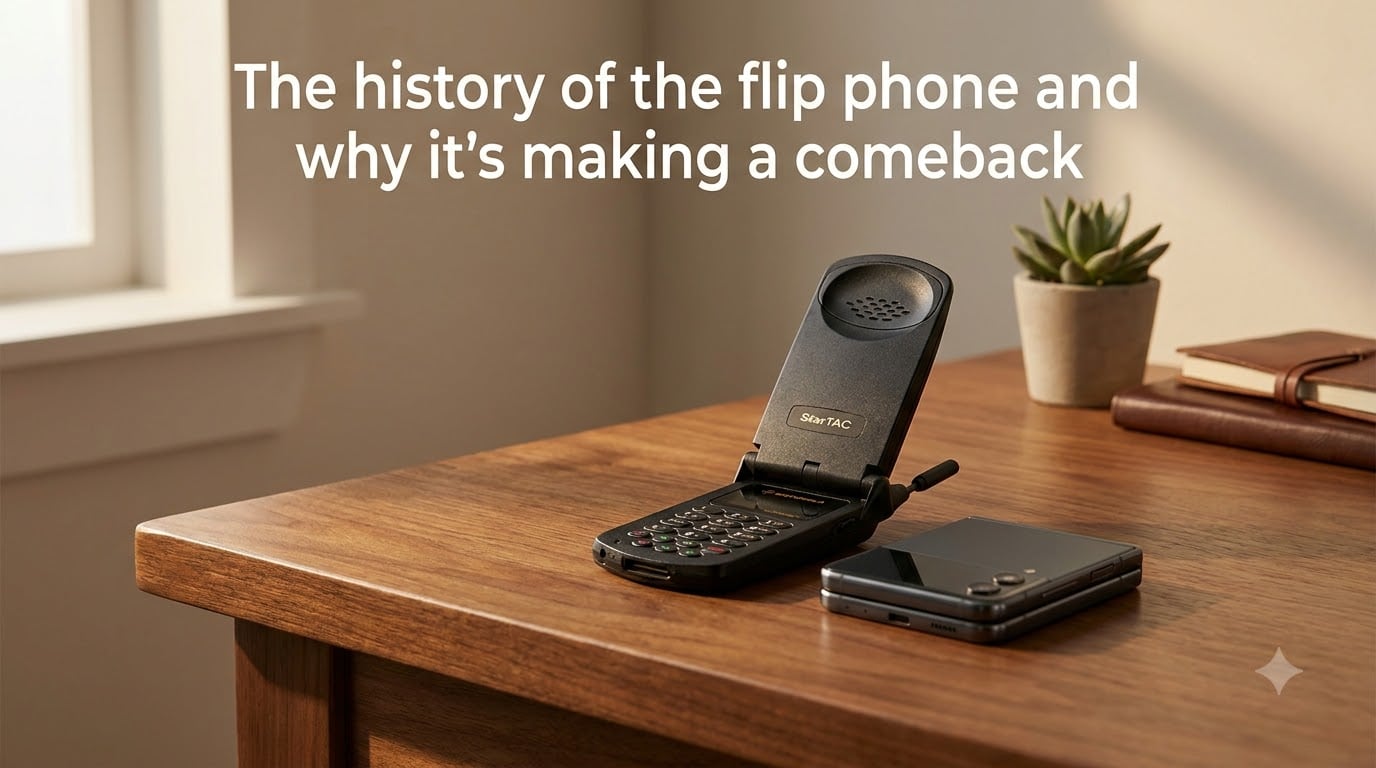
I still remember the satisfying click of closing my Motorola Razr after ending a call back in 2005. That little snap felt like punctuation at the end of a conversation. Two decades later, I am watching my Gen Z coworkers buy the same devices I thought were buried forever.
The history of the flip phone is one of the most fascinating comebacks in tech. From its invention in 1996 to its near-extinction after the iPhone launched in 2007, and now its surprising return driven by young people who never lived through its original era. I have spent the past three months researching this topic, talking to collectors, resellers, and Gen Z adopters to bring you the complete story.
Let me walk you through what a flip phone actually is, how it was invented, why it fell out of fashion, and why it is making a comeback in 2026.
Table of Contents
What Is a Flip Phone, and How Did It Get Its Name?
A flip phone is a clamshell-style mobile phone with a hinged design that folds in half to protect the screen and keyboard. The “flip” name comes from the satisfying motion of flipping it open to answer a call and flipping it shut to end one.
Unlike today’s slab-style smartphones, flip phones had two halves connected by a hinge. When closed, the screen and buttons were protected inside. When opened, they revealed a small display and a physical keypad. This compact form factor was revolutionary in an era when most phones were brick-sized.
Flip phones are also sometimes called clamshell phones, owing to their shell-like opening mechanism. You will also hear them called feature phones or dumb phones, though those terms cover a wider range of devices without touchscreens.
When Was the First Flip Phone Invented?
The first flip phone, the Motorola StarTAC, was released on January 3, 1996. It was inspired by the Star Trek communicators and earlier industrial design work that prioritized portability over the “bricks” that dominated the early mobile market.
Motorola engineers took inspiration from the Brionvega TS 502 radio designed by Marco Zanuso and Richard Sapper in 1965. That radio had a hinged clamshell form factor that proved a device could be compact and beautiful at once. The StarTAC team, led by designer Roger Jellicoe, adapted this philosophy for the mobile age.
The StarTAC weighed just 3.1 ounces, an astonishing figure for its time. It was the first phone to use a lithium-ion battery, which allowed for that lightweight build. Motorola sold 60 million units, making it one of the most successful consumer electronics products of the 1990s.
Before the StarTAC, Motorola had already released the MicroTAC in 1989, a “flip” design in the sense that a small flap covered the keypad. But the StarTAC was the first true clamshell that folded in half. That distinction matters when we talk about the history of the flip phone today.
The Golden Age of Flip Phones (1996 to 2007)
After the StarTAC launched, the late 1990s and early 2000s became the golden age of flip phones. Every major manufacturer released their own clamshell models, and the form factor became a cultural icon.
Nokia, Ericsson, Samsung, and LG all jumped into the clamshell market. Nokia released the Nokia 8110 in 1996 (the “banana phone” from The Matrix), though it was technically a slider rather than a flip. The actual flip Nokia 7200 series launched in 2003. Sony Ericsson had the T-series, including the iconic T68i.
But nothing defined the era like the Motorola Razr. Released in 2004, the Razr V3 was a metal-clad clamshell that became a fashion statement as much as a phone. Motorola sold over 130 million Razr units across its lifespan. It was the best-selling flip phone of all time.
During this golden age, flip phones added features at a rapid pace. Color screens arrived in the early 2000s, followed by built-in cameras, MP3 players, and polyphonic ringtones. By 2006, you could get a flip phone with a 2-megapixel camera and Bluetooth connectivity.
Customizable ringtones became a cultural phenomenon. I remember spending way too much time picking out the perfect polyphonic tone. Texting via T9 predictive input was a skill, and flip phones were the first devices to make SMS a daily habit for millions of people.
At its peak around 2005, flip phones and feature phones accounted for the vast majority of mobile sales worldwide. They were affordable, durable, and had batteries that lasted days, not hours. For most consumers, there was simply no reason to want anything else.
Why Did Flip Phones Die Out? The Smartphone Takeover
Flip phones began their decline in 2007 when Steve Jobs unveiled the iPhone. The first iPhone had a full touchscreen, a real web browser, and an app ecosystem. Suddenly, the clamshell form factor felt limiting.
The iPhone did not need a hinge because the entire screen was interactive. There was no need to flip anything open. Apple’s marketing made the clamshell look dated almost overnight, even though flip phones continued selling well for several more years.
Google’s Android launched in 2008, and by 2010, dozens of smartphone manufacturers were producing touchscreen devices at every price point. Samsung’s Galaxy line, HTC, and eventually Chinese brands like Xiaomi and Huawei flooded the market with slabs.
By 2012, smartphone shipments had officially overtaken feature phone sales globally. The writing was on the wall for flip phones. Major carriers stopped stocking them in their retail stores. App developers ignored them entirely. The ecosystem had moved on.
However, flip phones did not vanish completely. They survived in niche markets: prepaid carriers, older users who wanted simple devices, industrial workplaces where ruggedness mattered, and emerging markets where price was the deciding factor. Basic flip phones kept selling, just no longer as the default mobile experience.
Why Are Flip Phones Making a Comeback in 2026?
In 2026, flip phones are genuinely making a comeback. Sales of feature phones, including flip phones, grew by double digits in 2024 and 2025 according to industry tracking data. The category is no longer a relic; it is a small but real market segment again.
There are two distinct comeback stories happening simultaneously. The first is the dumb phone movement, where people intentionally downgrade to basic flip phones with no apps. The second is the smart flip phone category, led by Samsung Galaxy Z Flip and Motorola Razr reboots with foldable AMOLED displays.
The Samsung Galaxy Z Flip launched in 2020 and proved there was consumer appetite for a premium clamshell. It runs full Android, has flagship cameras, and folds into a compact square. Motorola relaunched the Razr in 2019 with a foldable screen, leaning hard on nostalgia.
Sales data backs this up. Samsung has shipped millions of Galaxy Z Flip units since 2020. The Motorola Razr reboot has gone through multiple generations. These are not novelty devices; they are serious products in the premium smartphone category.
Why are smart flip phones popular now? They offer a different ergonomic experience. They are compact when closed but expand into a full-size screen when opened. They stand out in a sea of identical glass slabs. For people who want a phone that feels different, the flip form factor delivers.
The hinge itself has become a status symbol. Folding and unfolding the phone in person is a tactile experience no slab can match. I have watched friends show off their Z Flips like watches, and the satisfaction is real.
Gen Z and the Dumb Phone Movement
Gen Z is driving the dumb phone comeback in a way nobody predicted. According to multiple industry reports, flip phone sales among users aged 18 to 24 increased by 148% in the early 2020s. Young people who never owned a flip phone during its original era are choosing them now.
The motivations are different from millennials who remember flip phones fondly. For Gen Z, the appeal is rebellion against smartphone addiction. They grew up with iPads in their cribs and Instagram in middle school. Many feel exhausted by constant connectivity.
Social media fuels the trend as much as it pushes back against it. TikTok and Reddit have thriving communities dedicated to “dumb phone” living. The subreddit r/dumbphones has over 200k members sharing tips, model recommendations, and detox experiences.
Real users report concrete benefits. One Gen Z adopter told me she cut her screen time from 7 hours a day to under 2 after switching to a flip phone. Another said he reads physical books now because he cannot scroll during downtime. These are not fringe voices; they are the mainstream of this movement.
There are practical limitations. Most flip phones cannot run WhatsApp, Instagram, or Spotify. Navigation is harder without Google Maps. Group chats become painful. Gen Z adopters acknowledge these tradeoffs but say the focus benefits outweigh the convenience losses.
The Mental Health and Digital Detox Connection
Mental health concerns are the deepest driver of the flip phone comeback. The term “brain rot” entered the Oxford Word of the Year discussion in 2024, referring to the cognitive effects of consuming endless short-form content.
Researchers have documented rising rates of anxiety, depression, and attention fragmentation among teenagers and young adults. Heavy smartphone use correlates with worse sleep, lower academic performance, and reduced face-to-face socialization. Flip phones offer a partial escape.
The digital detox angle is not new, but flip phones make it more accessible. Before, detox meant locking your smartphone in a drawer. Now, you can carry a flip phone as your daily driver and leave the smartphone for occasional use at home.
Privacy is another factor. Dumb phones do not track you the way smartphones do. No constant GPS, no app permissions harvesting data, no ad networks profiling your behavior. For privacy-conscious users, this is a major selling point.
Celebrity adoption amplifies the trend. Various high-profile figures have been spotted using flip phones or minimal smartphones. When billionaires and influencers choose flip phones, it signals to younger audiences that disconnection is a privilege worth pursuing.
Key Flip Phone Models That Defined an Era
Looking back at the history of the flip phone, a few models stand out as defining moments. The Motorola StarTAC (1996) proved clamshells could be mass-market successes. The Motorola Razr V3 (2004) made flip phones a fashion statement and remains the high-water mark for sales, with over 130 million units.
The Nokia 2720 Fold (2009) was one of the last great dumb flip phones before smartphones took over. The Samsung E700 (2003) brought color screens to the mainstream flip market. The Sony Ericsson Z520a (2005) was a cult favorite for its customizable design covers.
In the modern era, the Samsung Galaxy Z Flip series (2020 to present) brought flip phones back to the premium tier. The Motorola Razr reboot (2019 to present) leaned into nostalgia while delivering modern foldable technology. The Nokia 2780 Flip (2022) revived the dumb flip with 4G connectivity for basic calling and texting.
Each of these models represents a different vision of what a flip phone could be. The StarTAC was about miniaturization. The Razr was about style. The Z Flip is about merging nostalgia with cutting-edge display tech. The 2780 Flip is about affordability and simplicity.
Timeline of the History of the Flip Phone
Here is a quick timeline of the major moments in flip phone history:
1989: Motorola MicroTAC launches with a flip-down keypad cover.
1996: Motorola StarTAC releases on January 3, becoming the first true clamshell phone.
2003: Motorola Razr V3 prototype debuts, going on sale in 2004.
2004: Motorola Razr V3 launches and becomes a global phenomenon.
2007: Apple iPhone launches, beginning the smartphone era.
2008: Google Android launches, accelerating smartphone adoption.
2012: Smartphone shipments overtake feature phone sales worldwide.
2019: Motorola Razr reboot launches with foldable display.
2020: Samsung Galaxy Z Flip launches, popularizing smart flip phones.
2022: Gen Z dumb phone trend gains mainstream media coverage.
2024: Flip phone sales among 18-24 year olds up 148% since early 2020s.
2026: Feature phone category continues growing as digital detox movement expands.
FAQs
Why are flip phones becoming popular again?
Flip phones are becoming popular again because of three converging trends. Gen Z is rejecting smartphone addiction and seeking digital detox. Privacy concerns are pushing users away from data-hungry apps. And foldable display technology has made premium flip phones like the Samsung Galaxy Z Flip genuinely desirable again.
Are flip phones really coming back?
Yes, flip phones are really coming back, but with a split market. Smart flip phones with foldable displays from Samsung and Motorola are growing in the premium segment. Basic dumb flip phones are also growing among Gen Z users seeking digital minimalism. Feature phone sales increased by double digits in 2024 and 2025.
Are flip phones making a comeback in 2026?
Flip phones are making a comeback in 2026. Industry data shows continued growth in both premium smart flip phones (Samsung Z Flip, Motorola Razr) and basic dumb flip phones. The trend is strongest among Gen Z users aged 18 to 24, where sales have risen sharply since the early 2020s.
Are Gen Z going back to flip phones?
Yes, Gen Z is going back to flip phones in significant numbers. Flip phone sales among users aged 18 to 24 increased by 148% in the early 2020s. Young people cite digital detox, mental health, privacy, and screen time reduction as their main reasons for switching from smartphones to flip phones.
When did flip phones come out?
The first flip phone, the Motorola StarTAC, came out on January 3, 1996. It was the first mass-market clamshell phone and sold 60 million units. The form factor remained popular through the early 2000s, peaking with the Motorola Razr V3 in 2004 to 2007 before smartphones took over.
Who made the first flip phone?
Motorola made the first flip phone. The Motorola StarTAC was released on January 3, 1996, designed by Roger Jellicoe and his team. It was inspired by the Star Trek communicator and the Brionvega TS 502 radio designed by Marco Zanuso and Richard Sapper in 1965. The StarTAC pioneered the clamshell form factor.
Final Thoughts on the History of the Flip Phone
The history of the flip phone is really a story about the relationship between humans and their devices. The clamshell form factor solved a problem in 1996: how to make mobile phones smaller and more portable. It became a cultural icon. Then the iPhone solved a different problem: how to put a computer in your pocket. The flip phone became obsolete.
Now in 2026, we are watching the flip form factor return for new reasons. Foldable displays solve the screen-size problem without sacrificing portability. Dumb flip phones solve the attention-span problem without sacrificing basic communication. Different needs, same form factor.
For our team at Benq Siemens, this trend is fascinating because it shows that technology is not purely linear. Progress does not always mean more features, more apps, more connectivity. Sometimes progress means choosing to do less, intentionally.
If you are curious about trying a flip phone yourself, start by identifying your goal. Want premium tech with a tactile feel? Look at the Samsung Galaxy Z Flip or Motorola Razr reboot. Want digital detox with basic calling and texting? Try a Nokia 2720 or similar dumb flip. Both are valid choices in 2026, and both honor a 30-year-old design philosophy that refuses to stay buried.