
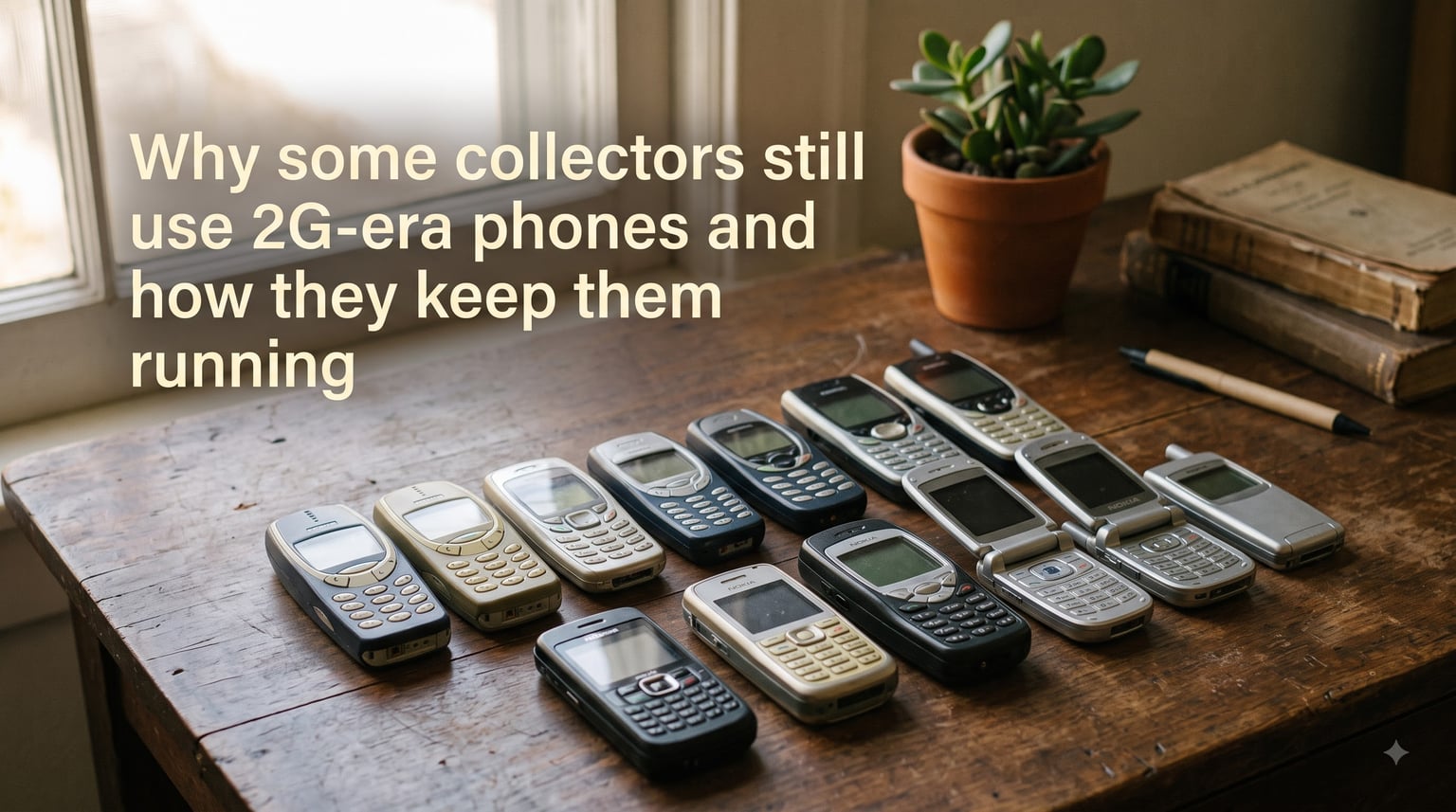
Yes, 2G-era phones are still usable in 2026, but with significant regional caveats. We talked to dozens of collectors and scoured the r/vintagemobilephones community to understand who keeps these old GSM devices alive, why they bother, and how they pull it off in an era of VoLTE-only smartphones.
T-Mobile officially shut down its US 2G network on August 3, 2026. AT&T did the same back in 2017. Yet the r/vintagemobilephones subreddit now sits at 27,000 members, and daily-use vintage phone posts show no signs of slowing. So what’s actually happening here? Let’s break it down.
Table of Contents
Are 2G-era phones still usable in 2026?
It depends entirely on where you live and which carrier you use. In much of Europe, parts of Asia, and select developing markets, 2G GSM networks remain active for voice, SMS, and basic data. In North America, the answer is far less friendly.
T-Mobile US completed its 2G shutdown on August 3, 2026, leaving American collectors with two practical options: roam on networks in other countries when traveling, or use 2G phones purely offline as camera-less, app-less devices that still handle basic functions when paired with Wi-Fi or modern accessories.
The good news: even without a cellular signal, your old Nokia 3310 still works as a flashlight, an FM radio (with headphones), a Snake game console, and a backup alarm clock. Collectors we spoke with treat their vintage phones as multi-purpose retro gadgets rather than primary communication tools.
Why 2G-era phones still have a following among collectors
Collectors keep 2G-era phones for reasons that go far beyond nostalgia, though nostalgia is certainly the headline driver. We dug into forum threads and private collector groups to surface the real motivations.
The nostalgia factor hits different for this generation
For people who came of age in the late 1990s and early 2000s, a Nokia 3310 or Motorola StarTAC is more than a gadget. It marks a specific moment in time when mobile phones became personal. One collector told us his Nokia 6300 survived three jobs, two moves, and a flood, and he still uses it on weekends.
The tactile satisfaction of pressing physical buttons cannot be replicated by a touchscreen. Collectors consistently mention the satisfying click of T9 typing, the audible polyphonic ringtones, and the chunky confidence of a phone that weighs more than a pack of gum.
Industrial design appreciation runs deep
Designers and engineers collect 2G-era phones for the same reasons car enthusiasts collect 1980s hatchbacks. The form factor was functional, the materials were honest, and there was genuine variety. Brands like BenQ Siemens, Sony Ericsson, and Alcatel produced devices with distinct visual identities during this era.
The BenQ Siemens S68, for example, is a slim bar phone with a brushed metal finish that still turns heads. The Siemens S55 introduced color displays to the mainstream in 2002. These are design artifacts, not just old electronics.
Digital detox is now mainstream
A growing slice of the collector community uses 2G phones as deliberate tools for digital minimalism. Without apps, push notifications, or social media, you get a device that does calls, texts, and maybe Snake, and absolutely nothing else.
One user on r/dumbphones described their Nokia 8210 as a “vacation from myself.” They keep a smartphone for work but use the Nokia exclusively on weekends and holidays. Battery life measured in days rather than hours is a significant draw.
Which vintage phones collectors actually use as daily drivers
Not every old phone is equally beloved. After analyzing community recommendations and personal experience reports, a handful of models dominate the conversation.
Nokia dominates the collector scene
The Nokia 3310 (2000) remains the undisputed king. It’s nearly indestructible, has a removable BL-5C battery that’s still manufactured today, and offers Snake II in its purest form. The Nokia 6300 (2007) is a fancier bar phone with a metal body, and the Nokia 6230 (2004) was one of the first phones with a proper camera and Bluetooth.
For flip phone fans, the Nokia 6131 (2006) and Nokia 2720 Fold (2009) are community favorites. They feel modern enough to be useful but retain the satisfying flip-to-answer gesture that smartphones eliminated.
BenQ Siemens and other heritage brands
The BenQ Siemens brand itself is a collector curiosity. After Siemens spun off its mobile division to BenQ in 2005, the resulting company produced phones like the BenQ-Siemens EF81 (a clamshell with two displays) and the BenQ-Siemens E71 (a slider) before exiting the market in 2007.
These models are rare enough to be valuable but well-documented enough to be repairable. Collectors prize them as snapshots of a transitional moment in mobile history when European engineering met Asian manufacturing ambition.
Motorola and Sony Ericsson deserve mentions
The Motorola RAZR V3 (2004) defined the mid-2000s flip phone aesthetic. Over 130 million units sold, and used units in good condition are still findable. The Motorola StarTAC (1996) is the original cool phone, and serious collectors pay real money for working examples.
Sony Ericsson’s T68 (2001) and T610 (2003) brought color screens and camera attachments to the feature phone market. The Sony Ericsson K750i (2005) is often called the best camera phone before smartphones took over, and it still takes surprisingly good photos.
Network availability by region and carrier (2026 update)
The single biggest factor in whether you can use a 2G-era phone daily is the network landscape in your country. Here’s what we know for 2026.
North America: largely sunset
T-Mobile US shut down its 2G GSM network on August 3, 2026, confirming earlier announcements. AT&T did the same in January 2017. Verizon never operated a 2G GSM network in the US (it was CDMA), and CDMA networks have also been shut down.
The practical result: if you live in the US and want cellular service on a 2G phone, your only option is roaming on a foreign carrier when traveling abroad, or using a regional MVNO that still maintains limited 2G support. Most US collectors treat their vintage phones as Wi-Fi-only devices or museum pieces.
Europe: 2G lives on for now
Most European carriers have committed to maintaining 2G GSM networks well into the late 2020s. The reasoning is pragmatic: 2G supports machine-to-machine (M2M) communication, smart meters, alarm systems, and elderly users with basic phones. Switzerland, Germany, the Netherlands, and the UK have all pledged to keep 2G running for at least several more years.
Finnish operators have been more aggressive, with some planning 2G shutdowns by 2026 end. Check with your specific carrier before relying on a vintage phone for daily use in Europe.
Asia-Pacific: mixed but mostly favorable
China, India, and Indonesia still operate 2G networks in some regions, particularly for low-income users and rural areas. Japan’s NTT Docomo shut down its 2G network in 2020, but SoftBank and KDDI still maintain some 2G support. Australia’s Telstra shut down 2G in 2016, but Optus still operates a limited 2G network.
If you’re buying a 2G-era phone specifically for daily use, your safest bet is to confirm carrier support in your specific region before committing.
How to keep a 2G-era phone running: battery, SIM, and repair
Now the practical part. Collectors who keep these phones functional follow a maintenance routine. Here’s the playbook.
Battery replacement is the #1 priority
After 20+ years, every original battery is dead or dangerous. Lithium-ion cells degrade even when unused, and a swollen battery can damage your phone or worse. The most common replacement battery is the Nokia BL-5C, which fits dozens of models and is still manufactured by third parties.
Reputable battery sellers include Cameron Sino, Empire Scientific, and various AliExpress vendors. Look for cells with at least 800 mAh capacity and built-in protection circuits. Avoid no-name batteries at suspiciously low prices, as they often lack safety features.
For BenQ Siemens phones, battery replacements are harder to find but not impossible. EF81 and E71 batteries occasionally appear on eBay. The EF81 uses a proprietary battery, so plan ahead if you buy one of these models.
SIM cards need careful handling
Modern smartphones use nano SIMs, but 2G phones typically use standard or micro SIMs. You’ll need a SIM adapter to use a current SIM card in a vintage phone. These adapters cost a few dollars and are widely available.
More importantly, your SIM must be provisioned for 2G GSM service. If your carrier has shut down its 2G network, no SIM will bring it back. If 2G is still active in your region, contact your carrier and ask for a 2G-compatible SIM, often called a “basic SIM” or “legacy SIM.”
Some collectors use prepaid MVNO SIMs specifically for their vintage phones. Services like Tracfone (US) and Giffgaff (UK) have historically been friendlier to older devices.
Repair resources are community-driven
iFixit hosts a growing collection of vintage phone teardown and repair guides. The Nokia 3310 guide, in particular, has been viewed hundreds of thousands of times. YouTube is also a goldmine; channels dedicated to retro electronics restoration show step-by-step repairs.
For BenQ Siemens phones specifically, the situation is trickier. The brand is defunct and official documentation is sparse. German-language forums and specialized collectors have pieced together repair knowledge, but expect to do some research.
Common repair issues include broken charging ports (micro-USB is replaceable), worn keypads (often available as parts), and corroded battery contacts (cleanable with isopropyl alcohol and a soft brush).
SIM unlocking and network compatibility for vintage devices
If you bought a 2G phone secondhand, it might be locked to a specific carrier. Here’s how to get it working on any network.
Check if it’s locked first
Insert a SIM card from a different carrier. If the phone displays “SIM not accepted” or “Enter unlock code,” it’s locked. If it connects normally, you’re already free to use any compatible network.
Find the unlock code
For Nokia phones, sites like DC-Unlocker and Nokia-free unlock codes provide IMEI-based unlock codes for a small fee (typically under $10). You’ll need your phone’s IMEI, which you can find by dialing *#06#.
For BenQ Siemens and Siemens phones, the unlocking process is more obscure. Some older Siemens models accept manufacturer codes that can be calculated using the IMEI and a free online tool. Others require specialized cables and software.
VoLTE is the silent killer
Even after unlocking, a 2G phone cannot make calls on networks that require VoLTE (Voice over LTE). If your carrier has retired its 2G and 3G networks but kept 4G/5G active, calls will fail because the phone cannot fall back to a compatible voice protocol.
This is the primary reason T-Mobile US 2G phones stopped working on August 3, 2026. The phones worked fine technically, but the network had nothing to connect them to.
Where collectors find parts, manuals, and community support
You don’t have to figure this out alone. The 2G phone collector community is welcoming, knowledgeable, and well-organized.
Reddit r/vintagemobilephones
This is the central hub. With 27,000 members, it features daily posts of working phones, repair tips, and identification help. The community explicitly welcomes daily-use vintage phones, unlike some stricter vintage electronics groups.
iFixit repair database
For hands-on repair, iFixit has free teardown and repair guides for many popular models. The community-edited format means instructions get better over time.
Specialty sellers and marketplaces
eBay is the obvious source for phones and parts. Etsy has emerged as a surprisingly good source for restored vintage phones. Specialist sellers like Retronaut and Vintage Phones Museum offer curated collections with warranties.
Brand-specific resources
For BenQ Siemens phones, German-language forums and the Sisyphus collector blog archive are valuable resources. The official BenQ-Siemens support site has been archived on the Wayback Machine and still contains firmware and manual downloads.
Frequently asked questions about 2G-era phone collecting
Are 2G phones still usable?
Yes, in regions where carriers still operate 2G GSM networks, including much of Europe, parts of Asia, and select other markets. In the US, T-Mobile shut down its 2G network on August 3, 2026, and ATu0026amp;T did the same in 2017, making daily cellular use impossible on those carriers.
What to do with an old 2G phone?
Three main options: use it as an offline device for calls and texts where 2G is still active, repurpose it as a dedicated gadget for music, flashlight, or games, or sell or donate it to a collector through eBay, Etsy, or the r/vintagemobilephones community.
Why do collectors still use 2G phones daily?
Collectors cite nostalgia, industrial design appreciation, digital detox benefits, multi-week battery life, and the tactile satisfaction of physical buttons. For some, a vintage phone is a deliberate tool for reducing screen time and reclaiming focus.
What can I do with a 2G phone?
Calls, SMS, alarm clock, FM radio, flashlight, basic games like Snake, contact storage, calculator, calendar, voice recorder, and simple notes. With Wi-Fi, some 2G phones can access WAP or modern web proxies for limited browsing.
How to maintain a vintage phone?
Replace the battery with a new lithium-ion cell, clean the charging port with isopropyl alcohol, store the phone in a cool dry place, replace worn keypads if needed, and use a modern SIM adapter with a 2G-compatible carrier SIM.
Where can I repair a vintage mobile phone?
iFixit hosts free repair guides for many models. The r/vintagemobilephones subreddit offers community troubleshooting. Specialty repair shops exist in major cities. For rare brands like BenQ Siemens, expect to do research and possibly source parts from collectors.
Are old mobile phones worth anything?
Common models in working condition typically sell for under $50. Rare models in original packaging, limited editions, or prototype units can fetch hundreds or thousands. The BenQ Siemens EF81 and certain Nokia 8800 variants are particularly sought after.
Final thoughts on keeping 2G-era phones alive
The 2G-era phone collector community proves that some technologies deserve preservation beyond their commercial lifespan. These devices represent a pivotal moment when mobile phones became personal, expressive, and culturally significant.
Whether you’re drawn to a Nokia 3310 for its indestructibility, a BenQ Siemens EF81 for its rarity, or a Motorola RAZR for its iconic design, the practical path forward is clear: replace the battery, source a 2G-compatible SIM if your region still supports it, and lean on the active community for repair guidance.
The T-Mobile 2G shutdown in August 2026 marks an inflection point, but it isn’t the end. European and Asian carriers will keep 2G alive for years. And even on networks that have sunset 2G entirely, these phones retain value as offline gadgets, design objects, and tangible connections to a simpler era of mobile technology.
If you’ve been holding onto a drawer full of old phones, now is the time to dust them off, charge them up, and join a community that knows exactly how to keep them running.