
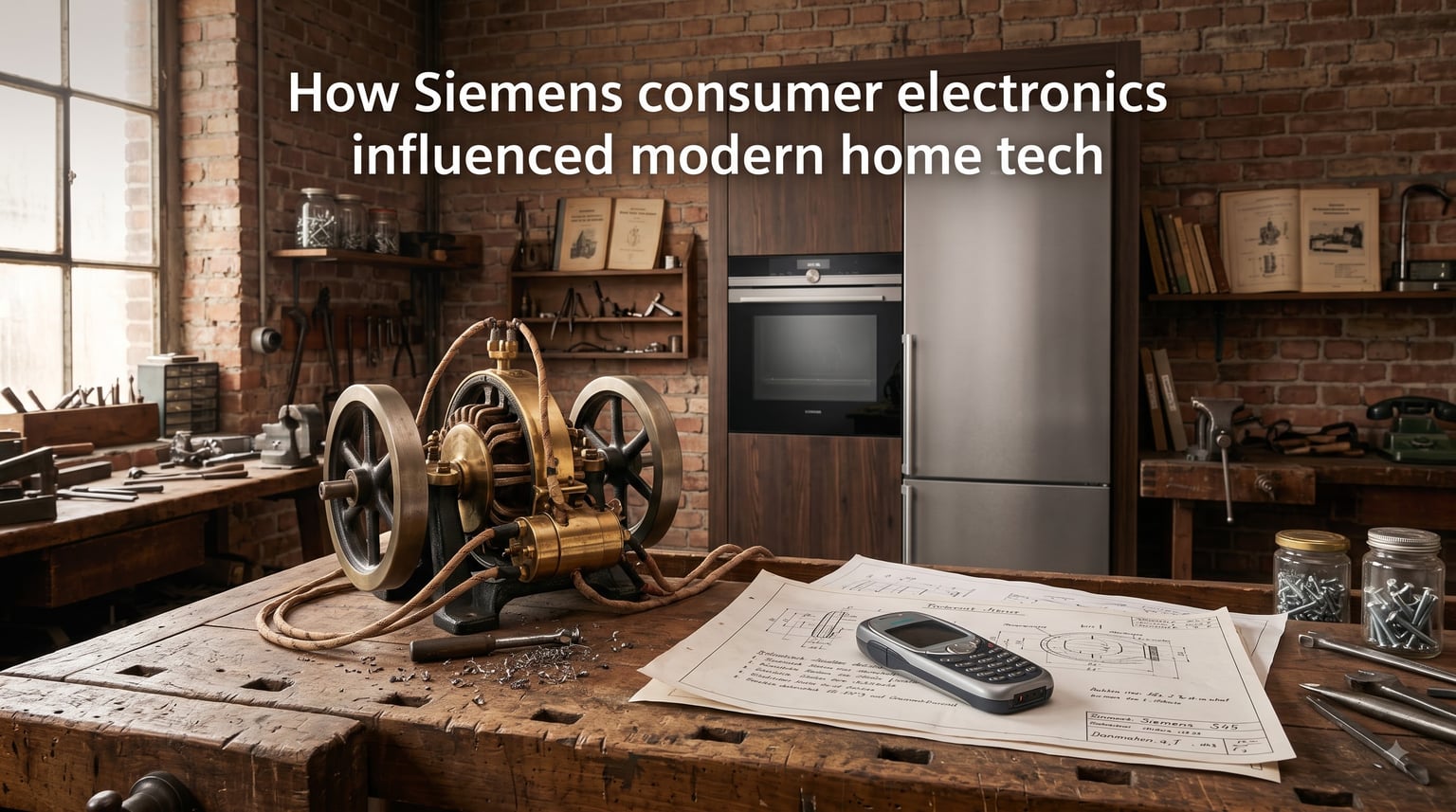
When I think about the modern smart home, I often trace its roots back to a small Berlin workshop where Werner von Siemens and Johann Georg Halske built pointer telegraphs in 1847. Siemens consumer electronics did not appear overnight. They grew out of nearly two centuries of electrical engineering breakthroughs that shaped how we light our kitchens, talk on our phones, and connect our appliances today.
This guide walks through the Siemens legacy that influenced modern home technology. I cover the founding era, the dynamo-electric principle, the rise of Siemens Mobile phones, the BenQ-Siemens merger, and the transition to Gigaset. You will also see how Siemens home appliances evolved into today’s smart Home Connect ecosystem. By the end, you will understand why a 19th-century German engineering firm still echoes through every connected device in your house.
Table of Contents
How Siemens Began: The 1847 Founding and Early Electrical Innovations
Siemens was founded on October 1, 1847 by Werner von Siemens and Johann Georg Halske in Berlin. Their first product was a pointer telegraph, a device that used magnetic needles to send coded messages across long distances. This invention laid the foundation for everything Siemens would later build, including the consumer electronics and home appliances we recognize today.
The Telegraph Era and Werner von Siemens (1847-1865)
Between 1847 and 1865, Siemens built telegraph lines across Europe and Russia. The company installed a 6,500 kilometer line from St. Petersburg to the Crimea and ran submarine cables through the Mediterranean. Werner von Siemens personally tested equipment in harsh field conditions, which built the engineering culture that would later define the brand.
During this period, Siemens also developed the first electrical fire alarm system and electric railway technology. These early wins established a pattern: the company solved practical problems with new electrical tools. That same pattern would repeat itself decades later when Siemens entered the consumer electronics market.
By 1866, the company had grown into a respected engineering firm with global reach. Werner von Siemens was known for insisting on rigorous testing and long-term reliability. That reputation for durability became the backbone of what we now call the “Made in Germany” quality seal.
The Dynamo-Electric Principle (1866) and Home Electricity
In 1866, Werner von Siemens discovered the dynamo-electric principle. This was the breakthrough that made it possible to generate electricity mechanically on a large scale. Before this invention, electrical power came mostly from chemical batteries, which were expensive and short-lived.
The dynamo changed everything. It allowed factories, homes, and cities to receive steady electrical current for the first time. Within a few years, Siemens dynamos powered street lighting in Berlin, Vienna, and London. The same engineering concept eventually drove the small motors inside washing machines, refrigerators, and kitchen blenders.
For consumers, the dynamo-electric principle meant one simple thing: electricity became cheap enough to bring into ordinary households. That shift created the entire home appliance industry. Without Siemens’ 1866 breakthrough, the timeline of home technology would have stretched out by decades.
Siemens Home Appliances: From 1957 to the Home Connect Era
Siemens entered the home appliance market officially in 1957, when the company created Siemens Electrogeräte AG (SE). This new division pooled the firm’s home electronics and home appliances operations into one focused business unit. From this point forward, Siemens would compete directly with brands like Bosch, Miele, and AEG in German kitchens and laundry rooms.
Siemens Electrogeräte AG and Post-War Appliance Boom
The post-war period was an ideal moment for home appliance innovation. European households had money to spend, and electrical infrastructure was finally widespread. Siemens introduced refrigerators, washing machines, and dishwashers that combined solid German engineering with practical features.
One early Siemens refrigerator from the 1930s already showed the brand’s commitment to design. By the 1960s and 1970s, Siemens ovens, cooktops, and laundry machines had become standard fixtures in middle-class homes across Germany, Austria, and Switzerland. The company even built washing machines with built-in heaters for cold climates, which made laundry easier in winter.
Through the 1980s and 1990s, Siemens home appliances built a reputation for precision temperature control, quiet operation, and long service life. These qualities matched what consumers wanted from premium kitchen equipment. The same focus on measurement and reliability would later translate directly into smart sensors for the Home Connect era.
Modern Smart Home Integration with Home Connect
In 2014, Siemens introduced its first home appliances with Home Connect, a platform that lets users control ovens, coffee makers, and dishwashers from a smartphone app. This was one of the earliest mainstream attempts to bring consumer appliances online in Europe.
Home Connect allowed users to preheat ovens remotely, monitor fridge temperatures, and reorder dishwasher detergent automatically. The platform grew into a full ecosystem that works with Alexa, Google Home, and other smart assistants. By the early 2020s, Siemens was selling Wi-Fi connected appliances as a core part of its premium range.
This move matters for understanding Siemens consumer electronics influence on modern home tech. The company that built the first practical dynamo in 1866 was now connecting refrigerators to the cloud. That is a direct 158-year engineering line, and it shows how foundational electrical work feeds into today’s smart home standards.
Siemens Mobile Phone History: Two Decades of Innovation
Siemens entered the mobile phone market in the 1980s with car phones and early GSM handsets. By the late 1990s, the company had become one of the top five mobile phone makers in the world. Siemens Mobile phones were known for solid build quality, long battery life, and early support for new features like WAP browsing and color screens.
Early Siemens Handsets and GSM Era (1990s)
Siemens launched its first mass-market GSM phones in the mid-1990s. Models like the Siemens S10 introduced color displays to the European mobile market in 1997. That was a major leap, since most phones at the time still used monochrome green LCDs.
Throughout the 1990s, Siemens built phones for European networks that prioritized call quality and signal reliability. The company invested heavily in GSM infrastructure partnerships, which gave it deep technical knowledge of mobile networks. That expertise later helped Siemens develop innovative features faster than many competitors.
By the end of the 1990s, Siemens Mobile was shipping tens of millions of phones annually. The brand had become a familiar sight in Europe, Asia, and Latin America. Yet the company was about to face the most difficult period of its consumer electronics history.
Notable Siemens Mobile Models from the Early 2000s
The early 2000s were a golden era for Siemens Mobile phones. Several models became cultural touchstones for an entire generation of European mobile users.
The Siemens C35i, released in 2000, was one of the first phones to offer WAP internet browsing at a price that mainstream consumers could afford. It sold over 10 million units and showed that mobile internet was ready for the mass market.
The Siemens SL45, released in 2001, was a flagship slider phone that introduced a built-in MP3 player at a time when most music players were separate devices. It also had a memory card slot, which was a rarity in phones back then.
The Siemens S55, launched in 2002, brought color screens and polyphonic ringtones to the mid-range market. It was one of the first phones to use Bluetooth for wireless headsets and data transfer.
The Siemens MC60, released in 2003, included an integrated camera, a feature that was still considered premium at the time. By making camera phones more affordable, Siemens pushed the entire industry toward camera-first mobile design.
The 2005 BenQ Acquisition
By 2004, Siemens Mobile was losing money. The global mobile phone market had become hypercompetitive, with Nokia, Samsung, and Motorola all fighting for shelf space. Despite strong engineering, Siemens could not keep up on marketing speed and software ecosystems.
In June 2005, Siemens AG sold its mobile phone division to BenQ, a Taiwanese electronics company. The deal closed in October 2005, and the mobile unit was renamed BenQ-Siemens. The last phones carrying the Siemens brand alone shipped in November 2005.
Siemens made this decision to focus on its more profitable industrial, energy, and healthcare businesses. Mobile phones had become a low-margin commodity, and the German engineering premium was no longer enough to win market share against Asian manufacturers.
What Happened After BenQ: The Gigaset Transition
The BenQ-Siemens story did not end neatly. Within a year and a half of acquiring the unit, BenQ itself ran into financial trouble, and the mobile division entered bankruptcy in 2006. That left thousands of customers with unsupported phones and created uncertainty about the future of the brand.
From BenQ-Siemens Bankruptcy to Independent Gigaset
The cordless phone business at Siemens had always been separate from the mobile phone division. It was based in Bocholt, Germany, and had been producing DECT phones since the 1990s. When BenQ-Siemens collapsed, the Bocholt team spun off as an independent company called Gigaset.
Gigaset kept the engineering expertise, the Bocholt factory, and the German manufacturing quality. The company continued to sell cordless phones under the Gigaset brand, which carried forward the Siemens DNA in home telecommunications.
From 2006 onward, Gigaset built a new portfolio of cordless phones, VoIP devices, and smart home sensors. The company even introduced Gigaset elements, a line of home security and automation products that competed directly with smart home startups.
Gigaset’s Bocholt Manufacturing and Modern Cordless Phones
The Bocholt factory has produced telecommunications equipment since 1941. Today, it remains one of the few places in Europe where consumer phones are still made on European soil. Gigaset has used this fact as a marketing strength, emphasizing German quality control and short supply chains.
Modern Gigaset cordless phones still use the DECT standard, which was developed in part with Siemens engineering input. DECT phones offer clearer calls, better range, and lower power consumption than older analog cordless phones. The standard is still used in millions of households across Europe today.
Gigaset also expanded into business IP phones, Android-based home phones, and senior-friendly devices with extra-large buttons and hearing-aid compatibility. Each of these product lines traces back to the same Siemens commitment to practical, reliable communication.
The 2024 VTech Acquisition
In 2024, VTech Holdings, a Hong Kong-based electronics company, completed its acquisition of Gigaset. The deal kept the Bocholt factory running and maintained the Gigaset brand. VTech brought broader distribution channels and stronger financial backing to support the next phase of cordless phone development.
For consumers, the VTech acquisition means that Siemens-descended phones will continue to be available across Europe. It also marks the end of Gigaset as an independent European consumer electronics brand. The transition from Siemens AG to Gigaset to VTech reflects a broader pattern: European consumer electronics have gradually consolidated under Asian ownership while European factories preserve their specialty roles.
How Siemens Shaped Modern Home Technology Standards?
Siemens’ influence on modern home technology goes beyond any single product. The company helped build several foundational standards that still appear in consumer electronics today. When you plug in a kitchen mixer, charge a smartphone, or connect a smart speaker to Wi-Fi, you are touching technology that traces back to Siemens engineering.
From Dynamo to Smart Home: The Technology Lineage
The dynamo-electric principle of 1866 eventually led to alternating current distribution, which made household electricity standard by the 1920s. Siemens was one of the companies that pushed AC adoption in Europe. Once homes had reliable AC power, vacuum cleaners, washing machines, and refrigerators could become mass-market products.
In the 1990s and 2000s, Siemens engineers contributed to DECT cordless phone standards and early GSM specifications. Those standards still define how cordless phones and mobile devices handle voice and data. By 2014, the same engineering culture had produced Home Connect, which uses Wi-Fi and cloud APIs to link kitchen appliances to smartphones.
There is a clear technical lineage: dynamo to AC grid to household appliances to connected devices. Each step built on the previous one. Without Siemens’ early work, the timeline of modern home technology would look very different.
Made in Germany Quality and Modern Tech Standards
The “Made in Germany” label originated in 1887 as a way to identify lower-quality British imports. German manufacturers, including Siemens, fought back by promoting rigorous engineering standards. Over time, the label shifted from a negative mark into a positive quality signal.
Siemens home appliances, Siemens Mobile phones, and Gigaset cordless phones all benefited from this heritage. Consumers trusted German brands to last longer, perform more accurately, and resist failure under stress. That trust still shapes buying decisions today, especially for premium kitchen and laundry equipment.
Modern smart home buyers also look for reliability. A connected refrigerator that drops off the network is worse than a non-connected one. The German engineering focus on durability and precision made the Siemens brand a natural fit for the smart home era, even as the company itself shifted focus to industrial markets.
FAQs
What is Siemens most famous for?
Siemens is most famous for pioneering electrical engineering, starting with the founding by Werner von Siemens in 1847 and the discovery of the dynamo-electric principle in 1866. The company built the first practical generators, laid transcontinental telegraph lines, and later expanded into home appliances and mobile phones. Today, Siemens AG is known globally for industrial automation, energy systems, and medical technology.
What did Siemens invent?
Siemens invented the pointer telegraph (1847), the dynamo-electric principle (1866), early electrical fire alarm systems, the first electric railway systems, and many foundational electrical engineering components. In the consumer space, the company developed early color-screen mobile phones (S10 in 1997), WAP-capable handsets, and the Home Connect smart appliance platform launched in 2014.
What happened to Siemens Mobile phone?
Siemens sold its mobile phone division to BenQ in 2005 for financial reasons. The unit was renamed BenQ-Siemens and the last standalone Siemens phones shipped in November 2005. BenQ-Siemens went bankrupt in 2006. The cordless phone business at the Bocholt factory was spun off as Gigaset, which continued selling DECT phones. Gigaset was acquired by VTech in 2024.
Is BenQ part of Siemens?
No, BenQ is not part of Siemens. BenQ is a separate Taiwanese electronics company that acquired the Siemens Mobile division in 2005. The combined entity was called BenQ-Siemens from 2005 to 2006, when it filed for bankruptcy. Siemens AG and BenQ Corporation are independent companies with no current ownership relationship.
What was the Siemens phone in the early 2000s?
Siemens released several iconic phones in the early 2000s. The Siemens C35i (2000) brought affordable WAP browsing to consumers. The Siemens SL45 (2001) added a built-in MP3 player and memory card slot. The Siemens S55 (2002) introduced color screens and Bluetooth to the mid-range market. The Siemens MC60 (2003) made camera phones accessible to more buyers.
What is the history of Siemens?
Siemens was founded in Berlin on October 1, 1847 by Werner von Siemens and Johann Georg Halske. Key milestones include the dynamo-electric principle (1866), transcontinental telegraph lines (1869), formation of Siemens Electrogerate AG for home appliances (1957), entry into mobile phones (1980s), BenQ sale of mobile division (2005), launch of Home Connect smart appliances (2014), and VTech acquisition of Gigaset (2024).
Conclusion
The story of how Siemens consumer electronics influenced modern home tech spans 179 years. From Werner von Siemens’ 1847 telegraph workshop to the 2014 Home Connect launch, the company kept pushing household technology forward through dynamos, GSM phones, and connected appliances.
Even after Siemens sold its mobile division in 2005, the brand’s DNA lives on in Gigaset cordless phones, BSH smart appliances, and the broader “Made in Germany” reputation. When you ask your oven to preheat remotely or pick up a DECT phone at home, you are using technology that owes a debt to Siemens engineering.
If you want to dive deeper, explore the Siemens Historical Institute archives, browse vintage Siemens phone collections on collector forums, or check out the current Home Connect device lineup. Each offers another window into the same long story of European engineering shaping the modern home.