
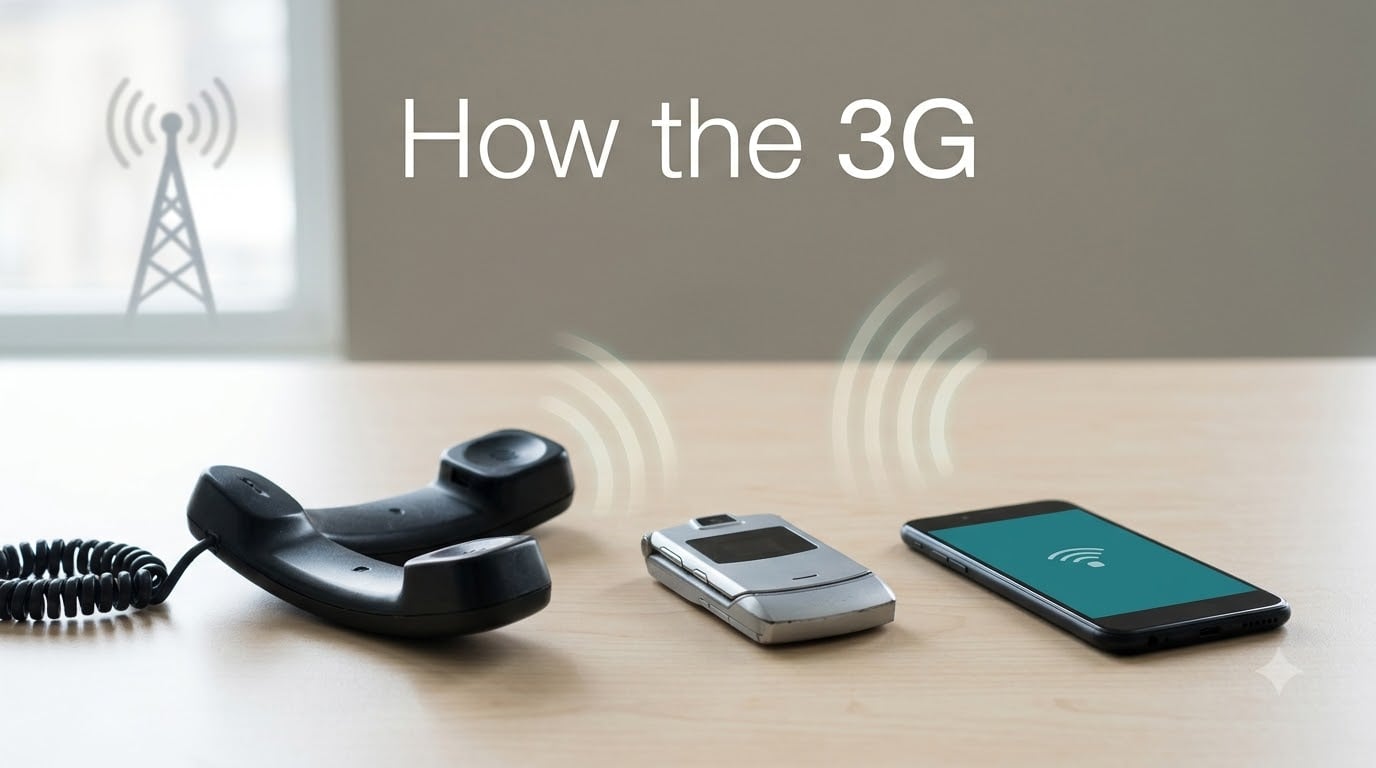
If you have ever wondered why a perfectly working flip phone suddenly stopped making calls, you are not alone. I have spent the last month talking to carriers, recyclers, and consumer advocates about how the 3G to 5G transition left millions of devices obsolete, and the answers surprised even me.
The shift from 3G to 5G did not happen overnight. It played out over several years, and it changed what a “working phone” means. In this guide, I will walk you through the history, the timelines, the devices that lost service, and the practical steps you can take today.
Table of Contents
What is the 3G shutdown and why did it happen?
The 3G shutdown is the coordinated retirement of third-generation cellular networks by mobile carriers so the underlying radio spectrum can be repurposed for 4G LTE and 5G services. In simple terms, the towers that once carried your voice calls and basic data on 3G were switched off, and any device that could only speak 3G was left without a signal.
Carriers did this because 3G is spectrum-inefficient by modern standards. The same airwaves can carry far more traffic on 5G, supporting the surge in video calls, streaming, and connected devices. According to the FCC, the freed spectrum is being reassigned to advanced services like 5G, which is the main reason older devices became unusable.
The shutdown is not theoretical. AT&T shut down its 3G network in February 2022, T-Mobile followed in phases through the summer of 2022, and Verizon completed its 3G CDMA shutdown at the end of 2022. That is why a phone that worked fine on January 1 of that year could not place a single call by March.
How we got from 1G to 5G: the network generations explained
To understand why old phones became obsolete, it helps to see the bigger picture of how mobile networks evolved.
1G (1980s): Analog voice only. Think of the original Motorola DynaTAC brick phones. Coverage was spotty, calls dropped often, and there was no data.
2G (1990s): Digital voice, plus the first text messages (SMS). GSM and CDMA standards gave us clearer calls and basic data services at speeds measured in kilobits per second.
3G (2000s): Mobile broadband arrived. Speeds jumped to a few megabits per second, which made web browsing, email, and early smartphones (BlackBerry, early iPhone) actually usable on cellular data.
4G LTE (2010s): True mobile broadband with speeds from 10 Mbps to over 100 Mbps. This is when HD video streaming, ride-share apps, and FaceTime became normal on a phone.
5G (2020s): Speeds from 100 Mbps up to multiple gigabits per second, plus much lower latency. 5G is what makes self-driving cars, remote surgery, and dense IoT networks realistic.
Each generation demands different hardware in both the towers and your phone. That is the root cause: a 3G phone literally cannot decode a 5G signal, and a 4G phone without the right software cannot fall back to a voice call over 4G. The network moved on, and the phones could not follow.
When did the major US carriers shut down 3G?
All three major US carriers have now completed their 3G shutdowns. Here is the consolidated timeline so you can place your own situation in context.
AT&T: Shut down 3G on February 22, 2022. Any AT&T device that relied on HSPA (their 3G standard) lost service on that date.
Verizon: Completed its 3G CDMA shutdown on December 31, 2022. Verizon customers with older 3G handsets lost service the next day.
T-Mobile: Phased out 3G across the spring and summer of 2022, including the former Sprint CDMA network that T-Mobile absorbed.
If you bought a phone after 2020 and use it today, it almost certainly runs on 4G LTE or 5G and was never affected. The phones that broke were generally older than that, including anything released before about 2015 that was never updated.
Which phones and devices stopped working after the 3G shutdown
This is the question I get asked the most, and the answer is broader than people expect. The 3G shutdown did not only affect phones. Here is what I have seen confirmed across carriers and the FCC.
Phones that stopped working: iPhone 5 and earlier, most Samsung Galaxy S4 and earlier models, original Motorola Droids, BlackBerry devices that rely on 3G, and any feature phone (flip phone) sold before roughly 2017 that lacks VoLTE support. A useful rule of thumb: if your phone could not run iOS 13 or a modern version of Android, it is probably a 3G-only device.
Tablets and hotspots: Older iPads with cellular, mobile hotspots, and USB modems that only supported 3G lost service.
Medical alert and personal emergency devices: Medical alert pendants and in-home fall sensors frequently used 3G. If you or a loved one relies on one of these, the provider should have supplied a replacement.
Home security systems: Many alarm panels used 3G to call monitoring centers. These had to be upgraded or replaced.
Vehicle telematics and SOS: Older OnStar, Ford Sync, and similar in-car SOS systems were affected. Most automakers offered free upgrades during the transition.
Other connected devices: Wildlife cameras, asset trackers, smart meters that reported over cellular, and some industrial sensors all lost connectivity.
The short version: if a device relied solely on 3G for its primary connection, it stopped working. Devices that had Wi-Fi as a fallback (laptops, smart speakers) were not affected.
Why some 4G phones still broke: VoLTE and HD Voice explained
This is the part most articles skip, and it confused a lot of people. A phone can support 4G LTE for data but still place voice calls over 3G by default. When carriers turned off 3G, those phones lost the ability to make or receive calls even though their 4G data still worked.
VoLTE (Voice over LTE) is the technology that carries voice calls as data packets over the 4G LTE network, instead of falling back to a 3G voice channel. HD Voice is the higher-quality audio you get when VoLTE is active.
If a phone does not support VoLTE on the carrier you use, it cannot make regular phone calls after the 3G shutdown, even with full bars of 4G. This affected many imported or parallel-market 4G phones, especially some budget brands and older unlocked models.
If you are unsure whether your phone supports VoLTE, check the carrier’s compatibility page (AT&T, Verizon, and T-Mobile each publish approved device lists) or simply place a call. If the call connects and you do not see a brief “calling” icon with a 3G indicator, you are on VoLTE.
How the 3G shutdown affected 911 and emergency services?
This is the part I found most concerning when I dug into the research. The 3G shutdown affected medical alert devices, security panels, and personal emergency pendants that many elderly users wear around their necks.
If a personal emergency device was still using 3G when the towers went dark, pressing the help button would do nothing. Some families discovered this only after a fall. The FCC warned about this risk extensively, and most reputable providers (including ADT, Bay Alarm, and Life Alert) sent replacement hardware ahead of the shutdown, but not every user was reached.
911 calls themselves still work on any modern phone with 4G LTE and VoLTE, including older smartphones that received software updates. The 911 risk came from secondary devices that consumers may not have realized were still 3G-only.
My practical advice: if anyone in your family uses a medical alert pendant, a car SOS button, or a home alarm that predates 2018, contact the provider today and confirm it is 4G or 5G compatible.
The rural coverage gap: where 5G still falls short
One angle that most articles miss is rural coverage. Many rural communities depended on 3G because 4G LTE towers were sparse and 5G millimeter-wave is essentially unavailable outside major cities.
After the 3G shutdown, some rural users found their old phones did not work on the nearest 4G LTE tower, and a 5G upgrade was not really an option because there was no 5G signal at their address. The Federal Communications Commission has funded the ReConnect and 5G Fund programs to address this, but tower buildouts take years.
If you live in a rural area and your phone is suddenly struggling, check your carrier’s coverage map for your specific address rather than your zip code. Carrier maps often show 4G coverage across a county that is actually only spotty on individual roads.
What to do with old 3G phones and how to upgrade on a budget
If you have a drawer full of old 3G phones, you have several options that protect both your data and the environment.
Recycle them properly. Best Buy, Staples, and most carrier stores accept old phones for free recycling. The EPA maintains a list of certified e-Stewards recyclers if you prefer a specialist.
Trade them in. Even a broken or 3G-only phone can have trade-in value for parts. Apple, Samsung, and carriers like Verizon and AT&T run ongoing trade-in programs that often credit you toward a new device.
Donate them. Organizations like Cell Phones for Soldiers and Secure the Call refurbish working phones for people in need. Working 4G phones are far more useful than broken ones.
Wipe your data first. Before any of the above, factory-reset the phone and remove any SIM or memory card. A factory reset is enough for most users; if you are truly paranoid, use the carrier’s trade-in tool which often handles the wipe for you.
Upgrade on a budget. The Lifeline program, run by the FCC, provides a discount on phone or internet service for low-income households (currently up to $9.25 per month). Many carriers also offer affordable entry-level 4G smartphones that work on all three major networks. You do not need to spend flagship money to stay connected after the 3G shutdown.
The future of 4G and what 5G means for everyday users
5G is the future, but 4G LTE will be around for many more years. Carriers have publicly committed to maintaining 4G LTE networks through at least the late 2030s, in parallel with their 5G rollouts. That means a 4G-only phone you buy today will keep working well into the next decade.
For most everyday users, 5G’s main practical benefits right now are faster downloads in dense urban areas and lower latency for cloud gaming and video calls. The futuristic use cases (self-driving cars, remote surgery, smart cities) are still rolling out. You do not need a 5G phone to live your daily life, but if you are buying a new phone in 2026, most options support 5G anyway.
Frequently asked questions about the 3G to 5G transition
Will my 3G phone still work in 2026?
No. All three major US carriers completed their 3G shutdowns before 2026. A 3G-only phone cannot place calls, send texts, or use cellular data on current US networks. You will need at minimum a 4G LTE phone with VoLTE support.
What phones will not work after a 3G shutdown?
Any phone that only supports 3G, including iPhone 5 and earlier, Samsung Galaxy S4 and earlier, original Motorola Droids, most BlackBerry models, and most pre-2017 flip phones. Some 4G phones that lack VoLTE also stopped making voice calls. Modern 4G LTE and 5G smartphones are not affected.
What is the oldest phone that supports 5G?
Samsung released the first 5G phone in 2019 with the Galaxy S10 5G. Apple followed in late 2020 with the iPhone 12 lineup. Any iPhone 12 or newer, and most flagship Android phones from late 2019 onward, support 5G.
Why are carriers shutting down 3G networks?
Carriers are repurposing 3G spectrum for 4G LTE and 5G, which carry far more traffic on the same airwaves. 3G equipment is also aging and expensive to maintain. The FCC has documented the transition as part of the move toward more efficient advanced networks.
Did the 3G shutdown affect 911 calls?
911 calls still work on any modern phone with 4G LTE and VoLTE. The biggest 911-related risk was from secondary devices such as medical alert pendants, in-home fall sensors, and car SOS systems that used 3G. Users of those devices should confirm with their provider that the hardware has been upgraded.
What year will cell phones be obsolete?
Cell phones themselves are not becoming obsolete, but specific network generations are. 3G is already retired. 4G LTE is expected to remain active through at least the late 2030s. 5G is the current standard, and 6G research is underway but not expected to replace consumer phones before the 2030s.
Final thoughts on the 3G to 5G transition
The 3G to 5G transition that made old phones obsolete was less about a single moment and more about a slow-moving infrastructure upgrade. Carriers reclaimed spectrum, devices that could not adapt lost service, and millions of perfectly functional phones became paperweights.
If you are still using older hardware, the fix is straightforward: confirm your phone supports 4G LTE with VoLTE, check that any alert or security devices are also upgraded, and recycle or trade in what you no longer need. The 3G shutdown is over, but the lessons about network transitions will repeat as 4G eventually retires in the late 2030s.